
Boards and substrates
| Term | What it means |
|---|---|
| BWP plywood | Boiling water proof plywood to IS 710, bonded with phenol formaldehyde. The correct carcass grade for Indian kitchens, bathrooms and any humid or coastal location. In Mumbai we specify it throughout, not only in wet areas. |
| BWR plywood | Boiling water resistant, to IS 303. A step below BWP: fine for dry internal joinery in a dry climate, and routinely mis-sold as equivalent to BWP. It is not. |
| MR plywood | Moisture resistant, urea-formaldehyde bonded. Interior-grade only. Acceptable in a dry bedroom wardrobe in a dry city; a liability in a Mumbai kitchen. |
| Marine plywood | BWP plywood made with a higher-quality, more uniform core to IS 710 marine specification. Used on external walls, balcony joinery and directly coastal locations. |
| HDHMR | High-density high-moisture-resistance board. An engineered panel that machines beautifully and takes a flawless painted or membrane finish, with better moisture behaviour than MDF but less than BWP ply. Good for shutters, not for a wet-area carcass. |
| MDF | Medium-density fibreboard. Homogeneous, machines cleanly, ideal for routed, fluted or painted shutter faces. Poor with standing water and poor at holding a screw under repeated load. |
| Particle board | Chipboard, usually pre-laminated. Cheap, heavy, and swells irreversibly when wet. Common in flat-pack furniture and inappropriate for permanent fitted joinery in Mumbai. |
| Pre-laminated board | A substrate — usually particle board or MDF — supplied with the laminate already bonded to both faces. Saves labour and is common in wardrobe internals, where the finish never gets wet. |
| Edge banding | The sealed strip applied to the cut edge of a board, in 0.8 mm or 2 mm PVC. Machine-applied banding on every edge, including hidden ones, is what keeps moisture out of a carcass. |
Finishes
| Term | What it means |
|---|---|
| Laminate | A decorative paper impregnated with resin and bonded to a substrate, typically 0.8 mm or 1 mm. Hard-wearing, enormous range, the default Indian shutter finish. Matte hides daily use far better than gloss. |
| Acrylic | A cast acrylic sheet bonded to a substrate, giving a deep, glass-like face. High-gloss acrylic shows every fingerprint; matte acrylic does not and is the more sensible choice in a family kitchen. |
| PU (polyurethane) | A sprayed paint finish built up in coats and cured. Seamless, available in any colour, repairable on site, and the most expensive of the common finishes. Needs a dust-controlled spray environment to look right. |
| Duco | The Indian trade name for an automotive-style sprayed lacquer finish, usually nitrocellulose. Similar look to PU, less durable, cheaper. |
| Veneer | A thin slice of real timber bonded to a substrate and then sealed, usually with matt PU. Real grain, so no two panels match exactly — which is either the appeal or the complaint, depending on the client. |
| Membrane / foil | A PVC film vacuum-pressed over a routed MDF shutter, wrapping the profile in one piece. Inexpensive, seamless on profiled doors, and vulnerable to heat — never directly above a hob. |
| Fluted panel | A wall or shutter face with regular vertical grooves, in veneer, MDF or PU. Adds depth and shadow to a flat plane without adding colour. Flute pitch, usually 40–80 mm, changes the effect entirely. |
Design and build under one accountable roof
Hardware
| Term | What it means |
|---|---|
| Soft-close hinge | A concealed hinge with an integrated damper so the shutter pulls itself shut over the last few degrees. Standard on any decent installation; the damper is also what stops shutters slamming out of alignment over years of use. |
| Full-extension runner | A drawer runner that brings the entire drawer box clear of the carcass, so the back of the drawer is reachable. The alternative — a roller channel — reaches about 75% and seizes in humidity. |
| Tandem box | A pre-engineered metal-sided drawer system with the runner integrated into the side. Stronger, thinner-walled and more repeatable than a ply drawer box on separate runners. |
| Magic corner | A pull-out mechanism that brings the contents of a blind kitchen corner out into the room in two linked trays. Recovers roughly the storage of a whole extra base unit from unreachable space. |
| Carousel | A rotating shelf system for a corner unit — the simpler, cheaper corner solution. Less capacity than a magic corner, and fine for a smaller kitchen. |
| Lift-up flap stay | A gas or mechanical arm that holds an upward-opening shutter in position. Essential on wall units above 600 mm wide, where a hinged door swings into head height. |
| Sliding gear | The track, rollers and guides for sliding wardrobe shutters. The component that fails first in most Indian wardrobes, and therefore the one worth upgrading. |
Area, measurement and contract language
| Term | What it means |
|---|---|
| Carpet area | The usable floor area inside the walls of a flat — what you can actually lay carpet on. This is the number interior costs should be quoted against, and the number our rates use. |
| Built-up area | Carpet area plus the thickness of the walls and the balcony. Typically 10–15% more than carpet area. |
| Super built-up / chargeable area | Built-up area plus a share of lobbies, lifts, staircases and amenities. Typically 25–40% more than carpet area, and the number property is sold on. Quoting interiors against it inflates the apparent rate. |
| RERA carpet area | The statutory definition of carpet area under RERA — net usable floor area excluding external walls, shafts and balconies, but including internal partition walls. Use this figure where the sale agreement states it. |
| BOQ (bill of quantities) | The line-item schedule of what is being built: item, quantity, unit, rate and amount, with brands named. The document that makes two quotations comparable. A lump sum is not a BOQ. |
| Provisional sum | A named allowance in the BOQ for scope whose price is not yet fixed — typically a landlord-nominated vendor package or an item you have not selected yet. It should be visible, labelled and reconciled against the actual invoice. |
| Variation order | A written, priced change to the agreed scope, approved before execution, stating both the cost and the programme impact. Verbal changes on site are the single biggest source of end-of-project disputes. |
| Running foot | A linear foot of joinery, the standard unit for wardrobes and kitchen counters. A rate per running foot must always state the height and depth it assumes, or it means nothing. |
| Ex-GST | Before 18% goods and services tax, which applies to interior works contracts. Every figure published on this site is ex-GST unless stated otherwise. |
Site and process
| Term | What it means |
|---|---|
| First fix | The services work done before surfaces are closed: electrical conduits and wiring, plumbing runs, data cabling, AC pipe routes. Getting this wrong is the most expensive mistake available on an interior project. |
| Second fix | The visible services work after surfaces are finished: switches, sockets, light fittings, taps, sanitaryware. |
| Cove | A recessed perimeter detail in a false ceiling that conceals an LED strip, washing light up the wall. The right choice where ceiling height will not allow a full false ceiling. |
| Snag list | The defects list produced at the end of a project. A studio should produce and close its own list before the client ever sees the space. |
| NOC | No-objection certificate — the society's or developer's written permission to carry out interior work, usually accompanied by a deposit, a crew list and agreed working hours. |
| Warm shell | A commercial space handed over with basic services in place — ceiling grid, flooring, lighting, HVAC distribution — ready for a tenant's fit-out. |
| Shell and core | A commercial space handed over as bare structure with only central services to the floor. The tenant builds everything else, at a materially higher fit-out cost than a warm shell. |
| Fit-out manual | The binding document a Grade-A landlord issues covering permitted materials, loading, drilling, sprinkler modification, ceiling access, working hours and insurance. It outranks your drawings. |
Everything in this section
All 100 glossary pages:
- What is a 2D layout?
- What is a 3D render?
- What is an acrylic finish?
- What is an AMC?
- What is a backsplash?
- What is a base unit?
- What is biophilic design?
- What is blockboard?
- What is a BOQ (bill of quantities)?
- What is the Brahmasthan?
- What is built-up area?
- What is BWP plywood?
- What is BWR plywood?
- What is a carcass?
- What is carpet area?
- What are ceramic tiles?
- What is a kitchen chimney?
- What is civil work?
- What is colour temperature (Kelvin)?
- What is a concealed cistern?
- What is cove lighting?
- What is CRI (colour rendering index)?
- What is a cutlery tray?
- What is a dado?
- What is a downlight?
- What is Duco paint?
- What is an elevation?
- What is engineered wood flooring?
- What is epoxy grout?
- What is a false ceiling?
- What is a fit-out?
- What is granite?
- What is grout?
- What is gypsum board?
- What is a handle-less (G-profile) kitchen?
- What is handover?
- What is HDHMR board?
- What is a hob?
- What is HPL (high pressure laminate)?
- What is Indian marble?
- What is an island kitchen?
- What is Italian marble?
- What is the kitchen work triangle?
- What is an L-shaped kitchen?
- What is laminate flooring?
- What is laminate?
- What is a loft?
- What is a lumen?
- What is lux?
- What is LVT flooring?
- What is marine ply?
- What is MDF?
- What is melamine?
- What is a membrane finish?
- What is MEP?
- What is minimalism?
- What is a modular kitchen?
- What is a mood board?
- What is MR plywood?
- What is a parallel kitchen?
- What is particle board?
- What is POP (plaster of Paris)?
- What are porcelain tiles?
- What is primer?
- What is profile lighting?
- What is PU polish?
- What is putty?
- What is a quartz countertop?
- What is a quotation?
- What is RERA carpet area?
- What is a section drawing?
- What is a semi-modular kitchen?
- What is shell & core?
- What is a shutter?
- What is skirting?
- What is a sliding wardrobe?
- What is a snag list?
- What is a society NOC?
- What is a soft-close hinge?
- What is SPC flooring?
- What is super built-up area?
- What is a tall unit?
- What is a tandem box?
- What is texture paint?
- What is a track light?
- What does turnkey mean?
- What is a U-shaped kitchen?
- What is Vaastu?
- What is a vanity unit?
- What is veneer?
- What are vitrified tiles?
- What is a walk-in closet?
- What is a walkthrough?
- What is a wall unit?
- What is wallpaper?
- What is a warm shell?
- What is a warranty in interiors?
- What is waterproofing?
- What is a wet & dry bathroom?
- What is a working drawing?
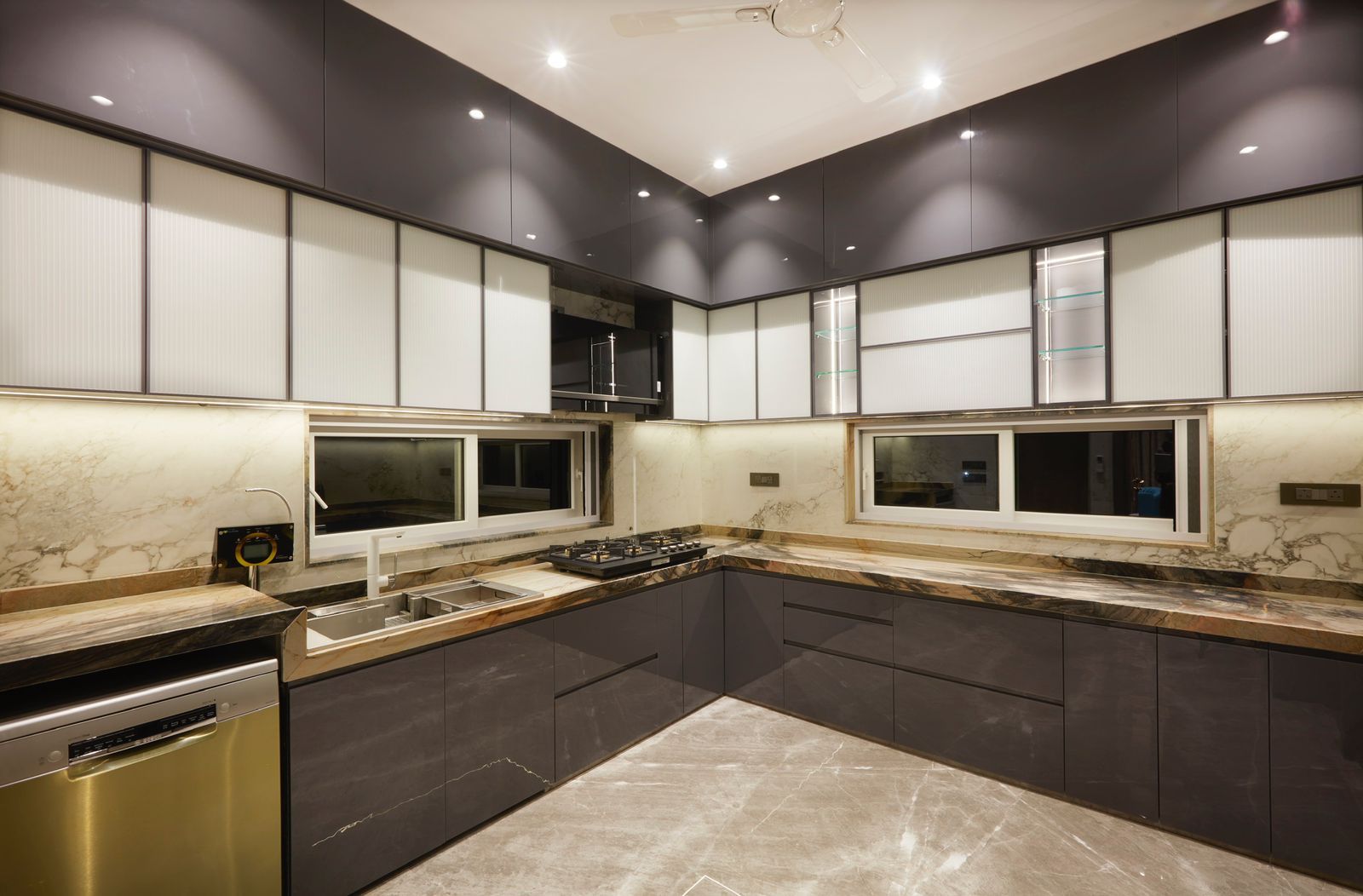
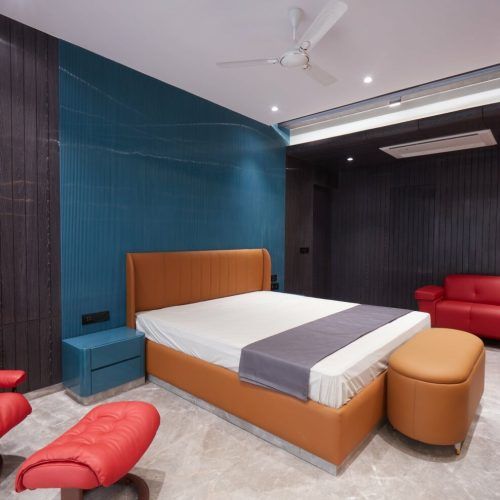


Selected work by Greenbox Design Studio. Tap any image to enlarge.
Frequently asked questions
What is the difference between BWP and BWR plywood?+
BWP (IS 710) is bonded with phenol formaldehyde and survives prolonged water contact; BWR (IS 303) is a lower grade that resists moisture but not immersion. The two are routinely conflated in quotations. In a Mumbai kitchen, bathroom or coastal flat, only BWP is appropriate — and the price difference is small relative to the cost of replacing a swollen carcass.
Should interior costs be quoted on carpet area or built-up area?+
Carpet area. It is the usable floor area inside the walls and it is what the joinery actually relates to. Quoting against super built-up area — which can be 25–40% larger — makes a rate look far lower than it is. Always confirm which area a per-sq-ft rate refers to before comparing two quotations.
What is a provisional sum and should I be worried about one?+
It is a named allowance for scope whose price is not yet fixed — most often a landlord-nominated vendor package, or an item you have not chosen yet. A labelled, visible provisional sum is good practice. What you should worry about is an unlabelled one, or a lump sum that turns out to have several hidden inside it.
What is the difference between first fix and second fix?+
First fix is everything buried before surfaces close — conduits, wiring, plumbing runs, data cabling, AC pipe routes. Second fix is everything visible afterwards — switches, sockets, fittings, taps. The rule that matters is that no ceiling or wall should close until the first fix behind it has been tested.
What does “running foot” mean in a wardrobe quotation?+
One linear foot of the wardrobe run. A rate per running foot is meaningless unless it states the assumed height and depth: a 7 ft high, 2 ft deep wardrobe at ₹1,900 per running foot is a different product from a 9 ft high one at the same rate. Always ask what height and depth the rate assumes.