
Boards: what to put behind the finish
The carcass is the part of the work nobody sees and nobody can replace without dismantling the installation. In a city with a four-month monsoon and year-round humidity above 70%, this is the decision that determines whether the joinery lasts eight years or eighteen.
| Board | Rate (₹/sq ft, board only) | Water behaviour | Screw holding | Use it for | Do not use it for |
|---|---|---|---|---|---|
| BWP plywood (IS 710) | ₹105 – 165 | Survives prolonged contact; the phenolic bond does not fail | Excellent | Every carcass in Mumbai — kitchen, wardrobe, wet areas, external walls | Nothing; it is the default here |
| Marine plywood | ₹150 – 220 | Best available; uniform void-free core | Excellent | Balconies, external walls, directly coastal flats in Worli, Juhu, Bandstand | Internal dry joinery — it is unnecessary spend |
| BWR plywood (IS 303) | ₹75 – 115 | Resists moisture, fails under prolonged contact | Very good | Dry internal joinery in a dry climate | Any Mumbai wet area; it is routinely mis-sold as BWP |
| MR plywood | ₹58 – 90 | Interior grade only; delaminates when wet | Good | Dry-climate internal work | Mumbai kitchens, bathrooms and external walls |
| HDHMR | ₹95 – 140 | Better than MDF, well short of BWP | Good | Routed and painted shutters, fluted panels, PU faces | Wet-area carcasses |
| MDF | ₹48 – 85 | Poor; swells irreversibly | Fair — poor under repeated load | Routed shutter faces, fluted panels, painted profiles | Carcasses, anything load-bearing, anything near water |
| Particle board | ₹35 – 60 | Very poor | Poor | Flat-pack furniture, temporary work | Permanent fitted joinery in Mumbai |
Rates are for the board only and exclude labour, hardware and finish. A finished BWP wardrobe carcass with hardware typically works out at ₹1,500–₹2,400 per sq ft of elevation.
The carcass is the only thing in a wardrobe you cannot change your mind about later. Everything else — shutter, handle, colour — is a decision you can revisit in ten years.
Greenbox specification note
Shutter finishes compared
This is where most of the visible budget goes and where most clients over-specify. A finish decision is reversible in a way a carcass decision is not, so if the budget is tight, this is the line to compress.
| Finish | Rate (₹/sq ft, supplied & fixed) | Looks like | Durability | Fingerprints | Repairable on site | Best for |
|---|---|---|---|---|---|---|
| Matte laminate | ₹190 – 340 | Flat, even, huge colour range | Very good | Barely shows | No — replace the panel | Wardrobe carcasses and shutters, utility areas, budget-sensitive kitchens |
| Gloss laminate | ₹230 – 390 | Reflective, brightens dark rooms | Very good | Shows readily | No | Deep, narrow kitchens where reflectance helps |
| Matte acrylic | ₹520 – 850 | Deep, solid, near-seamless | Excellent | Barely shows | Minor scuffs only | Kitchen shutters and feature faces in a family home |
| High-gloss acrylic | ₹560 – 920 | Mirror depth | Excellent | Shows everything | Minor scuffs only | Show kitchens, low-traffic feature runs |
| Membrane / foil | ₹260 – 430 | Seamless over a routed profile | Moderate | Low | No | Profiled and shaker-style shutters on a budget |
| PU (polyurethane) | ₹640 – 1,150 | Seamless, any colour, soft sheen | Very good | Low on matte | Yes — this is its real advantage | Bespoke colours, curved and profiled work, luxury schemes |
| Natural veneer + matt PU | ₹680 – 1,400 | Real timber grain, no two panels alike | Very good | Low | Yes, with skill | Feature walls, headboards, boardroom panelling, warm schemes |
Two practical notes. First, membrane foil should never sit directly above a hob — heat lifts it from the substrate. Second, veneer is a natural product: batch variation is inherent, and a client who wants perfect uniformity should be steered to laminate or PU rather than sold veneer and disappointed.
Design and build under one accountable roof
Countertops
A kitchen counter in an Indian home meets turmeric, lemon, oil, hot vessels and a great deal of water, every single day. This is not a surface on which to make a purely visual decision.
| Material | Rate (₹/sq ft, supplied & fixed) | Porous | Stain risk | Heat | Maintenance | Verdict |
|---|---|---|---|---|---|---|
| Quartz (engineered) | ₹720 – 1,900 | No | Very low | Good — use a trivet | None beyond cleaning | The default recommendation for daily Indian cooking |
| Granite | ₹380 – 1,100 | Slightly | Low | Excellent | Seal every 2–3 years | Best value; excellent with heat; limited pale colour range |
| Marble | ₹550 – 3,500+ | Yes | High — turmeric, lemon, oil | Good | Reseal annually; expect patina | Beautiful and high-maintenance. A legitimate choice made knowingly |
| Sintered stone | ₹1,600 – 3,800 | No | Very low | Excellent | None | Technically the best surface available; priced accordingly |
| Solid surface (acrylic) | ₹850 – 1,700 | No | Low | Poor — marks under hot vessels | Buffable, seamless joints | Vanities and reception counters, not Indian hobs |
| Stainless steel | ₹550 – 1,200 | No | None | Excellent | Scratches into a patina | Commercial kitchens and serious home cooks |
Flooring
| Flooring | Rate (₹/sq ft, supplied & fixed) | Wet areas | Underfoot | Mumbai verdict |
|---|---|---|---|---|
| Vitrified tile | ₹85 – 320 | Yes | Hard, cool | The sensible Mumbai default — durable, cheap, monsoon-proof, endless formats |
| Large-format porcelain | ₹250 – 700 | Yes | Hard, cool | Fewer grout lines and a more continuous plane; needs a very flat screed |
| Italian marble | ₹450 – 2,500+ | Yes, sealed | Cool, luxurious | Beautiful and porous; stains and etches, and needs periodic polishing |
| Indian marble / Kota | ₹110 – 400 | Yes | Cool | Good value, robust, honest; widely used in older Mumbai buildings and worth retaining if sound |
| Engineered wood | ₹320 – 900 | No | Warm, quiet | Works well in bedrooms and studies; keep it out of kitchens, bathrooms and balconies |
| Laminate flooring | ₹120 – 320 | No | Warm, slightly hollow | Budget warmth for bedrooms; swells permanently if water sits on a joint |
| Vinyl / SPC | ₹95 – 280 | Yes | Warm, quiet | Underrated in Mumbai — waterproof, quiet, quick to lay, good over an existing sound floor |
| Carpet tile | ₹75 – 260 | No | Warm, quiet | Commercial floors; the most cost-effective acoustic treatment in an office or study |
Existing sound flooring is usually worth keeping. Replacing a good vitrified floor typically consumes 8–15% of a full-home interior budget for no functional gain.
Coastal and monsoon specification
Two environmental factors change the specification in this city, and they are not the same thing. Humidity affects the whole metropolitan region and is handled with BWP boards, full edge banding and proper runners. Salt affects roughly the first kilometre from open water and is a metallurgy problem, not a board problem.
| Exposure | Where | Boards | Hardware | Other |
|---|---|---|---|---|
| Inland | Powai, Chembur, Mulund, Kharghar, Thane | BWP throughout | SS 304, soft-close | Standard AC; anti-fungal emulsion on north walls |
| Mild coastal | Malad creek side, Seawoods, Versova inland | BWP throughout | SS 304 internal, SS 316 on balconies | Ventilated cavity behind external-wall joinery |
| Direct coastal | Worli, Juhu, Bandstand, Madh | Marine ply on external walls and balconies | SS 316 throughout, including concealed fixings | Anodised aluminium externally; corrosion-protected AC coils |
Where materials sit in a budget
| Element | Share of a typical full-home budget | Reversible later? |
|---|---|---|
| Carcass boards | 18 – 24% | No — requires dismantling |
| Shutter finishes | 14 – 20% | Yes |
| Hardware | 8 – 14% | Partly — hinges and runners can be swapped |
| Countertops and stone | 6 – 12% | Yes |
| Flooring | 0 – 15% | Yes, disruptively |
| Electrical, lighting and ceiling | 14 – 20% | No — first fix is buried |
| Paint and finishes | 5 – 9% | Yes |
| Labour, logistics and management | 12 – 18% | — |
Percentages are indicative for a Mumbai 2–3BHK at premium finish. Compare material options against your own scope with the material cost comparison tool.
Everything in this section
All 60 materials and brands pages:
- Acoustic panels: NRC, coverage and what they cannot do
- ACP sheets: core grade, coating and fire rules
- Acrylic shutters: sheet spec, edging and real rates
- Specifying Asian Paints: tiers, coverage and BOQ
- Berger Paints: range, tiers and where we use it
- Blockboard: the board for long spans and flush doors
- Blum: a narrow range, and what the premium buys
- Bosch built-in appliances: planning before buying
- Buying BWP plywood: verification, rates and BOQ
- Century Ply: reading the grades and checking delivery
- Duco paint on joinery: what it is and when to use it
- Dulux in India: colour, tiers and specification notes
- Ebco: the Indian value option, used honestly
- Elica: hood types and choosing between them
- Engineered wood floors: wear layer, fixing and upkeep
- Faber chimneys: suction, ducting and the real spec
- Granite: varieties, sealing and what it really costs
- Greenlam: surfaces, doors and flooring from one family
- Greenply: what the company makes now, and how to buy
- Grohe: a fittings specialist, and how to use one
- Gypsum ceilings: framing centres, boards and rates
- Hafele: a catalogue brand, and how to specify from it
- Havells: lighting inside a wider electrical range
- HDHMR board: what the premium over MDF buys you
- Specifying Hettich hardware in an Indian project
- Hindware: value sanitaryware, specified properly
- Compact HPL: self-supporting panels that take weather
- Indian marble: Makrana to Katni, and what each costs
- Italian marble: what you are buying and what it demands
- Jaquar: tiering, pressure and service reality
- Johnson tiles: heavy duty, commercial and industrial
- Kajaria tiles: reading the range and the rate card
- Kohler: premium bath products and what they demand
- Lacquered glass: back-painted panels done properly
- Laminate flooring: AC ratings and the monsoon problem
- Specifying laminate: grades, rates and BOQ wording
- Legrand wiring devices: plates, modules and planning
- MDF: density, routing and the jobs it should be doing
- Membrane shutters: where the foil works and where it lifts
- Merino: laminate, compact and where each belongs
- Nerolac: decorative range and coatings heritage
- Nitco: tiles, mosaic and marble from a Mumbai base
- Particle board: the honest case for and against
- Philips lighting: specifying by lumens, CRI and driver
- POP ceilings: where wet plaster still wins
- Porcelain tiles and slabs: where the premium is real
- PU finish: coats, sheen, rates and site conditions
- PVC ceilings: the right answer in four rooms only
- Engineered quartz: slab spec, fabrication and rates
- Schneider: wiring devices and the board behind them
- Somany: tiles, bathware and how to buy them well
- SPC flooring: wear layer, subfloor and real-world life
- Texture paint: the finishes, the labour and the rates
- Toughened glass: thickness, heat soak and edge work
- Natural veneer: species, thickness and polishing rates
- Vitrified tiles: GVT, PGVT, DGVT and full body
- Wallpaper: roll maths, substrates and damp walls
- Wipro lighting: workplace luminaires and UGR
- Wooden ceilings: rafters, louvres and what they weigh
- WPC boards: waterproof, and only that far
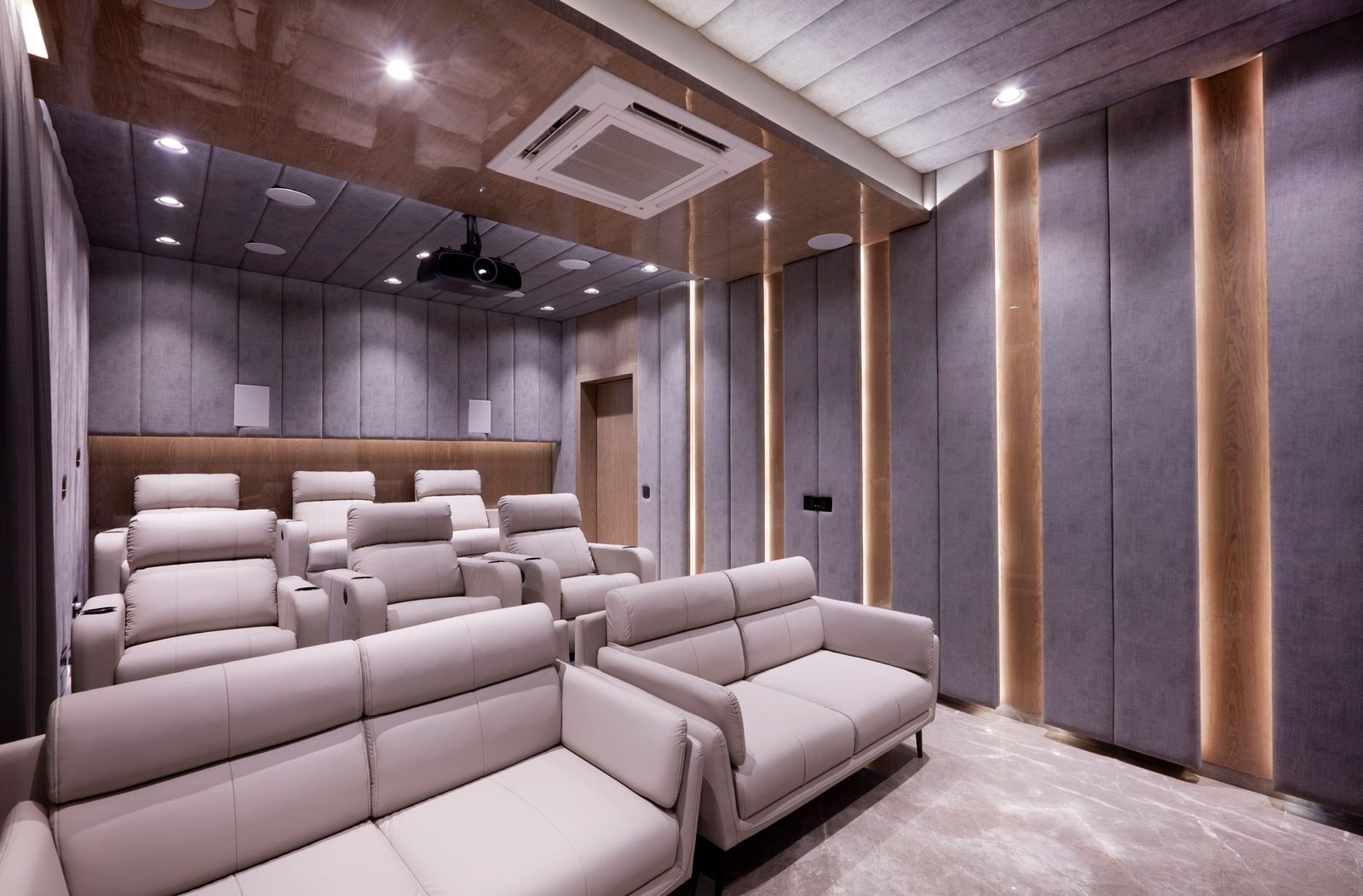
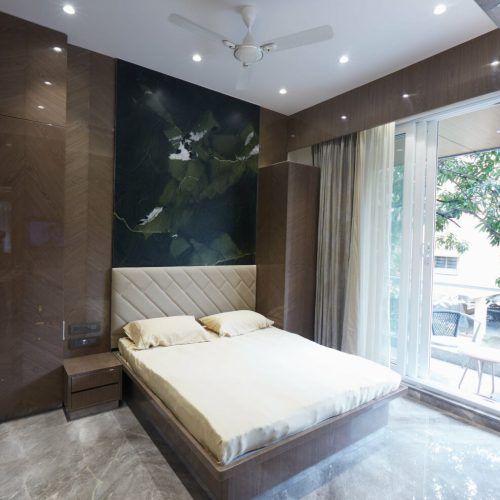
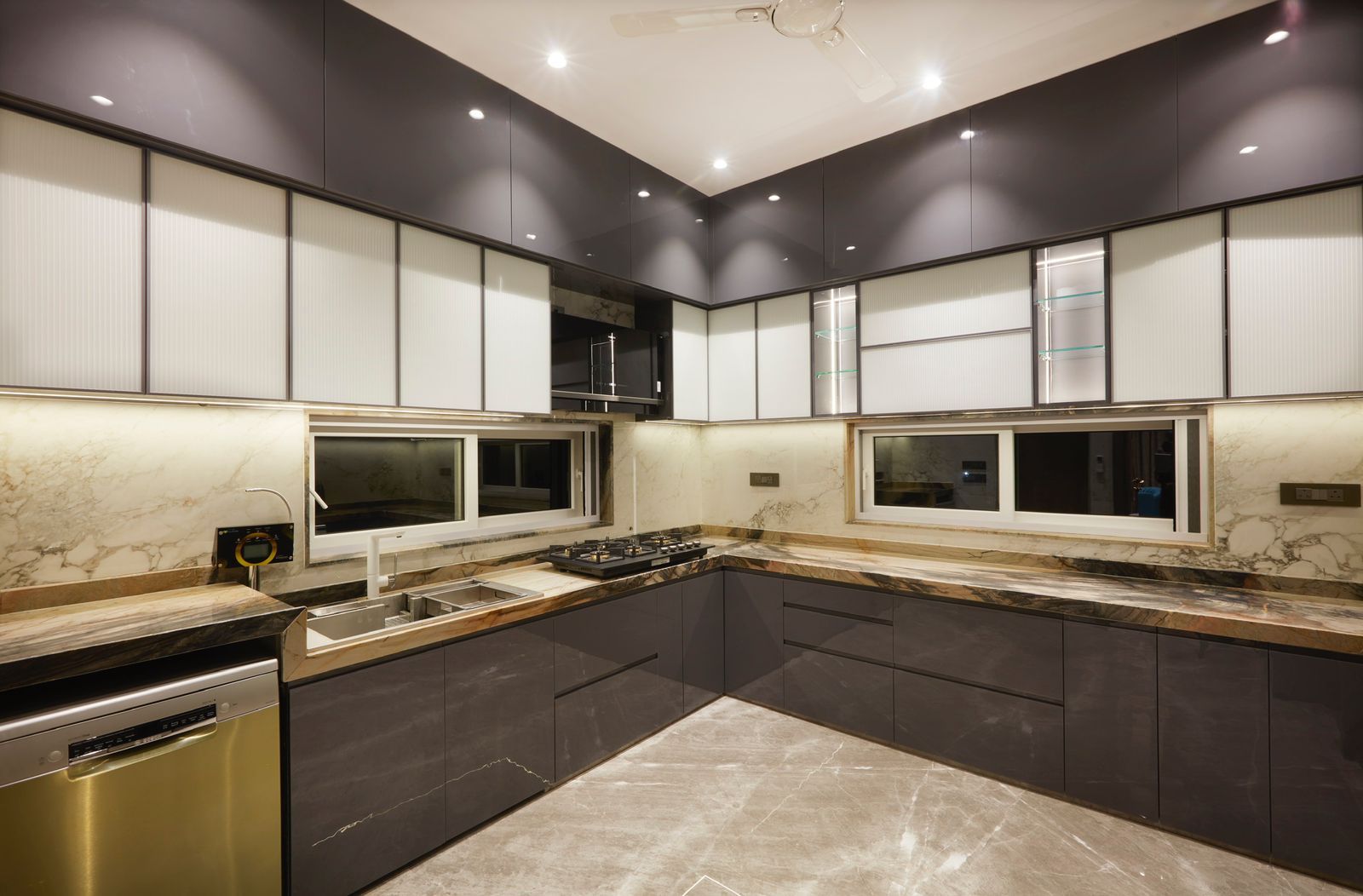
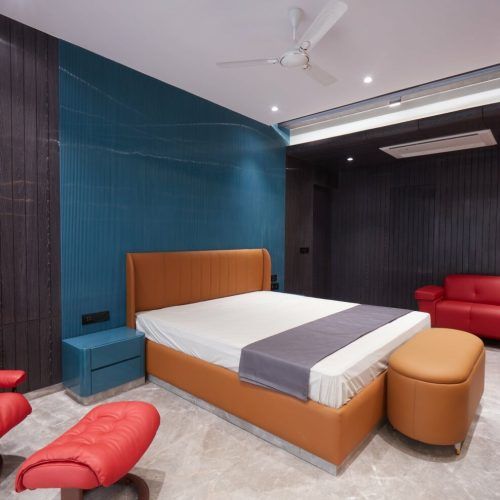
Selected work by Greenbox Design Studio. Tap any image to enlarge.
Frequently asked questions
What plywood should I use in a Mumbai kitchen?+
BWP plywood to IS 710, at ₹105–₹165 per sq ft for the board. Nothing else is appropriate — MR grade delaminates and particle board swells irreversibly. Marine ply is a step above BWP and is worth its premium only on external walls, balconies and directly coastal flats.
Is PU worth the cost over acrylic?+
PU costs roughly ₹640–₹1,150 per sq ft against ₹520–₹850 for matte acrylic, and buys you two things acrylic cannot: any colour you want, and repairability on site. Acrylic gives greater depth of finish for less money. For a flat-fronted kitchen in a standard colour, acrylic wins; for bespoke colours or profiled work, PU.
Quartz or granite for an Indian kitchen?+
Quartz if the budget allows — non-porous, no sealing, unaffected by turmeric, lemon and oil, at ₹720–₹1,900 per sq ft. Granite at ₹380–₹1,100 is better value, handles hot vessels better than quartz, and needs resealing every two to three years. Both are far more practical than marble for daily Indian cooking.
Can I put wooden flooring in a Mumbai flat?+
Engineered wood, yes, in bedrooms and studies, at ₹320–₹900 per sq ft supplied and fixed. Keep it out of kitchens, bathrooms, utility areas and balconies, and check for rising damp on ground-floor and hill-side flats before laying anything. Solid timber is not a sensible choice in this climate.
How do I tell BWP plywood from BWR on site?+
Check the IS marking on the board edge — IS 710 is BWP, IS 303 is BWR — and the manufacturer's stamp, and keep the delivery challans. Ask for a boil test on an offcut: BWP survives 72 hours in boiling water without delaminating. Substitution at delivery is common enough that inspecting the boards before they are cut is worth the ten minutes.