
Four depths of refurbishment
| Depth | Scope | ₹ per sq ft | Downtime | Typical driver |
|---|---|---|---|---|
| Refresh | Paint, carpet or flooring, lighting relamp, graphics | ₹490 – 770 | Weekends only | Lease renewal, brand refresh |
| Light refurbishment | Above plus furniture replacement, meeting-room upgrades, AV | ₹770 – 1,200 | Zone by zone, 2 – 4 weeks | Hybrid working changes |
| Medium refurbishment | Above plus partition changes, ceiling, electrical distribution | ₹1,200 – 1,580 | 6 – 10 weeks phased | Headcount or structure change |
| Deep refurbishment | Strip back to shell, all services renewed | ₹1,580 – 1,970 | 10 – 16 weeks, usually vacated | 20-year-old services, major repositioning |
Excluding 18% GST, IT hardware and landlord charges. For comparison, a new fit-out of the same floor runs ₹2,030–₹3,050 per sq ft, because it includes the base services a refurbishment inherits. That new-fit-out band is taken from workplace projects Greenbox has completed and billed, audited line by line and held at October 2026 prices; the refurbishment depths above are set against it.
Audit before you design
The cheapest square foot in a refurbishment is the one you do not touch. Before design starts we survey what exists and score it for reuse, because a great deal of what gets skipped is serviceable.
| Asset | Typical life | Reuse test | Refurbish cost vs new |
|---|---|---|---|
| Workstation frames and legs | 15 – 20 years | Structurally sound, height adjustable | 25 – 35% of new |
| Desktops and screens | 8 – 12 years | Edges intact, no delamination | Re-top at 30 – 40% |
| Task chairs | 8 – 12 years | Gas lift and mechanism working | Re-upholster at 20 – 30% |
| Storage and pedestals | 15 years+ | Runners and locks working | Re-face at 25% |
| Ceiling grid | 20 years+ | Grid true, tiles stained only | Retile at 15 – 20% |
| Light fittings, pre-LED | — | Never worth keeping | Replace; payback in 2 – 4 years |
| HVAC indoor units, 12 years+ | — | Efficiency and noise both poor | Replace during a deep refurb |
A furniture refurbishment programme typically saves 55–70% against replacement and takes one to two weeks off the programme, since nothing waits on manufacturing lead times.
Half the furniture in most offices is fine and looks tired. Re-topping and re-upholstering it costs a third of replacement and nobody can tell.
Greenbox commercial team
Design and build under one accountable roof
Phasing around an operating business
The purpose of a phased refurbishment is that nobody goes home. It requires more planning than a vacated build and it almost always costs less than the alternative, once temporary space and moving costs are counted.
- Zone the floorDivide into three to five zones sized so that each can be vacated by moving people into swing space or spare desks, not into a different building.
- Create swing space firstRefurbish one zone completely before touching any other. It becomes the temporary home for the next group and proves the specification.
- Seal properlyFull-height dust barriers with a zip door, negative pressure where possible, and floor protection along the route to the service lift. Half-height barriers do nothing.
- Schedule noise out of hoursCore cutting, demolition and ceiling work after 7pm or at weekends. Quiet trades run during the day so the programme keeps moving.
- Hand back each zone completeCleaned, tested, occupied. Never leave a zone at 90% to start the next — the last 10% never gets done.
- Keep IT continuousStructured cabling migrated zone by zone with a tested cutover, out of hours, rather than a floor-wide switchover.
Services: the part that decides a deep refurbishment
- HVAC over 12 years old is inefficient, noisy and increasingly hard to get parts for. In a deep refurbishment it is usually the largest single line, and the operating-cost saving is real enough to model.
- Lighting to LED is the clearest financial case in the building: typically a two to four year payback on energy alone, before counting the improvement in how the office looks and feels.
- Electrical distribution designed for a 2008 office with desktop PCs and no meeting-room AV will be under-provisioned. Check circuit loading before adding anything.
- Structured cabling. Cat6A as the sensible baseline, with a proper containment route. Legacy cable abandoned in the ceiling void is both a fire load and a nuisance; remove it while the ceiling is open.
- Fire detection must be re-verified against any changed partition layout, and in most buildings this is a landlord-nominated vendor's scope.
- Acoustics. The most frequent post-occupancy complaint in Indian offices, and a refurbishment is the cheapest moment to fix it — absorptive ceiling tiles, partition upgrades to slab level around meeting rooms, and separation of loud from focused zones.
The lease clause to read first
Before designing anything permanent, read the reinstatement or dilapidations clause. Many Indian commercial leases require the tenant to return the premises to their original condition at expiry, which means anything you build may have to be removed at your cost.
- Establish the reinstatement baseline in writing — with photographs, ideally agreed with the landlord at the start of the refurbishment.
- Design demountable where the lease is short. Glazed partition systems, modular joinery and carpet tiles are removable; blockwork and screeded floors are not.
- Negotiate a waiver. Landlords frequently waive reinstatement for improvements they would keep anyway, but only if you ask before you build.
- Budget for it if you cannot waive it. Reinstatement typically runs 8–15% of the original fit-out cost and it arrives at the least convenient moment in a lease.
Measuring whether it worked
A refurbishment is a capital decision, and the businesses that get the most from one define what success looks like before the first drawing. These are the measures worth baselining beforehand, because none of them can be reconstructed afterwards.
| Measure | How to baseline it | What a good refurbishment does |
|---|---|---|
| Desk utilisation | Two weeks of occupancy counts before work starts | Reveals whether you need desks or settings |
| Meeting room booking conflicts | Export three months of calendar data | Right-sizes rooms; usually means more small ones |
| Energy consumption per sq ft | Twelve months of bills | LED and HVAC renewal typically cut 18–30% |
| Post-occupancy survey | Short survey before and 90 days after | Acoustics and temperature dominate both times |
| Space per person | Usable area divided by headcount | Often reveals capacity you already own |
| Facilities tickets per month | Twelve months of the helpdesk log | A good refurbishment halves them |
Collect these before design begins. A refurbishment justified only on appearance is much harder to fund a second time.
Where we work
We refurbish workplaces nationally. For Grade-A landlord rules, mandated vendors, night-shift premiums and micro-market rates, see office renovation contractors in Mumbai.
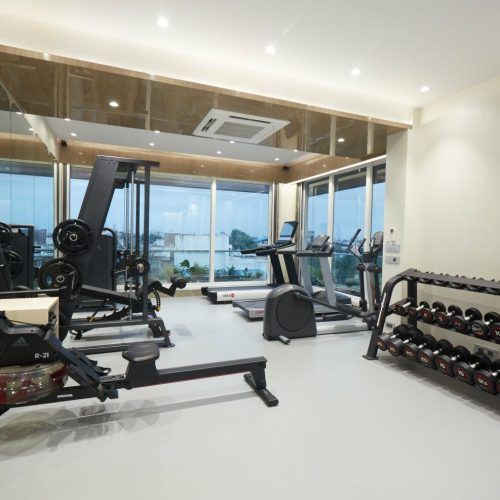
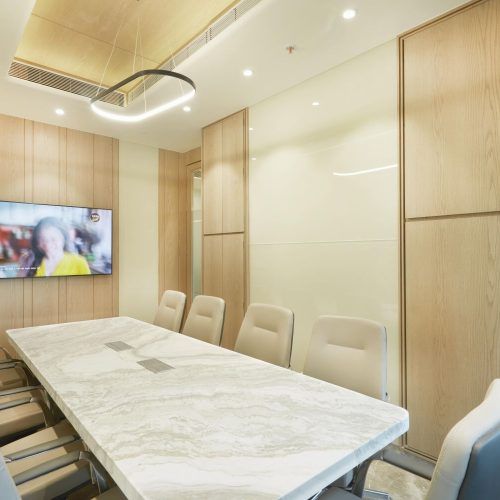
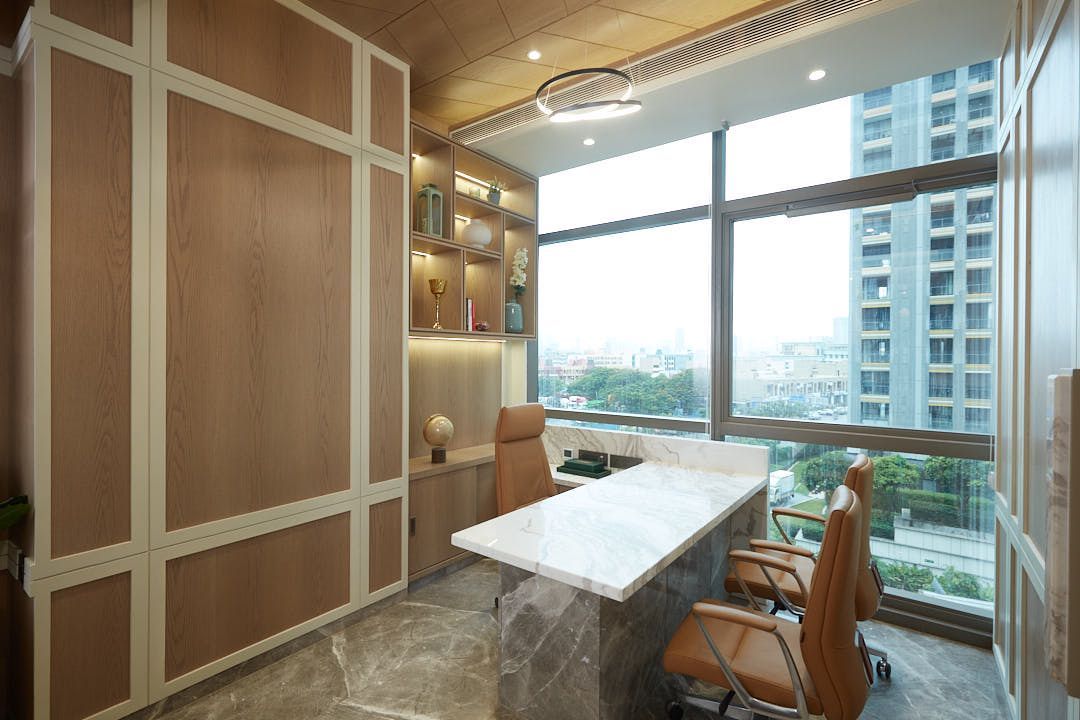
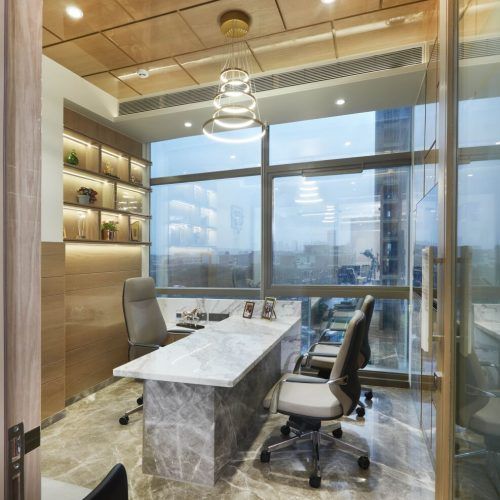
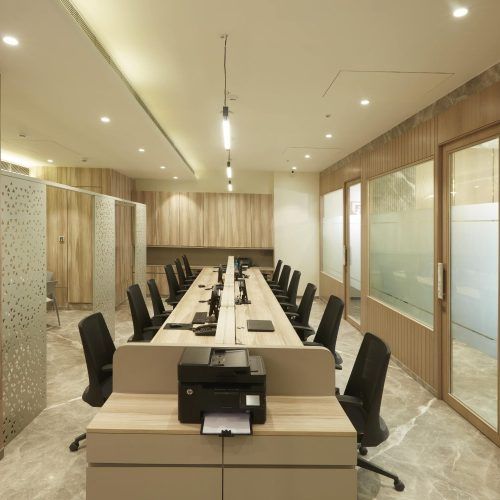
Selected work by Greenbox Design Studio. Tap any image to enlarge.
Frequently asked questions
How much does an office renovation cost per sq ft?+
₹490–₹770 for a refresh, ₹770–₹1,200 for a light refurbishment, ₹1,200–₹1,580 for a medium refurbishment with partition and ceiling changes, and ₹1,580–₹1,970 for a deep strip-back. That is roughly 40–60% of a new fit-out on the same floor, because the base services and shell are inherited.
Can we stay in the office during renovation?+
Yes, with proper zoning. We divide the floor into three to five zones, refurbish one completely to create swing space, then rotate people through. It adds 20–35% to the programme and removes relocation cost entirely. Full-height sealed dust barriers and out-of-hours noisy work are what make it tolerable.
Is it worth refurbishing existing office furniture?+
Usually. Workstation frames last 15–20 years and re-topping costs 30–40% of new; task chairs can be re-upholstered at 20–30% of replacement if the gas lift and mechanism work. A furniture refurbishment programme typically saves 55–70% against buying new and avoids manufacturing lead times.
What is a reinstatement or dilapidations clause?+
A lease provision requiring you to return the premises to their original condition at expiry, so anything permanent you build may have to be removed at your cost — typically 8–15% of the fit-out value. Read it before designing, design demountable where the lease is short, and ask the landlord for a waiver on improvements they would keep.
What gives the biggest improvement for the money?+
Lighting and acoustics. Replacing pre-LED fittings pays back in two to four years on energy alone and transforms how the space reads, while absorptive ceiling tiles, partitions taken to slab level around meeting rooms and separating loud from focused zones address the most common post-occupancy complaint in Indian offices.