
The room comes first
Every dimension of a rectangular room produces standing waves at predictable frequencies. When two dimensions are simple multiples of each other, those modes stack and you get a boomy, uneven bass that no subwoofer setting will fix.
| Room aspect (H : W : L) | Verdict | Why |
|---|---|---|
| 1 : 1.6 : 2.33 | Excellent — the classic ratio | Modes spread evenly across the low end |
| 1 : 1.4 : 1.9 | Very good | Well distributed, works in smaller rooms |
| 1 : 1.5 : 2.5 | Good | Slight clustering, manageable with treatment |
| 1 : 2 : 4 | Poor | Modes stack at the same frequencies — severe boom |
| Perfectly square | Avoid | Worst case; identical modes on both axes |
Where the room is already built and cannot be changed, the fix is bass trapping in the corners plus careful subwoofer placement, not a different subwoofer.
Acoustic treatment that actually does something
Acoustic foam glued randomly to a wall is decoration. Treatment works when it is placed where the sound arrives, in the right thickness for the frequency you are trying to control.
- Bass traps in all four vertical corners. Thick porous absorbers, 300 mm or more across the corner. This is the highest-value treatment in any room and the one most often skipped.
- First reflection points, absorbed. Mirror trick: have someone slide a mirror along the side wall while you sit in the main seat. Wherever you see a speaker, put a 50–100 mm absorber. Same for the ceiling.
- Rear wall, diffused rather than deadened. A fully absorbent back wall makes the room feel lifeless. Diffusers or a bookshelf-like scattering surface keep it alive.
- Thickness follows frequency. 25 mm panels only touch the top end and are why over-foamed rooms sound thin and harsh. 50 mm minimum for side walls, 100 mm plus for anything meant to control the lower midrange.
- Target RT60 of 0.3 to 0.4 seconds in a domestic cinema. Below 0.25 the room is oppressive; above 0.5 dialogue smears.
- Heavy fabric on the screen wall and a proper acoustically transparent screen if the centre speaker sits behind it.
People spend eight lakh on speakers and forty thousand on the room, then ask why it does not sound like the demo. The demo room was the product.
Greenbox principal designer
Design and build under one accountable roof
Screen size, seating distance and sightlines
Screen size follows viewing distance, not wall width. The reliable rule is to work from the screen height and the seating row position, then check the sightline over the row in front.
| Seating distance | Recommended screen diagonal | Riser needed for row 2 | Notes |
|---|---|---|---|
| 2.4 m (8 ft) | 100 – 110 in | Not usually | Single row; 4K content only |
| 3.0 m (10 ft) | 120 – 133 in | 150 mm | The sweet spot for most Indian rooms |
| 3.6 m (12 ft) | 133 – 150 in | 200 mm | Two comfortable rows |
| 4.5 m (15 ft) | 150 – 180 in | 250 – 300 mm | Needs a long room and a bright projector |
Rule of thumb: seating distance of roughly 1.5 to 2 times the screen width for cinematic immersion at 4K. Riser height is set so the second row's eye line clears the first row's headrest by 100 mm.
Speaker layout: how many channels are worth it
| Configuration | Room size | Ceiling height needed | Typical system cost | Worth it when |
|---|---|---|---|---|
| 2.1 stereo | Any | Any | ₹60,000 – 2,00,000 | Music first, film second |
| 5.1 | 10 x 12 ft up | Any | ₹1,80,000 – 5,00,000 | The sensible default for most homes |
| 7.1 | 12 x 16 ft up | Any | ₹3,00,000 – 8,00,000 | Two seating rows, long room |
| 5.1.2 / 5.1.4 Atmos | 12 x 16 ft up | 2,700 mm+ finished | ₹4,50,000 – 14,00,000 | Dedicated room with height to spare |
| 7.2.4 and beyond | 14 x 20 ft up | 3,000 mm+ finished | ₹12,00,000 – 40,00,000 | Purpose-built cinema rooms only |
Excluding 18% GST, room build and acoustic treatment. Height channels need genuine ceiling clearance — in-ceiling Atmos speakers in a 2,550 mm room fire straight down at the seats and defeat the point.
The things that get forgotten
- HVAC noise. A cinema room needs a background noise level under about 30 dB. That means oversized, low-velocity ducting, a remote indoor unit where possible, and lined plenums. A standard split unit at full speed is louder than quiet dialogue.
- Dedicated electrical circuits. Amplifier and projector on separate circuits from the lighting, ideally with an isolation transformer. Dimmer buzz on an audio circuit is a real and avoidable problem.
- Light control. Blackout is non-negotiable for a projector. Matte dark surfaces on the screen wall and ceiling in front of the screen; any light-coloured surface reflects back and lowers contrast.
- Cable routing. Conduit for HDMI runs over 10 m, with a pull string left in place. HDMI standards change; the conduit outlives them.
- Seating comfort over seat count. Recliners need 900 mm of rear clearance. Six seats crammed into a room for four is how a cinema stops being used.
- Calibration. A measurement microphone and room correction pass, done after treatment. Budget half a day; it is the cheapest improvement available at the end of a project.
Budget tiers
| Tier | Room build and acoustics | AV system | Total |
|---|---|---|---|
| Media room in a living space | ₹80,000 – 2,00,000 | ₹1,80,000 – 3,50,000 | ₹4.5 – 7 L |
| Converted bedroom, dedicated | ₹2,50,000 – 5,00,000 | ₹3,00,000 – 7,00,000 | ₹7 – 14 L |
| Purpose-built cinema room | ₹6,00,000 – 12,00,000 | ₹7,00,000 – 18,00,000 | ₹15 – 30 L |
| Reference room with isolation | ₹12,00,000 – 20,00,000 | ₹15,00,000 – 30,00,000 | ₹30 – 45 L+ |
Excluding 18% GST. Room build covers framing, acoustic treatment, seating, lighting, joinery and finishes. Isolation means a decoupled room-within-a-room build.
Where we work
We design and build home cinemas across India. For the apartment-specific version — noise transfer to neighbours, society rules and converting a Mumbai bedroom — see home theatre designers in Mumbai.
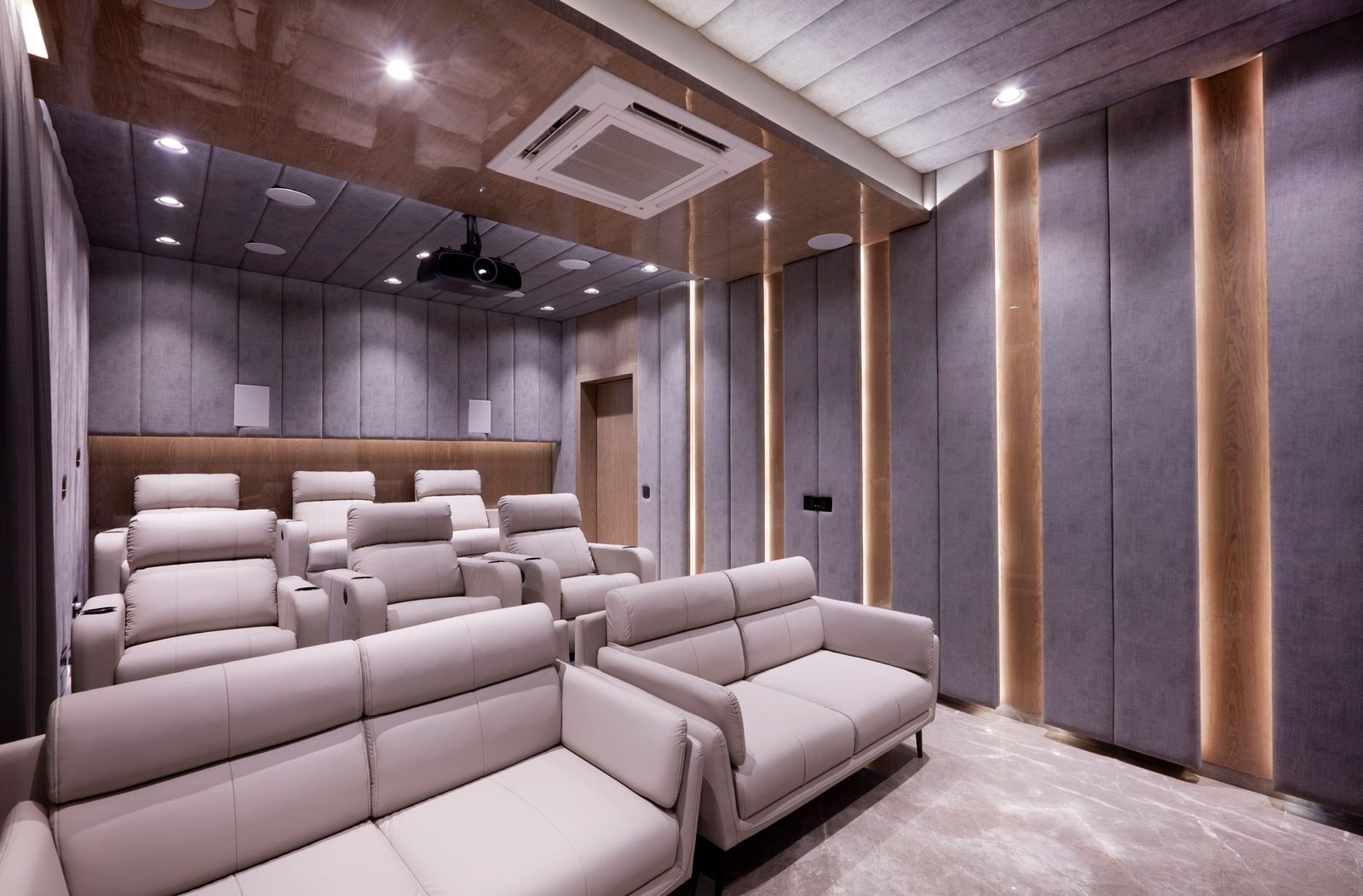
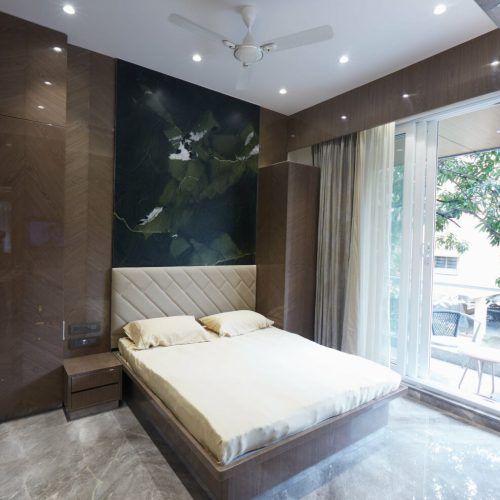
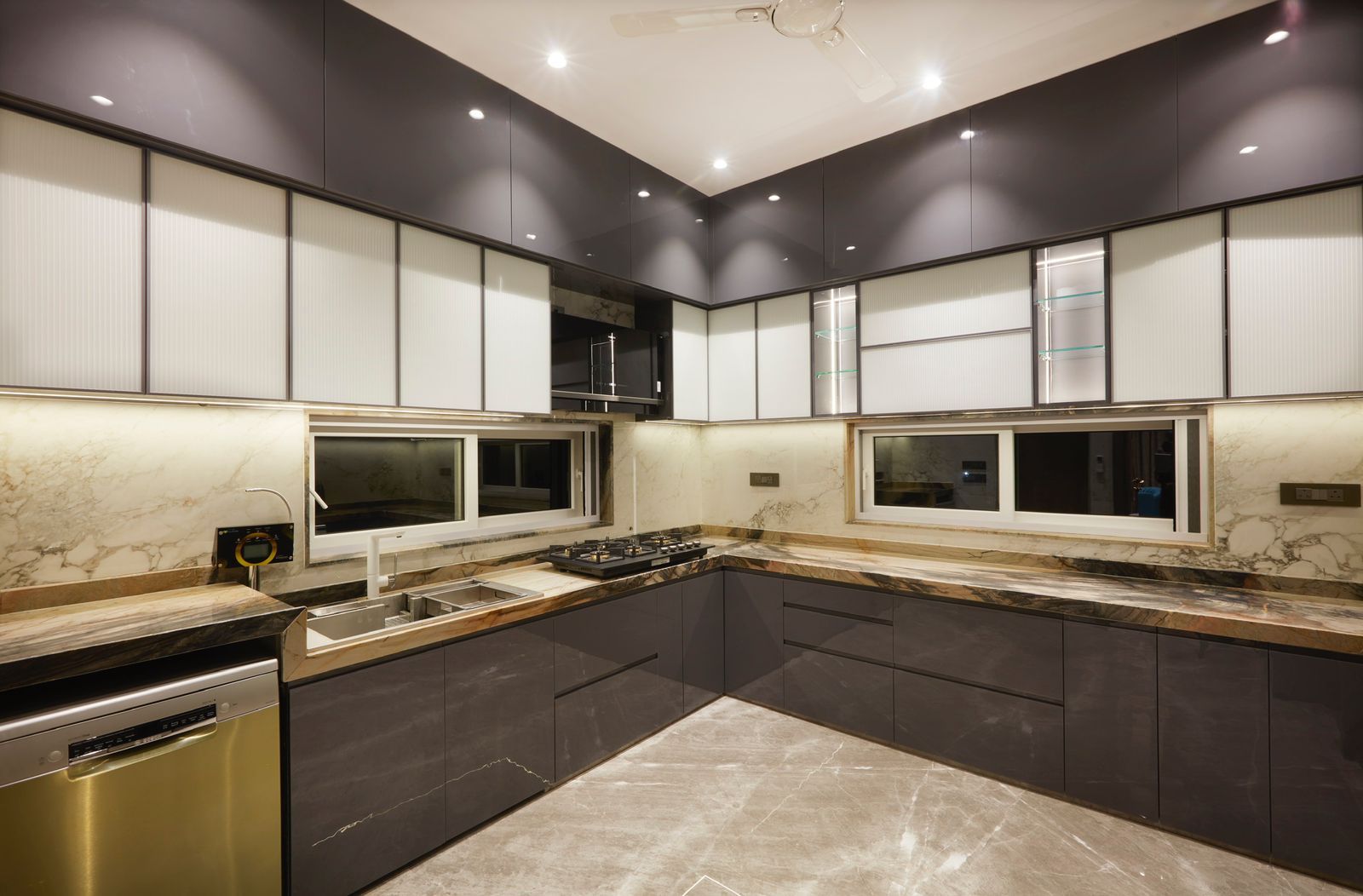
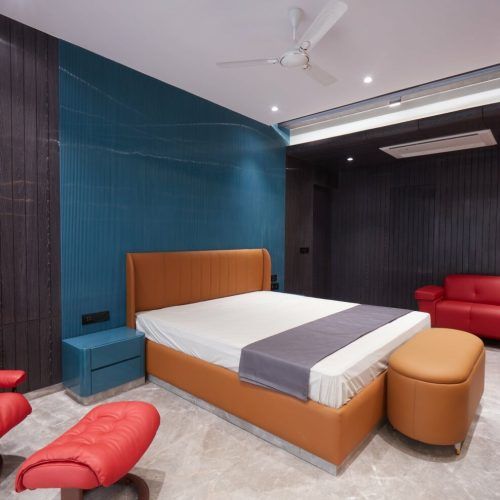
Selected work by Greenbox Design Studio. Tap any image to enlarge.
Frequently asked questions
How much does a home theatre cost?+
₹4.5–₹7 lakh for a media room in a living space, ₹7–₹14 lakh for a dedicated converted bedroom, ₹15–₹30 lakh for a purpose-built cinema room and ₹30–₹45 lakh or more for a reference room with structural isolation. Roughly 20–30% of any of these should go to the room build and acoustics rather than equipment.
What size room do I need for a home theatre?+
A 5.1 system works from about 10 x 12 ft, 7.1 wants 12 x 16 ft, and Atmos needs both that footprint and a finished ceiling height of 2,700 mm or more. Room proportion matters as much as size: aim for something near a 1 : 1.6 : 2.33 height-to-width-to-length ratio and avoid square rooms.
How far should I sit from the screen?+
Roughly 1.5 to 2 times the screen width for 4K content. At 3 metres a 120–133 inch screen is right; at 3.6 metres, 133–150 inches. If a second row is needed, raise it on a 200 mm riser so the rear eye line clears the front headrest by about 100 mm.
Is acoustic treatment really necessary?+
It is the highest-return spend in the whole project. Bass traps in the four corners, absorbers at the first reflection points and diffusion on the rear wall take a room from boomy and smeared to clear, and cost a fraction of an equipment upgrade that would achieve less. Target an RT60 of 0.3–0.4 seconds.
Do I need a projector or will a large TV do?+
Below about 3 metres of viewing distance a 85–98 inch TV is brighter, simpler and needs no blackout. Beyond that, a projector gives a genuinely cinematic 120 inches or more for less money — provided you can achieve full blackout and keep the surfaces around the screen dark and matte.