
1. Interior designer vs contractor
| Design-and-build studio | Contractor only | |
|---|---|---|
| What you get | Design, specification, procurement, execution and project management under one contract | Execution against drawings you supply or against verbal instruction |
| Typical Mumbai cost | ₹1,300 – ₹3,500+ per sq ft of carpet area | 15 – 25% less, before the cost of your own time and any rework |
| Who carries coordination risk | The studio | You |
| Who resolves a clash on site | The studio, against the drawing it produced | You, usually while standing in the flat |
| Best for | Anything involving layout change, added storage, moved services or more than three trades | Like-for-like replacement where the layout and services are unchanged |
| Honest weakness | You pay for coordination you could theoretically do yourself | There is no single accountable party when something does not fit |
The case for a contractor is real and we will say so: if your layout works, your storage is adequate and you are replacing like for like, a good contractor is the correct and cheaper answer. What a contractor cannot do is tell you that your brief is wrong. Compare the two against your own scope with the cost comparison tool.
2. Turnkey vs piecemeal
| Turnkey (one contract) | Piecemeal (trade by trade) | |
|---|---|---|
| Contract | One party, one date, one price | Five to eight separate engagements |
| Programme | 10 – 18 weeks for a full home, sequenced | Typically 40 – 70% longer; each trade waits for the last |
| Cost | Higher headline rate | Lower trade rates, higher total once rework and your time are counted |
| Who sequences the work | The studio | You, daily |
| Failure mode | You are tied to one party's capacity | Every gap between two trades is an argument about whose scope it was |
| Best for | Full homes, occupied renovations, commercial fit-outs, anyone with a job | Single elements, very small scopes, or an owner who can supervise full time |
For a single kitchen or a wardrobe run, piecemeal is often the right call — there is very little to sequence. For a full home, the coordination burden is the project, and handing it to yourself is rarely the saving it appears to be.
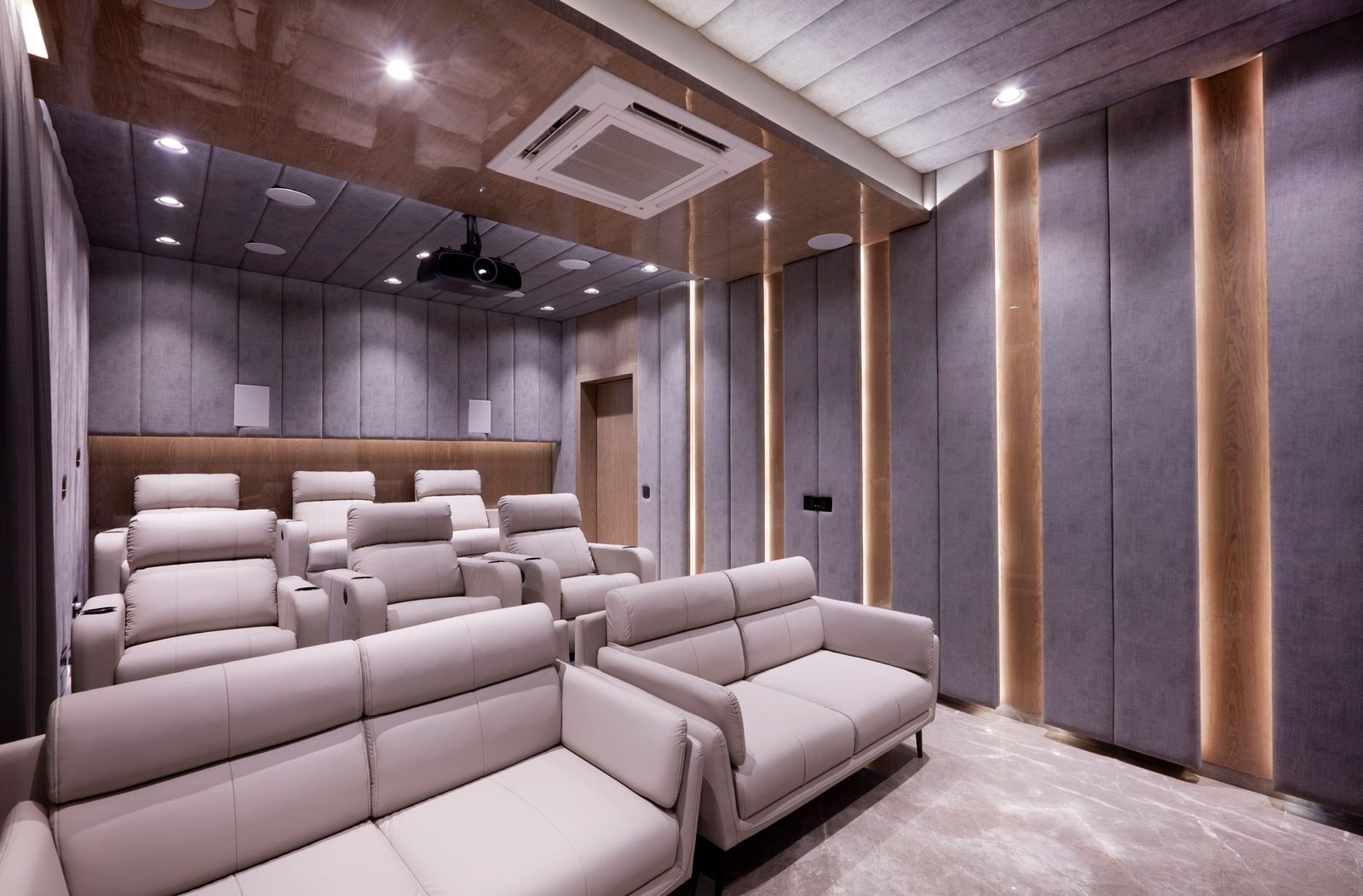
Design and build under one accountable roof
3. Modular vs site carpentry
| Factory modular | Site carpentry | |
|---|---|---|
| Where it is made | Machine-cut and edge-banded in a factory, installed on site | Cut and assembled in your flat |
| Edge sealing | Machine-applied banding on every edge, including hidden ones | Hand-applied; hidden edges frequently left raw |
| Squareness and repeatability | Consistent | Depends entirely on the carpenter |
| Dust and time on site | 3 – 5 days for a kitchen | 3 – 5 weeks, with dust throughout |
| Odd dimensions and curves | Limited without bespoke tooling | Excellent — this is its real advantage |
| Cost | Comparable at equal specification; cheaper at scale | Cheaper at low specification, dearer for good work |
| Best for | Kitchens, wardrobes, repeated units, anything in an occupied home | Heritage buildings, curved or non-orthogonal spaces, one-off pieces |
4. Where the marginal rupee should go
If your budget is ₹50,000 short of the scheme you want, this table tells you where to take it from and where not to.
| Spend it on | Not on | Why |
|---|---|---|
| BWP carcass throughout | An upgraded shutter finish | The carcass cannot be changed later; the shutter can |
| Full-extension soft-close runners | Handles and knobs | Runners cycle thousands of times a year; handles are cosmetic |
| Full height with a loft | A second feature wall | 30 – 40% more capacity for about 18% more cost |
| Three lighting circuits | More light fittings on one circuit | How a room feels at 9pm is a switching problem, not a fitting problem |
| Corner recovery in the kitchen | A larger tall unit | A magic corner recovers space you have already paid for in the plan |
| Electrical first fix done properly | Anything visible | It is buried. Everything else can be revisited |
5. Material head-to-heads, condensed
The full rate tables and the reasoning behind each of these are on the materials guide. This is the short version, as a decision table.
| Decision | Pick this | Unless |
|---|---|---|
| BWP vs MR plywood | BWP, always, in Mumbai | You are in a genuinely dry climate and the joinery is nowhere near water |
| Acrylic vs laminate shutters | Matte laminate for volume, matte acrylic on kitchen and feature faces | The budget is tight — then laminate throughout and better hardware |
| PU vs acrylic | Acrylic for flat shutters in a standard colour | You need a bespoke colour, a curved profile, or on-site repairability |
| Quartz vs marble countertop | Quartz for daily Indian cooking | You want marble and accept annual resealing and a patina |
| Vitrified vs engineered wood | Vitrified in living, kitchen, bathrooms and balconies | Bedrooms and studies, where engineered wood is warmer and quieter |
| Hinged vs sliding wardrobe | Hinged wherever there is 900 mm of clear floor | Circulation is tighter than that — then sliding, and pay for good gear |
| Gypsum vs POP ceiling | Gypsum board — cleaner, faster, less site mess | You need a curved or moulded profile that gypsum cannot form |
6. Renovate now vs wait for redevelopment
A question we are asked constantly in Borivali, Chembur and Mulund, and the only honest answer starts with a question back: how firm is the redevelopment timeline?
- Development agreement signed and an IOD or commencement certificate in hand — do not do a full interior. Spend on safety, damp and comfort only. Anything fitted is a write-off.
- Society talking about redevelopment, nothing signed — Mumbai redevelopment routinely takes five to ten years from first discussion to possession. A ten-year-life interior at essential specification is usually a reasonable investment.
- No process at all — treat the flat as permanent and specify accordingly.
- In every case, keep the material and brand schedule from your fit-out. If the building does redevelop, it tells the next carpenter exactly what you had.
7. Buy ready furniture vs build it in
| Ready / loose furniture | Built-in joinery | |
|---|---|---|
| Cost for equivalent storage | Lower per item, higher per cubic foot of usable storage | Higher per item, better per cubic foot |
| Fit to the space | Standard sizes; gaps and dead space at the edges | Made to the wall, floor to ceiling, no dead space |
| Moves with you | Yes | No |
| Lead time | Immediate to four weeks | Four to five weeks in the factory |
| Best for | Seating, dining tables, beds where storage is not needed, rentals | Wardrobes, kitchens, TV walls, entrance zones, anything storage-led |
A practical rule: buy the things you sit on, build the things you store in. Loose seating and dining furniture is usually better bought, because comfort and proportion are hard to get right bespoke and easy to test in a showroom.
8. In-house execution vs outsourced
When you appoint a studio, ask who actually builds. A design practice that outsources execution to a contractor reintroduces the designer-versus-contractor gap inside your own contract, with you arbitrating between two parties who are both paid by you.
We execute what we draw, which is why the bill of quantities is written by the people who have to build from it and why we are willing to put a completion date in the contract. That is a structural argument rather than a promise about effort, and it is the one thing on this page we would say is not really a two-sided comparison.
Everything in this section
All 30 comparisons pages:
- Acrylic vs PU: sheet or spray, and why
- Asian Paints vs Berger: how to actually decide
- Blum vs Hettich: narrow specialist or broad range
- BWP vs BWR plywood: what the grades mean
- Design-build vs design-bid-build for a fit-out
- Engineered wood vs laminate: real timber or print
- Glass vs gypsum partition: light against privacy
- Granite vs marble: where each one belongs
- Gypsum vs POP: dry board or wet plaster
- Hettich vs Hafele: two ways to buy hardware
- Interior designer vs contractor: who to appoint
- Italian vs Indian marble: the real difference
- Jaquar vs Kohler: where to spend in a bathroom
- Kajaria vs Somany: buy the tile, not the brand
- Laminate vs acrylic: what the extra buys
- Laminate vs veneer: cost, life and honesty
- Platform vs local studio: two delivery models
- MDF vs HDHMR: is the denser board worth it
- Modular vs carpenter kitchen: which to build
- Open office vs cabins: density, noise and cost
- Plywood vs MDF: use both, in the right places
- PVC vs gypsum ceiling: room by room
- Quartz vs granite for an Indian kitchen counter
- Renovate vs redo: keep it or strip it out
- Sliding vs hinged wardrobe: the space maths
- SPC vs laminate flooring: the water question
- Turnkey vs labour contract: who buys the material
- Vitrified tiles vs marble: the honest floor test
- Walk-in closet vs wardrobe: is it worth the floor
- Wallpaper vs texture paint on a feature wall
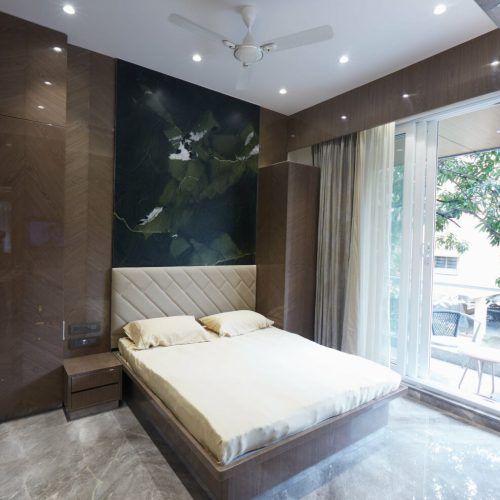
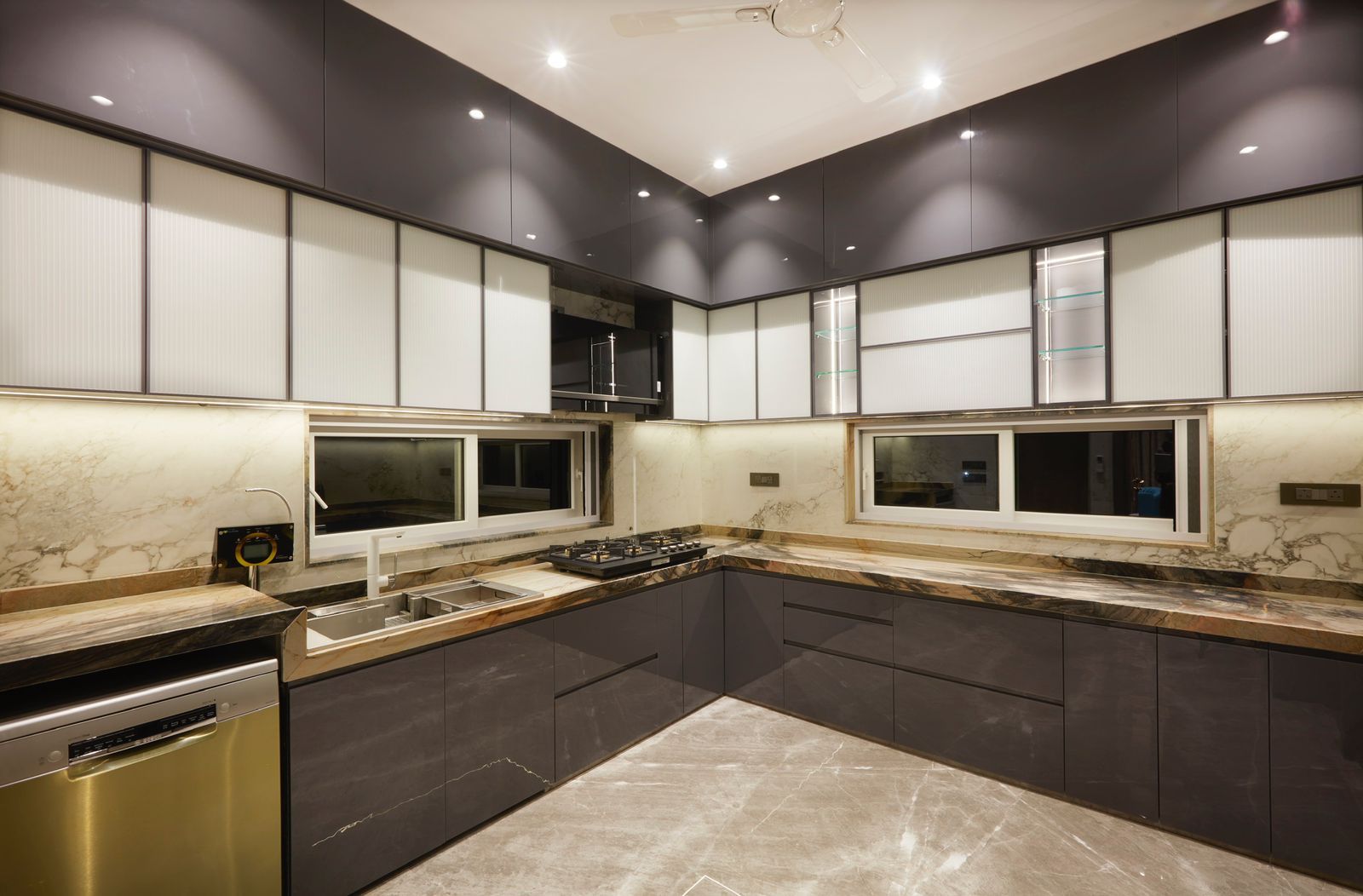
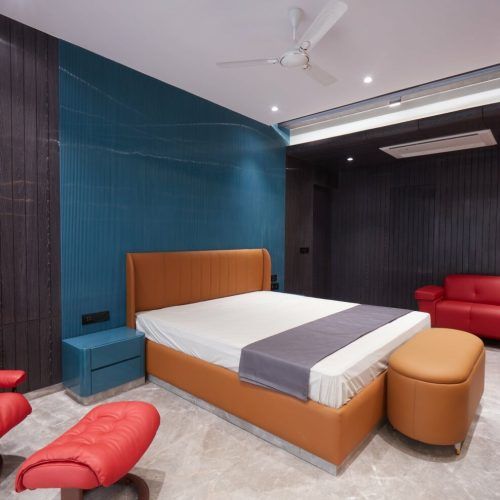

Selected work by Greenbox Design Studio. Tap any image to enlarge.
Frequently asked questions
Is a design-and-build studio always better than a contractor?+
No. If your layout works, your storage is adequate and you are replacing like for like, a good contractor is the correct and cheaper answer — typically 15–25% less. A studio earns its premium when the layout changes, storage is added, services move, or more than three trades have to be sequenced around each other.
Is turnkey more expensive than managing trades yourself?+
The headline rate is higher. The total often is not, once rework, extended programme and your own time are counted — piecemeal projects typically run 40–70% longer. For a single kitchen or wardrobe run there is little to sequence and piecemeal usually wins; for a full home it rarely does.
Is factory modular always better than site carpentry?+
Not always. Modular gives better edge sealing, squarer boxes and three to five days on site instead of three to five weeks. Site carpentry still wins on odd dimensions, curves, heritage buildings and one-off pieces, where bespoke tooling would cost more than skilled hands. At equal specification the cost is comparable.
Should I renovate a flat that may be redeveloped?+
If the development agreement is signed and an IOD or commencement certificate exists, do not do a full interior — spend only on safety, damp and comfort. If the society is merely discussing it, Mumbai redevelopment routinely takes five to ten years, and a ten-year-life interior at essential specification is usually a reasonable investment.
If my budget is short, what should I cut first?+
Shutter finish, then loose furniture, then flooring if the existing floor is sound. Never the carcass grade, the drawer runners or the electrical first fix — those are the items that are either buried or cannot be changed without dismantling the work. Phasing by room beats thinning the specification everywhere.