
Rate per sq ft by ceiling type
| Ceiling type | ₹ / sq ft | Where it makes sense |
|---|---|---|
| Plain gypsum board, flat or peripheral | ₹70 – 95 | Bedrooms and passages where you only need to hide conduits and gain a cove |
| POP on chicken mesh | ₹85 – 130 | Curved and organic shapes; slower, wetter and messier than gypsum |
| PVC panel | ₹70 – 110 | Utility areas, bathrooms and balconies — waterproof but visibly plastic |
| Gypsum with cove and profile lighting | ₹100 – 145 | Living rooms and master bedrooms; the most common residential choice |
| Grid / mineral fibre (Armstrong type) | ₹110 – 160 | Where services above must stay accessible |
| Multi-level designer gypsum | ₹150 – 220 | Living and dining where the ceiling is part of the design |
| Wooden rafter, veneer or metal baffle | ₹300 – 650 | Feature ceilings; specialist fabrication and fire treatment |
Ex-GST. Includes GI framing, board, jointing, finishing and light cut-outs. Excludes fittings, cabling and painting of the ceiling.
Room-by-room totals
Area covered is the horizontal area of the ceiling you actually board, not the room's floor area if you are only doing a peripheral drop. Three common specifications, priced across a 2BHK:
| Room / area covered | Plain gypsum ₹85/sq ft | Cove + profile ₹130/sq ft | Multi-level ₹190/sq ft |
|---|---|---|---|
| Bedroom — 120 sq ft | ₹10,200 | ₹15,600 | ₹22,800 |
| Living and dining — 250 sq ft | ₹21,250 | ₹32,500 | ₹47,500 |
| Kitchen — 70 sq ft | ₹5,950 | ₹9,100 | ₹13,300 |
| Passage and foyer — 60 sq ft | ₹5,100 | ₹7,800 | ₹11,400 |
| Whole 2BHK — 600 sq ft covered | ₹51,000 | ₹78,000 | ₹1,14,000 |
Area × rate. Ex-GST and ex-light fittings. The 600 sq ft whole-home row includes the second bedroom.

Ceilings costed by the square foot covered
What is inside the rate
A ₹78,000 cove-and-profile ceiling across 600 sq ft of a 2BHK — ₹130 per sq ft — opened up:
| Component | Cost | Share |
|---|---|---|
| GI framing — perimeter channel, intermediate and ceiling sections, soffit cleats | ₹19,500 | 25% |
| Gypsum board, 12.5mm, plus moisture-resistant board over the kitchen | ₹17,200 | 22% |
| Jointing — tape, joint compound, two coats of putty, primer | ₹10,900 | 14% |
| Installation labour and levelling | ₹19,500 | 25% |
| Cove detail, profile channel and light cut-outs | ₹8,600 | 11% |
| Scaffolding, protection and debris removal | ₹2,300 | 3% |
| Total (ex-GST) | ₹78,000 | 100% |
What changes the price
| Change | Delta | Why |
|---|---|---|
| POP instead of gypsum for the same design | +10 – 18% | Wet work, longer curing, more labour days and far more site cleaning |
| Adding a second level to the design | +35 – 50% | Double framing, double board, twice the edges to finish |
| Moisture-resistant board over kitchen and bathrooms | +25 – 35% on that area | Green board at ₹95–₹140/sq ft against ₹55–₹80 for standard |
| Profile-light channel instead of a plain cove | +12 – 20% | Aluminium channel, diffuser, precise setting-out and a separate circuit |
| Each additional spot-light cut-out | +₹180 – 350 | Marking, hole-sawing, wiring loop and re-finishing |
| Curved or circular detailing | +20 – 30% | Cut and kerfed board, more framing, more jointing length |
| Slab height above 12 ft | +8 – 15% | Scaffolding rather than trestles, slower handling, two-person operations |
| Working around existing AC ducting and beams | +5 – 12% | Bulkheads, drops, service access panels and site-made junctions |
| Fire-rated board in a common passage | +30 – 45% | Specified board, sealed penetrations and certified installation |
Gypsum or POP — the practical answer
- Gypsum is factory-made, dimensionally stable, dry to install, and finishes flat. It goes up in two to four days for a 2BHK and cracks only where the framing was wrong.
- POP is cheaper in labour-rich markets, handles curves without kerfing, and gives a seamless monolithic surface — but it is wet work, needs a week to dry, and hairline cracks along the wall junction are common in the first year.
- Use gypsum for flat and stepped work, POP for curves and domes, and PVC only in wet and utility areas.
- Never mix them in one visible plane. The two surfaces take paint differently and the joint always shows.
People choose a ceiling from a photo and then discover the photo cost sixty thousand rupees in light fittings the ceiling quote never mentioned.
Greenbox design team
How to read a false ceiling quote
- Check the unit. The rate must be per square foot of area actually boarded. A peripheral drop around a 150 sq ft room may only be 60 sq ft of ceiling — paying for 150 is the most common overcharge in this trade.
- Ask for the framing specification. GI perimeter channel, intermediate channel and ceiling sections at stated centres, with the gauge named. Framing at 3 ft centres instead of 2 ft saves the contractor money and cracks within a year.
- Confirm the board. Brand, thickness (12.5mm is standard) and where moisture-resistant board is being used instead of plain.
- Count the cut-outs. The number of spot and COB openings should be a quantity in the quote, because each one is ₹180–₹350 of work and they multiply quickly.
- Separate the lighting. Ask for a second, itemised list of fittings, drivers and profiles. This is where ceiling budgets actually overrun.
- Check who paints it. Putty, primer and two coats at ₹18–₹32 per sq ft is either in the ceiling quote or in the painting quote — and on a surprising number of projects it is in neither.
- Ask about access panels for any valve, VRF unit or plumbing junction being covered. Retrofitting one later means cutting a finished ceiling.
What this excludes
- 18% GST — on a ₹78,000 ceiling that is ₹14,040, taking it to ₹92,040. Run yours through the GST on interior work calculator.
- Light fittings — spots, COB lights, LED strip, drivers and profiles. On a 2BHK this is commonly ₹25,000–₹90,000 and is the single biggest surprise on ceiling budgets.
- Electrical cabling and circuits — the cut-out is included; the wire, switch and dimmer are not.
- Painting the ceiling — ₹18–₹32 per sq ft for putty, primer and two coats, unless explicitly bundled.
- AC grille and diffuser cut-outs coordinated with the HVAC contractor.
- Access panels for valves, VRF units or plumbing above the ceiling, ₹1,800–₹4,500 each.
- Removing an existing ceiling — ₹18–₹30 per sq ft including bagged debris.
Work out your own number with the false ceiling cost calculator. Mumbai rates run higher — see false ceiling cost in Mumbai.


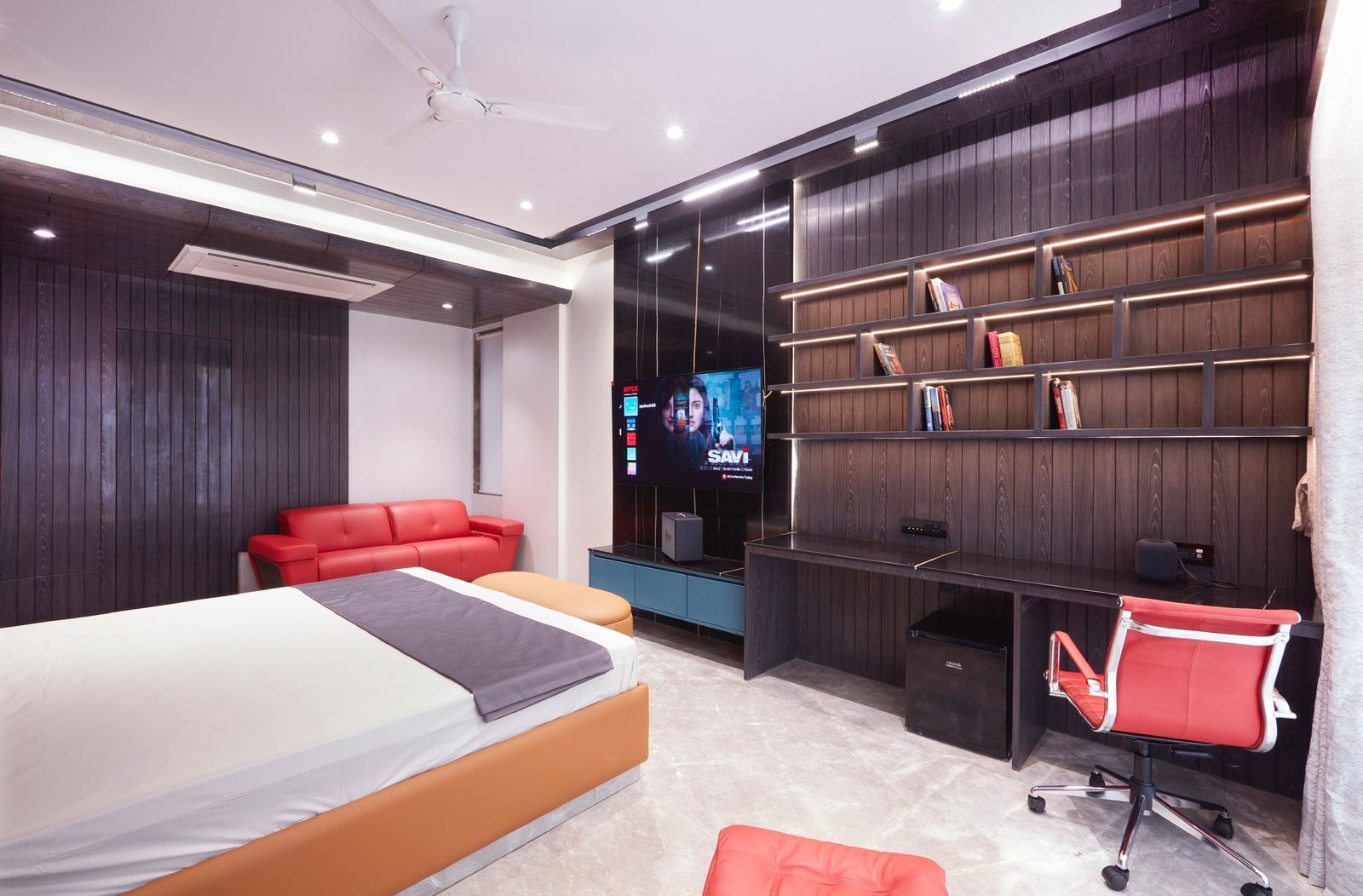

Selected work by Greenbox Design Studio. Tap any image to enlarge.
Frequently asked questions
How much does a false ceiling cost per sq ft in India?+
₹70–₹95 per sq ft for plain gypsum, ₹85–₹130 for POP, ₹100–₹145 for gypsum with a cove and profile lighting, ₹110–₹160 for a grid ceiling and ₹150–₹220 for multi-level designer work, all excluding 18% GST and light fittings.
What does a false ceiling cost for a whole 2BHK?+
About ₹51,000 for plain gypsum across 600 sq ft of covered area, ₹78,000 with a cove and profile lighting, and ₹1,14,000 for multi-level designer work. Light fittings add a further ₹25,000–₹90,000 and are quoted separately.
Is gypsum or POP better for a false ceiling?+
Gypsum for flat and stepped ceilings — it is dry work, dimensionally stable, finishes flat and installs in two to four days. POP for curves and domes, where it gives a seamless surface, but it is wet work, needs about a week to dry, and hairline cracking at wall junctions is common in the first year.
Are lights included in a false ceiling quote?+
No. The quote covers framing, board, jointing, finishing and the cut-outs. The spot lights, COB fittings, LED strip, drivers and aluminium profiles are separate, commonly ₹25,000–₹90,000 for a 2BHK, as is the cabling, switching and dimming.
How much height does a false ceiling take?+
Four to six inches for a plain gypsum ceiling, six to nine inches where a cove or profile channel is involved, and ten to fourteen inches where AC ducting or a beam has to be concealed. In a flat with a 9'6" slab that still leaves comfortable headroom; below 9'0" restrict it to a peripheral drop.
How long does a false ceiling take to install?+
Three to six days for about 600 sq ft in gypsum, plus two days for putty and paint. POP takes eight to twelve days for the same area because of drying time. All other trades wait on the ceiling, so it is usually sequenced immediately after electrical first-fix.