
Convert your area figures
Tell the tool which number you already have. It derives the other two.
How this converter works
- Carpet to built-up: built-up = carpet × wall allowance. The allowance is 1.15 for thin walls with no balcony, 1.20 for a standard flat, 1.25 for thick walls with a large balcony.
- Built-up to super built-up: super built-up = built-up × loading factor, from 1.20 in older buildings to 1.40 in an amenity-heavy luxury tower.
- Working backwards simply inverts each step: built-up = super built-up ÷ loading, carpet = built-up ÷ wall allowance.
- Rate distortion is computed as super built-up ÷ carpet − 1. At 20% walls and 30% loading, that is a 56% understatement of the true per-sq-ft rate.
| Term | What it includes | What it excludes | Who uses it |
|---|---|---|---|
| RERA carpet area | Net usable floor inside the flat, internal partition walls counted as per RERA | External walls, balcony, terrace, service shafts, common areas | Statutory disclosure, interior contractors |
| Built-up area | Carpet area plus external wall thickness plus balcony and terrace | Common areas, lifts, lobbies, amenities | Municipal approvals, some older agreements |
| Super built-up area | Built-up plus a pro-rata share of lobbies, staircases, lifts, clubhouse, gym | Nothing much — it is the largest figure | Marketing brochures, price-per-sq-ft headlines |
| Loading | The percentage by which super built-up exceeds built-up | — | Builders; unregulated, so it varies by project |
Design and build under one accountable roof
Worked example: a 1,000 sq ft Mumbai tower flat
- Super built-up on the brochure = 1,000 sq ft
- Typical Mumbai tower loading of 30% → built-up = 1,000 ÷ 1.30 = 769 sq ft
- Standard 20% wall and balcony allowance → carpet = 769 ÷ 1.20 = 641 sq ft
- Carpet is 64.1% of the advertised area
- A designer quoting ₹2,000 per sq ft on the 1,000 figure is actually charging ₹20,00,000 ÷ 641 = ₹3,120 per sq ft of carpet
- That is a 56% understatement of the real rate — and the single most common way an interior quote is made to look cheap.
Why this matters when you compare interior quotes
Two studios quote your flat. One says ₹1,850 per sq ft, the other ₹2,900. The first is quoting on the super built-up figure from your brochure; the second is quoting on carpet. On the same 1,000 sq ft super built-up flat, the first works out to ₹18.5 lakh and the second to ₹18.6 lakh — the same money, presented two ways. The cheaper-looking number is the one calculated on the bigger area.
There is no dishonesty required for this to happen. It is genuinely ambiguous unless someone says which area basis they used. Our practice is to state the carpet area on the front page of every quotation and price on that, which is also the only basis on which two quotes can be compared at all.
How to find your real carpet area
- Check the agreement for saleSince 2017, RERA requires the carpet area to be stated in the agreement. It is the legally binding figure and it is what you should use.
- Check the MahaRERA project pageRegistered projects publish unit-wise carpet areas. Search the project registration number and download the disclosure.
- Measure it yourselfWall to wall, room by room, in feet, and add up the rooms. Exclude the balcony, the duct and the wall thickness. A 5% variance from the agreement figure is normal; 15% is worth a conversation.
- Ask the interior contractor which basis they usedOne sentence, in writing, on the quotation. If they will not state it, the quote cannot be compared with anyone else's.
What this converter does not do
- It does not tell you your legal carpet area — the agreement for sale does that
- It cannot know your building's actual loading, which varies by project and is not disclosed
- It does not account for exclusive terraces, which are usually charged at a discounted rate
- It does not price interior work — use the interior cost calculator once you have the carpet figure
This calculator uses the same rate bands and site rules our estimators apply, taken from Greenbox project records and cross-checked against 2026 supplier and contractor quotations in Mumbai. It is an indicative estimate, not a quotation — the real figure depends on your drawings, site condition and the brands you finally specify.
Worked comparison: the same flat, three ways
| Basis used | Area | Rate quoted | Total | True carpet rate |
|---|---|---|---|---|
| Super built-up | 1,000 sq ft | ₹1,850 / sq ft | ₹18.50 L | ₹2,886 / sq ft |
| Built-up | 769 sq ft | ₹2,400 / sq ft | ₹18.46 L | ₹2,880 / sq ft |
| RERA carpet | 641 sq ft | ₹2,880 / sq ft | ₹18.46 L | ₹2,880 / sq ft |
All three rows are the same quotation. Only the basis, and therefore the headline rate, changes.
This is why a per-sq-ft rate on its own tells you nothing. The three rows above are identical quotations from the same studio for the same work, and the headline rate varies by 56% purely on which area figure was used as the divisor. Before you compare anything, convert both quotes to carpet area.
Where each figure legitimately belongs
- Carpet area — interior quotations, flooring, painting, false ceiling, and your own furniture planning. It is the only surface anybody actually works on.
- Built-up area — municipal approvals, property tax assessment in some jurisdictions, and older agreements written before RERA.
- Super built-up area — the builder's price list and the maintenance charge, which is usually levied per super built-up square foot. It is a commercial convention, not a measurement of anything you own alone.
- Balcony and terrace — quoted separately, typically at half rate for interior work, because the scope is usually flooring, railing and lighting rather than joinery.
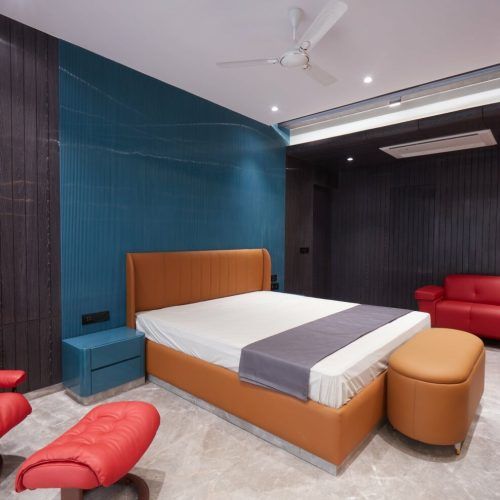



Selected work by Greenbox Design Studio. Tap any image to enlarge.
Frequently asked questions
What is the difference between carpet area and built-up area?+
Carpet area is the net usable floor inside your flat. Built-up area adds the thickness of external walls plus the balcony and terrace, typically 15–25% more. Super built-up adds your share of the building's lobbies, lifts and amenities on top of that — usually another 25–40%.
Is carpet area 70% of built-up area?+
Carpet is usually 80–87% of built-up area, not 70%. The 70% figure people remember is carpet as a share of super built-up, which at 20% walls and 30% loading works out closer to 64%. The two comparisons get mixed up constantly.
What is builder loading and is it legal?+
Loading is the percentage by which a builder inflates built-up area to super built-up to account for common areas. It is legal and unregulated — a builder may load 25% or 40%. What RERA does require is that the carpet area be disclosed separately, which is why the carpet figure is the one to trust.
Which area should interior work be quoted on?+
Carpet area, always. It is the only surface a contractor actually works on. A rate quoted on built-up understates the real carpet rate by around 20%; on super built-up, by around 56%. Ask for the basis in writing before comparing two quotations.
Does carpet area include the balcony?+
No. Under RERA, carpet area excludes the balcony, the verandah, the open terrace and service shafts, though it does include the area under internal partition walls. Balconies are normally charged separately, often at half rate.