
Work out how much paint to buy
Enter the surface areas in square feet. Spreading rates are per coat.
How this calculator works
- Total surface = wall area + ceiling area, both in square feet. Do not subtract small windows and doors — the paint you save is the paint you lose in cutting-in.
- Effective spread = nominal spread × surface factor. Smooth putty ×1.0, painted but chalky ×0.85, fresh plaster ×0.75, rough or textured ×0.65.
- Topcoat litres = total surface × coats ÷ effective spread.
- Primer litres = total surface ÷ 120, a single coat, when primer is selected.
- Pack suggestion fills greedily from 20 L down to 1 L and rounds the last pack up, so the suggestion is always at least the litres required.
| Paint type | Nominal spread per litre per coat | Coats normally needed | Note |
|---|---|---|---|
| Acrylic distemper | 110 sq ft | 2 | Chalky finish, cheapest, not washable |
| Interior emulsion | 140 sq ft | 2 | The standard for walls and ceilings |
| Exterior emulsion | 105 sq ft | 2 | Thicker film, higher pigment loading |
| Enamel on wood or metal | 160 sq ft | 2 | Spreads further but needs full drying between coats |
| Wall primer | 120 sq ft | 1 | Seals and binds; always over fresh putty |
Manufacturer figures are laboratory values on ideal substrates. The surface factor in the calculator brings them back to site reality.
Design and build under one accountable roof
Worked example: a 700 sq ft flat
- Wall area = 1,800 sq ft, ceiling area = 600 sq ft, total 2,400 sq ft
- Interior emulsion on a smooth putty finish: effective spread = 140 × 1.0 = 140 sq ft per litre per coat
- Topcoat = 2,400 × 2 coats ÷ 140 = 34.3 litres
- Buy as 1 × 20 L + 1 × 10 L + 1 × 4 L + 1 × 1 L = 35 litres
- Primer = 2,400 ÷ 120 = 20 litres, bought as 1 × 20 L
- Total to buy = 55 litres of material.
Why site coverage never matches the tin
Manufacturers quote spreading rates measured on a flat, sealed, laboratory panel with a roller at a controlled film thickness. On a real Mumbai wall you have absorbency variation, cutting-in around switch plates and skirting, a roller that loads unevenly at the start of each tray, and a painter who works faster in the afternoon. Fifteen to twenty-five per cent below the stated rate is normal, and that is what the surface factor in this calculator encodes.
The one case where you genuinely beat the tin figure is a second coat over a well-sealed first coat on smooth putty. If you have the budget for only one upgrade, spend it on preparation rather than on a higher paint grade — the same emulsion looks like a different product over properly finished putty.
What this calculator does not cover
- The cost of paint and labour — use the house painting cost calculator for that
- Putty quantity, which is measured in kilograms rather than litres
- Texture, metallic and designer finishes, which are applied by trowel at very different rates
- Wood and metal preparation — sanding sealer, wood primer, red oxide
- Tinting losses when a shade is machine-mixed in small packs
This calculator uses the same rate bands and site rules our estimators apply, taken from Greenbox project records and cross-checked against 2026 supplier and contractor quotations in Mumbai. It is an indicative estimate, not a quotation — the real figure depends on your drawings, site condition and the brands you finally specify.
How much putty, in kilograms
Putty is sold by weight, not volume, which is why it never appears in a paint calculator. The working figure is 1 kg per 12–14 sq ft for two coats on a reasonably flat plastered wall. A 2,400 sq ft surface therefore needs roughly 180–200 kg, bought in 40 kg bags — five bags, allowing for waste at the mixing tray.
Acrylic wall putty and cement-based putty are not interchangeable. Cement-based putty needs water curing and is the right choice over fresh plaster in a damp-prone Mumbai wall; acrylic putty goes over an existing sound paint film and dries faster, but will not tolerate a wall that still carries moisture. Ask which one is being used before the bags arrive, because the sanding dust looks identical and the failure modes are not.
A shopping list for a standard 2BHK repaint
| Item | Quantity for 2,400 sq ft | Pack size | Note |
|---|---|---|---|
| Wall putty, two coats | 180 – 200 kg | 40 kg bag | Five bags; skip where the existing film is sound |
| Wall primer | 20 litres | 20 L | One coat, always over fresh putty |
| Interior emulsion | 34 – 36 litres | 20 L + 10 L + 4 L + 1 L | Two coats; buy the tinted shade in one batch |
| Enamel for doors and grilles | 4 – 6 litres | 4 L + 1 L | Two coats over a sanding sealer or red oxide |
| Sandpaper, 180 and 320 grit | 2 – 3 kg | Loose | The 320 pass is what makes emulsion look flat |
| Masking tape and drop sheets | 1 set | — | Cheaper than repainting a skirting line |
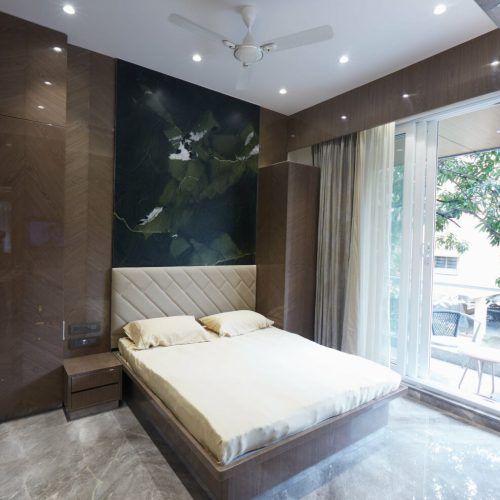
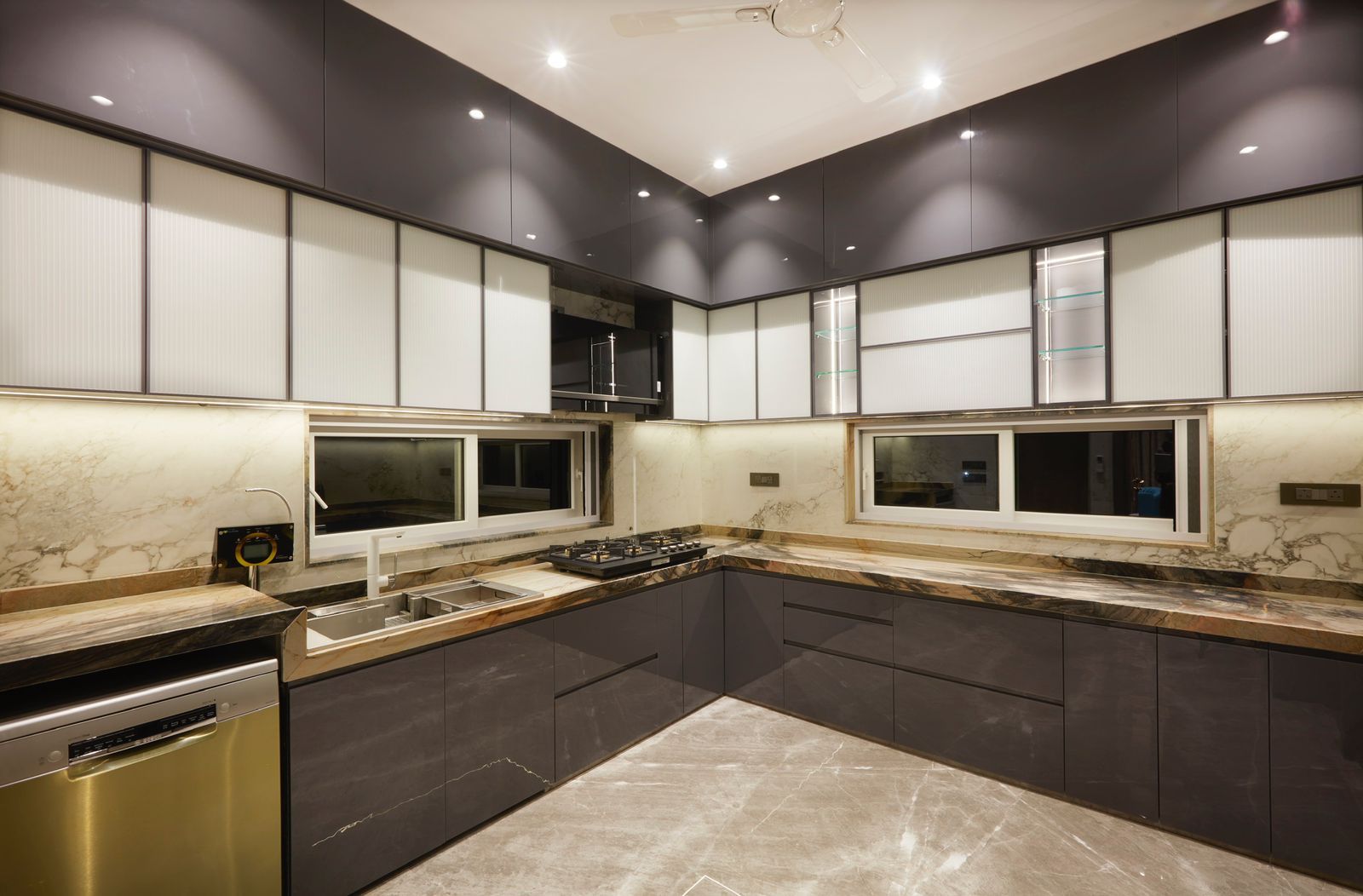
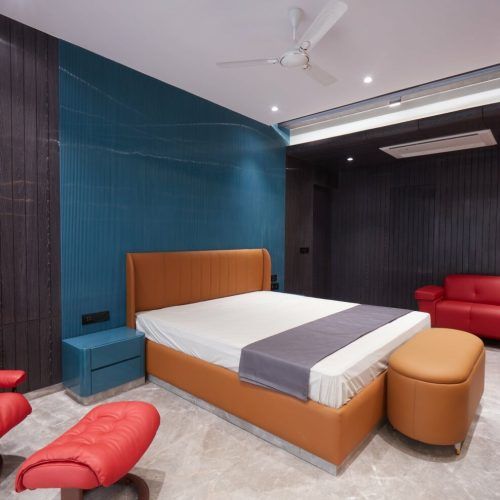
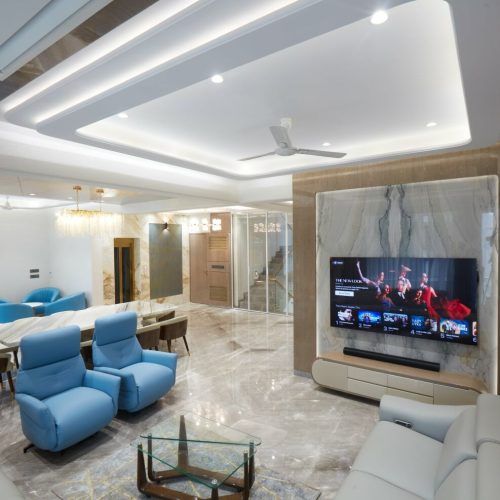
Selected work by Greenbox Design Studio. Tap any image to enlarge.
Frequently asked questions
How many litres of paint do I need for a 2BHK?+
About 34 litres of interior emulsion for two coats over roughly 2,400 sq ft of wall and ceiling, plus 20 litres of primer. A 1BHK needs about 22 litres plus 13 of primer; a 3BHK around 48 litres plus 28. Fresh plaster increases all of these by about a quarter.
How much area does 1 litre of paint cover?+
About 140 sq ft per coat for interior emulsion on a smooth putty surface, 110 for acrylic distemper, 105 for exterior emulsion and 160 for enamel. On fresh plaster expect 25% less; on a rough or textured surface, 35% less.
Do I need primer if the wall is already painted?+
Not always. Over a sound, non-chalky existing paint film in the same colour family you can go straight to topcoat. Over fresh putty, over a chalky old distemper, or when changing from a dark to a light shade, primer saves you an entire coat of finish paint.
Should I subtract windows and doors from the area?+
Only if they add up to a large fraction of the wall — a full-height glazed wall, for instance. For ordinary windows and doors, leave them in. The extra paint is consumed by cutting-in around frames, which uses more material per square foot than rolling.
What pack sizes does paint come in?+
Indian emulsions are sold in 1, 4, 10 and 20 litre packs. The 20 litre pack is meaningfully cheaper per litre, so the calculator fills from the largest size down. Buy the whole quantity of a tinted shade at once — machine-mixed batches vary slightly.