
Varieties, and the Mumbai price reality
| Variety | Character | Slab rate (₹/sq ft) | Where it works |
|---|---|---|---|
| Carrara | Grey-white with soft grey veining | ₹350 – 700 | Bathrooms, dado, secondary floors |
| Statuario | Bright white with bold grey veins | ₹900 – 2,400 | Living room floors, feature walls |
| Calacatta | Warm white with thick dramatic veining | ₹1,400 – 3,500 | Feature slabs, island cladding |
| Botticino | Warm beige, fine even grain | ₹320 – 620 | Large floor areas; the practical choice |
| Crema Marfil | Cream, very consistent | ₹380 – 750 | Living and dining floors |
| Travertine | Porous, banded, honed | ₹280 – 600 | Walls and dry areas; needs fill |
| Grey / Bardiglio | Mid to dark grey with white veining | ₹450 – 1,100 | Contemporary schemes, bathroom walls |
Add ₹120–220 per sq ft for laying, grinding, polishing and edge work. Book-matched feature walls carry a further premium for slab selection and wastage.
Etching, staining and the reality of living with it
Marble is calcium carbonate. Acid dissolves it. This is chemistry, not quality, and no sealer prevents it entirely — sealers reduce staining, not etching.
- A drop of lemon juice on a polished Statuario floor leaves a matt spot within minutes. It can be re-polished locally, but the repair area will read slightly different in raking light.
- Oil stains penetrate and darken. A poultice can draw most of it out; on a light stone a shadow often remains.
- Honed marble hides etching far better than polished, because there is less gloss to lose. For a dining room floor in a family home, honed is the sensible specification even though polished is what clients ask for.
- The corridor outside a kitchen is the highest-risk area in any Indian home. We frequently specify marble in the living and formal areas and a hard-wearing tile in the circulation spine.

Design and build under one accountable roof
Laying: where most Mumbai marble jobs go wrong
- Bedding. Marble is laid on a cement-sand bed, usually 25–40 mm. The bed must be uniform — hollow spots are the source of most cracked slabs and they sound different when tapped. A hollow-sounding slab at handover should be lifted and re-laid.
- Moisture from below. A wet bed dries through the stone over weeks. On light marble that migrating moisture carries salts and leaves a permanent patch. Neat cement slurry as a bonding coat, and a full three weeks before grinding, prevent it.
- Grinding and polishing. Three to five passes with progressively finer abrasives, then a crystallisation or diamond polish. Rushing this stage is the single most common failure, and in Mumbai it is usually driven by the client wanting to move in.
- Protection. Once polished, the floor must be covered until the last trade leaves. Scaffold feet and dropped hardware leave marks that only a re-grind removes.
Mumbai humidity, the monsoon and the sea
- Marble laid during the monsoon takes far longer to dry through the bed. We either avoid laying between late June and mid-September or extend the curing window and accept the programme hit.
- In sea-facing flats, salt deposits combine with humidity and slowly dull a polished surface. Dry mopping and an annual diamond polish keep it right.
- Bathrooms: marble on a wet-area floor needs the substrate waterproofed properly first. Water reaching the bedding from a failed waterproofing layer shows as a dark patch on the stone above, and there is no cure short of lifting.
- Never use a wet mop with detergent daily. Damp mop with plain water; use a marble-safe pH-neutral cleaner occasionally.
Care, life and BOQ wording
- Annual: a light diamond polish on high-traffic areas, roughly ₹35–70 per sq ft in Mumbai. Every five to eight years, a full re-grind and polish at ₹80–150 per sq ft restores it completely — which is the great advantage of solid stone.
- Expected life: indefinite. Marble floors in Mumbai buildings from the 1960s are still serviceable after a re-grind.
- BOQ: “Flooring in 18 mm imported marble, variety [name], slabs selected and numbered by client at yard; laid on 30 mm cement-sand bed with neat cement slurry bonding; minimum 21 days curing before grinding.”
- BOQ: “Finishing: machine grinding in not fewer than four passes followed by diamond polishing; joints under 1 mm, filled with matching resin; no epoxy grout lines.”
- BOQ: “Floor to be fully protected until completion of all other trades. Hollow-sounding slabs to be lifted and re-laid at contractor’s cost.”
Specification summary
| Property | Specification |
|---|---|
| Thickness | 18 – 20 mm, fibre-mesh backed |
| Bedding | 30 mm cement-sand with slurry bonding coat |
| Curing before polish | 21 days minimum |
| Finish | Honed for family homes, polished for formal areas |
| Joint width | Under 1 mm, resin filled |
| Rate | ₹350 – 3,500 slab + ₹120 – 220 laying, per sq ft |
| Maintenance | Annual buff; full re-grind every 5–8 years |
| Not for | Kitchen counters, unprotected wet areas, households that will not use coasters |

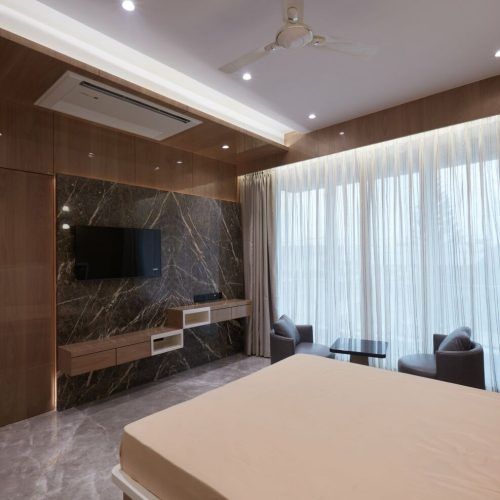
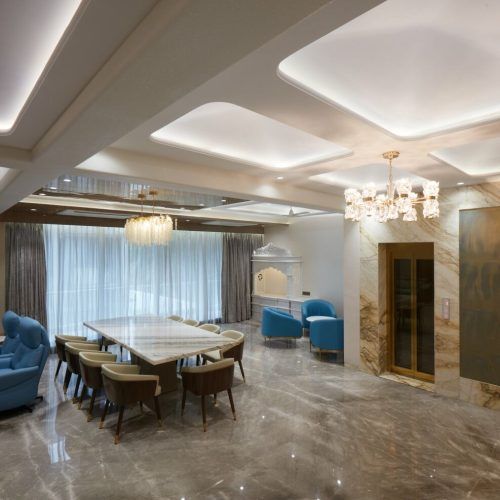

Selected work by Greenbox Design Studio. Tap any image to enlarge.
Frequently asked questions
Is Italian marble suitable for a kitchen counter?+
No. Lemon, curd, vinegar and turmeric are daily kitchen materials and all of them attack marble. We have replaced marble counters within three years of installation more than once. Use quartz or granite on the counter and put the marble on the floor or a feature wall.
Why is my new marble floor showing patches?+
Usually moisture still migrating through the bedding mortar, carrying salts to the surface. It appears in the first weeks and often fades over two to three months as the bed dries. It is prevented by adequate curing before polishing, which is exactly the step that gets compressed when a family wants to move in.
What is the difference between Italian and Indian marble?+
Origin, consistency and price. Imported marble is generally whiter, more dramatically veined and three to eight times the cost. Indian marble is harder in several varieties and far better value for large areas. The full comparison, with rates, is on our Italian versus Indian marble page.
Does Italian marble need sealing?+
Yes, with a penetrating impregnating sealer, re-applied every year or two. Understand what it does: it slows staining by reducing absorption. It does not stop acid etching, because etching is a chemical reaction with the stone itself.
How long does an Italian marble floor take to install?+
Laying is quick — a few days for a flat. The programme is dominated by curing and polishing: three weeks of curing, then two to four days of grinding and polishing per 600–800 sq ft. Any contractor offering the whole thing in ten days is skipping the curing.