
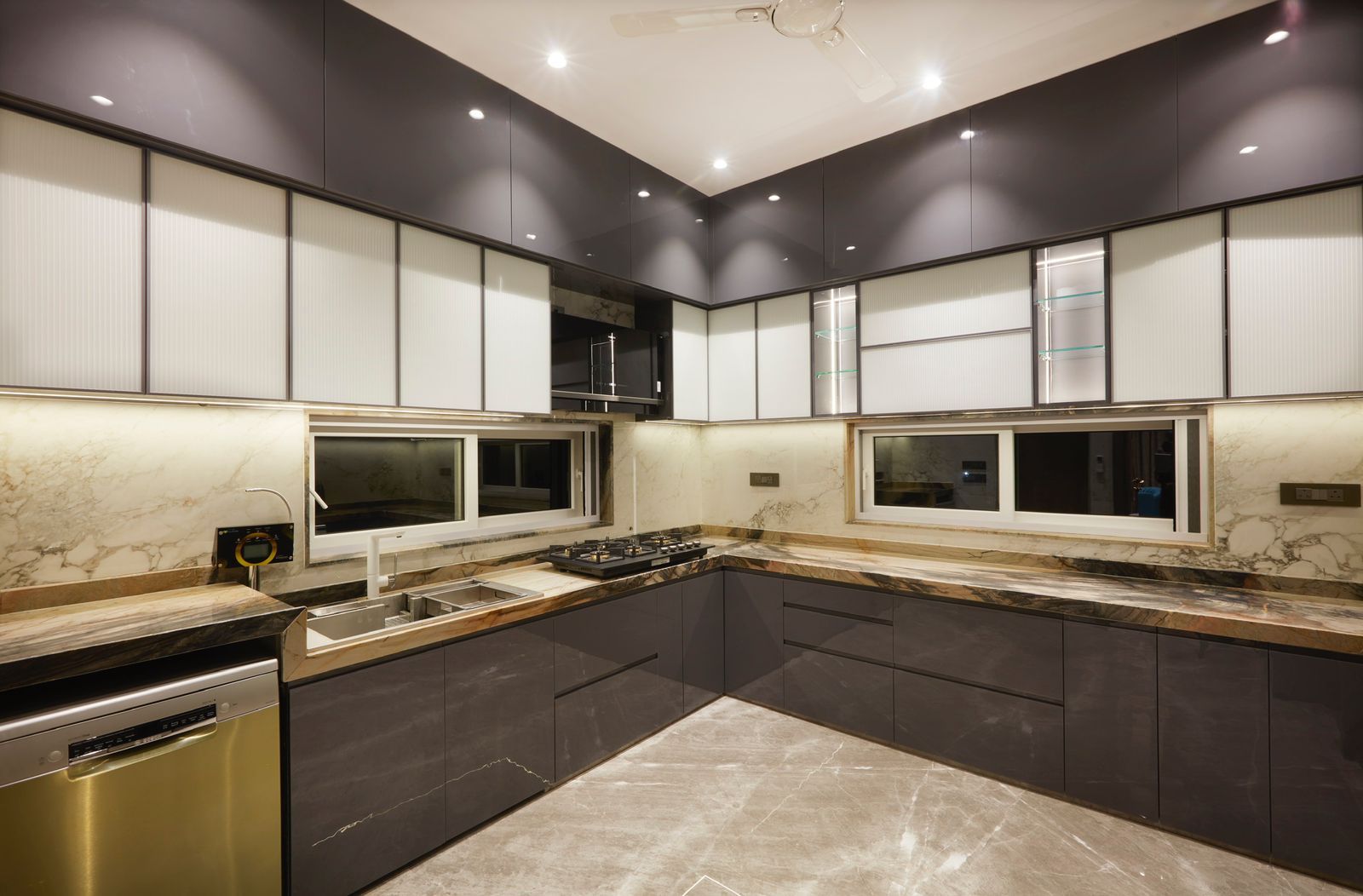
Varieties available in the Mumbai market and what they cost
| Variety | Character | Rate (₹/sq ft) | Best use |
|---|---|---|---|
| Black Galaxy | Deep black with fine gold flecks; dense and consistent | ₹220 – 400 | Kitchen counters; hides stains well |
| Absolute Black | Uniform matt black, no figure | ₹180 – 320 | Counters and vanity tops in dark schemes |
| Steel Grey | Mid grey with fine black speckle | ₹120 – 210 | Value counters; very forgiving in use |
| Kashmir White | Cream base with burgundy garnet spots | ₹160 – 280 | Light kitchens; more porous than black stone |
| Tan Brown | Brown-red with black; very dense | ₹150 – 260 | Counters, staircase treads |
| Imperial Red | Strong red-pink figure | ₹190 – 340 | Feature surfaces, pooja units, thresholds |
| Imported exotics | Wide range of figure and colour | ₹450 – 1,400 | Islands and feature slabs only |
Fabrication adds ₹150–350 per running foot. Rates vary by slab selection; pick your slab rather than a name on a list.
Porosity: the part vendors skip
All granite absorbs some liquid; how much depends on the variety. Dark, dense stone such as Absolute Black absorbs very little. Light, granular stone such as Kashmir White absorbs noticeably more, and in an Indian kitchen it is turmeric, oil and beetroot that find it.
- Test before you buy: leave a few drops of water on a polished sample for ten minutes and wipe. If the stone darkens where the water sat, that variety needs diligent sealing.
- Specify a penetrating impregnating sealer, applied after installation and again before handover. Topical sealers that sit on the surface wear off in months and look patchy.
- Re-seal every 18–30 months in a working kitchen. The test is the same water drop — when it darkens the stone, it is time.
- The underside and the cut edges absorb faster than the polished face. Seal all faces, not just the top.
Design and build under one accountable roof
Heat, chips and the honest weaknesses
- Heat: no practical limit in a domestic kitchen. This is the reason many Indian households still prefer granite and it is a legitimate reason.
- Chipping: an edge takes a chip from a dropped steel vessel. It can be filled with a colour-matched epoxy but the repair is visible at close range.
- Acid etching: granite is far more acid-resistant than marble, but lemon left on a light-coloured polished stone for hours will still dull the finish slightly.
- Radon and stain scares: ignore them; they are marketing from competing materials. The real issues are porosity and consistency, both manageable.
- Consistency: the genuine drawback. Natural stone varies and a second slab from a different block will not match. Buy the whole kitchen from one block.
Granite in Mumbai and on the coast
Granite is the least climate-sensitive surface on this site. Humidity does nothing to it and salt air does nothing to it. Two Mumbai-specific notes are still worth making.
- Weight and access. A 20 mm granite slab at 3,000 × 1,800 mm weighs roughly 270 kg. In an older Bandra or Dadar building with a 400 kg lift and a narrow landing, the slab may need to be cut into two pieces before hoisting, which adds a seam. Decide where that seam goes before delivery day, not on the landing.
- Balcony and open terrace use. Granite handles Mumbai rain and sun indefinitely. A leathered or flamed finish is safer underfoot than polished once it is wet.
- Sealing intervals shorten slightly in humid coastal flats because the stone stays marginally damp; take the top of the 18–30 month range as your default in Juhu or Worli.
Care, life and BOQ wording
- Daily: pH-neutral cleaner or plain soapy water. Avoid vinegar, lemon-based cleaners and acidic bathroom cleaners on light stone.
- Expected life: 30 years and beyond. Granite usually outlives the kitchen it was installed in.
- BOQ: “Counter in 20 mm granite, variety [name], slabs selected and marked by client at supplier yard, single block for the whole kitchen; polished finish; pencil-round front edge; radiused internal corners at all cut-outs.”
- BOQ: “All six faces to receive penetrating impregnating sealer before handover; second application after installation and before client occupation.”
- BOQ: “Slab hoisting, lift protection and society permissions included in rate. Cutting on site not permitted inside the flat.”
Specification summary
| Property | Specification |
|---|---|
| Thickness | 20 mm counters, 16–18 mm cladding and flooring |
| Finish | Polished for counters, leathered or flamed for wet floors |
| Sealing | Penetrating sealer, all faces, re-applied every 18–30 months |
| Heat | No practical limit in domestic use |
| Rate | ₹120 – 450 per sq ft, common Indian varieties |
| Slab selection | Client-marked at yard; one block per kitchen |
| Life | 30 years plus |
| Weakness | Porosity on light stone, edge chipping, slab-to-slab variation |
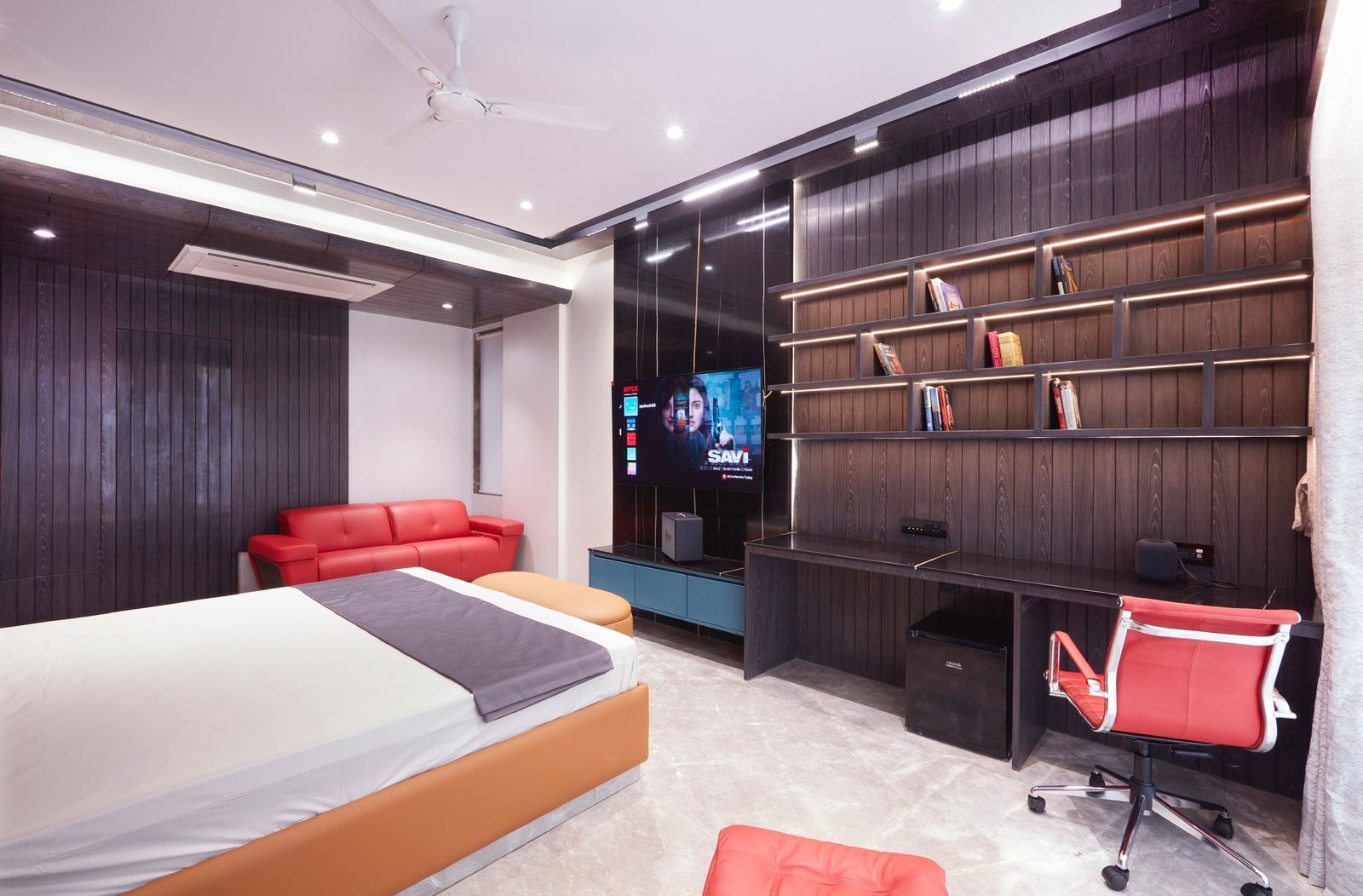
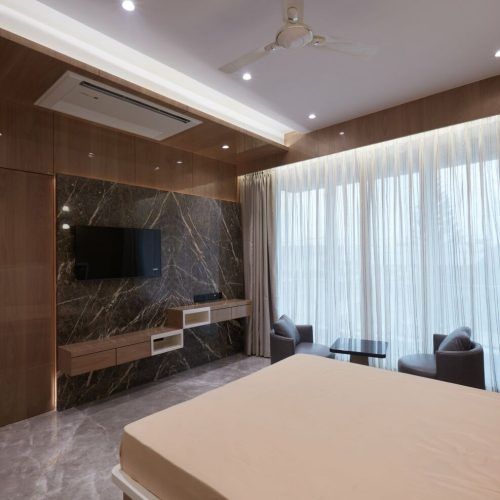
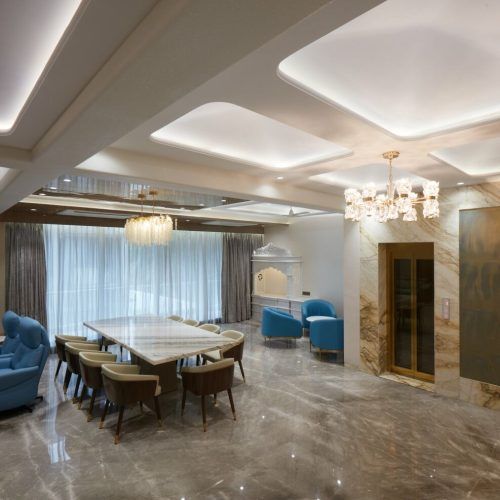
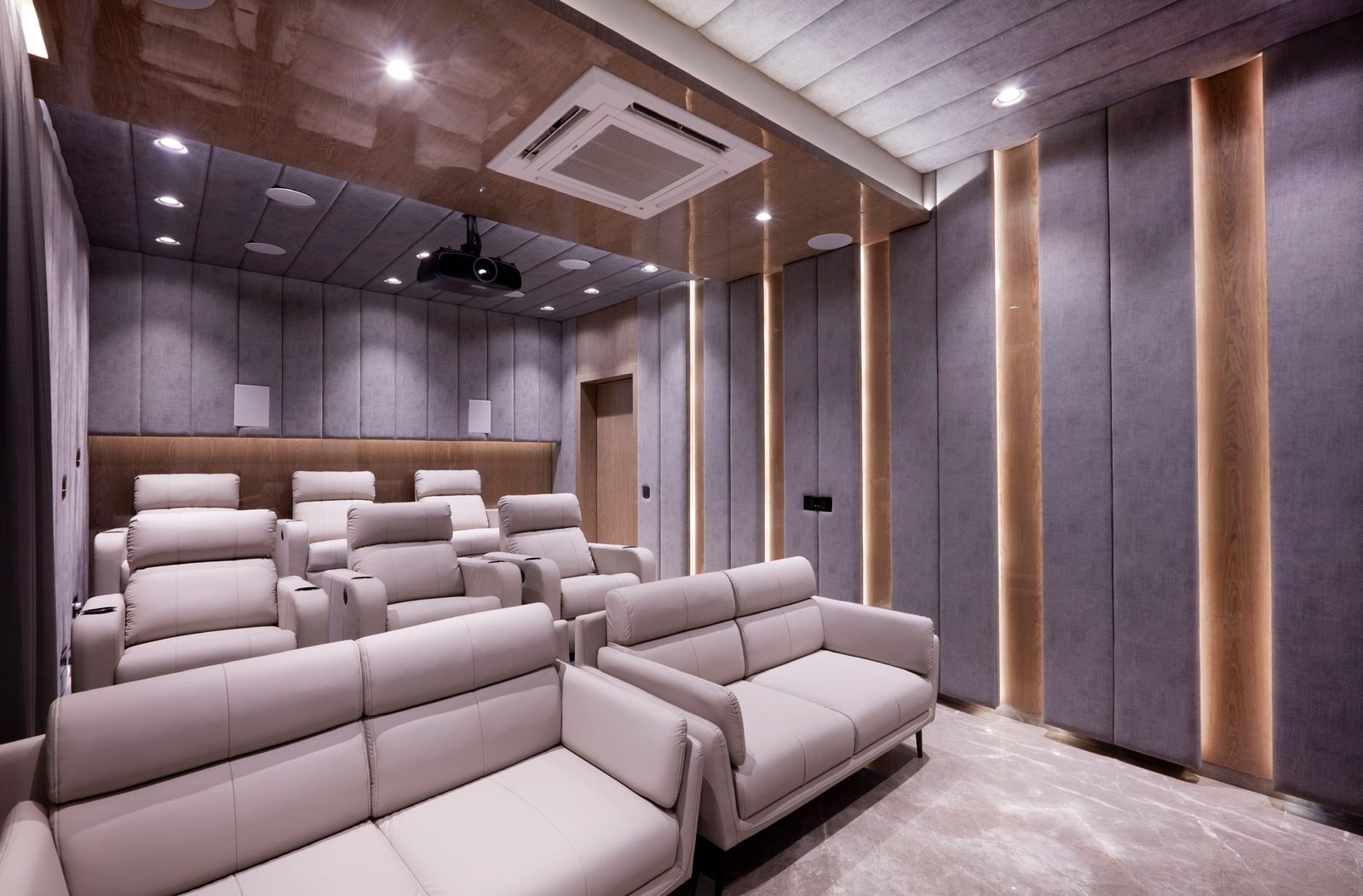
Selected work by Greenbox Design Studio. Tap any image to enlarge.
Frequently asked questions
Does granite stain?+
Light, granular varieties do if unsealed — turmeric, oil and beetroot are the usual culprits in an Indian kitchen. Dark dense granite such as Absolute Black rarely shows anything. A penetrating sealer re-applied every 18–30 months makes staining a non-issue on any variety.
What thickness of granite should a kitchen counter be?+
20 mm. Sixteen millimetre slab is intended for cladding and flooring and is sometimes offered for counters because it is cheaper; it is more prone to cracking at cut-outs and needs continuous support. If a quotation does not state the thickness, ask.
Is Indian granite as good as imported?+
For kitchen use, generally better value. Indian black granites are among the densest commercial stone available anywhere. Imported exotics are bought for figure and colour, not for performance, and they cost three to four times as much.
Can granite be joined without a visible seam?+
Not invisibly, but well. A colour-matched epoxy seam on dark stone at a sensible location is barely noticeable. On light, heavily figured stone the seam always shows to some degree. Place it where cabinetry or a hob interrupts the eye.
How is granite priced — by slab or by finished area?+
Slab rate per square foot plus fabrication per running foot, and Mumbai suppliers usually charge for the full slab consumed rather than the finished piece. Ask whether wastage is in the rate; on an L-shaped kitchen the difference can be 15–20%.