
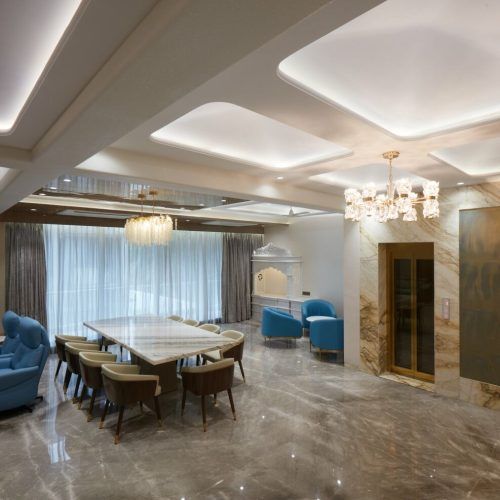
Where porcelain does something other materials cannot
| Application | Specification | Rate (₹/sq ft) | Why porcelain |
|---|---|---|---|
| Kitchen countertop | 12 mm slab, mitred 40 mm edge | ₹320 – 650 installed | Heat proof, non-porous, no sealing, lighter than stone |
| Feature wall over existing tile | 6 mm slab on adhesive | ₹220 – 420 installed | No demolition, no debris, no society complaints |
| Bathroom wall, floor to ceiling | 9 mm slab, 1,200 × 2,400 | ₹260 – 480 installed | Two joints instead of forty; nothing for mould to live in |
| Balcony and facade cladding | 9–12 mm, frost and UV stable | ₹240 – 520 installed | Colour does not fade; salt air has no effect |
| Furniture and table tops | 6 mm slab bonded to ply | ₹280 – 550 installed | Stone look at a weight a carcass can carry |
| Standard floor tile | 9 mm, 600 × 1,200 | ₹90 – 220 material | Same as vitrified; buy on type and PEI |
Reading the technical sheet
- Water absorption: under 0.5% by mass. This is the defining number and it should be on the box.
- Breaking strength: relevant for thin slabs. A 6 mm slab has lower breaking strength than a 9 mm tile and must be fully bedded, never dot-fixed.
- Rectified: the edges are ground square after firing, allowing 1.5–2 mm joints. Almost all slab product is rectified.
- Surface finish: polished, matt, structured or lappato. Polished porcelain on a bathroom floor is a fall waiting to happen.
- Thickness: 6 mm for wall overlay, 9 mm for floors and walls, 12 mm for counters and anything self-supporting at an edge.
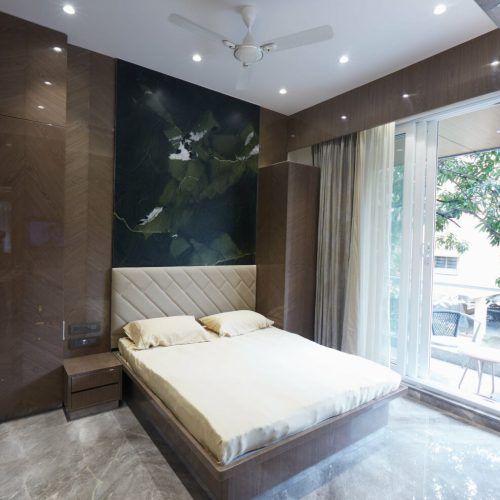
Design and build under one accountable roof
Fixing large-format slab: the part that costs money
- The substrate must be flat within 3 mm over 2 m. On a wall in a 1990s Mumbai building it rarely is, so allow for a levelling render before the tiling rate applies.
- Adhesive must be a C2TE-class cement adhesive applied with a notched trowel and back-buttered, giving full coverage. Any void behind a slab becomes a crack when something is dropped on it.
- Slabs need suction lifters and at least two fitters. Labour for slab work runs ₹90–180 per sq ft against ₹35–70 for ordinary tiling.
- Cutting, drilling and mitring are done with a bridge saw and water. An internal mitred corner on a counter is a specialist operation and should be priced per running foot.
- Movement joints every 4–5 m on large floor areas, and at every change of plane. Skipping them is why long tiled corridors tent in hot weather.
Mumbai considerations
- Access is the first question. A 1,200 × 2,400 slab does not fit in most Mumbai passenger lifts and often cannot turn the landing. Many buildings require slabs to be carried up the stair by four men, and some societies will not permit it at all. Check before specifying.
- For occupied renovations, 6 mm overlay slab on an existing bathroom wall removes the demolition phase entirely — no chiselling, no debris bags on the service lift, no three days of noise complaints. That alone justifies the material in some societies.
- Salt and UV have no effect, which makes porcelain the most sensible balcony cladding available in a sea-facing flat.
- For counters, porcelain accepts a hot vessel where quartz does not, and needs no sealing where granite does. Its weakness is edge impact — a dropped pressure cooker on a mitred corner will chip it.
Care, life and BOQ wording
- Neutral cleaner and water. Nothing else is required; the surface is effectively impervious.
- Expected life: 25 years plus on floors, indefinite on walls. Chipped edges are the only realistic failure.
- BOQ: “Porcelain slab, 1,200 × 2,400 mm, thickness as scheduled, water absorption under 0.5%, rectified; fixed with C2TE adhesive, back-buttered to 100% coverage, joints 2 mm, epoxy grouted.”
- BOQ: “Contractor to confirm site access for slab dimensions and to include all hoisting, stair carriage and society permissions in the rate.”
- BOQ: “Movement joints at 4 m centres and at all changes of plane, sealed with neutral-cure silicone.”
Specification summary
| Property | Specification |
|---|---|
| Water absorption | Under 0.5% |
| Slab size | 1,200 × 2,400 mm typical |
| Thickness | 6 mm overlay, 9 mm floor and wall, 12 mm counters |
| Edges | Rectified; 2 mm joints |
| Adhesive | C2TE class, 100% coverage, back-buttered |
| Rate | ₹140 – 450 material; ₹90 – 180 laying, per sq ft |
| Strengths | Heat, UV, salt, stain and scratch resistance; no sealing |
| Weakness | Edge impact; site access for slab handling |
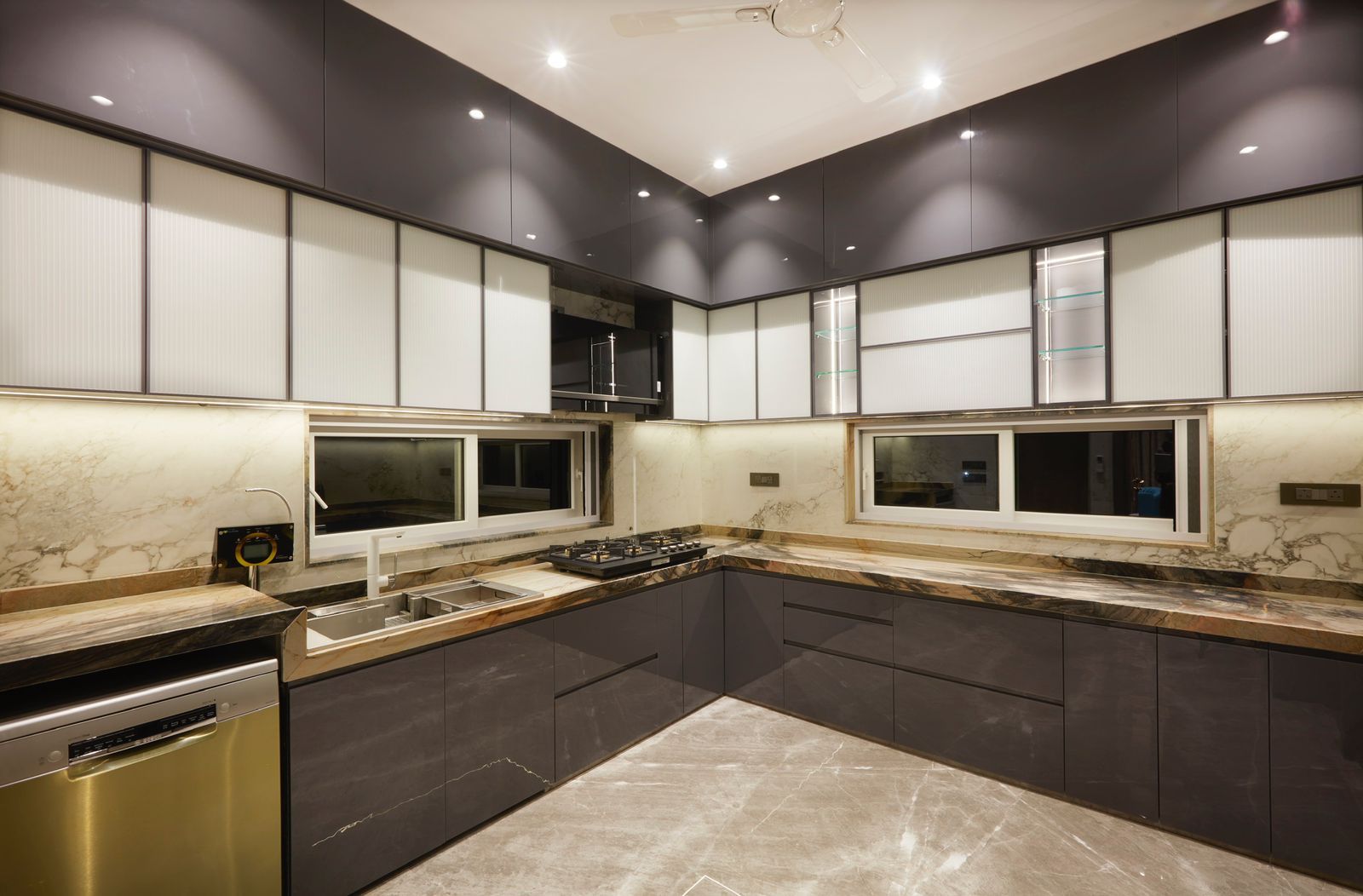
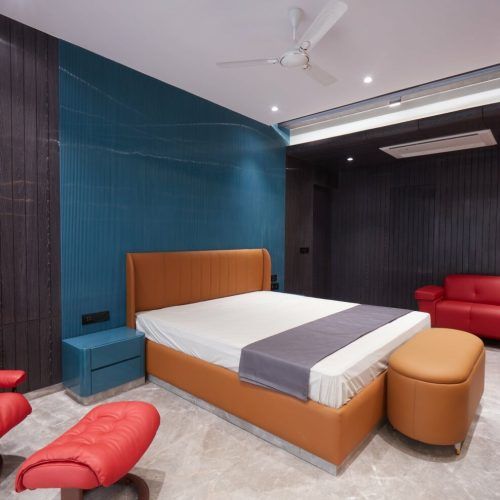
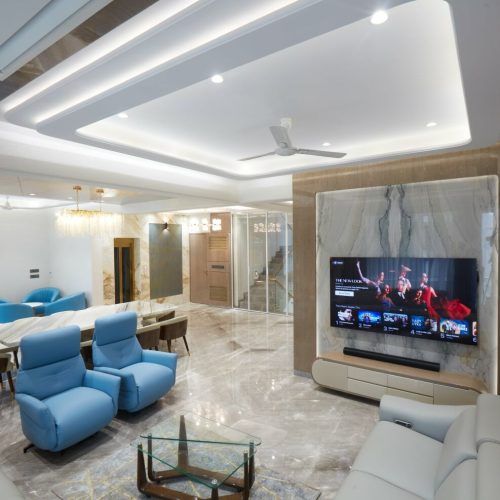
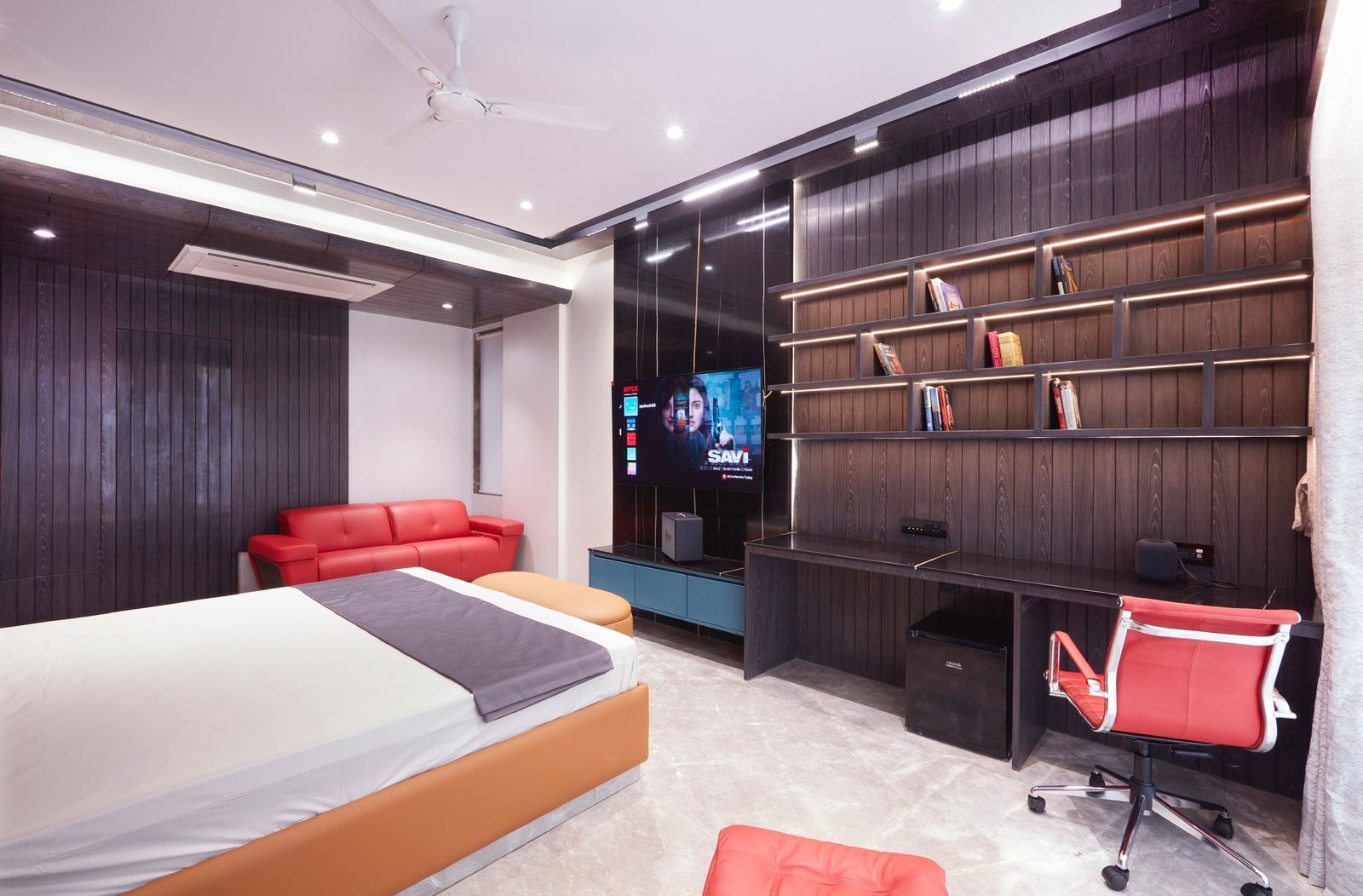
Selected work by Greenbox Design Studio. Tap any image to enlarge.
Frequently asked questions
Is porcelain the same as vitrified tile?+
Broadly, yes — most Indian vitrified tile is porcelain by body classification. The words diverge in practice: vitrified usually means standard-format floor tile, while porcelain in the trade increasingly means large-format slab for counters, walls and facades. Buy on absorption, thickness and rectification rather than on the label.
Can a porcelain slab be used as a kitchen counter?+
Yes, in 12 mm with a mitred edge. It takes a hot pan, needs no sealing and does not stain. The trade-off against quartz is edge chipping and a higher fabrication cost, because slabs must be cut and mitred with a bridge saw.
Will a 6 mm slab crack if I tile over an existing wall?+
Not if it is fully bedded. Thin slab has lower breaking strength, so the adhesive bed must be continuous with no voids — back-buttered and notched. Dot-fixing a 6 mm slab guarantees a crack the first time something knocks it.
Why is laying porcelain slab so much more expensive?+
Two fitters, suction lifters, a bridge saw, water cutting, levelling systems and a substrate that has to be prepared flat. Labour of ₹90–180 per sq ft against ₹35–70 for ordinary tile is a genuine cost difference, not a mark-up.
Is porcelain good for a Mumbai balcony?+
It is the best option available. UV does not fade it, salt does not attack it, monsoon water does not penetrate it, and a structured surface gives usable slip resistance when wet. Lay it to falls with a proper waterproofing layer underneath.