
Construction and what to specify
| Parameter | Options | Greenbox default | Why |
|---|---|---|---|
| Wear layer | 0.6 / 2 / 3 / 4 mm | 3 mm | Allows two sandings over the floor’s life |
| Core | HDF / 3-ply / multi-ply birch | Multi-ply | Far better dimensional stability in humidity |
| Overall thickness | 10 – 21 mm | 14 – 15 mm | Stiff enough to glue down; standard door clearances |
| Species | Oak, walnut, teak, maple | European oak | Availability, price stability, refinishing familiarity |
| Surface finish | UV lacquer / hardwax oil | UV lacquer for families, oil for character | Lacquer resists water; oil is repairable in patches |
| Plank width | 125 – 260 mm | 180 – 220 mm | Wider planks cup more in humidity swings |
| Installation | Floating / glue-down | Glue-down in coastal flats | Quieter, more stable, no hollow sound |
2026 Indian rates
| Build | Rate (₹/sq ft, supplied & fixed) | Comment |
|---|---|---|
| Oak, 12 mm, 2 mm wear layer, floating | ₹350 – 480 | Entry level; one refinish in its life |
| Oak, 14 mm, 3 mm wear layer, floating | ₹450 – 620 | The sensible residential specification |
| Oak, 15 mm, 3 mm wear layer, glue-down | ₹560 – 750 | Add ₹60–110 per sq ft for adhesive and labour |
| Walnut or teak, 15 mm, 3 mm wear layer | ₹700 – 900 | Species premium |
| Herringbone or chevron layup | +₹120 – 250 per sq ft | Slower laying, higher wastage |
| Sanding and re-finishing existing floor | ₹120 – 220 per sq ft | Once or twice in the floor’s life |
A 350 sq ft master bedroom suite in 14 mm oak, glue-down, typically runs ₹2.0–2.6 lakh installed.

Design and build under one accountable roof
Humidity: the whole argument
Wood gains and loses moisture with the air around it, and it moves across the grain when it does. Mumbai swings from around 45% relative humidity in a February afternoon to over 85% through the monsoon. A wide plank will expand measurably across that range.
- Acclimatise properly. Boxes open, in the room, for 72 hours minimum, with the air conditioning running as it will in service. A floor laid straight off a truck will move after installation.
- Expansion gap of 10–12 mm at every perimeter on a floating floor, more on runs over 8 m. Glue-down needs less, but still needs a perimeter gap.
- Narrower planks move less. A 180 mm plank is a safer choice than a 260 mm one in this city, whatever the showroom prefers.
- Air conditioning is not optional for timber in a sea-facing flat. A bedroom that is sealed and cooled for part of the day holds a stable enough range; a permanently open, sea-facing room does not, and there we recommend SPC.
- Never in a bathroom, kitchen or balcony. Splash is survivable; standing water is not.
Living with it in Mumbai
- Sunlight changes the colour. Oak ambers, walnut lightens. Leave a rug in one place for two years and you will see its outline when it moves. Rotate rugs, or accept the patina.
- Grit is the enemy of any lacquered floor. A doormat at the entrance and no outdoor footwear inside is worth more than any finish upgrade.
- Hardwax oil finishes can be spot-repaired: clean, abrade lightly, re-oil the area, and it blends. UV lacquer cannot be spot-repaired and needs a full-room sand when it wears through.
- Castor chairs destroy timber floors. A chair mat or soft castors are cheaper than a re-sand.
- In the monsoon, wipe entrance areas dry rather than mopping. Water tracked in at a doorway is the most common source of edge damage.
Care, life and BOQ wording
- Weekly: vacuum with a hard-floor head, then a barely damp microfibre. Use a timber-specific cleaner, not a general floor cleaner.
- Expected life: 25–30 years with a 3 mm wear layer and two re-sands, which is longer than laminate or SPC by a wide margin.
- BOQ: “Flooring in 14 mm engineered oak, 3 mm sawn wear layer, multi-ply birch core, UV lacquered, plank width 180–200 mm; acclimatised in situ for minimum 72 hours before installation.”
- BOQ: “Fixing: full-bed flexible polymer adhesive over levelled screed, flatness within 3 mm under a 2 m straight edge; 10 mm perimeter expansion gap.”
- BOQ: “Exclusions: kitchen, bathrooms, utility and balconies. Threshold profiles at all junctions with tiled areas.”
Specification summary
| Property | Specification |
|---|---|
| Wear layer | 3 mm sawn hardwood |
| Core | Multi-ply birch |
| Thickness | 14 – 15 mm |
| Plank width | 180 – 220 mm |
| Fixing | Glue-down preferred in coastal flats |
| Acclimatisation | 72 hours minimum, in room, boxes open |
| Rate | ₹350 – 900 per sq ft supplied and fixed |
| Life | 25 – 30 years with two re-sands |
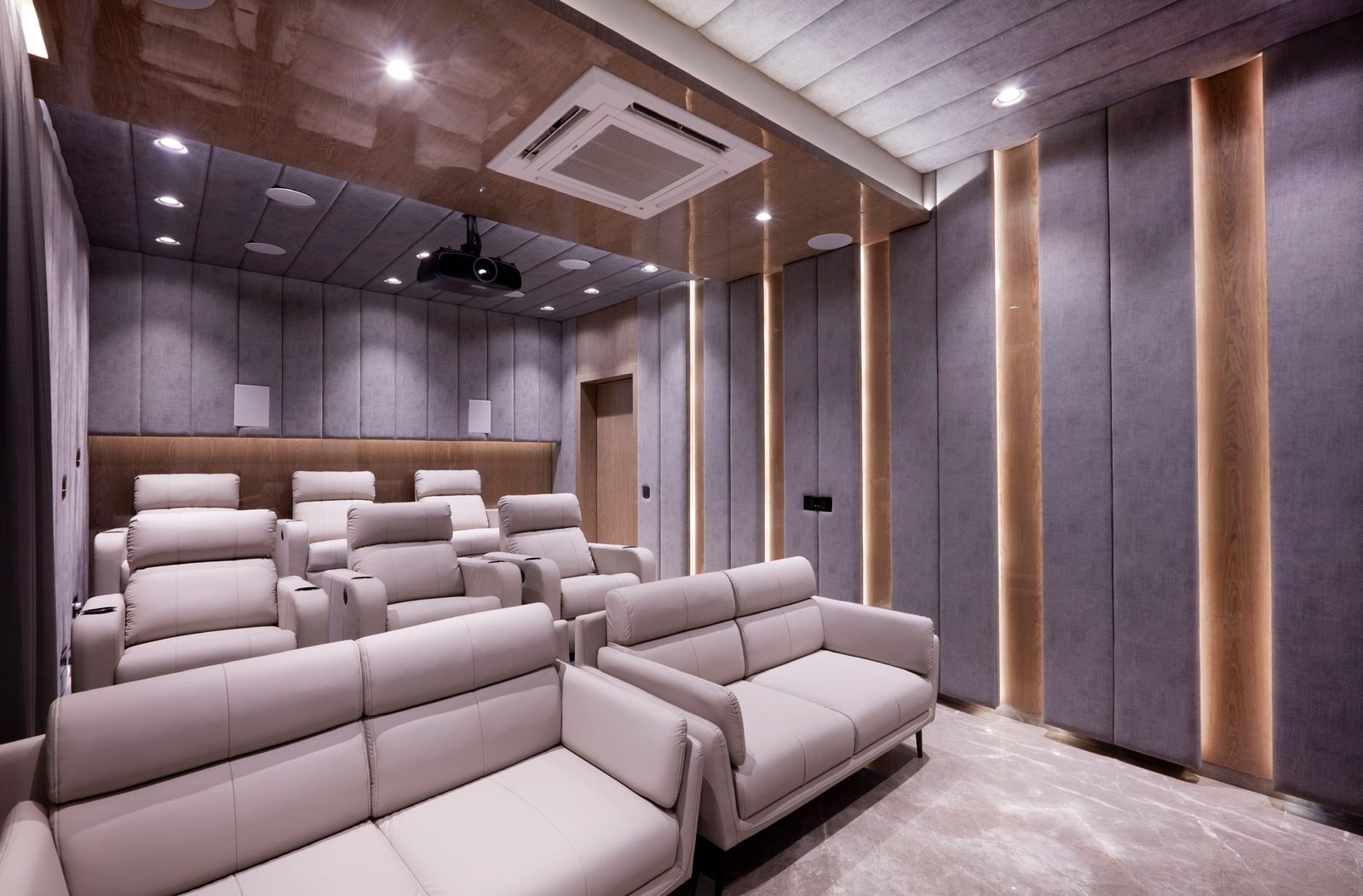
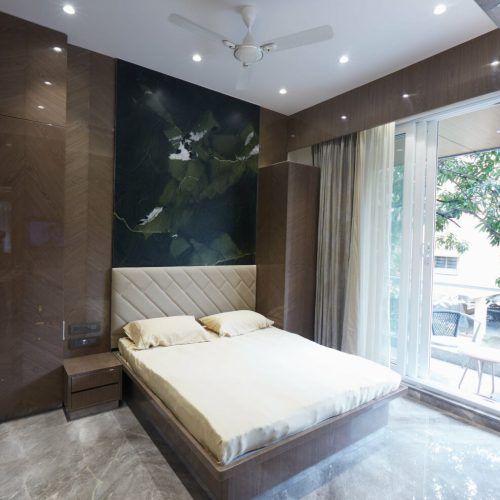


Selected work by Greenbox Design Studio. Tap any image to enlarge.
Frequently asked questions
Can engineered wood be used throughout a Mumbai flat?+
In bedrooms, living and dining areas, yes, if the flat is air-conditioned for part of the day and not permanently open to sea air. Never in kitchens, bathrooms, utility areas or balconies. A common and sensible scheme is timber in the private rooms and vitrified tile in the wet and circulation areas.
How many times can an engineered floor be sanded?+
Roughly once per millimetre of wear layer above the first millimetre — so a 3 mm layer gives two full sands, a 2 mm layer one. A 0.6 mm veneer product cannot be sanded at all and should be priced as a laminate alternative, not as timber.
Is solid wood better than engineered?+
Not in Mumbai. Solid timber moves far more with humidity and is more likely to cup, gap or crown. Engineered construction cross-laminates the core so movement is a fraction of solid. For this climate, engineered is the technically better product as well as the cheaper one.
Glue-down or floating — which should I choose?+
Glue-down if the budget allows, especially in a humid or coastal flat. It is quieter underfoot, more dimensionally stable, has no hollow sound and handles wider planks better. It costs ₹60–110 per square foot more and cannot be lifted and reused.
What does refinishing cost?+
In Mumbai, ₹120–220 per sq ft for sanding, filling, staining if required and three coats of lacquer, taking three to four days per room with the room out of use. It renews the floor completely, and it is the reason engineered timber outlives every printed-surface floor.