
Categories relevant to fit-out work
| Category | Governing specification | Where we use it | Band we observe (₹/sq ft) |
|---|---|---|---|
| Ceramic wall tile | Design and size | Bathroom and pantry walls | ₹35 – 85 |
| Vitrified floor tile | Absorption, PEI class | Offices, homes | ₹50 – 160 |
| Full body vitrified | PEI V, through colour | Corridors, reception, retail | ₹120 – 220 |
| Heavy duty / industrial | Breaking strength, chemical resistance | Kitchens in F&B, service areas, warehouses | ₹140 – 320 |
| Anti-static and special | Surface resistivity | Server rooms, labs | ₹280 – 650 |
| Engineered quartz surfaces | Slab size, thickness | Counters, vanities, pantry tops | ₹380 – 900 |
| Sanitaryware | — | Washrooms | Per piece |
Market observations from buying in Mumbai, not official pricing. Project quantities in a commercial fit-out attract materially better rates than retail.
Specifying for a commercial floor
A retail or office floor is judged by different criteria from a living room, and the criteria are measurable.
- Abrasion. PEI V for a retail shop floor, a reception, or any area with continuous footfall and grit tracked in from a Mumbai street.
- Breaking strength. Trolleys, pallet movers and service equipment need a rated tile on a full adhesive bed. This is the number to ask for in a back-of-house area.
- Chemical resistance. In a commercial kitchen or a lab, the floor meets cleaning chemicals daily. Specify the tile and, more importantly, an epoxy grout that will survive them.
- Slip. R11 or R12 in commercial kitchens and washroom floors. A landlord’s fit-out manual will often specify a minimum, and insurers increasingly ask.
- Coving. In F&B and lab areas, a coved skirting tile at the wall junction is required for cleaning and is far easier to install with the floor than afterwards.
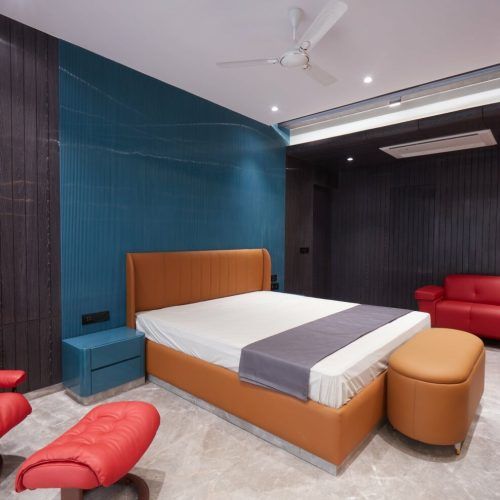
Design and build under one accountable roof
Phased and multi-site projects
- Commercial clients rarely fit out everything at once. A floor laid in phase one has to be matched in phase three, eighteen months later, which is where long-established product lines earn their keep.
- Record the exact product, size and shade lot in the fit-out handover file. On a multi-site retail rollout this is the difference between consistency and a patchwork.
- Buy phase-two spares with phase one where the budget allows. Storage costs less than a mismatch.
- Confirm with the landlord’s fit-out manual before specifying: many Mumbai commercial buildings restrict floor loading, wet trades and debris movement in ways that affect tile choice.
- Where an existing floor must be matched and the line is discontinued, a deliberate contrast at a threshold usually looks better than a near-miss match.
Engineered surfaces alongside tiles
Quartz-type engineered slabs from a tile manufacturer are the same material category as any other engineered quartz: crushed quartz in a polymer binder, non-porous, requiring no sealing, and vulnerable to direct heat. For pantry counters and washroom vanities in a commercial fit-out they are usually the sensible specification.
- Specify 20 mm thickness with a mitred edge for counters; 12 mm is for vertical and light-duty applications.
- Non-porous means no sealing, which in a shared office pantry is a maintenance saving worth having.
- Keep it away from direct heat — the resin binder marks permanently above roughly 150°C.
- Template after the carcasses are installed, exactly as with any stone counter.
Our independence
Greenbox is an independent design and build studio with no dealership, distributorship or commercial arrangement with H&R Johnson, Prism Johnson or any other tile or surface manufacturer. We specify on the merits of each item, buy at market rates through Mumbai suppliers, and pass through invoices where we procure. Nothing here is an official price.
Specification summary
| Area | Specification |
|---|---|
| Office floors | Vitrified, PEI IV–V, rectified |
| Reception and retail | Full body, PEI V |
| Commercial kitchens | Heavy duty tile, R11+, epoxy grout, coved skirting |
| Server rooms | Anti-static tile where specified by the IT brief |
| Washrooms | R10 minimum floor, epoxy grout |
| Pantry counters | 20 mm engineered quartz, mitred edge |
| Records | Product, size and shade lot in the handover file |



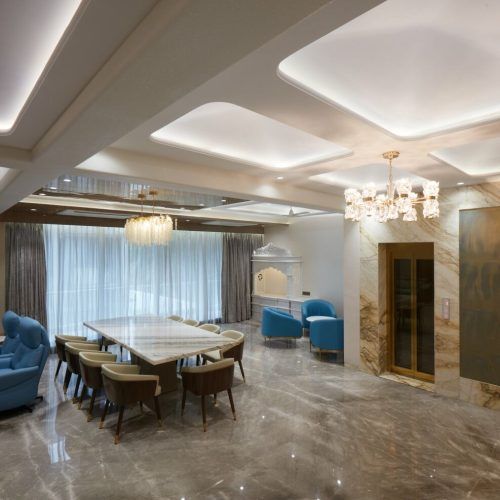
Selected work by Greenbox Design Studio. Tap any image to enlarge.
Frequently asked questions
What is a heavy-duty tile and do I need one?+
A thicker tile with a higher breaking strength and PEI V abrasion class, intended for trolleys, continuous footfall and grit. In a home, no. In a retail shop, a commercial kitchen or a back-of-house corridor, yes — an ordinary floor tile there will chip and wear along the traffic line within two years.
Do I need anti-skid tiles in an office?+
In washrooms and pantries, yes, R10 minimum. On the main floor plate, a matt-finish tile is usually sufficient. Check the landlord’s fit-out manual, because many Mumbai commercial buildings now specify a minimum slip rating for wet areas.
Is Greenbox a Johnson dealer?+
No. We hold no dealership, distributorship or channel relationship with this or any other tile brand. We specify on merit, buy on the open market and pass through supplier invoices where we procure for clients.
How do I match a floor in a later phase?+
Record the product name, size and shade lot at the first phase and buy spares then. If the line is discontinued by phase three, a deliberate contrast at a threshold reads far better than an approximate match laid continuously.
Are engineered quartz counters worth it in an office pantry?+
Usually yes. They need no sealing, do not stain from coffee or turmeric and clean with ordinary detergent, which in a shared pantry with no dedicated housekeeping is the practical argument. Keep a trivet policy for hot vessels, because the binder marks above roughly 150°C.