

Products and where they belong
| Product | Thickness | Substrate needed | Application |
|---|---|---|---|
| Decorative laminate, interior | 0.8 mm | Yes | Carcass internals, shelving |
| Decorative laminate, general purpose | 1.0 mm | Yes | Shutters, drawer fronts, panels |
| Textured / synchronised laminate | 1.0 – 1.2 mm | Yes | Feature shutters, wall panelling |
| Balancing laminate | 0.5 – 0.7 mm | Yes | Reverse face of every shutter |
| Post-forming laminate | 0.5 – 0.6 mm | Yes | Wrapped edges and curves |
| Compact laminate | 6 – 12 mm | No — self-supporting | Washroom cubicles, lockers, wet-area panels |
| Exterior-grade compact | 8 – 12 mm | No | Balcony cladding, soffits |
Mumbai market bands we observe
| Item | Band we observe | Note |
|---|---|---|
| 0.8 mm interior laminate sheet | ₹820 – 1,450 per 8 × 4 ft | Internals and shelving |
| 1.0 mm decorative laminate sheet | ₹1,250 – 2,300 per 8 × 4 ft | Shutter grade |
| 1.0 mm textured laminate | ₹1,850 – 2,700 per sheet | Feature surfaces |
| Balancing laminate | ₹440 – 780 per sheet | Never optional |
| Compact laminate, 12 mm | ₹290 – 460 per sq ft | Cubicles and wet areas |
| Exterior compact, 10 mm | ₹420 – 640 per sq ft | UV-stable grade |
| Cubicle hardware, SS | ₹4,500 – 12,000 per cubicle | Grade 316 near the coast |
Buying observations only. Sheet prices move with design collection more than with technical grade.

Design and build under one accountable roof
Getting laminate work right on site
- Balance every panel. A shutter laminated on one face only will cup in Mumbai humidity within two monsoons. The reverse face takes a balancing sheet as a matter of course.
- Specify the adhesive. Marine-grade synthetic resin, applied both faces, with a four-hour cold press. Contact adhesive on shutter faces is the commonest cause of bubbling and edge lift.
- Band all four edges in 2 mm PVC, machine applied, including the hidden bottom edge of a base unit.
- Check the batch. Order all sheets of one shade together and check the batch reference; two batches on adjacent shutters will read as slightly different colours in daylight.
- Keep surplus. Two square metres of each shade, stored flat, so a damaged panel in year four can be replaced from the same batch rather than a discontinued one.
When to use compact instead of laminate over board
- Washroom cubicles — there is no better answer. Twelve millimetre compact with stainless hardware ignores water entirely.
- Lockers and storage in gyms, clubhouses and site offices.
- Wet-area wall lining where a tiled surface with grout would become a cleaning problem.
- Balcony and semi-exposed cladding, using exterior grade with UV-stable resins.
- Anywhere a board core would be the failure point and the panel can be self-supporting. Compact costs more per square foot and removes an entire class of defect.
Care and how long a laminated surface lasts
Laminate is a thermoset surface and it does not wear out the way a painted finish does. What ages a laminated kitchen is the edges, the adhesive line and fashion, roughly in that order.
- Clean with a dry microfibre first and then a barely damp cloth. Grit dragged across a matte surface dulls it faster than any cleaning product.
- Never use scouring pads, thinner or alkaline floor cleaner on a laminate face. All three burnish or bleach the print layer permanently.
- Check edge bands annually and re-glue a lifted corner before it takes in water. A ten-minute repair prevents a shutter replacement.
- Expect 12–15 years on wardrobe fronts and 8–12 on kitchen fronts that cook daily, in a Mumbai flat.
- Because repair means replacement, surplus sheet from the original batch is the single most useful thing to keep after handover.
Our independence
Greenbox is an independent design and build studio. We hold no dealership, distributorship or commercial relationship with Merino Industries or with any other surfacing manufacturer. We specify on merit, buy through Mumbai dealers at market rates, and pass through supplier invoices where we procure for a client. The figures here are our observations from buying.

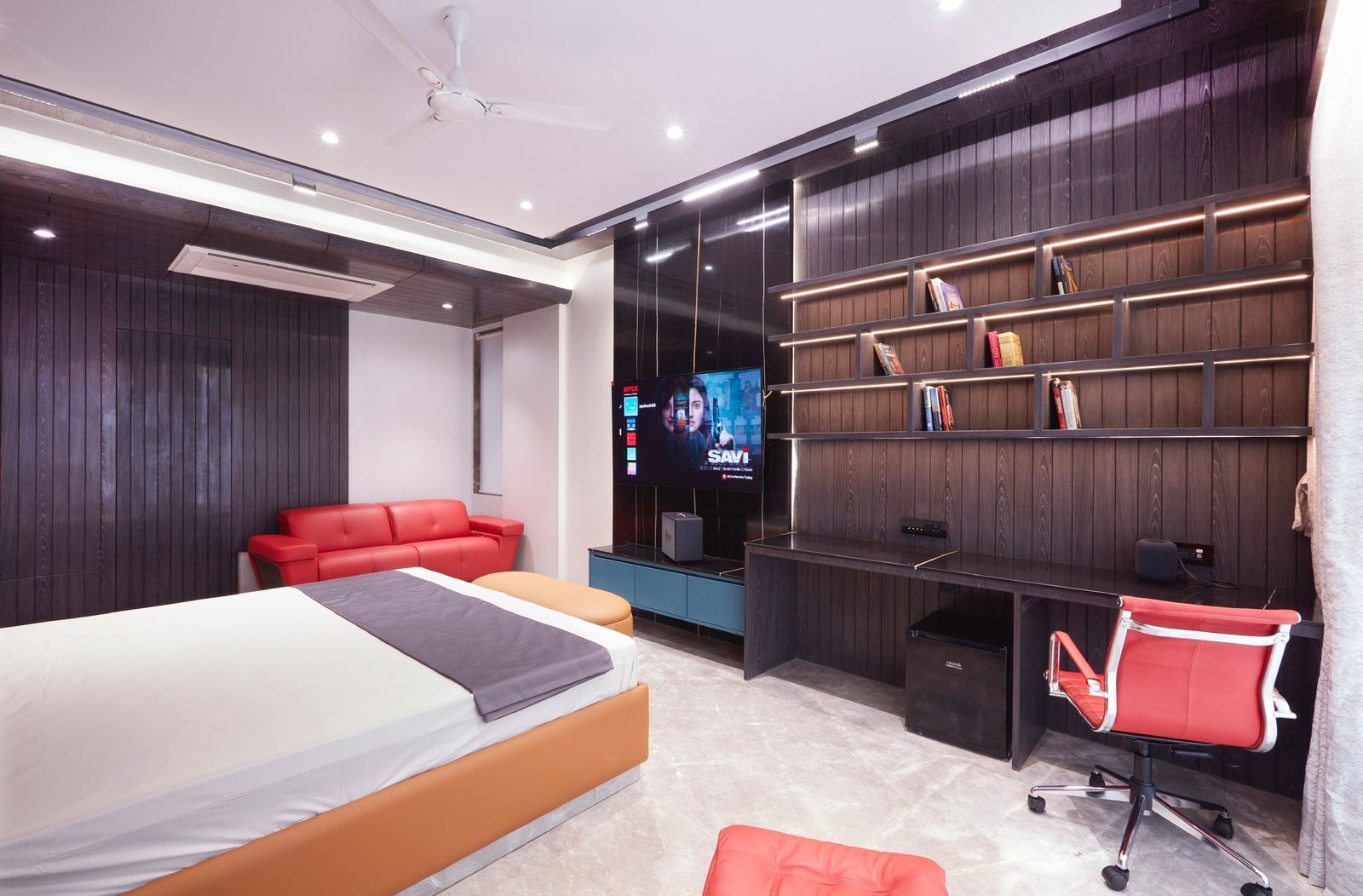


Selected work by Greenbox Design Studio. Tap any image to enlarge.
Frequently asked questions
What thickness of laminate should I use?+
One millimetre on shutters and exposed faces, 0.8 mm inside cabinets and on shelving, and a 0.5–0.7 mm balancing sheet on the reverse of every shutter. Using 0.8 mm on a kitchen front to save money is a false economy; the panel dents and the edge band holds less well.
What is compact laminate and when do I need it?+
It is the same material pressed to 6–12 mm so it is self-supporting and needs no board behind it. Use it for washroom cubicles, lockers and wet-area panels, where any board core would eventually swell. It costs more per square foot and removes the failure mode entirely.
Is Greenbox a Merino dealer?+
No. We hold no dealership or distribution arrangement with Merino or with any other laminate manufacturer. We specify on merit, buy through the open market and pass through supplier invoices where we procure.
Why do two shutters in the same shade look different?+
Different production batches. Laminate shade varies slightly between batches, and the difference shows most on adjacent vertical panels in daylight. Order all sheets of a shade at once, check the batch reference on delivery and keep surplus from the same batch for future repairs.
Can laminate be used in a bathroom?+
On a vanity door away from direct water, with all edges banded, yes. On anything that will be wet regularly, no — the board behind the laminate is what fails. For wet areas use compact laminate or a WPC carcass instead.