
The grades you will actually be offered, and how to tell them apart
Indian laminate is made to IS 2046, and the number that matters on a quotation is the type letter, not the brand. A dealer will show you a shade card and quote a sheet rate; what he will not volunteer is that the same shade exists in three grades at three prices. Ask for the grade in writing.
| Grade | Nominal thickness | How to identify it | Correct use | Sheet rate (8 × 4 ft) |
|---|---|---|---|---|
| Type S / general purpose | 1.0 mm | Stiff, snaps cleanly when flexed hard; edge shows a dark kraft core | Shutters, drawer fronts, exposed panels | ₹1,300 – 2,200 |
| Type S, textured / synchronised | 1.0 – 1.2 mm | Emboss registers to the printed grain — run a fingernail across and along; it feels different | Feature shutters, wall panelling, veneer-substitute work | ₹1,900 – 2,600 |
| Interior grade | 0.8 mm | Flexes without protest; lighter sheet | Carcass internals, shelving, cabinet backs | ₹850 – 1,400 |
| Post-forming grade | 0.5 – 0.6 mm | Bends around a 10 mm radius warm without whitening | Wrapped counter noses, curved reception fronts | ₹900 – 1,600 |
| Balancing / liner | 0.5 – 0.7 mm | Plain, usually white or grey, printed on one face only | Reverse face of every shutter | ₹450 – 750 |
Rates are material only. Anti-fingerprint matte sheets sit at the top of the Type S band, typically ₹2,100–3,200.
What a laminated shutter actually costs once it is on the wall
Clients compare sheet rates; quotations are written in rupees per square foot of shutter elevation. The conversion is not linear, because a 2 ft × 7 ft shutter consumes a full sheet width, wastes the offcut, and carries board, banding, adhesive and labour on top.
| Build-up | Rate (₹/sq ft of elevation) | What is inside it |
|---|---|---|
| 18 mm BWP ply + 1 mm matte laminate + 0.8 mm PVC band | ₹190 – 250 | Wardrobe and utility shutters; the Mumbai workhorse |
| 18 mm BWP ply + 1 mm textured laminate + 2 mm band | ₹260 – 340 | Kitchen fronts that get opened daily |
| 18 mm BWP ply + 1 mm gloss laminate + 2 mm band | ₹230 – 390 | Deep, narrow kitchens where reflectance is doing work |
| 18 mm HDHMR + 1 mm laminate, machine-pressed | ₹240 – 320 | Factory-pressed shutters; flatter, fewer bubbles |
Add 18% GST. A 10 ft × 7 ft wardrobe elevation at ₹220/sq ft is ₹15,400 of shutter before internals and hardware.
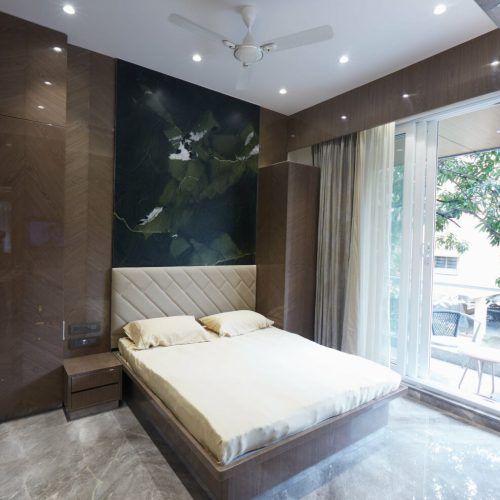
Design and build under one accountable roof
Where laminate performs and where it quietly fails
- Performs: wardrobe and kitchen shutters, cabinet internals, study and office joinery, rented flats, anything that has to survive a family without ceremony.
- Performs: dark colours in matte anti-fingerprint, which is the one place laminate now beats acrylic on day-to-day maintenance.
- Fails: any edge exposed to standing water — a sink-front bottom rail with an unbanded edge will swell within two monsoons.
- Fails: repair. A scratched acrylic shutter can be buffed; a scratched laminate shutter is replaced. Order and store two extra square metres of your shade at the outset.
Mumbai humidity, and what the sea actually does to it
Laminate itself is unbothered by humidity — it is a thermoset sheet. The failures we are called to inspect are always at the glue line or the edge. Between June and September the ambient relative humidity in the suburbs sits above 80% for weeks, and a shutter pressed with a general-purpose white adhesive in that window never reaches full bond strength. The laminate lifts at the corner about fourteen months later.
- Specify a synthetic resin adhesive of the marine or heat-resistant class, applied to both faces, with a minimum 4-hour press. This costs perhaps ₹8 per sq ft more and removes the commonest failure mode.
- Within roughly 2 km of the water — Bandstand, Juhu Tara Road, Worli Sea Face, Versova — salt keeps surfaces permanently slightly damp. Use 2 mm PVC edge banding rather than 0.8 mm; the thicker band survives being wiped daily.
- Balance every panel. An unbalanced 7 ft shutter in Mumbai will cup visibly across its width by the second monsoon.
Care, and how long it really lasts
| Interval | What to do | Why |
|---|---|---|
| Weekly | Dry microfibre, then a barely damp cloth | Grit is what dulls a matte surface, not cleaning |
| Monthly | Mild detergent solution on grease-prone kitchen fronts | Cooking film hardens and then needs abrasives, which polish the matte unevenly |
| Yearly | Check and re-glue any lifted edge band before it takes in water | A 10-minute repair prevents a shutter replacement |
| Never | Scouring pads, thinner, acetone, alkaline floor cleaner | All four burnish or bleach the print layer permanently |
Realistic life in a Mumbai flat: 12–15 years on wardrobes, 8–12 on kitchen fronts that cook daily. Fashion usually retires a laminate before wear does.
What to write in the BOQ so you actually get it
Most laminate disputes come from a one-word line item. “Laminate finish shutters — 120 sq ft” obliges nobody to anything. This is the wording we issue:
- “Shutters: 18 mm BWP plywood to IS 710, faced one side with 1.0 mm decorative laminate to IS 2046 Type S in approved shade, reverse face with 0.7 mm balancing laminate of same manufacturer.”
- “Bonding: synthetic resin adhesive, marine grade, both faces, cold-pressed minimum four hours. Contact adhesive not permitted on shutter faces.”
- “Edges: 2 mm PVC edge band, machine-applied, all four edges including hidden bottom edge. Hand-applied banding not accepted.”
- “Rate all-inclusive of wastage; measurement on finished elevation, openings deducted over 0.5 sqm. Supplier to leave 2 sqm surplus sheet on site.”
That last clause matters more than clients expect. Measurement convention — elevation versus developed area — can move a wardrobe quotation by 12%.
Specification summary
| Property | Specification |
|---|---|
| Standard | IS 2046 (decorative thermosetting laminated sheets) |
| Shutter thickness | 1.0 mm face, 0.7 mm balancer |
| Substrate | 18 mm BWP ply (IS 710) or 18 mm HDHMR for machine-pressed work |
| Adhesive | Marine-grade synthetic resin, both faces, 4-hour press |
| Edge band | 2 mm PVC, machine-applied, four edges |
| Finished rate | ₹190 – 390 per sq ft of elevation, ex-GST |
| Expected life | 12–15 years wardrobe, 8–12 years kitchen |
| Not suitable for | Curved profiles, unbanded wet edges, surfaces you expect to repair |
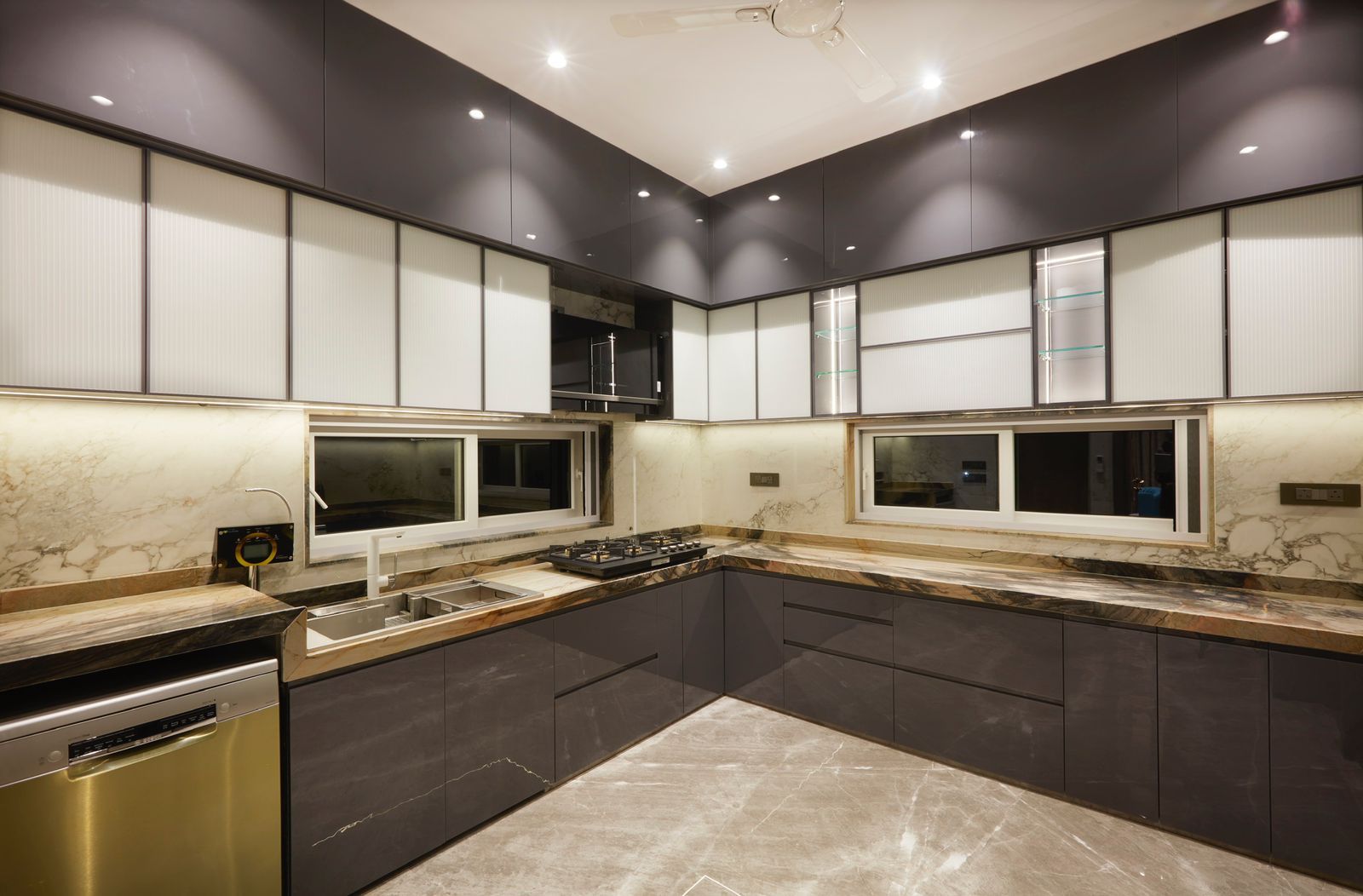
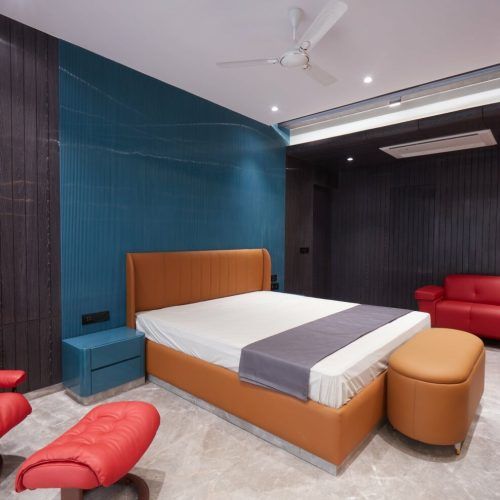
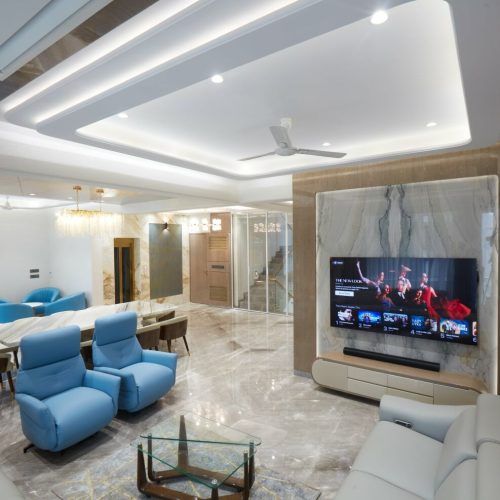
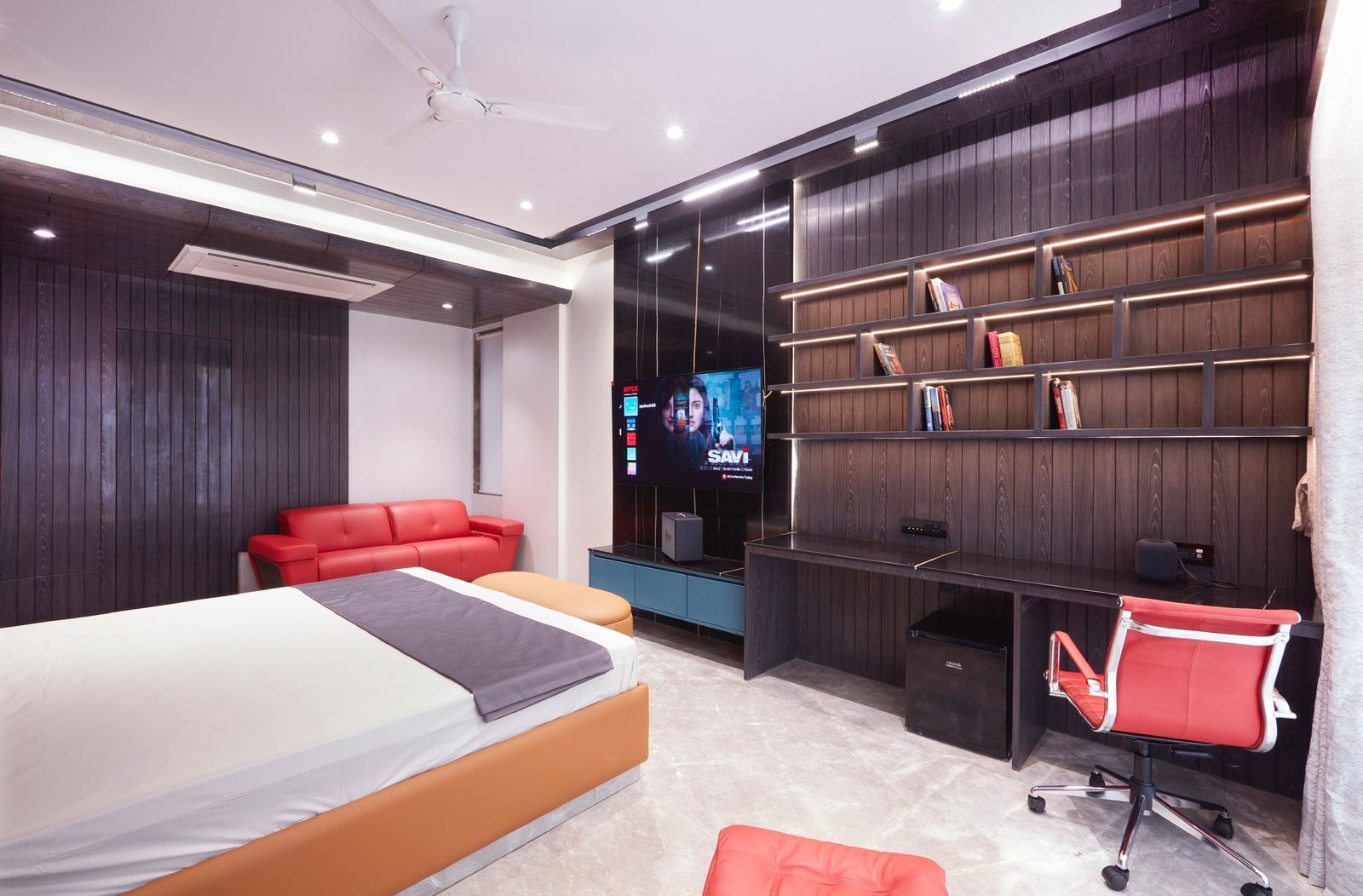
Selected work by Greenbox Design Studio. Tap any image to enlarge.
Frequently asked questions
Is 1 mm laminate really worth the extra over 0.8 mm on shutters?+
On shutters, yes. The difference is about ₹18–25 per sq ft of elevation and it buys you a stiffer sheet that resists denting from a ring or a key and holds an edge band better. On internals and shelving, 0.8 mm is the correct choice and paying for 1 mm there is waste.
Can laminate be repaired if it gets scratched?+
Not meaningfully. Thermoset laminate has a melamine wear layer over a printed sheet; once that is cut through, filler and touch-up pens show. The panel is replaced. This is the practical argument for keeping surplus sheet of your shade on site — shade runs are discontinued faster than furniture wears out.
Why did my laminate bubble in the middle of the panel?+
Almost always trapped solvent or insufficient press time. Contact adhesive flashed off too fast in humid weather, the sheet was laid before the solvent left, and the vapour formed a blister. It cannot be repaired by re-heating; the sheet is lifted and re-pressed, which usually means a new sheet.
Is laminate safe over a kitchen hob?+
Not directly behind or above one. Laminate tolerates roughly 120°C briefly, and a wall shutter 450 mm above a burner sees more than that. Use lacquered glass or stainless steel as the splashback and keep laminate outside the immediate heat zone.
Does Greenbox charge extra for the balancing laminate?+
No — it is inside our shutter rate, because a shutter without it is a warranty claim waiting to happen. If a competing quotation is materially cheaper per square foot, the balancing sheet is one of the three places to look. The other two are board grade and edge band thickness.