

Two different materials, compared properly
| Criterion | Granite | Marble |
|---|---|---|
| Geology | Igneous, quartz and feldspar | Metamorphic limestone, calcium carbonate |
| Hardness | High — resists scratching | Moderate; soft varieties scratch easily |
| Acid resistance | Good | Poor — etches on contact |
| Heat | No practical limit | Good, but staining is the issue |
| Porosity | Low to moderate | Moderate to high |
| Rate | ₹120 – 450 per sq ft | ₹70 – 3,500 per sq ft |
| Renewable | No | Yes — re-grind and polish |
| Best use | Counters, treads, thresholds | Floors, walls, formal areas |
| Worst use | Large pale floors where joints show | Kitchen counters |
Room by room, with rates
| Location | Our choice | Rate installed | Reason |
|---|---|---|---|
| Kitchen counter | Granite | ₹220 – 550 per sq ft | Heat and acid immunity |
| Living room floor | Marble | ₹250 – 900 per sq ft | Appearance; re-polishable |
| Bedroom floor | Marble or vitrified | ₹180 – 600 per sq ft | Low traffic, low risk |
| Kitchen floor | Vitrified tile | ₹100 – 250 per sq ft | Neither stone is ideal under oil |
| Staircase treads | Granite | ₹320 – 700 per sq ft | Edge durability |
| Bathroom floor | Marble or anti-skid tile | ₹200 – 700 per sq ft | Acidic cleaners rule out marble if used |
| Window sills and thresholds | Granite | ₹180 – 420 per sq ft | Weather and impact |
| Pooja unit and feature walls | Marble | ₹300 – 1,200 per sq ft | Appearance is the whole point |

Design and build under one accountable roof
Etching: the word most clients hear too late
Etching is not staining. A stain is something absorbed into the stone; an etch is the polished surface dissolved away by acid. A drop of lemon juice on polished marble leaves a dull matt spot within minutes, and no sealer prevents it, because a sealer reduces absorption and does nothing about a chemical reaction with the stone itself.
- The kitchen counter is where this matters most, and it is why marble counters fail in Indian homes within a few years.
- Honed marble hides etching far better than polished, because there is less gloss to lose. For a family dining room floor, honed is the sensible specification.
- Bathroom cleaners are mostly acidic. A single wipe on marble skirting etches it.
- Granite is not immune — lemon left on a light polished granite for hours will dull it slightly — but the timescale is hours rather than minutes and the effect is far less.
- Re-polishing marble at ₹60–150 per sq ft restores it completely, which is the compensating advantage. Granite cannot be re-polished on site to the same standard.
When marble is the right answer despite everything
- Living and dining floors in a formal home, where the material is the scheme.
- Entrance lobbies and passages in a bungalow, where the impression matters and traffic can be managed.
- Pooja units, feature walls and cladding, where it never meets food or cleaners.
- Any project where a re-grind at year eight is an acceptable maintenance event. Stone floors can be renewed indefinitely, which is why 1960s Mumbai marble floors are still in service.
- Bathroom walls, where water is present but acids are not, provided the waterproofing beneath is sound.
Buying either one in the Mumbai market
Both are sold by the square foot of slab, both are quoted before fabrication, and both are bought in stone yards where the slab in front of you is the product. A few habits protect you.
- Select and mark your own slabs at the yard, and photograph the markings. Substitution between selection and delivery is the commonest complaint in stone buying.
- Buy the whole job from one block. A second block of the same variety name will not match, and on a floor that difference runs across the room.
- Ask whether the rate is for the slab consumed or the finished area. On an L-shaped counter, wastage can be 15–20% and who pays for it should be in writing.
- Confirm hoisting. A 20 mm slab at 3,000 × 1,800 mm weighs about 270 kg, and in an older building it may need cutting before it reaches the flat, which adds a seam.
- Get the sealing specified as a line item for granite and marble, applied after installation and again before handover.
Verdict
| If you want… | Choose | Accept |
|---|---|---|
| A counter that survives Indian cooking | Granite | Sealing every 18–30 months |
| A floor that looks extraordinary | Marble | Etching, careful cleaning, periodic re-polish |
| A floor that needs nothing | Vitrified tile | It is not stone and does not read as stone up close |
| Both in one flat | Marble in formal areas, granite on counters and treads | Two maintenance regimes |
What we specify in most Mumbai flats: granite on the kitchen counter, marble or large-format vitrified in the living and dining areas, vitrified in the kitchen and bathrooms, and granite on any threshold or sill. Mixing is normal; using one stone everywhere is what produces regret.

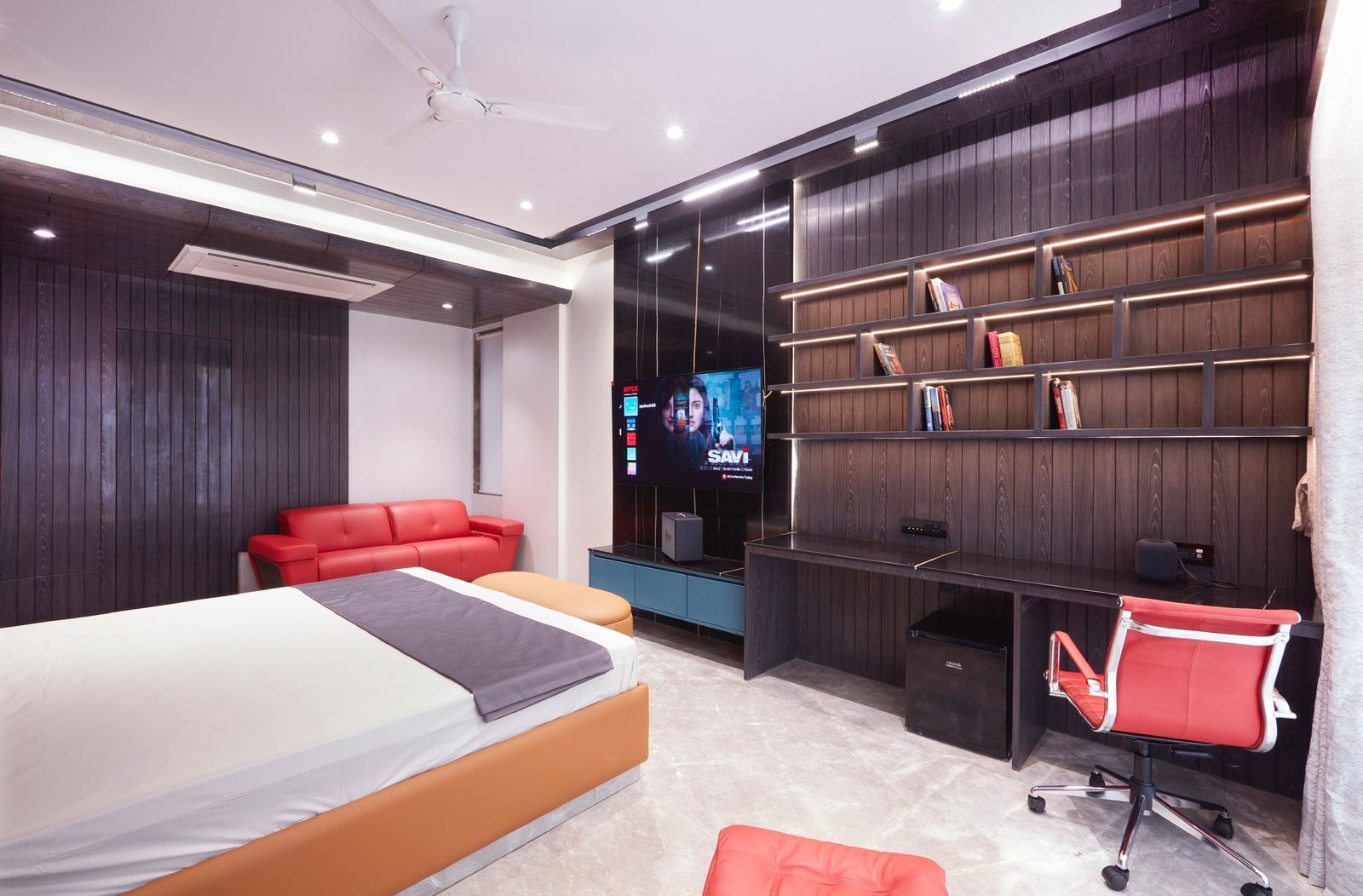


Selected work by Greenbox Design Studio. Tap any image to enlarge.
Frequently asked questions
Can marble be used on a kitchen counter?+
It can be installed and it will look beautiful for about two years. Lemon, curd, vinegar and turmeric are daily kitchen materials and all of them attack marble. We have replaced marble counters within three years more than once. Use granite or quartz and put the marble on the floor.
Is granite out of fashion?+
Speckled mid-tone granites of the 2000s are, certainly. Absolute Black, Black Galaxy and honed dark granites are as contemporary as any surface available and cost a fraction of imported marble. Fashion is about which variety, not about the material.
Which is more expensive?+
Indian marble and granite overlap heavily at ₹70–450 per sq ft. Imported marble is in a different bracket entirely at ₹350–3,500. Laying and polishing costs are also higher for marble because of the curing and grinding programme.
Can a marble floor be repaired if it stains?+
Usually, yes. Surface etching is removed by re-polishing; absorbed stains are drawn out with a poultice, though a shadow can remain on light stone. This renewability is the strongest practical argument for solid stone over any printed surface.
What do you use in your own projects?+
Granite on counters, treads and sills; marble or large-format vitrified on living and dining floors; vitrified in kitchens and bathrooms. The mix is deliberate and it is what we would install in our own homes.