
Compare the three hiring routes
Same works value, three delivery models, all the hidden costs on the table.
How this comparison works
Three routes, each priced on the same base works value, with four cost heads: the contract, the design fee, the expected variations, a defect reserve, and your time.
| Cost head | Contractor only | Designer + contractor | Turnkey design & build |
|---|---|---|---|
| Contract value | 1.00 × works | 1.04 × works | 1.18 × works |
| Design fee | None | 6–9% of works | Inside the contract |
| Variations | 12% × risk factor | 7% × risk factor | 3% × risk factor |
| Defect reserve | 4.5% | 3.0% | Nil — warranty carried |
| Your time | 11 hrs / week | 6 hrs / week | 1.5 hrs / week |
- Contractor only. You pay the works value with no design fee and no premium. You also carry the highest variation exposure, because without drawings the scope is defined by conversation, and you carry the defect risk yourself.
- Designer plus separate contractor. A design fee of 6–9% buys drawings and specification, which cuts variations to about 7%. The contract runs 4% higher because a specified material is a named material. You still coordinate two parties.
- Turnkey design and build. The 18% premium covers design, project management and a warranty. Variations drop to about 3% because the scope is drawn before it is priced, and the defect reserve goes to nil because the warranty carries it.
- Your time is costed at your own hourly figure, at 11, 6 and 1.5 hours per week respectively. These are measured from our own client-contact records and from what clients on split contracts have told us afterwards.

Design and build under one accountable roof
When each route genuinely wins
- Contractor only — small, simple, and you have time
A single-room refresh, a painting and minor joinery job, a flat you are not living in, a brief that will not change. Under about ₹5 lakh of works with low variation risk, the absence of a design fee and a turnkey premium outweighs everything else, provided you actually do the managing. Set the tool to a low works value, low variation risk and a modest hourly rate and you will see it come out on top.
- Designer plus contractor — you want authorship, and control
Right where the design matters a great deal, you have a contractor you already trust, and you have the temperament to hold two parties to one programme. The failure mode is specific and common: when something goes wrong, the designer says it is a workmanship issue and the contractor says it is a drawing issue, and you are the only person in the room who can settle it.
- Turnkey — large, complex, or you are short of time
Full-home projects, anything with civil work, anything in an occupied flat, and anything where you cannot be on site twice a week. The premium buys a single point of accountability, which is worth most precisely when things go wrong. Above roughly ₹10 lakh of works it typically wins on total cost, not just on convenience.
The costs people leave out
- Variations. The largest single item, and the one nobody budgets. Without drawings, every decision taken on site is a variation priced by the person doing the work.
- Rework. A socket in the wrong place, a wardrobe that fouls a window, a ceiling that clashes with the AC. All cheap on paper and expensive in a finished flat.
- Your time. Site visits, material runs to Lohar Chawl, phone calls at 11pm, and the days you take off. Put a real number on it; most people's hour is worth more than they credit.
- Defect risk. Who pays when a shutter warps in month eight? On a turnkey contract with a written warranty, not you. On a cash contractor job, you.
- Delay cost. Rent paid on two properties, or a hotel, or a family living in one room. Rarely in anyone's comparison and frequently the biggest number of all.
- GST treatment. An unregistered contractor cannot issue a tax invoice, which matters if you need one. See the GST on interior work calculator.
A contractor's quote is a price. A turnkey contract is a price and a promise about what happens when it goes wrong. The difference between them is what you are actually buying.
Greenbox design & build team
The tool opens on a ₹20 lakh works value because that is roughly what a 700 sq ft Mumbai flat costs at essential-to-premium finish on our audited October 2026 rates — ₹2,610 to ₹3,910 per sq ft of carpet area. The design fee band of 6–9% sits inside the 4–9% we charge on our own contracts. The route percentages come from Greenbox site records and from quotes we have reviewed. Treat the output as a planning figure: accurate enough to brief a landlord, a bank or a spouse, and not accurate enough to sign a contract against.
What this tool does not cover
- Our bias, stated plainly. We are a turnkey design-and-build studio. The percentages above come from our own records and from quotes we have reviewed, and we have published every one so you can substitute your own.
- Fee structures vary. Some designers charge per sq ft rather than a percentage; some contractors work on a cost-plus basis. Convert to a percentage of works before comparing.
- GST is excluded throughout and applies differently across the three routes — a turnkey works contract is a single 18% supply, while a split arrangement may attract different rates on goods and services.
- The defect reserve is an expected value, not an insurance premium. Your actual outcome is either zero or considerably more than the reserve.
- Delay costs, temporary accommodation and storage are not modelled and can exceed every other difference here.
- It assumes you have a competent contractor available. On the contractor-only route with a poor contractor, no model on this page survives contact.


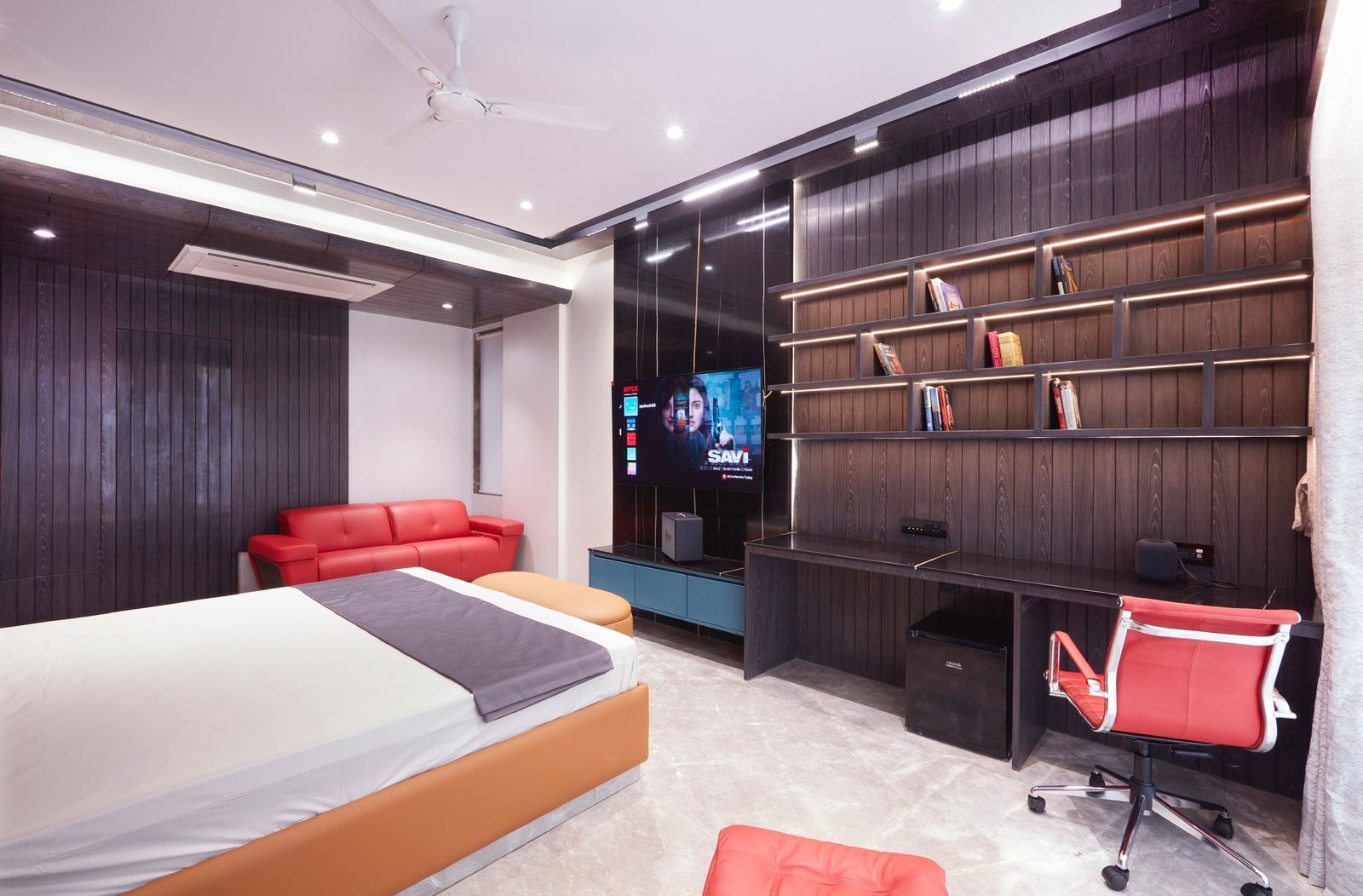

Selected work by Greenbox Design Studio. Tap any image to enlarge.
Frequently asked questions
Is it cheaper to hire a contractor instead of an interior designer?+
On the contract value, yes — there is no design fee and no turnkey premium. On total cost of ownership the gap mostly closes, because variations run around 12% of works without drawings against 3% on a drawn and fixed scope, and because you spend roughly eleven hours a week managing it. On small, simple jobs the contractor still wins; on full homes it usually does not.
What do interior designers charge in India?+
Independent designers typically charge 6–12% of the works value, or ₹80–250 per sq ft of carpet area, for design and drawings without execution. Turnkey design-and-build firms absorb the design fee into the contract, which is why their per-sq-ft rate looks higher than a bare contractor's.
Why are variations so much higher on a contractor-only project?+
Because without drawings the scope is defined in conversation, and every decision taken on site becomes a priced change by the person doing the work. With a drawn and specified scope, the contractor has priced a defined thing and a variation is genuinely a change of mind, not a gap in the brief.
Can I hire a designer for drawings only and manage the build myself?+
Yes, and it is a legitimate route — it is the second column in this tool. Expect a design fee of 6–9%, a slightly higher contract because materials are specified by brand, and about six hours a week of your own time coordinating the two parties. It works best when you already have a contractor you trust.
Does a turnkey contract really reduce variations?+
It reduces them where the scope is drawn and frozen before pricing, which is the whole point of the design stage. It does not protect you from changing your mind — a client-driven change is a variation on any contract. What it removes is the category of variation caused by nobody having decided in the first place.