
The comparison
| Criterion | SPC rigid core | Laminate |
|---|---|---|
| Core | Limestone powder and PVC | High density fibreboard |
| Water behaviour | Unaffected; core does not swell | Swells irreversibly; plank is scrapped |
| Thickness | 4 – 6 mm | 7 – 12 mm |
| Wear surface | 0.2 – 0.5 mm PU wear layer | Melamine, rated AC3 – AC5 |
| Scratch resistance | Good | Very good — better than SPC |
| Installed rate | ₹110 – 260 per sq ft | ₹80 – 200 per sq ft |
| Subfloor tolerance | 3 mm under a 2 m straight edge | Slightly more forgiving |
| Sound underfoot | Firm with IXPE backing | Warmer and softer with foam underlay |
| Thermal movement | Noticeable in direct sun | Minimal |
| Life in Mumbai | 8 – 15 years | 8 – 12 years, if kept dry |
Costed on a 650 sq ft flat
| Line | 5 mm SPC, 0.3 mm wear layer | 10 mm laminate, AC4 |
|---|---|---|
| Material and laying, 700 sq ft | ₹1,19,000 | ₹91,000 |
| Underlay | included, IXPE backed | ₹14,000 |
| Subfloor levelling where required | ₹28,000 | ₹22,000 |
| Skirting, 260 rft | ₹23,400 | ₹20,800 |
| Threshold profiles | ₹4,500 | ₹4,500 |
| Total, ex-GST | ₹1,74,900 | ₹1,52,300 |
A difference of about ₹22,600, or roughly 15%, to remove the single most likely cause of failure in this climate.
Design and build under one accountable roof
The water argument, in specifics
Laminate is not a bad product. It is a product designed for European homes with closed windows, dry floors and no monsoon, and it does that job well.
- A washing machine overflow, a leaking AC drain, a bucket knocked over — each of these is a routine event in an Indian home and each destroys a laminate floor locally and permanently.
- Water reaches the core through the joint, the HDF swells, the plank edge lifts into a ridge and it never comes back down.
- Water-resistant laminate improves the surface and the joint seal, which buys you time against a spill. The core is still HDF.
- SPC has no cellulose in the core. Standing water on it for a day does nothing at all.
- Humidity alone damages neither. It is liquid water, and in Mumbai that arrives whether anyone planned for it or not.
Where laminate is still the right call
- First-floor and above bedrooms in an inland suburb, air-conditioned, with no balcony door.
- Offices and studies where the cleaning regime is dry.
- A tight budget where the ₹22,000 difference is the difference between doing the floor and not.
- Where you specifically want the harder wear surface — AC5 laminate outperforms most SPC wear layers on abrasion.
- Where the subfloor is poor and levelling is not in the budget; the thicker laminate plank bridges minor unevenness better than 5 mm SPC.
Installation, where both go wrong the same way
- Expansion gap. Eight to ten millimetres at every wall, column and door frame, covered by skirting fixed to the wall and never to the floor. Silicone across that gap is the commonest installation error and it causes buckling in May.
- Subfloor flatness. Check with a 2 m straight edge; more than 3 mm of gap means levelling compound first. A floating floor over hollows flexes and the joints work loose.
- Acclimatisation. Both want 48 hours in the room before laying. Boxes flat, in the room they will be installed in.
- Run length. Limit a continuous run to about 12 m in any direction, with a transition profile at a doorway beyond that.
- Spares. Keep 5% of planks from the original batch. Both materials are replaced plank by plank, and a new batch will not match.
What happens when the floor is damaged
Neither floor is repairable in the way a stone or timber floor is. Both are replaced plank by plank, and how easy that is depends on decisions taken at installation.
- A floating floor can be unclicked from the nearest wall back to the damaged plank, which is straightforward in a bedroom and awkward in the middle of an open-plan living area.
- The alternative is cutting the damaged plank out and gluing a replacement in, which works and is visible on close inspection.
- Either method needs a plank from the original batch. Print runs and wear-layer batches change, and a plank bought two years later will differ subtly in tone.
- Keep 5% of the original order, stored flat and dry in a loft. This is the single most useful thing you can do for a click floor at handover.
- With SPC, water damage is not a reason for replacement; with laminate it is the usual reason, and it typically affects a strip of planks rather than one.
Verdict
| Room | What we specify |
|---|---|
| Living and dining | SPC — balcony doors and wet footfall |
| Bedrooms, air-conditioned, upper floor | Either; laminate acceptable on a tight budget |
| Bedrooms, ground floor or sea-facing | SPC |
| Kitchen, bathroom, utility, balcony | Neither — use vitrified tile |
| Rental fit-out | SPC — tenants are harder on floors than owners |
| Office | SPC at 0.5 mm wear layer, or AC5 laminate |
Summary: SPC, unless the room is genuinely dry and the budget genuinely will not stretch. The fifteen per cent premium buys out the one failure mode that is otherwise near-certain over a fifteen-year life in Mumbai.
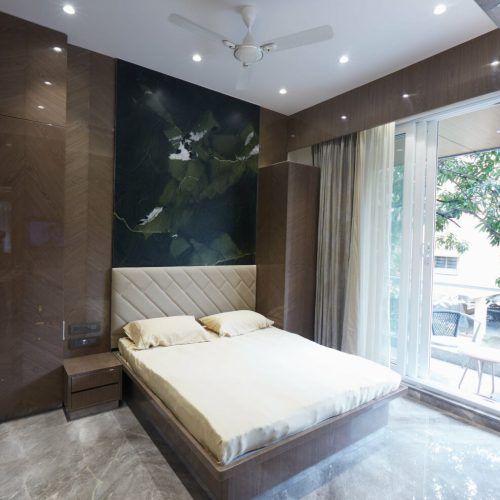
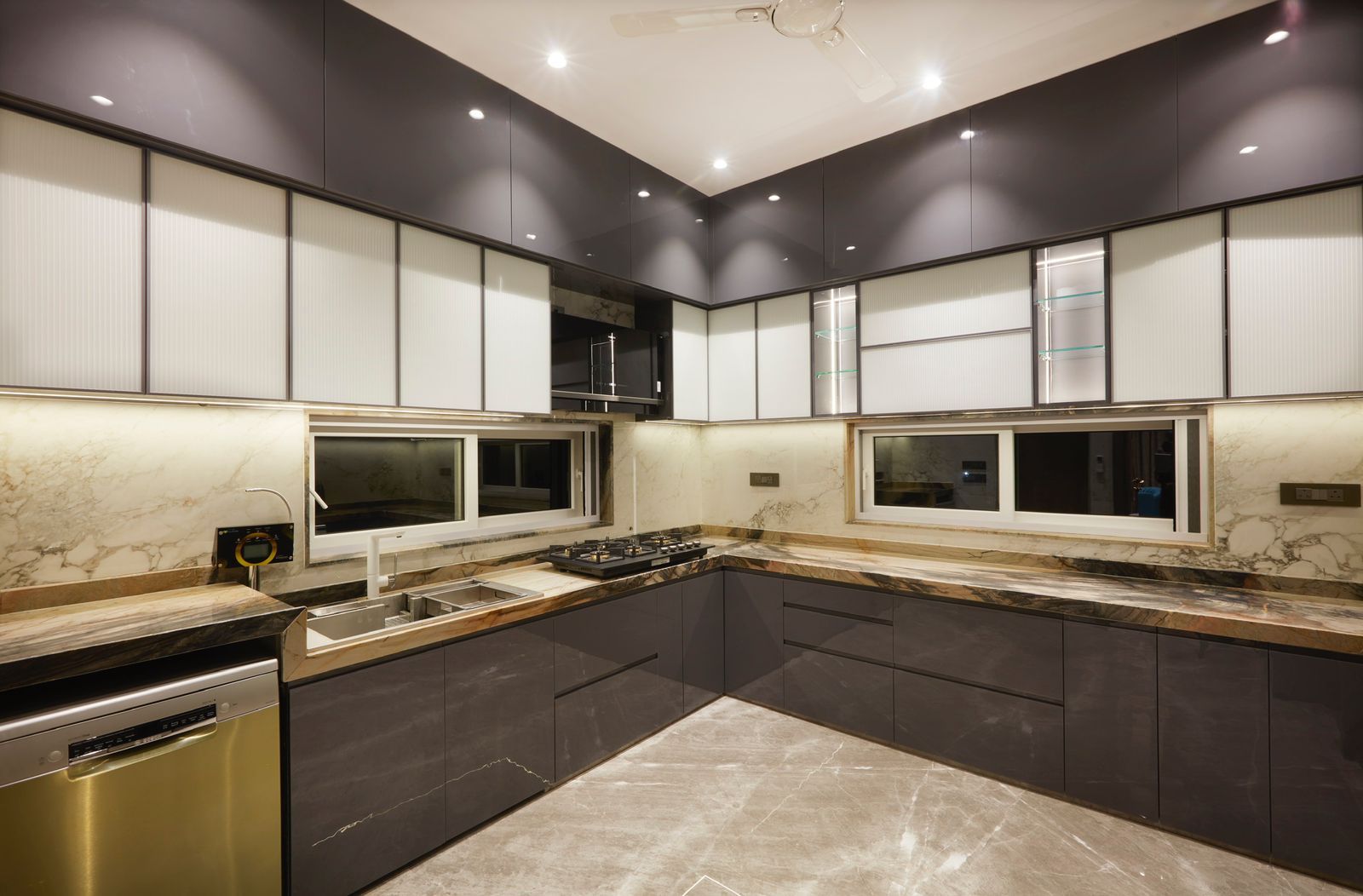
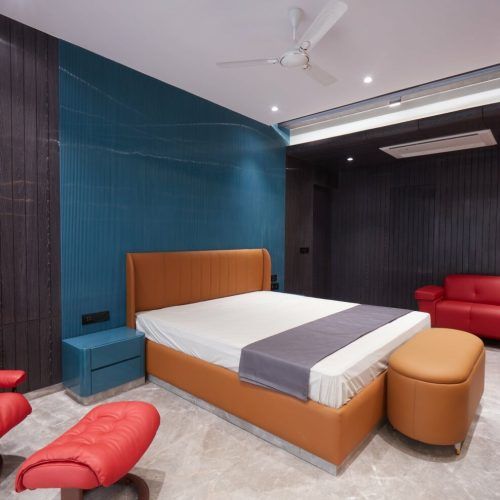
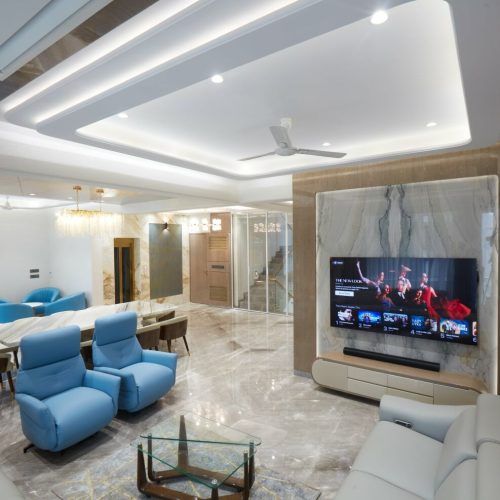
Selected work by Greenbox Design Studio. Tap any image to enlarge.
Frequently asked questions
Is SPC really waterproof?+
The plank is — the core is limestone and PVC, which do not absorb water, and the surface is impervious. Standing water can eventually pass through a joint, so treat it as fully mop-safe and splash-proof rather than as a waterproof membrane.
Is laminate ever the better choice?+
In a dry, air-conditioned upper-floor bedroom, yes, and AC5 laminate is more abrasion resistant than most SPC wear layers. It also bridges a slightly uneven subfloor better because the plank is thicker. Outside those conditions, the water risk outweighs both advantages.
Can either be laid over existing tiles?+
Yes, both, which is their main appeal in a Mumbai renovation: no demolition, no debris and no society objections. The tiles must be sound and flat within 3 mm over 2 m, and loose tiles must come out first.
Why did my floor buckle in summer?+
Thermal expansion with no room to move. The expansion gap was filled with skirting adhesive or silicone, or the run exceeded 12 m without a transition. Re-cutting the perimeter gap usually releases it, and it applies to both materials.
Which feels better underfoot?+
Laminate, marginally, because it is thicker and usually laid over a foam underlay — it is warmer and quieter. SPC with a 1.5 mm IXPE backing is close; SPC at 4 mm without backing sounds hollow and reads as plastic.