
The comparison
| Criterion | Imported Italian marble | Indian marble |
|---|---|---|
| Slab rate | ₹350 – 3,500 per sq ft | ₹70 – 450 per sq ft |
| Thickness | 18 – 20 mm, fibre-mesh backed | 16 – 18 mm, usually unbacked |
| Whiteness | Generally brighter, cleaner ground | Varies; Makrana and Ambaji are good whites |
| Veining | Often dramatic and directional | Generally finer and more even |
| Hardness | Varies; many whites are soft | Varies; Makrana and Banswara are hard |
| Consistency within a lot | Good, slabs sequentially numbered | Variable — buy from one consignment |
| Laying rate | ₹120 – 220 per sq ft | ₹100 – 180 per sq ft |
| Re-polishing | ₹80 – 150 per sq ft | ₹60 – 120 per sq ft |
| Availability of a repeat lot | Difficult after a year | Easier for common varieties |
Costed on a 600 sq ft living and dining floor
| Line | Indian — Ambaji white | Imported — Statuario |
|---|---|---|
| Slab, 660 sq ft with 10% wastage | ₹1,32,000 | ₹9,24,000 |
| Laying, bedding, curing | ₹78,000 | ₹96,000 |
| Grinding and diamond polishing | ₹42,000 | ₹54,000 |
| Skirting, 130 rft | ₹19,500 | ₹65,000 |
| Wastage, edge work, protection | ₹16,000 | ₹38,000 |
| Total, ex-GST | ₹2,87,500 | ₹11,77,000 |
The ratio is roughly four to one. On a bedroom floor that difference buys the entire wardrobe run.
Design and build under one accountable roof
Hardness, and the myth worth correcting
Clients often assume imported marble is the higher-quality material in every respect. On appearance, frequently. On durability, not necessarily.
- Makrana, the Indian white used in the Taj Mahal, is denser and harder than most commercial imported whites.
- Banswara and Ambaji whites hold traffic well and are the sensible choice for a corridor or an entrance area.
- Soft commercial Indian whites — the cheapest in the yard — scratch under ordinary furniture movement, which is where the material’s poor reputation comes from.
- Several imported whites are soft, and in a heavily used family living room they develop a traffic path within a few years.
- The honest test is to draw a steel key across a polished offcut of the actual consignment, in the yard, before buying. Do this for both origins.
When imported marble earns its price
- A formal living room floor where the material is the scheme and the traffic is manageable.
- A book-matched feature wall, where the drama of a single dramatic vein carried across two mirrored slabs is the whole point.
- A bathroom in a luxury scheme, cladding walls rather than floors.
- Where a specific ground colour is required — a true bright white with grey veining that no Indian variety reproduces.
- Where the budget makes the difference immaterial and the client wants the material they want. That is a legitimate reason and we will not argue against it.
What the monsoon does to a new marble floor
Both origins behave identically here, and the failure is always in the laying rather than the stone. Marble laid on a wet bed in July dries through the slab over weeks, carrying salts to the surface.
- The symptom is a pale patch or a map-like stain appearing two to six weeks after polishing, most visible on a white stone.
- It frequently fades over two to three months as the bed dries, and frequently does not, which makes it an argument rather than a defect.
- Prevention is a neat cement slurry bonding coat, a properly graded bed and a full three weeks of curing before grinding — exactly the step that gets compressed when a family wants to move in.
- We avoid laying marble between late June and mid-September wherever the programme allows, and where it does not, we extend the curing and say so in writing at the start.
- This applies equally to a ₹90 Indian white and a ₹2,000 Statuario. Expensive stone laid badly looks worse, because the expectation is higher.
Verdict by area and budget
| Area | Recommendation | Why |
|---|---|---|
| Whole-flat flooring on a budget | Indian — Rajnagar or Ambaji | Four times the area for the same money |
| Living and dining, mid budget | Indian — Banswara or Katni | Good whites and beiges at a fraction of imported |
| Living room, high budget | Imported — Botticino or Crema Marfil | Consistency over a large area |
| Single feature wall | Imported — Statuario or Calacatta | Drama concentrated where it is seen |
| Corridors and entrances | Indian — Makrana | Hardness matters more than whiteness |
| Pooja unit and thresholds | Indian — Makrana or green | Traditional and hard wearing |
The specification we write most often: a hard Indian white across the general floor area, with one imported feature element — a wall, a threshold, a vanity top — where the drama is concentrated. It reads as an expensive scheme and costs a fraction of one.



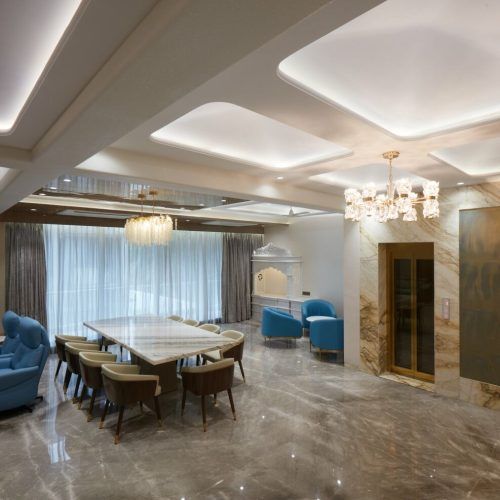
Selected work by Greenbox Design Studio. Tap any image to enlarge.
Frequently asked questions
Is Italian marble better quality than Indian marble?+
Better in appearance, usually — whiter grounds and more dramatic veining. Not necessarily better in durability; Makrana and Banswara are harder than several imported whites. Judge hardness on the actual consignment with a scratch test rather than by origin.
Why is imported marble so much more expensive?+
Quarrying, processing, shipping and duty, plus the market premium on famous quarry names. On a 600 sq ft floor the difference between a good Indian white and a premium imported white can be eight to nine lakh rupees.
Do both need the same installation care?+
Yes. Thirty millimetre cement-sand bed with a slurry bonding coat, 21 days of curing before grinding, then multiple grinding passes and a diamond polish. Compressing the curing is the commonest cause of patchy new marble floors, whatever the origin.
Can I mix Indian and imported marble in one flat?+
Yes, and it is usually the sensible plan — a hard Indian white across the general floor with one imported feature element. Do not mix two whites in the same continuous floor plane; the difference in ground colour will be obvious.
Which needs more maintenance?+
Both need the same regime: no acidic cleaners, prompt wiping of spills, sealing every 18–24 months and a re-polish every six to ten years. Indian re-polishing is slightly cheaper per square foot. Neither is a low-maintenance floor.