
Side by side
| Criterion | Engineered quartz | Natural granite |
|---|---|---|
| Composition | 88–93% crushed quartz in resin | Quarried igneous stone |
| Slab rate | ₹380 – 950 per sq ft | ₹120 – 450 per sq ft |
| Porosity | Non-porous | Porous; varies by variety |
| Sealing | Never | Every 18 – 30 months |
| Heat | Marks above about 150°C | No practical domestic limit |
| Stains from turmeric and oil | None | Possible on light stone if unsealed |
| Consistency | Manufactured — identical slabs | Natural — buy the slab you saw |
| Outdoor and sunlight | Binder ambers over years | Unaffected |
| Repair of a chip | Colour-matched resin, near invisible | Colour-matched epoxy, visible up close |
Costed on a 14 running foot L-shaped counter
| Line | Granite, Steel Grey | Quartz, mid-range veined |
|---|---|---|
| Slab, 32 sq ft at rate | ₹5,760 | ₹19,200 |
| Fabrication, 14 rft | ₹3,500 | ₹4,200 |
| Sink and hob cut-outs | included | included |
| Front edge profile | ₹2,800 pencil round | ₹7,000 mitred 40 mm |
| Splashback, 18 sq ft | ₹3,240 | ₹10,800 |
| Transport, hoisting, fitting | ₹6,500 | ₹7,500 |
| Total, ex-GST | ₹21,800 | ₹48,700 |
Premium granite varieties and premium quartz both push these figures up substantially; the ratio between them stays roughly similar.
Design and build under one accountable roof
The heat question, which is the one that matters
In most Indian kitchens a vessel comes off the flame and goes somewhere. If that somewhere is the counter, granite is the correct material and no amount of explaining will change the household’s habit.
- Quartz resin discolours above roughly 150°C, leaving a dull grey ring that cannot be polished out. It is not a warranty defect; it is the material behaving as designed.
- A trivet solves it entirely, and a household that will genuinely use one loses nothing by choosing quartz.
- Be honest about this before specifying. We ask the question directly at the design meeting, and the answer decides the material more often than the budget does.
- A practical compromise: quartz counter with a granite or stainless landing strip beside the hob. It costs a little more in fabrication and removes the risk entirely.
- The reverse risk — staining granite with turmeric — is solved by sealing, which requires someone to remember every two years.
When granite is genuinely the better choice
- Households where hot vessels go straight onto the counter. Stated plainly, this is most Indian kitchens.
- Budgets where the ₹25,000–50,000 saved buys better hardware or a better carcass.
- Dark stone schemes, where Absolute Black or Black Galaxy hides everything and needs almost no sealing.
- Outdoor and balcony counters, where quartz’s binder would amber in UV.
- Clients who actively want natural stone with variation, rather than a manufactured surface.
When quartz is worth the premium
- Light-coloured counters. A white or pale grey quartz will look the same in year ten; a pale granite will not without disciplined sealing.
- Households with domestic staff doing the cooking, where the sealing regime is unlikely to be maintained by anyone.
- Kitchens where the counter is a visual feature — an island in an open-plan living room — and consistency of pattern matters.
- Anyone who has previously had a granite counter stain and does not want to repeat it.
- Bathroom vanities, where quartz’s non-porosity is an advantage and heat is a non-issue.
Fabrication, which is where both materials are actually won or lost
The slab is a factory product in the case of quartz and a quarried product in the case of granite. The countertop, however, is a hand-made object, cut by a fabricator in a yard in Kurla or Bhiwandi, and most counter failures trace back to that stage rather than to the material.
- Radiused internal corners at the sink and hob cut-outs. Square internal corners concentrate stress and are where almost every counter crack starts, in either material.
- The carcass tops must be level within 2 mm across the run. A slab laid on an uneven carcass is under permanent stress.
- Template after the units are installed, not from the design drawing. Mumbai walls are rarely plumb and a 10 mm error becomes a visible wedge of silicone.
- Steel flat support under any overhang beyond 250 mm, on a breakfast bar or an island.
- Agree the seam position on a drawing before cutting. One seam per 10 feet of run is unavoidable; where it lands is a choice.
Verdict by household
| Household | Our recommendation |
|---|---|
| Cooks Indian food daily, vessels off flame to counter | Granite, dark variety |
| Cooks daily, will use trivets | Quartz, with a stainless landing strip by the hob |
| Light-coloured kitchen scheme | Quartz — pale granite will stain |
| Open island counter, visual feature | Quartz for pattern consistency |
| Budget under ₹30,000 for the counter | Granite — quartz is not reachable at that figure |
| Balcony or outdoor counter | Granite — quartz ambers in UV |
What we specify most often in Mumbai: quartz on the main counter, with a granite or stainless insert beside the hob for hot vessels, and granite in the utility. It costs a little more than either alone and it removes both failure modes.
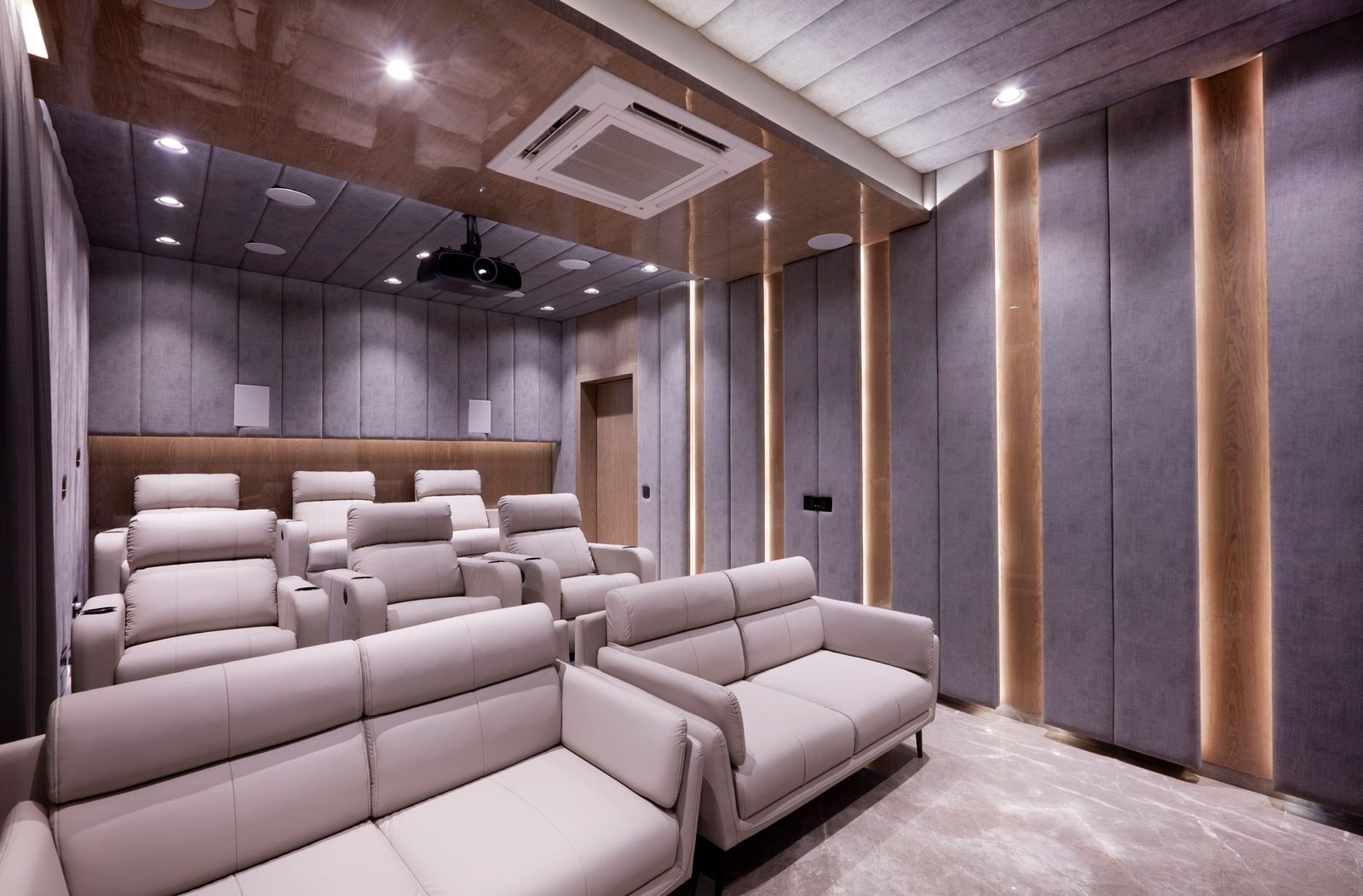
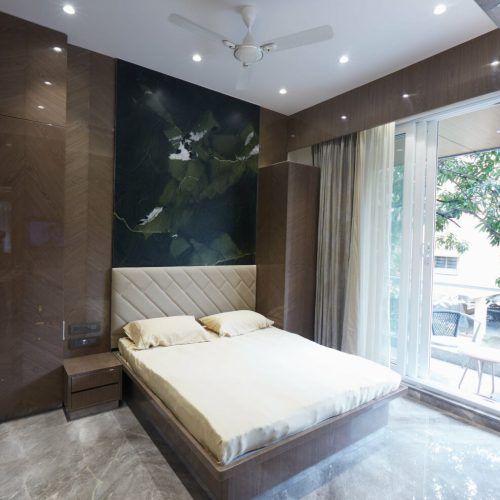
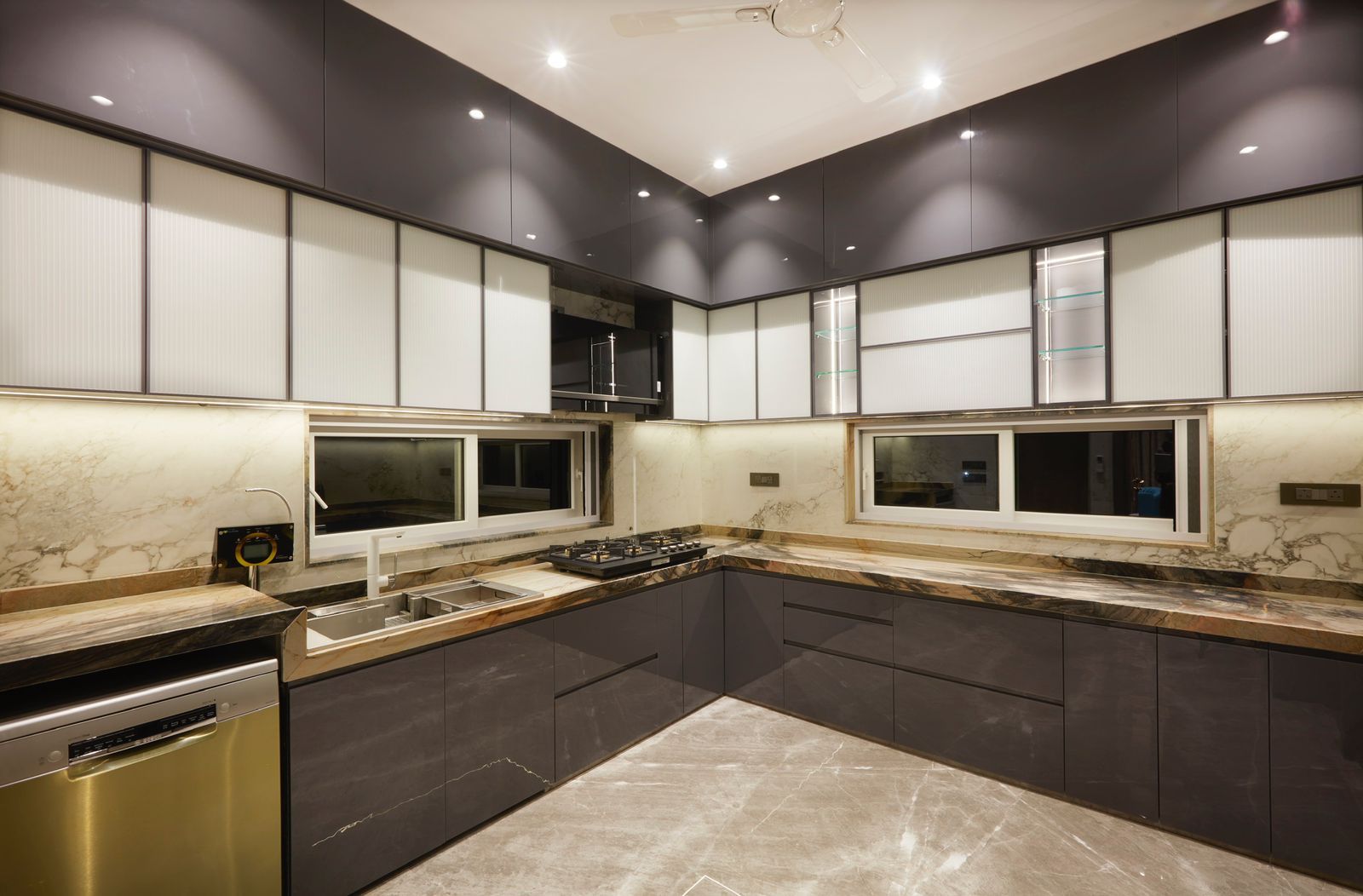
Selected work by Greenbox Design Studio. Tap any image to enlarge.
Frequently asked questions
Does quartz really never need sealing?+
Correct — the quartz grains are bound in resin with no interconnected pores, so there is nothing for a sealer to penetrate. If a quotation includes annual quartz sealing, it has been copied from a granite specification.
Will turmeric stain granite?+
Light, granular varieties, yes, if they are unsealed. Dark dense stone such as Absolute Black rarely shows anything. A penetrating sealer applied at handover and re-applied every 18–30 months makes staining a non-issue on any variety.
Can I put a hot pan on quartz for a few seconds?+
You may get away with it, and you may not. The damage is a permanent dull mark, so it is not worth testing. Keep a trivet, or specify a granite or stainless landing strip beside the hob, which is the detail we use most often.
Which looks better?+
A matter of taste, but the honest observation is that quartz gives you consistency and granite gives you character. A veined quartz in a photograph is indistinguishable from marble; a Black Galaxy granite has a depth no manufactured surface reproduces.
Which is easier to live with over ten years?+
Quartz, marginally, because it needs nothing. Granite needs a sealer every couple of years, which is a twenty-minute job that most households forget. If you will remember, granite is the more forgiving surface in every other respect.