
What to compare instead of the name
| Specification | What to require | Why it matters |
|---|---|---|
| Water absorption | Under 0.5% for any floor tile | Defines vitrified; anything higher belongs on a wall |
| PEI abrasion class | III bedrooms, IV living, V commercial | Predicts where the traffic path will wear |
| Type | GVT, PGVT, double charge or full body | Decides what a chip looks like |
| Slip rating | R10 minimum in wet areas | The only genuinely safety-related line |
| Rectified or not | Rectified for 2 mm joints | Changes the look more than the pattern does |
| Shade lot | One lot for the whole quantity | Two lots in one room show as a band |
| Size | 600 × 600 to 800 × 1,600 mm | Drives laying cost as well as appearance |
Market bands we observe in Mumbai
| Category | Band we observe, either brand | Comment |
|---|---|---|
| Ceramic wall tile | ₹32 – 90 per sq ft | Buy on design; performance is not the issue |
| GVT floor tile, 600 × 600 | ₹42 – 95 | Bedroom grade |
| PGVT, 800 × 800 | ₹70 – 160 | Living room grade |
| Double charge, 600 × 600 | ₹95 – 185 | Corridors and lobbies |
| Full body, 600 × 600 | ₹110 – 220 | Commercial and heavy traffic |
| Large format, 800 × 1,600 | ₹135 – 320 | Plus higher laying labour |
| Laying, standard sizes | ₹35 – 70 | Add ₹25 – 45 for large format |
Buying observations, not official price lists. Dealer discounting on tiles in Mumbai is substantial and varies with order size and season.
Design and build under one accountable roof
The decision rule we actually use
- Fix the specification first — type, size, absorption, PEI class, slip rating, rectified or not — room by room, before looking at any design.
- Shortlist designs from both manufacturers that meet that specification. This usually leaves a manageable set rather than a showroom’s worth.
- Check single-lot availability for your full quantity plus 10%. This eliminates more candidates than anything else and is the commonest cause of a compromised floor.
- Compare delivered price per square foot, converting from box rates, and check whether delivery is to the flat or the building gate.
- Then choose on appearance. By this stage the choice is genuinely aesthetic, which is where it should be.
Where the real money and the real risk sit
- Laying, not the tile. A ₹90 tile laid on full adhesive coverage with levelling clips outperforms a ₹200 tile dot-fixed on a sand-cement bed, every time.
- Grout. Epoxy in wet areas at ₹35–70 per sq ft more is the single best value line in a tiling package in Mumbai.
- Shade lot. Running short mid-job and buying a second lot is the most visible defect a tiled floor can have, and it is entirely avoidable.
- Wastage. Eight to ten per cent on a straight layout, twelve to fifteen on a diagonal or heavily cut room. Who pays for wastage should be written down.
- Access. Large-format slabs may not fit a Mumbai passenger lift. Confirm before committing to the size.
What to do in the showroom
Tile showrooms are designed to sell on appearance, with samples displayed vertically under flattering light. Three habits change what you walk out with.
- Put the sample on the floor and stand back. A tile viewed at eye level on a display rack looks nothing like the same tile underfoot at four feet.
- Ask for the technical sheet, not the brochure page. Absorption, PEI class, breaking strength and slip rating should be printed figures, not adjectives.
- Look at four tiles together, not one. Design repeat is invisible on a single piece and obvious across four. On a large floor a short repeat reads as a pattern.
- Check the edge. Run a finger along it: rectified tiles are square and sharp, unrectified are slightly rounded and need a wider joint.
- Ask, in writing, how much of your quantity is available in one shade lot today. This is the question that most often changes the answer.
Verdict
| Situation | What we would do |
|---|---|
| Standard residential flat | Specify by class; choose design and lot availability |
| Commercial floor plate | Full body PEI V from whichever brand stocks the quantity |
| Large-format feature floor | Whichever has the design, subject to lift access |
| Bathrooms and balconies | R10 anti-skid; brand irrelevant |
| Phased or multi-site project | Whichever line the dealer confirms will stay available |
| Tight budget | Correct class at the lower price; do not drop the class |
Our conclusion: at matched specifications these two are close enough that the brand should be the last variable you fix, not the first. Fix class, size and slip rating; then buy the design you like from whichever manufacturer can supply your whole quantity in one shade lot. Greenbox holds no dealership with either.
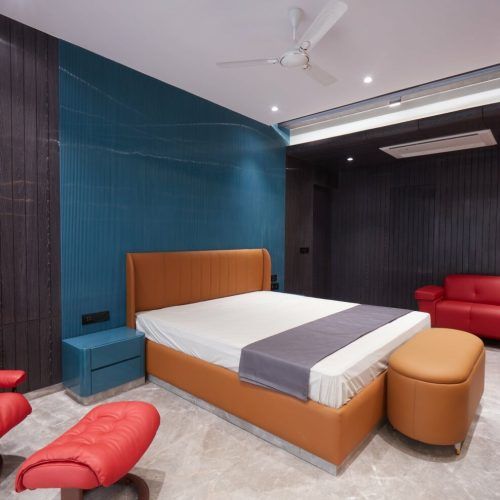
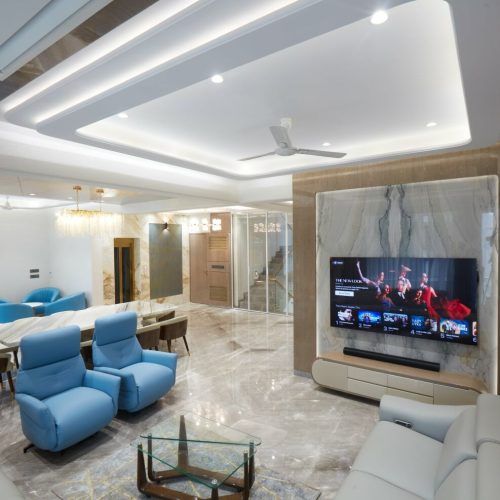
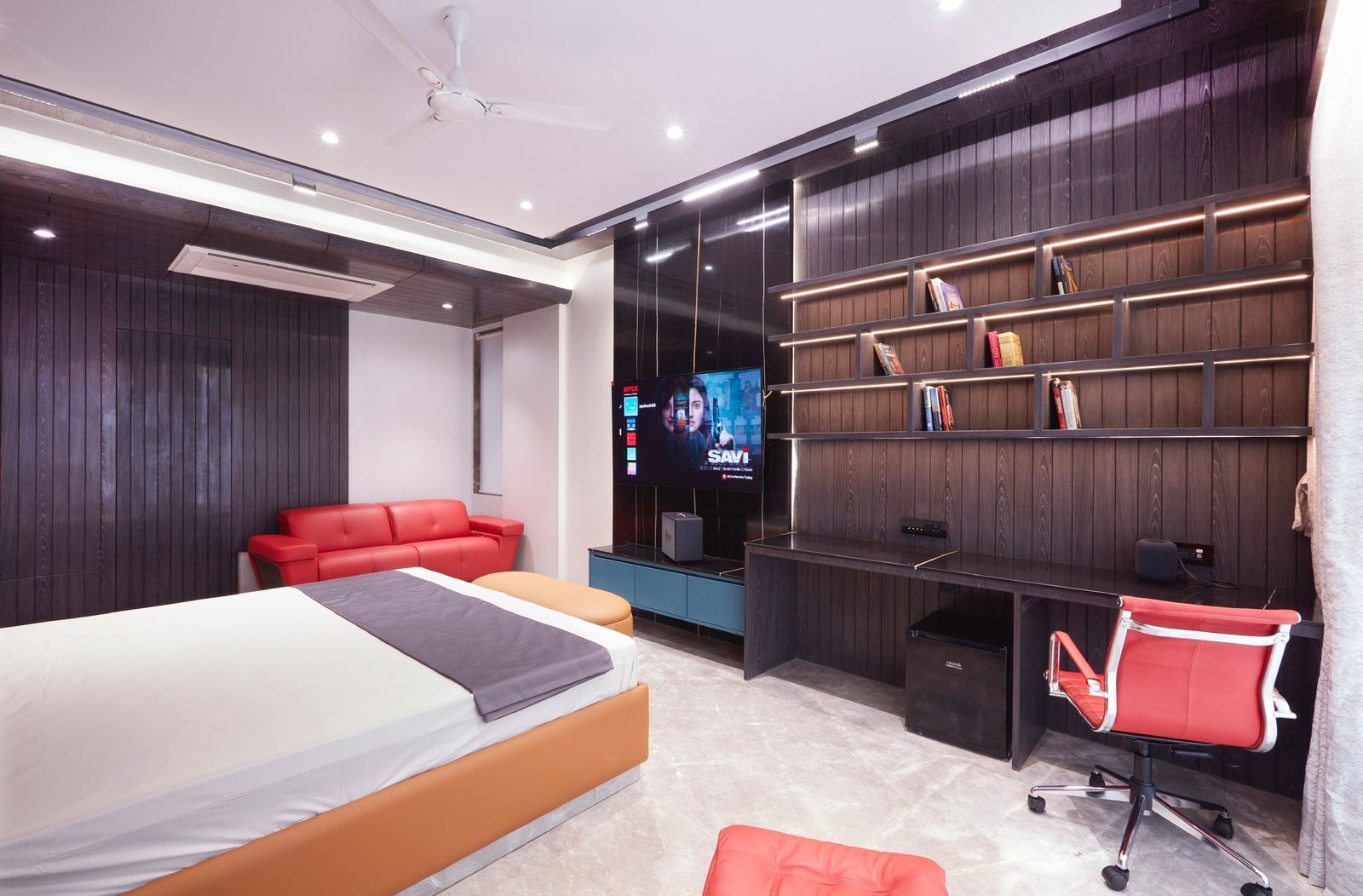
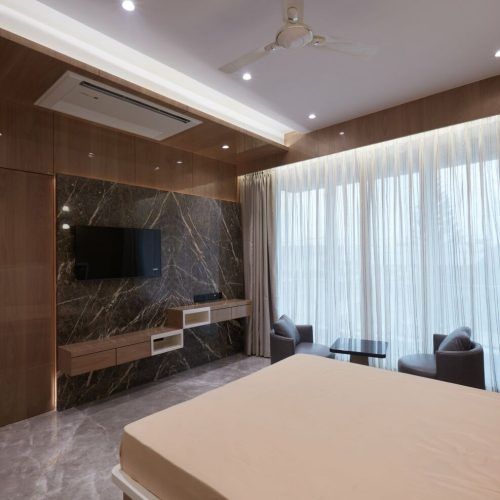
Selected work by Greenbox Design Studio. Tap any image to enlarge.
Frequently asked questions
Is one brand better quality than the other?+
At matched specifications, not in any way we can demonstrate on site. Both manufacture across the full range from ceramic wall tile to full body. Compare the actual tile on absorption, PEI class and slip rating, and the brand question largely dissolves.
What is the most important number on a tile box?+
Water absorption, which must be under 0.5% for any floor tile, followed by PEI abrasion class. Those two tell you where the tile belongs. Slip rating matters third and only in wet areas, where it matters a great deal.
Is Greenbox a dealer for either brand?+
No. We hold no dealership, distributorship or channel relationship with Kajaria, Somany or any other tile manufacturer. We specify on merit, buy through Mumbai dealers on the open market and pass through invoices where we procure.
How much extra should I order?+
Eight to ten per cent over the measured area for a straight layout and twelve to fifteen for diagonal or heavily cut rooms, plus three to five per cent retained as spares. All of it from one shade lot, checked box by box at delivery.
Does the brand matter for resale or valuation?+
No. What a buyer notices is the size, the joint width, whether the floor is level and whether the grout is clean. A well-laid mid-priced tile presents better than a premium tile laid with visible lippage.