
Side by side
| Criterion | Vitrified tile | Marble |
|---|---|---|
| Installed rate | ₹100 – 290 per sq ft | ₹250 – 900+ per sq ft |
| Joints | 2 – 3 mm grout lines | Under 1 mm, resin filled |
| Programme | 2 – 4 days, walkable immediately | 3 weeks curing plus 3 – 4 days polishing |
| Acid etching | None | Permanent on contact |
| Staining | None | Possible; sealing required |
| Renewable | No | Yes — re-grind and polish |
| Underfoot in Mumbai heat | Cool | Cooler |
| Slip when wet | Depends on finish; specify R10 | Polished marble is slippery |
| Repair of one damaged area | Replace a tile if you kept spares | Local re-polish or piece replacement |
Costed on a 650 sq ft flat
| Line | 800 × 800 PGVT tile | Indian marble, Ambaji |
|---|---|---|
| Material, 715 sq ft with wastage | ₹71,500 | ₹1,43,000 |
| Demolition and disposal of old floor | ₹26,000 | ₹26,000 |
| Laying, adhesive, levelling | ₹36,000 | ₹85,000 |
| Grinding and polishing | — | ₹46,000 |
| Skirting, 260 rft | ₹18,200 | ₹39,000 |
| Total, ex-GST | ₹1,51,700 | ₹3,39,000 |
The tile option also releases three weeks of programme, which in an occupied renovation is worth real money in rent or disruption.

Design and build under one accountable roof
The visual gap, and how much of it large format closes
Ten years ago the argument was easy: tile looked like tile. Large-format porcelain and PGVT have changed that, and at 800 × 1,600 mm with rectified 2 mm joints, a good tile at four feet reads as stone.
- What still gives it away up close is the repeat. A tile design repeats every four to six faces; marble never repeats. In a large open living area, a trained eye sees the pattern.
- Joint lines remain, even at 2 mm. Marble laid well has joints under 1 mm filled with matching resin and reads as continuous.
- Edges and skirting are where tile shows most. A stone skirting cut from the floor slabs matches exactly; a tile skirting has a cut edge.
- Reflectance differs. Polished marble has depth because light enters the stone slightly; a printed glaze does not.
- At a normal standing distance, in a normally furnished flat, most visitors cannot tell. That is the honest position.
When marble is worth it anyway
- A formal living room in a large flat or bungalow where the floor is a significant part of the impression.
- A long-horizon home. A marble floor re-ground at year twelve looks new; a tile floor at year twelve looks twelve years old.
- Where the client wants a genuinely seamless floor and the joint lines of tile would irritate them daily. This is a real preference and worth respecting.
- Where a specific stone is part of the design language — a green marble threshold, a Makrana pooja platform, a book-matched entrance.
- In a bungalow or duplex where the same stone can run through several levels and the continuity is the effect.
What each one costs to live with
The installed price is only the first number. Over fifteen years the two floors ask for very different things from the household.
| Over 15 years | Vitrified tile | Marble |
|---|---|---|
| Routine cleaning | Any neutral cleaner | pH-neutral only; no acidic products |
| Sealing | None | Every 18 – 24 months |
| Periodic renewal | None possible | Re-grind and polish at ₹60 – 150 per sq ft |
| Grout maintenance | Re-grout wet areas once | Not applicable |
| Risk of permanent damage | Chipped tile from impact | Etching from a single spill |
| Appearance at year 15 | Dated but intact | As new after a re-grind |
That last row is the strongest argument for stone and the reason marble floors survive in Mumbai buildings from the 1960s. It only counts if somebody is prepared to have the flat out of use for a few days at year twelve.
Verdict by flat and budget
| Situation | Recommendation |
|---|---|
| 2BHK, occupied renovation, tight programme | Large-format vitrified tile |
| 3BHK, family with young children | Vitrified tile throughout; stone only in a feature area |
| 3BHK, formal entertaining, mid-high budget | Indian marble in living and dining, tile elsewhere |
| Duplex or bungalow, long horizon | Marble — renewability justifies it |
| Rental or resale fit-out | Vitrified tile, without hesitation |
| Kitchen, bathrooms, utility, balcony | Tile in every case, regardless of budget |
Our default for a Mumbai flat: 800 × 800 mm double-charge or PGVT tile in the living, dining and bedrooms, anti-skid tile in the wet areas, and stone reserved for one deliberate element such as an entrance threshold or a pooja platform.

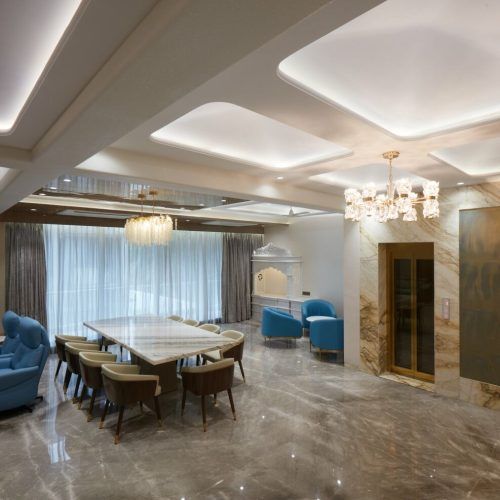
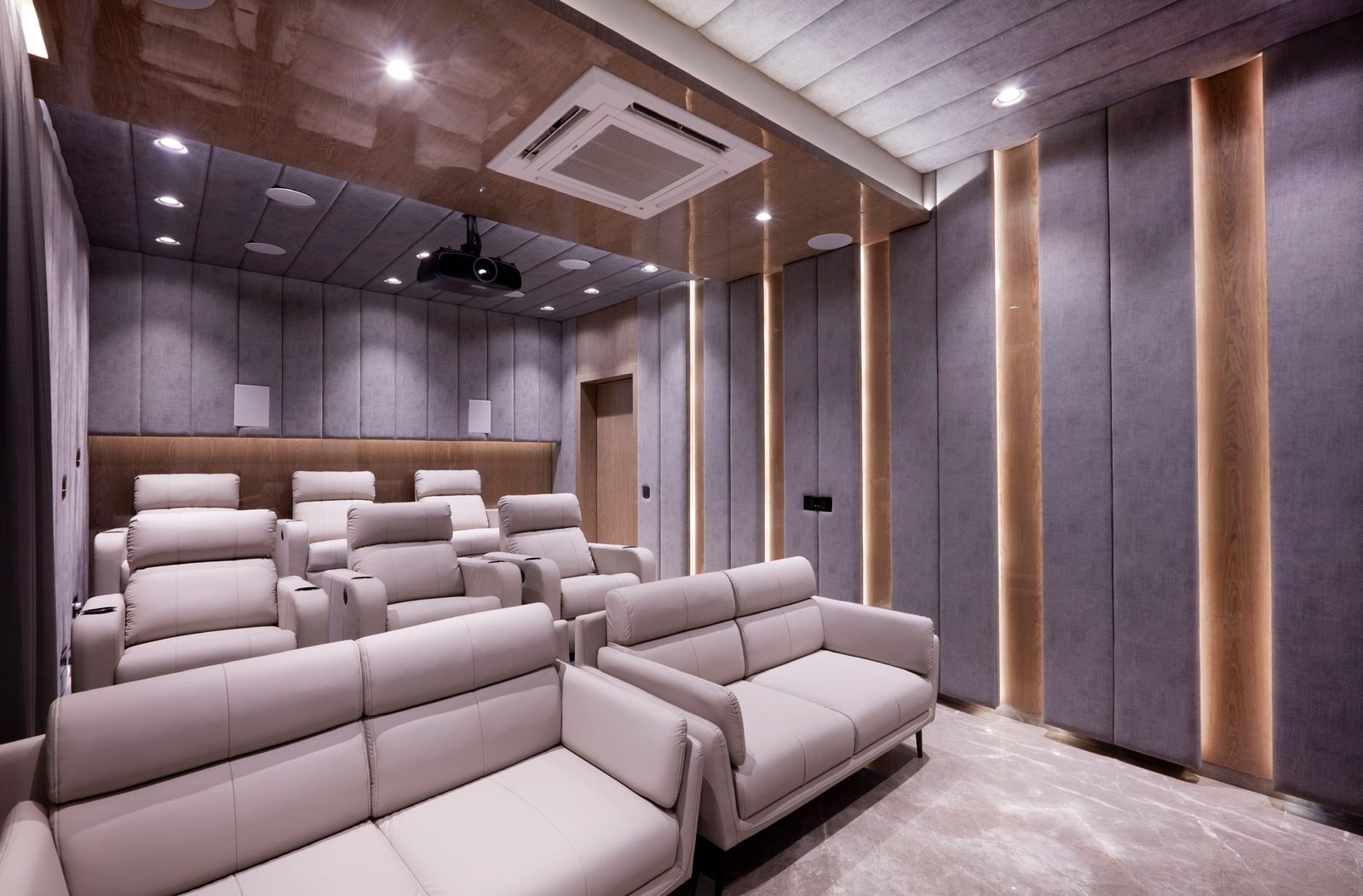
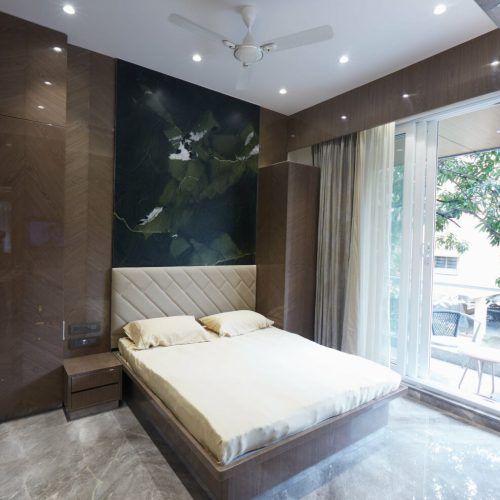
Selected work by Greenbox Design Studio. Tap any image to enlarge.
Frequently asked questions
Does a tiled floor look cheap next to marble?+
Not in large format with rectified 2 mm joints. At four feet a good 800 × 1,600 mm tile reads as stone. What still differs up close is the design repeat and the joint lines, and how much that matters depends on the room and on you.
Can vitrified tile be laid over an existing marble floor?+
Technically yes with a bonding primer, but we advise against it in older Mumbai buildings. You raise the floor level at every threshold, you inherit whatever is loose underneath, and debonding of the whole assembly is a real risk. Lift the old floor.
How much time does each take?+
Tile: two to four days for a flat and walkable immediately. Marble: laying is quick, but three weeks of curing before grinding, then three to four days of polishing. In an occupied renovation that programme difference often decides the material.
Which is better for a Mumbai monsoon?+
Tile. It does not stain, does not etch and needs no sealing, and wet feet through the front door are a four-month reality here. Marble handles water perfectly well but the acidic cleaners used on wet floors are the problem.
Is marble worth it in a small flat?+
Rarely. In a 650 sq ft flat the floor is largely covered by furniture and the visual return on an extra two lakh is small. We would spend it on joinery, lighting or the kitchen, all of which are used every day.