
Head to head
| Criterion | Engineered wood | Laminate |
|---|---|---|
| Surface | 2 – 4 mm real hardwood | Printed decor under melamine |
| Core | Multi-ply birch or HDF | HDF |
| Installed rate | ₹350 – 900 per sq ft | ₹80 – 200 per sq ft |
| Refinishing | Twice with a 3 mm wear layer | Not possible |
| Scratch resistance | Moderate; depends on the lacquer | High — AC4 and AC5 are very tough |
| Repair of a scuff | Spot repair on oiled finishes | Replace the plank |
| Humidity movement | Real; needs gaps and acclimatisation | Minimal |
| Underfoot | Warm, solid, quiet | Slightly hollow without good underlay |
| Life | 25 – 30 years with two re-sands | 8 – 12 years |
| Colour over time | Ambers or lightens with light | Stable |
Costed on a 350 sq ft bedroom suite
| Line | Laminate AC4, 10 mm | Engineered oak, 14 mm, 3 mm wear layer |
|---|---|---|
| Material and laying, 385 sq ft | ₹50,000 | ₹2,11,750 |
| Underlay or adhesive | ₹7,700 | ₹23,100 glue-down |
| Subfloor levelling | ₹13,500 | ₹17,300 |
| Skirting, 78 rft | ₹6,200 | ₹15,600 |
| Total, ex-GST | ₹77,400 | ₹2,67,750 |
Add a re-sand at year twelve for the timber at ₹120–220 per sq ft, and a full replacement at year ten for the laminate.
Design and build under one accountable roof
What the extra actually buys
- Renewability. A 3 mm wear layer takes two full sands. At year twelve, a timber floor is made new for ₹120–220 per sq ft; a laminate floor at year twelve is replaced.
- Depth. Real timber has grain that continues into the surface and takes light differently across the board. A printed decor repeats every few planks and reflects uniformly.
- Edges. A sawn timber plank has a real edge with real grain; a laminate plank has a printed bevel.
- Underfoot. Glue-down engineered timber is solid and quiet. Even good laminate sounds slightly hollow.
- Ageing. Timber develops colour. Laminate does not change, which is either an advantage or the reason it eventually looks dated, depending on your view.
Where laminate wins outright
- Households with dogs. Claws mark timber lacquer quickly and barely touch AC5 laminate.
- Children’s bedrooms, where the floor is used rather than admired.
- Rental flats, where the horizon is short and the tenant’s care is unknown.
- Rooms that are not air-conditioned and open to a balcony, where timber movement will be at its worst.
- Any project where choosing laminate releases ₹1.5–2 lakh for the joinery. In most Mumbai flats the joinery is used more than the floor is admired.
Humidity: the Mumbai constraint on timber
Wood gains and loses moisture with the air around it and moves across the grain when it does. Relative humidity in a Mumbai flat swings from around 45% on a February afternoon to over 85% through the monsoon, which is a wide range for a natural material.
- Acclimatise for at least 72 hours in the room, with the boxes open and the air conditioning running as it will in service.
- Specify 10–12 mm expansion gaps and narrower planks — 180 mm rather than 260 mm — because a wider board moves further across its width.
- Glue-down installation is materially more stable than floating, and in a coastal flat it is worth the ₹60–110 per sq ft premium.
- In a permanently open, sea-facing room, we do not recommend timber at all. SPC delivers a similar look without the risk.
- Laminate’s HDF core moves far less, which is the one climate advantage it holds — until water reaches it.
Buying either one without being misled
Both categories contain products sold under the same name at wildly different specifications, and showroom staff rarely volunteer the numbers that separate them.
- For engineered timber, ask the wear layer thickness in millimetres. A 0.6 mm veneer product and a 3 mm sawn layer are both called engineered wood and are not the same purchase.
- Ask what the core is. Multi-ply birch is dimensionally stable; an HDF core in an engineered plank behaves much more like laminate in humidity.
- For laminate, ask the AC class and the thickness. AC3 at 7 mm and AC5 at 12 mm are different products at similar-sounding prices.
- Ask what the quoted rate includes. Underlay, skirting, threshold profiles and subfloor levelling are frequently excluded and together add 25–35%.
- Ask for a full plank as a sample, not a 100 mm chip. Repeat patterns and bevel detail are invisible on a small sample and obvious across a room.
Verdict by room and budget
| Situation | Recommendation |
|---|---|
| Master bedroom suite, air-conditioned, mid-high budget | Engineered oak, glue-down, 3 mm wear layer |
| Children’s bedroom | Laminate AC4 |
| Living room with balcony access | SPC, or engineered timber only if the room is closed and cooled |
| Whole flat on a limited budget | Laminate in bedrooms, tile elsewhere |
| Rental or resale | Laminate or SPC |
| Long-horizon family home | Engineered timber — the re-sand at year twelve is the point |
Our default: engineered timber in the master suite of a home the client intends to keep, laminate or SPC elsewhere, and tile in every wet area. Timber throughout a Mumbai flat is rarely the right specification, however good it looks in the drawing.
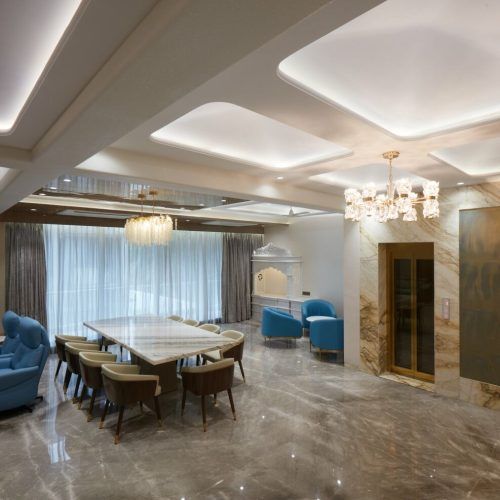
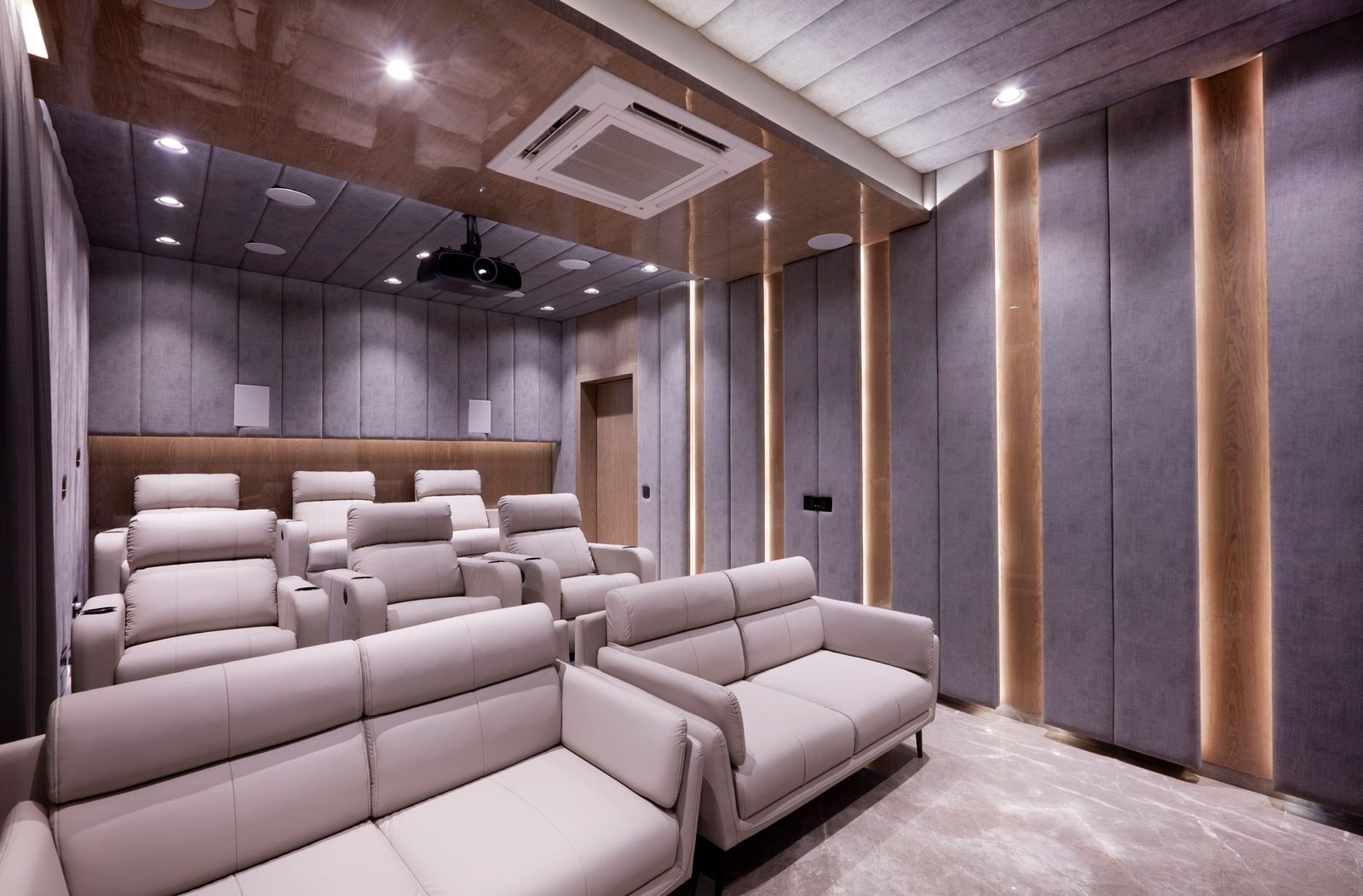
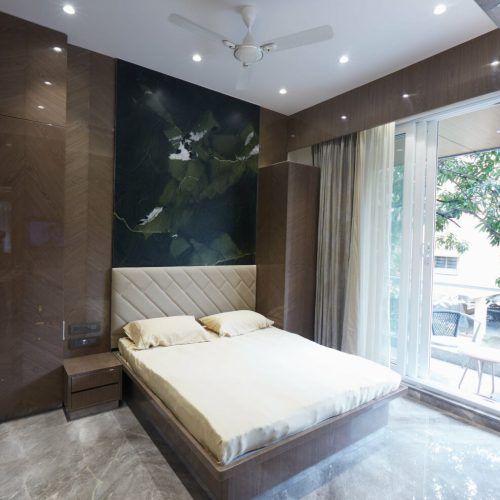
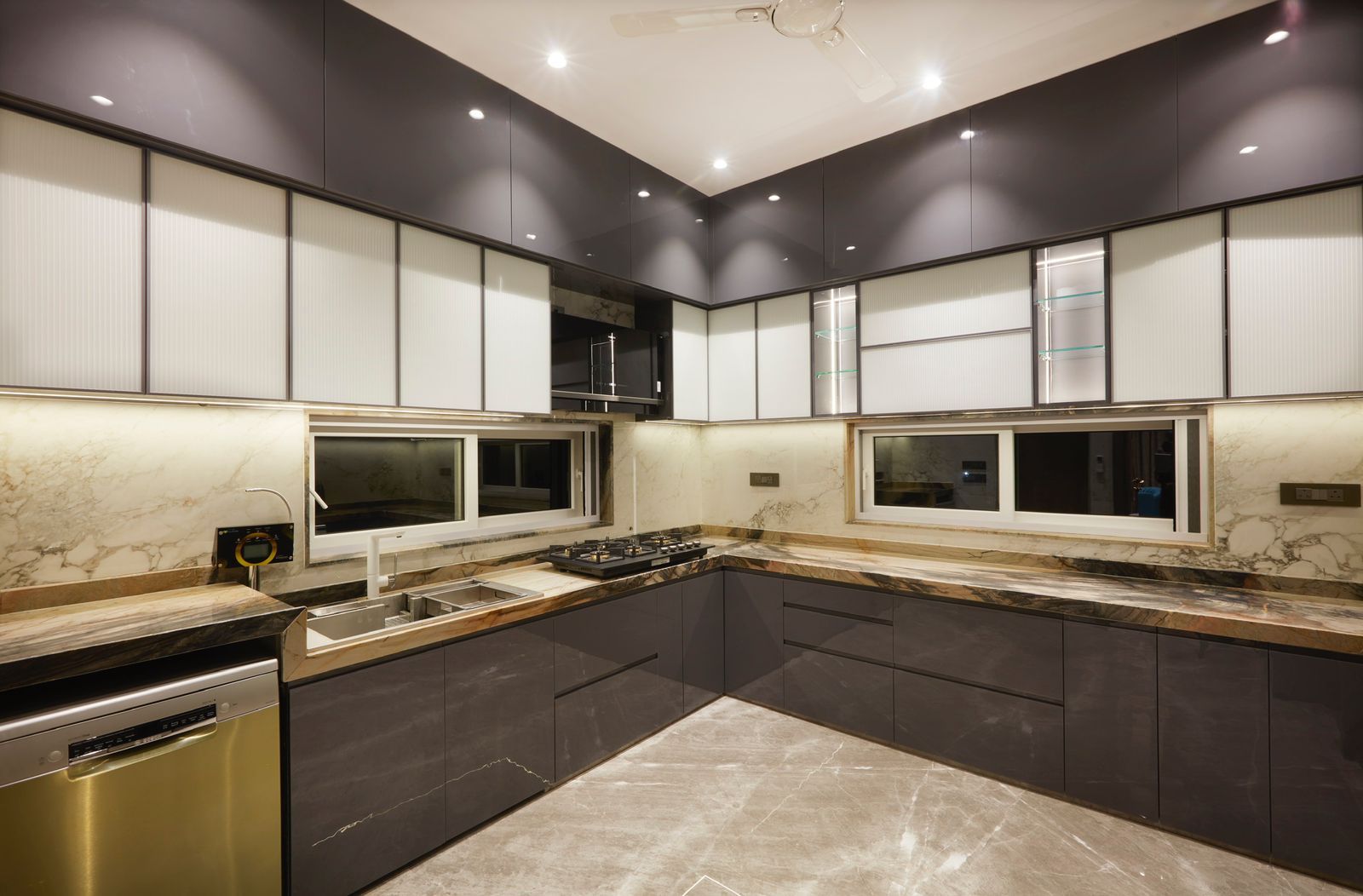
Selected work by Greenbox Design Studio. Tap any image to enlarge.
Frequently asked questions
Can engineered wood be sanded like solid wood?+
Yes, but only as many times as the wear layer allows — roughly once per millimetre above the first. A 3 mm layer gives two full sands; a 0.6 mm veneer product gives none and should be priced against laminate, not against timber.
Does laminate look convincing?+
At the top of the market, yes — embossed-in-register texture follows the printed grain and at three feet it reads as timber. What gives it away is the repeat every few planks and the uniform way it reflects light.
Which is better with pets?+
Laminate, clearly. AC4 and AC5 surfaces resist claw marks far better than a lacquered timber floor. If you have a dog and want timber, choose a hardwax-oiled finish that can be spot-repaired rather than a lacquer that cannot.
Can I use engineered wood in a Mumbai living room?+
If the room is air-conditioned for part of the day and the balcony door is not permanently open, yes. In a sea-facing flat with open windows, we would specify SPC instead. Never in the kitchen, bathrooms, utility or balcony.
What is the real lifetime cost difference?+
Over twenty-five years, a timber floor installed once with two re-sands often costs less than three laminate floors installed sequentially. That maths only works if you intend to stay, and if somebody will actually commission the re-sand.