
Head to head
| Criterion | Laminate | Natural veneer |
|---|---|---|
| What it is | Resin-impregnated printed paper, 1 mm | 0.5 mm slice of real timber |
| Installed rate | ₹190 – 390 per sq ft | ₹480 – 1,400 per sq ft |
| Consistency | Identical sheet to sheet | Every panel differs; bundles must be matched |
| Scratch resistance | High | Moderate — depends on the polish |
| Water tolerance at an edge | Good if banded | Poor unless sealed on all six faces |
| Repairable | No — replace the panel | Yes — sand and re-coat in place |
| Ages by | Looking dated | Developing colour and depth |
| Life in a Mumbai flat | 12 – 15 years wardrobes | 15 – 20 years with one re-coat |
| Sunlight | Colour-stable | Ambers or lightens; shading recommended |
Costed on a real elevation
A master bedroom wardrobe of 12 ft width by 8 ft height is 96 sq ft of elevation. Same BWP carcass, same hardware, only the face material changes.
| Line | Laminate | Veneer, matt PU polished |
|---|---|---|
| Carcass, 19 mm BWP | ₹96,000 | ₹96,000 |
| Shutter faces, 96 sq ft | ₹23,000 | ₹62,000 |
| Internals and shelving | ₹34,000 | ₹34,000 |
| Hardware, mid tier | ₹28,000 | ₹28,000 |
| Polishing on site | — | ₹18,000 |
| Total, ex-GST | ₹1,81,000 | ₹2,38,000 |
The delta is ₹57,000 on one wardrobe, or roughly ₹1.7 lakh across three. Add the year-eight re-coat at ₹120–180 per sq ft for veneer.
Design and build under one accountable roof
The trade-offs, stated honestly
- Veneer is a commitment. It needs sealing on six faces, shading from strong sun, dry cleaning and a re-coat around year eight. A household that will not do those things gets a tired-looking wardrobe.
- Laminate is unrepairable but replaceable. A damaged shutter is swapped for a new one, which is fine if you kept surplus sheet and impossible if the shade is discontinued.
- Veneer is never consistent. Clients who want thirty feet of identical grain should specify reconstituted veneer or accept laminate; natural timber will not deliver it.
- Laminate has become very good. Textured, synchronised laminates register the emboss to the printed grain, and at three feet most people cannot tell. At arm’s length, they can.
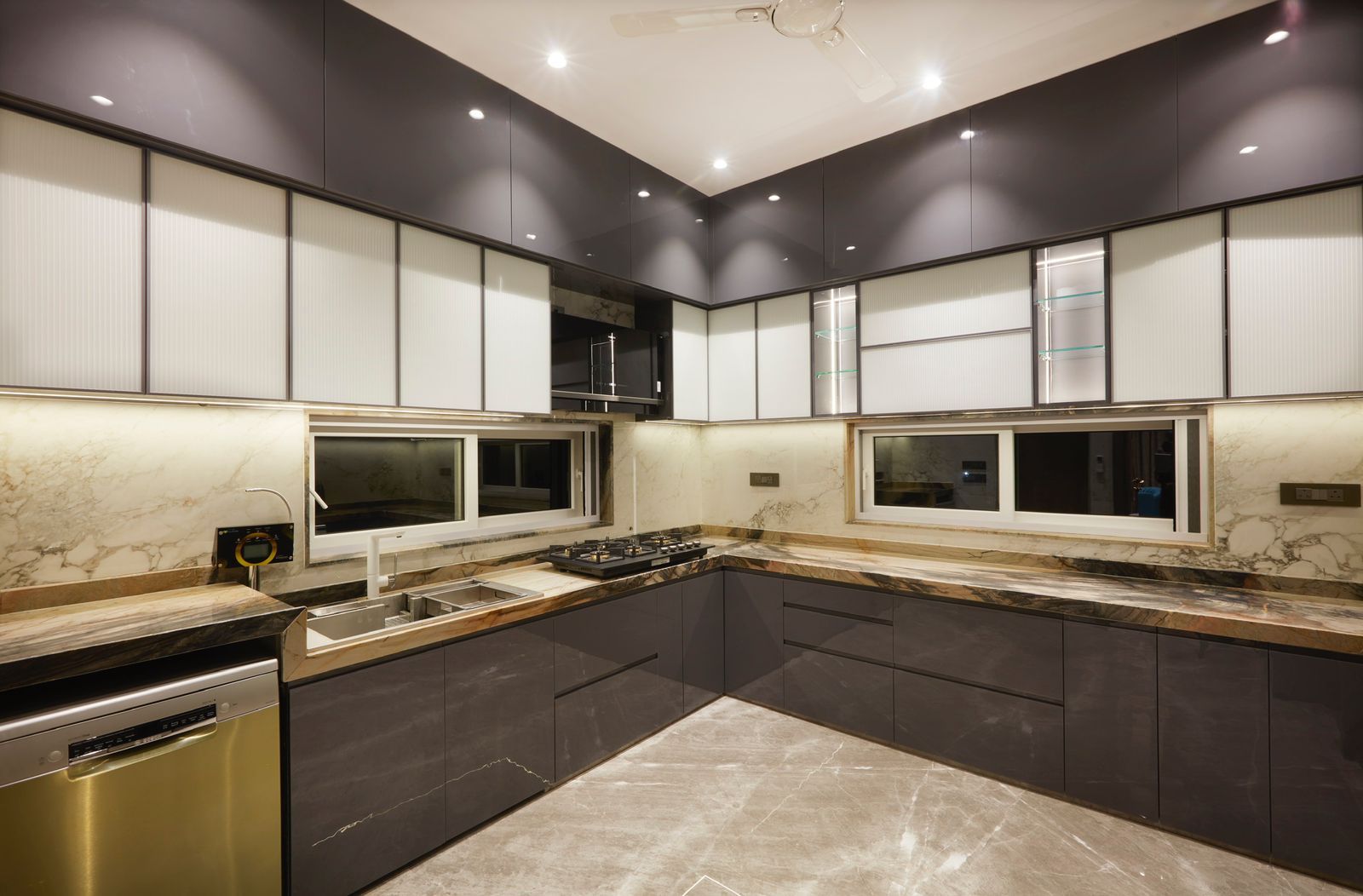
- Veneer in a kitchen base run is a mistake. We build kitchens with veneer tall units and laminate or acrylic base shutters in a matched tone, and the difference is invisible from the doorway.
When laminate is the better answer, not just the cheaper one
- Kitchen base units, utility joinery and anything near water.
- Children’s bedrooms, where the finish will be tested rather than admired.
- Rental and resale fit-outs, where durability per rupee is the whole brief.
- Long continuous runs where consistency matters more than character.
- Any flat where the money saved lets you upgrade the carcass from BWR to BWP. That is a better trade than a nicer face on a weaker box.
How each looks after ten years in a Mumbai flat
New, both materials look excellent, and showroom comparisons tell you nothing useful. The interesting question is what a decade of humidity, sunlight and family use does to each.
- Laminate at year ten: the face is largely unchanged — that is the point of a thermoset surface. What has aged is the edge banding at the corners, the odd chipped edge and, most of all, the design language. Laminate schemes date; they do not wear out.
- Veneer at year ten: the polish has dulled, the colour has shifted, and any panel in afternoon sun is visibly lighter or warmer than its neighbour. A re-coat at ₹120–180 per sq ft brings it back completely, and that is the material’s genuine long-term advantage.
- Laminate failures are mechanical: a lifted edge band, a bubbled face from a poor adhesive, an impact chip. None can be repaired; each means a replaced panel.
- Veneer failures are cosmetic first: a water ring, a scuffed edge, an uneven sheen. All of them are sandable.
- The practical consequence: if you plan to renovate again in twelve years, laminate is the sensible material. If this joinery is meant to last twenty-five, veneer justifies the premium.
Verdict by budget
| Joinery budget for a 2BHK | What we would specify |
|---|---|
| Under ₹5 lakh | Laminate throughout; put the saving into BWP carcasses and better hardware |
| ₹5 – 8 lakh | Laminate on wardrobes and kitchen, veneer on one feature element such as the bed back |
| ₹8 – 12 lakh | Veneer on bedroom wardrobe fronts and the living room panelling, laminate in the kitchen and utility |
| Above ₹12 lakh | Veneer wherever it is seen, with matched laminate or acrylic wherever it is used hard |
If we had to choose one for a whole flat and could not mix: laminate. It is the more sensible material for how Indian homes are actually used, and the money saved buys a better carcass. But mixing is almost always available, and it is almost always the better answer.
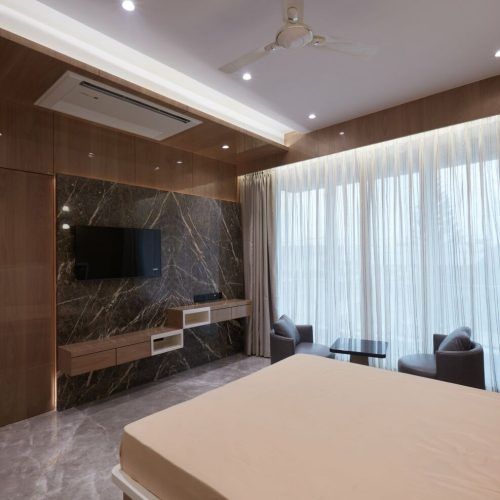
Selected work by Greenbox Design Studio. Tap any image to enlarge.
Frequently asked questions
Can people tell the difference between veneer and a good laminate?+
At three feet, often not — textured synchronised laminates are convincing. At arm’s length and under raking light, yes: the repeat in the print becomes visible and the grain does not continue around an edge. Whether that matters depends on the room and on you.
Is veneer more durable than laminate?+
Less scratch resistant, more repairable. Laminate resists damage better day to day; veneer can be sanded and re-coated when it eventually looks tired, which laminate cannot. Over twenty years, well-maintained veneer outlasts laminate; over five, laminate looks better.
Can I use veneer in a kitchen?+
On tall units and away from the sink and hob, yes, and it looks superb. On base units, no. The standard solution is veneer talls with laminate or acrylic base shutters in a matched tone, which costs less and survives.
Does veneer need maintenance?+
Dry dusting, no standing water, shading from strong afternoon sun, and a PU re-coat at roughly year eight costing ₹120–180 per sq ft. If nobody in the household will do the first three, specify laminate and spend the difference elsewhere.
Which is better for resale value?+
Neither materially changes a flat’s value in Mumbai. What buyers notice is whether the joinery is sound, the kitchen works and the finishes are intact. A well-executed laminate scheme shows better at resale than tired veneer.