
Specifying for a closed house
| Element | City home | Farmhouse | Why |
|---|---|---|---|
| Upholstery | Any fabric | Removable washable covers, or leather | Fabric left in a closed humid house mildews; covers can be taken home or washed |
| Mattresses and bedding | Left made up | Stored in a sealed box with silica between visits | A made bed in a closed house for three weeks in July is not a made bed |
| Carcass | BWP in wet areas | BWP or WPC throughout, edge-sealed on all faces | No air movement means every carcass is at ambient humidity continuously |
| Flooring | Anything | Stone, terracotta, vitrified — not timber or laminate | Timber floors in an unoccupied humid house cup and gap |
| Curtains | Any | Washable, lined, on rings so they can be taken down | They will need washing after the monsoon, every year |
| Paint | Emulsion | Washable exterior-grade on external walls, breathable inside | Wall moisture is higher and nobody is wiping it off |
| Electronics | Left plugged in | Switched off at the socket, and a surge protection device at the board | Rural supply surges are real and there is nobody to unplug during a storm |
Pests, damp and the things that arrive
- Termite treatment, pre-construction and annual. A soil treatment at construction and a contract for annual inspection. In a rural or semi-rural plot this is not optional, and timber joinery without it is a two-year investment.
- Rodent exclusion is a detailing job. Seal every service penetration with steel wool and mortar, not foam. Mesh every vent, every gap at the eaves and the gap under every external door. A rodent in a closed house for three weeks does a remarkable amount of damage.
- Insect mesh on every opening, on a frame that can be opened for cleaning. The house will be aired when you arrive, and you will want the windows open without the wildlife.
- Snakes and the perimeter. Keep planting 600 mm clear of the external walls, avoid dense ground cover against the plinth, and seal the gap under every door.
- Damp is the slow one. An unventilated house builds humidity for three weeks. Cross-ventilation designed into the plan, louvred vents that can be left open securely, and a dehumidifier on a timer where there is reliable power.
- Water ingress goes unnoticed. A roof leak in a city home is found the same day; here it is found three weeks later. Overspecify the roof, and consider a simple water-leak sensor on a mobile alert.
Empty for twenty-five days a month, and it has to survive that
Power and water
- Assume the supply fails. A grid connection in a rural or semi-rural location is intermittent, and a farmhouse with no backup is a farmhouse you cannot use in May.
- Solar with battery storage is now the sensible default rather than a statement. A 3–5 kW system with 5–10 kWh of storage costs ₹3.5–₹8 lakh and covers lights, fans, the pump, the refrigerator and the router indefinitely.
- A generator for the air conditioning if the house is used in summer, because solar sized for AC gets expensive quickly. A 7.5–15 kVA silent set is ₹2.5–₹6 lakh installed.
- Water source and storage. Borewell, tanker or a municipal line, with an underground sump of at least a full weekend’s use plus reserve, and an overhead tank for gravity feed.
- Test the water and treat it. Rural groundwater is frequently hard, saline or iron-bearing. A test costs ₹2,000 and decides whether you need softening, an iron filter or reverse osmosis — and it decides your tap and shower specification too, because hard water destroys chrome.
- Waste water. A septic tank and soak pit properly sized and positioned, or a small treatment plant. Position it downhill and away from the borewell, and design access for desludging.
Designing for arrival and departure
The experience of a weekend house is bookended by two twenty-minute rituals, and designing for them is what makes a house genuinely usable rather than a project you dread visiting.
| Ritual | What has to happen | What the design provides |
|---|---|---|
| Arrival | Power on, water on, house aired, bedding out, fridge running | A single labelled control point; a bedding store in each bedroom; a fridge on the backup circuit that stays running |
| Opening up | Windows and louvres open, fans on | Openings that one person can operate; secure louvres that can stay open |
| Departure | Everything closed, soft goods stored, water and gas off, power down except essentials | A departure checklist mounted by the door and a single main switch that leaves the essentials live |
| Between visits | Caretaker access, watering, a weekly airing | A separate caretaker entrance or a lockable store, and an external tap with an irrigation timer |
The best farmhouse we ever built has a laminated card by the front door with nine things on it. The client says it is the most useful thing in the house.
Greenbox principal designer
Materials that suit the brief
- Stone, terracotta and kota floors. Cool underfoot, indifferent to humidity, improve with age and survive being unwashed for a month.
- Lime plaster and mineral paint. Breathable, which matters in a house that is closed for long periods, and they mark gracefully rather than badly.
- Solid or seasoned timber with an oil finish, not PU. An oiled surface can be refreshed locally after a damp season; a lacquered one that has blistered has to be stripped.
- Leather, canvas and jute over delicate upholstery. All three tolerate humidity and improve with wear.
- Stainless or powder-coated steel for anything outdoors, and galvanised for anything structural. Mild steel in a semi-rural plot with no one repainting it lasts three years.
- Simple, robust hardware. Nothing with an electronic component that has to survive three weeks of humidity, and nothing that cannot be replaced from a town twenty kilometres away.
Planning the house around how it is used
A weekend house is occupied differently from a home. Usually more people, all at once, for two days, and then nobody. That pattern should be in the plan.
- More beds than bedrooms. Weekend houses host. Two bedrooms and a family room that sleeps four more is often more useful than four bedrooms, and it is cheaper.
- One very large shared space. The point of these houses is everybody in one room. Make the living, dining and kitchen a single generous volume that opens outward.
- An outdoor kitchen or a barbecue point. It is used on every visit and it keeps the heat and the smell out of the house.
- A verandah deeper than you think. 2,400 mm minimum, and 3,000 if the budget allows. Below 2,000 mm a verandah is a corridor with a view rather than a room.
- A bathroom reachable from outside. Wet from the pool or the garden, nobody should be crossing the living room. One bathroom with an external door solves it.
- Storage for the things that stay. Games, books, sports equipment, spare bedding, tools. A weekend house accumulates, and without a store it accumulates on surfaces.
Related and local
For weekend homes within reach of Mumbai — Alibaug, Karjat, Lonavala and the Palghar coast — see farmhouse interior designers in Mumbai. For a permanently occupied standalone house, see villa interior design, which shares the structure but not the intermittency.
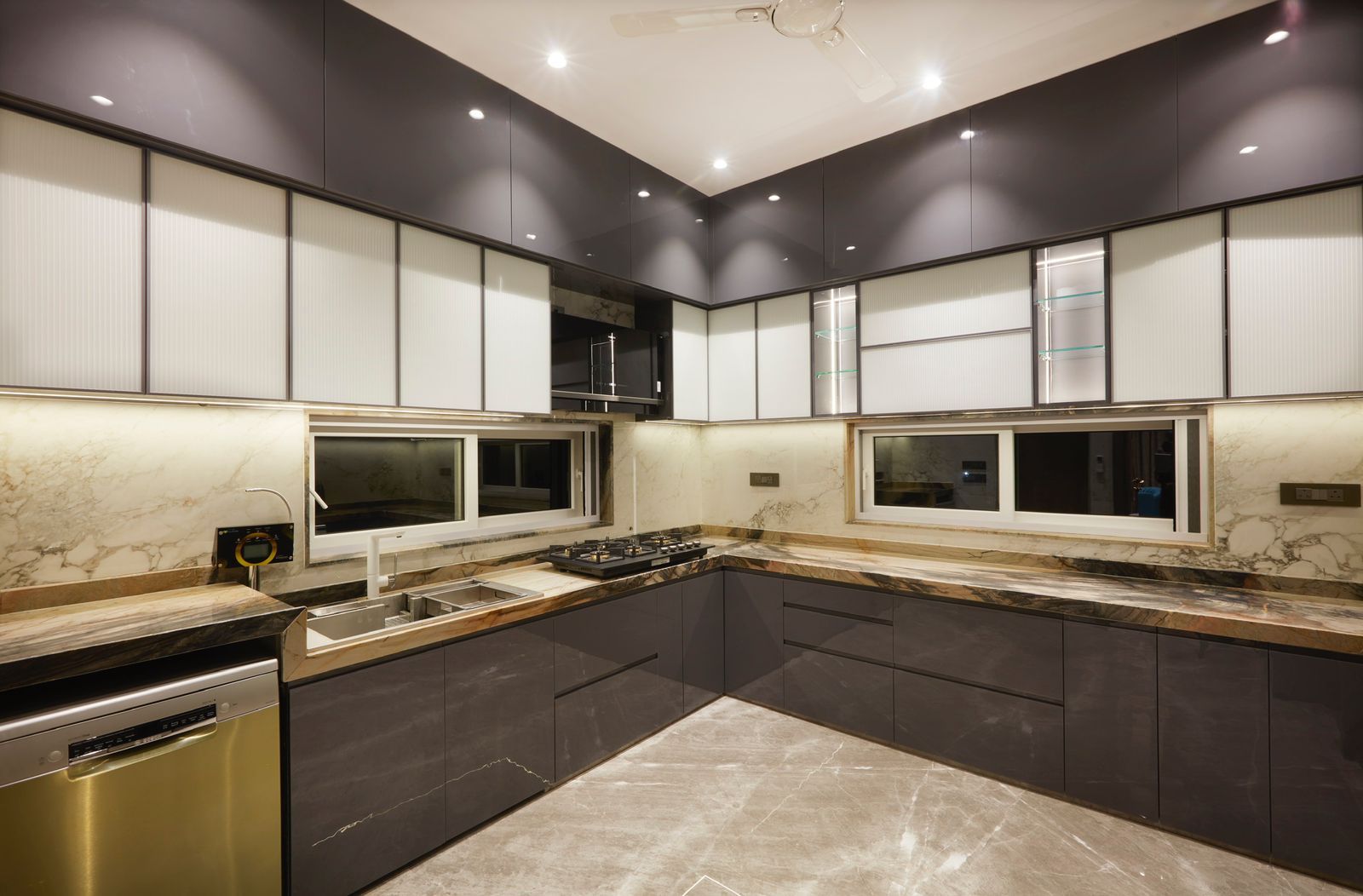
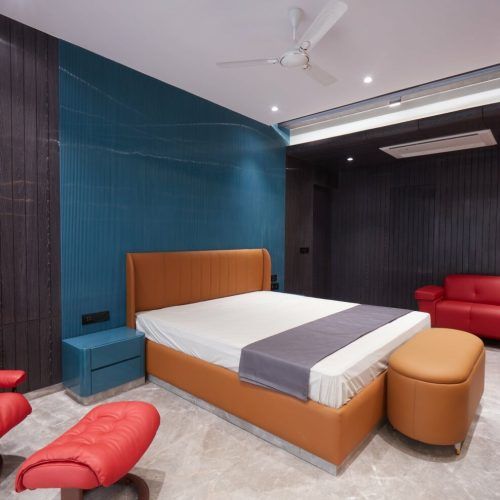
Selected work by Greenbox Design Studio. Tap any image to enlarge.
Frequently asked questions
What is different about designing a weekend house?+
It is empty for most of the month with no air movement, no dehumidification and nobody to notice a leak. That rules out timber floors, delicate upholstery and made-up beds, and it adds requirements a city home does not have — pest exclusion, off-grid power and water, water treatment and a caretaker arrangement.
How much does a farmhouse interior cost?+
₹1,400–₹4,000 per sq ft of built-up area, ex-GST, over a programme of 20–32 weeks. Solar with battery storage adds ₹3.5–₹8 lakh, a silent generator ₹2.5–₹6 lakh, and water treatment, septic and borewell work are all separate from the interior package.
How do you keep pests out of an empty house?+
A soil termite treatment at construction with an annual inspection contract; every service penetration sealed with steel wool and mortar rather than foam; insect mesh on every opening in a cleanable frame; planting kept 600 mm clear of the external walls; and the gap under every external door sealed. A rodent in a closed house for three weeks does a great deal of damage.
What flooring works in a farmhouse?+
Stone, terracotta, kota or vitrified. All are indifferent to humidity, cool underfoot and survive a month without cleaning. Timber and laminate floors in an unoccupied humid house cup and gap, and repairing that is more disruptive than the floor was worth.
Is solar worth it for a weekend home?+
Usually yes. A 3–5 kW system with 5–10 kWh of battery storage at ₹3.5–₹8 lakh covers lights, fans, the pump, the refrigerator and the router indefinitely, which is exactly the load you need running while nobody is there. Air conditioning is a different calculation and is generally better served by a generator.
Should I test the water?+
Always, before specifying anything. A ₹2,000 test tells you whether rural groundwater is hard, saline or iron-bearing, which decides whether you need softening, an iron filter or reverse osmosis. It also decides the tap and shower specification, because hard water strips chrome and blocks aerators within a year.