
Four locations, four different problems
| Location | From Mumbai | The climate problem | ₹ / sq ft |
|---|---|---|---|
| Alibaug and Kihim | Ferry 1 hr, or road 2.5–3 hrs | Full coastal salt exposure; sandy ground and high water table | ₹2,200 – 4,500 |
| Kashid, Murud, Nagaon | Road 3.5 – 4.5 hrs | Coastal, more remote; labour and material supply is the constraint | ₹1,900 – 3,600 |
| Karjat and Neral | Road 2 – 2.5 hrs | Heavy monsoon, river-adjacent plots, humidity year round | ₹1,700 – 3,200 |
| Lonavala and Khandala | Road 2 – 2.5 hrs | 2,500–4,000 mm of rain, fog, wind-driven water on every elevation | ₹2,000 – 4,000 |
| Palghar, Kelve, Dahanu | Road 2 – 3 hrs | Coastal, hot, quieter; the best value of the five | ₹1,600 – 3,000 |
Built-up area basis, ex-GST. Excludes landscape, boundary, pool, solar, borewell and septic, all of which are substantial separate items.
Logistics, which is most of the premium
- Material travels from Mumbai. Joinery, hardware, stone, sanitaryware and finishes all come from the city, in full loads, on a schedule. Freight and handling is typically 4–7% of the project.
- So does the crew. Skilled carpenters, polishers and electricians travel and stay. Accommodation, food and travel add 6–11% and it belongs on the BOQ as a named line rather than hidden in the rates.
- Local labour for civil work. Masonry, plaster and tiling teams are available locally and are generally good. Fine joinery and finishing are not, and pretending otherwise is the commonest cause of a poor farmhouse.
- Deliveries are consolidated, not incremental. A forgotten item is not a two-hour problem; it is a week. We over-order consumables deliberately and keep a locked stores container on site.
- Supervision costs more. A site three hours away needs a resident supervisor rather than visits, and that has to be priced honestly.
- Alibaug ferry loads have limits. The Mandwa and Rewas routes have vehicle restrictions, so heavy or oversized items go by road via Panvel, which is three hours instead of one.
Two and a half hours from Bandra, and a different climate
The envelope, in this rainfall
- Lonavala and Karjat take 2,500–4,000 mm a year. That is three to four times Mumbai and it arrives horizontally. Every elevation is a weather elevation, not just the west one.
- Deep overhangs earn their cost. A 900–1,200 mm roof overhang keeps water off the walls and windows and is cheaper than any waterproofing remedy.
- Roof waterproofing October to May only. A membrane laid in the monsoon debonds, and in a house nobody visits for three weeks the failure is discovered late.
- External joinery in the ghats is a liability. Timber doors and windows on an exposed elevation need a deep reveal, a drip and an annual maintenance commitment, or they should be aluminium.
- Fog and condensation at Lonavala mean that even internal surfaces stay damp. Breathable finishes, cross ventilation and no sealed cupboards on external walls.
- Plinth and ground levels. A high plinth, drainage away from the building and no paving above the internal floor level. Most of the damp problems we find in these houses start here.
The caretaker, who is part of the design
Almost every functioning weekend house near Mumbai has a caretaker, and the houses that work well have designed for that person rather than accommodating them afterwards.
| Provision | What it needs | Why |
|---|---|---|
| Caretaker accommodation | A room with a window, a WC, a washing point and a lockable cupboard | The same standard you would accept; it is somebody’s home |
| Separate access | An entrance that does not pass through the main house | Independence in both directions |
| A lockable owner’s store | One room or a large cupboard that stays locked between visits | Personal items, alcohol, electronics, linen |
| Simple controls | Labelled switches, one main, clear valve positions | Instructions have to be followable without a phone call |
| Irrigation on a timer | An external tap and a timer for the planting | Watering should not depend on somebody remembering |
| A defined maintenance list | Weekly airing, monthly checks, seasonal tasks, written down | The difference between a house that lasts and one that decays quietly |
A client in Karjat came down after the monsoon to find the house perfect and the caretaker’s room with water coming through the roof. We now build that room to the same specification as the rest of the house, and it is not a negotiation.
Greenbox principal designer
What the programme looks like from Mumbai
- Weeks 1–4 — survey and design. Two site visits minimum, because a plot three hours away cannot be re-measured casually. Levels, orientation, water source, power position, access route and the neighbours all recorded at once.
- Weeks 5–8 — BOQ, approvals and the long-lead order. Solar, generator, borewell, septic and any imported item ordered now, because a six-week lead item on a remote site is a six-week stoppage.
- Weeks 9–16 — civil, waterproofing and services. Local teams, resident supervision, and the roof completed before any monsoon window closes.
- Weeks 17–28 — joinery and finishes. Made in Mumbai, delivered in consolidated loads, installed by a travelling crew accommodated on or near site.
- Weeks 29–36 — external works, landscape and commissioning. Driveway, boundary, planting, irrigation, solar commissioning and a full handover walk with the caretaker present.
- Then a twelve-month check. These houses reveal their faults after one full monsoon, not at handover. We build a post-monsoon visit into every farmhouse contract.
Coastal, at Alibaug and Kashid
A house within a kilometre of the sea at Alibaug, Kihim or Kashid is in a harsher environment than anywhere in Mumbai city. SS 316 on every exposed fixing without exception, marine ply on all external walls and balcony joinery, anodised aluminium at 25 microns or a marine-grade powder coat, and corrosion-protected AC coils on every unit. Sandy ground and a high water table add two more items: a proper waterproofed plinth with a damp-proof course, because rising damp here is faster than in the city, and a septic system positioned with real care relative to the borewell. Salt also reaches the interiors — expect to wipe down hardware regularly and to specify hinges and runners that can be replaced rather than ones built into the carcass.
The general discipline
Specifying for intermittent occupancy, pest and damp exclusion, off-grid power and water, and the arrival and departure rituals are set out on farmhouse interior design services. For a permanently occupied standalone house in this region, see villa interior designers in Mumbai.
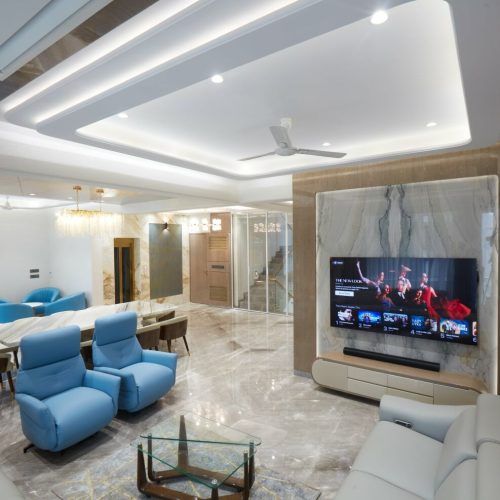
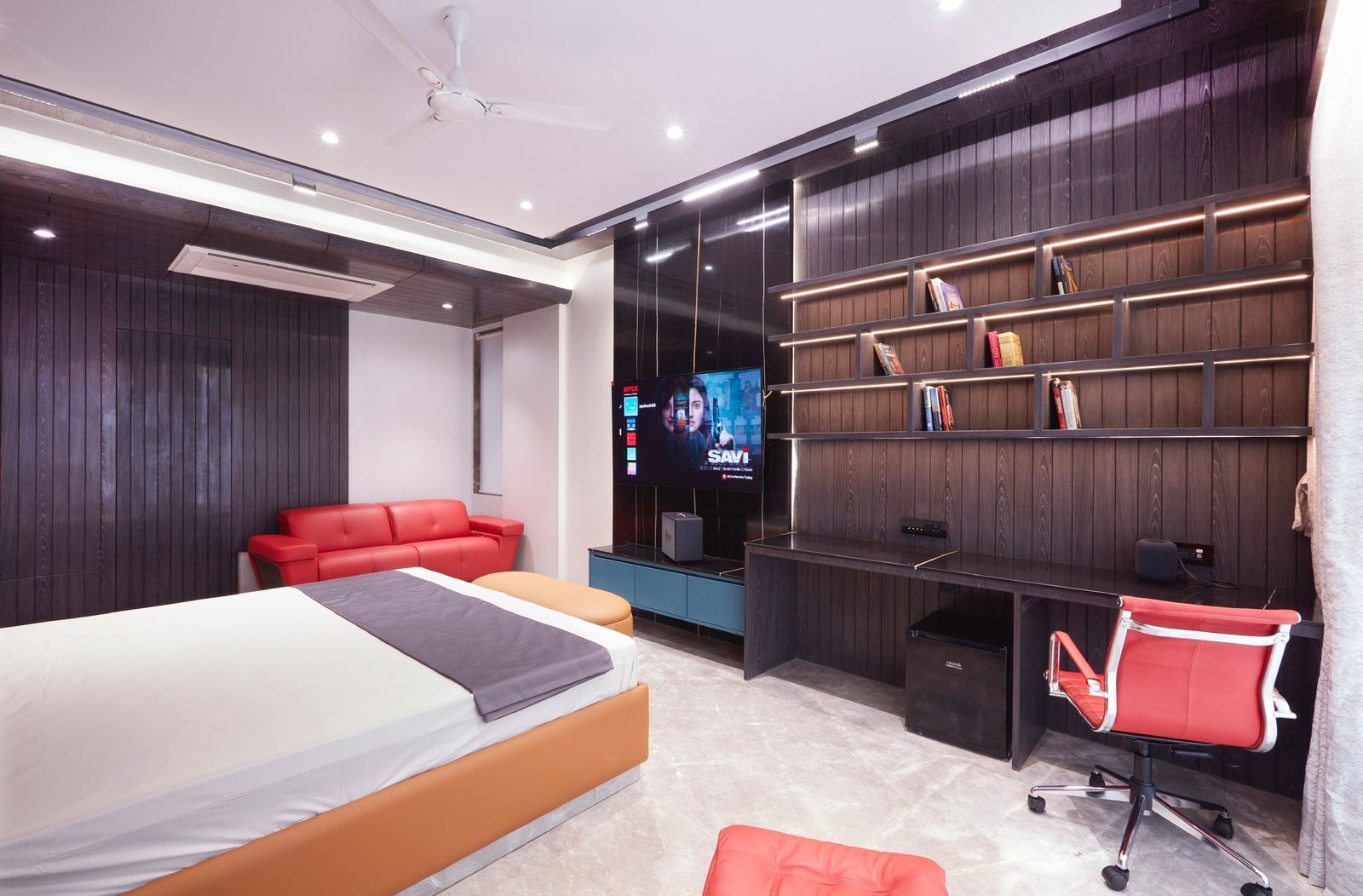
Selected work by Greenbox Design Studio. Tap any image to enlarge.
Frequently asked questions
What does a weekend home cost to do up near Mumbai?+
₹1,600–₹3,000 per sq ft of built-up area in Palghar and Dahanu, ₹1,700–₹3,200 in Karjat, ₹1,900–₹3,600 in Kashid and Murud, ₹2,000–₹4,000 in Lonavala and ₹2,200–₹4,500 in Alibaug and Kihim. Ex-GST, excluding landscape, boundary, pool, solar, borewell and septic.
Why is a farmhouse more expensive per sq ft than a city home?+
Because everything travels. Material freight and handling is 4–7% of the project and the crew — skilled carpenters, polishers and electricians who are not available locally — adds 6–11% in travel, accommodation and food. Supervision also costs more, because a site three hours away needs a resident supervisor rather than visits.
How much rain does a Lonavala or Karjat house get?+
2,500–4,000 mm a year, three to four times Mumbai, and it arrives horizontally, so every elevation is a weather elevation. Deep 900–1,200 mm roof overhangs, roof waterproofing laid October to May only, deep window reveals with drips, and a high plinth with drainage away from the building.
Is Alibaug harsher than Mumbai for materials?+
Yes, considerably, within a kilometre of the sea. SS 316 on every exposed fixing without exception, marine ply on external walls and balcony joinery, anodised aluminium at 25 microns, corrosion-protected AC coils on every unit, and hinges and runners specified so they can be replaced rather than built permanently into a carcass.
Do I need a caretaker?+
Almost every functioning weekend house near Mumbai has one, and the houses that work have designed for them: a room with a window, a WC, a washing point and a lockable cupboard, a separate entrance, a lockable owner's store for personal items, labelled controls, irrigation on a timer and a written maintenance list.
Can I get to an Alibaug site by ferry with materials?+
Partly. The Mandwa and Rewas ferry routes have vehicle restrictions, so heavy or oversized loads go by road via Panvel, which is about three hours instead of one. We consolidate deliveries into full loads on a schedule and keep a locked stores container on site, because a forgotten item is a week rather than an afternoon.