
What Mumbai does to a floor
Three local conditions decide this. Humidity between 80% and 95% for four months a year, which any wood-based product will absorb and then release, moving as it does so. Wet feet — Indian bathroom use and monsoon entry mean water reaches the floor outside wet areas routinely, not occasionally. And salt-laden air within a couple of kilometres of the coast, which attacks metal trims and fixings rather than the floor itself but shows up as rust staining at thresholds.
Against that, the flat is usually a concrete slab with a screed, at a fixed level set by the door thresholds, in a building where the lift limits the size of what can be carried up. Those constraints matter as much as the material choice.
The materials compared
| Flooring | Humidity | Wet areas | Rate laid / sq ft | Life |
|---|---|---|---|---|
| Vitrified tile, 800 × 800 | Excellent | Yes | ₹110 – ₹210 | 20 yrs+ |
| Vitrified tile, 1200 × 600 | Excellent | Yes | ₹150 – ₹260 | 20 yrs+ |
| Ceramic tile | Excellent | Yes | ₹65 – ₹120 | 10 – 15 yrs |
| Engineered wood | Good if RH controlled | No | ₹320 – ₹750 | 15 – 20 yrs |
| Laminate | Poor — joints swell | No | ₹120 – ₹260 | 5 – 8 yrs here |
| Luxury vinyl plank (LVT) | Very good | Splash tolerant | ₹180 – ₹420 | 10 – 15 yrs |
| Natural stone (Kota, marble) | Good | Yes, if sealed | ₹190 – ₹900 | 30 yrs+ |
| Mosaic / terrazzo, existing | Excellent | Yes | ₹85 – ₹160 to polish | Already proven |
Design and build under one accountable roof
Why large format changes the room
The single most visible difference between a well-floored flat and an ordinary one is the number of lines in the floor. A 600 × 600 tile in a 12 × 14 foot bedroom produces about 60 grout lines. The same room in 1200 × 600 produces 28. Fewer lines read as a larger, calmer plane, and grout is also the part of a floor that discolours, so fewer joints means less visible ageing.
Large format has two costs. It needs a flatter substrate — deviation above 3 mm over 2 m will produce lippage between tiles, which is both visible and a trip hazard, so an old flat often needs a levelling screed first at ₹45–₹90 per sq ft. And it is heavier and more awkward to carry up in a small lift; a 1200 × 600 porcelain tile weighs about 17 kg and comes two to a box.
Wood, honestly
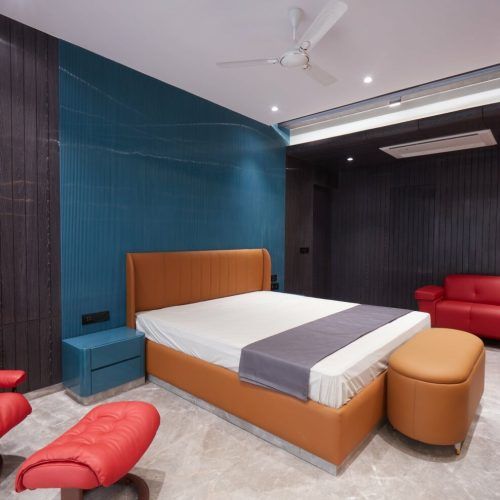
Clients ask for wooden bedroom floors constantly, and the honest answer depends on which product and which room. Solid wood in Mumbai moves seasonally enough to open gaps and cup at the board edges; we no longer specify it for flats. Laminate — an HDF core with a printed surface — is the cheapest and the worst performer here, because the core swells irreversibly at any joint that gets wet, and a mop is enough. Engineered wood, with a real hardwood veneer over a plywood core, is dimensionally much more stable and is the only wood-based floor we recommend, in bedrooms only, at ₹320–₹750 per sq ft.
Whichever you choose, do not lay it during the monsoon. Boards that acclimatise at 90% relative humidity shrink in December, and 1–2 mm gaps open at every joint across the room. Acclimatise the material in the flat for 72 hours before laying and lay between November and May.
Wet areas, balconies and thresholds
- Bathrooms: anti-skid rated tile, R10 or better, in a 300 × 300 or 600 × 600 format. Larger tiles reduce the fall available to the drain and are harder to grade correctly.
- Fall to drain: 1 in 80 minimum across a bathroom floor. Check it with a spirit level and a bucket of water before the grout goes in, not after.
- Balconies: anti-skid, frost-irrelevant but UV-relevant; an outdoor-rated porcelain holds colour where an indoor tile fades.
- Thresholds: keep the level change under 10 mm, and use a stone or solid-surface threshold rather than an aluminium profile near the sea, which will corrode.
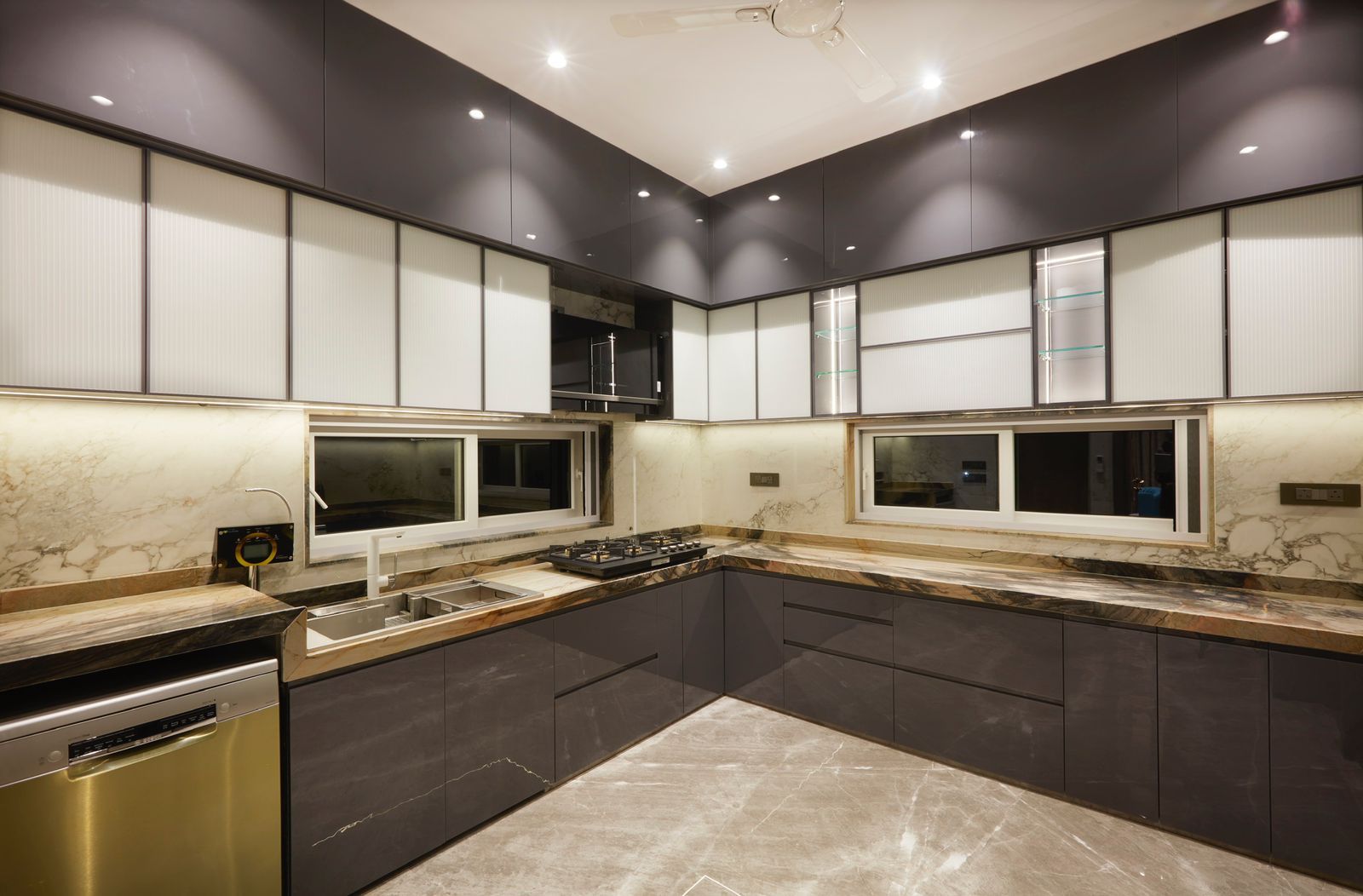
- Kitchen: the same tile as the living area for continuity, but check the anti-skid rating; a polished floor with a spill of oil on it is genuinely dangerous.
- Skirting: 75–100 mm in the same material as the floor reads cleanest. MDF skirting on an external wall will swell; use PVC or WPC there.
If the existing floor is sound and level, the best flooring decision in Mumbai is usually to keep it and spend the money on light.
Greenbox principal designer
Grout, and why it decides how the floor ages
The tile you choose will look much the same in ten years. The grout will not. Standard cementitious grout is porous, absorbs everything that gets mopped into it, and goes from light grey to a patchy dark grey within two or three years in a household with children or pets. Epoxy grout costs ₹28–₹55 per sq ft more to lay and is genuinely non-porous — it stays the colour it was. On a 900 sq ft flat that is ₹25,000 to ₹50,000, which is a real sum, but it is the difference between a floor that reads as new at year five and one that reads as tired.
Two related decisions. Keep the joint width tight — 2 mm for rectified vitrified tile, which is what large-format porcelain is designed for — because a narrow joint is both less visible and less absorbent than a 5 mm one. And choose a grout colour a shade darker than the tile rather than matching it exactly; an exact match shows dirt as a colour change, while a slightly darker joint reads as intentional and ages invisibly.
Should you replace what is there?
Often not. Replacing a serviceable floor in a 900 sq ft flat costs ₹1.6–₹2.8 lakh and adds two to three weeks to the programme, during which nothing else can proceed in those rooms. Before committing, check three things: is it level within 3 mm over 2 m, are there hollow-sounding tiles indicating poor bedding, and is the colour something you can live with under new lighting? If the answers are yes, no and yes, leave it alone. Mosaic and terrazzo in older buildings particularly deserve a grind and polish rather than a skip — at ₹85–₹160 per sq ft it is a third of the cost of new tile and produces a floor nobody manufactures any more.



Selected work by Greenbox Design Studio. Tap any image to enlarge.
Frequently asked questions
Is vitrified tile or wooden flooring better for Mumbai?+
Vitrified tile, for everywhere except bedrooms. It is dimensionally unaffected by the 80–95% humidity Mumbai sees from June to September, is genuinely waterproof, and lasts twenty years or more. Engineered wood is a reasonable bedroom choice; solid wood and laminate are not, in this climate.
What tile size should I use?+
800 × 800 mm as a default, 1200 × 600 mm where the budget and the substrate allow. Larger formats mean fewer grout lines, which reads as a calmer, larger floor and ages better — grout is what discolours. Check that the substrate is flat within 3 mm over 2 m first.
Can I lay wooden flooring during the monsoon?+
No. Boards acclimatised at 90% relative humidity will shrink once the air dries in November, opening 1–2 mm gaps at every joint. Lay any wood-based floor between November and May, and acclimatise the material inside the flat for 72 hours first.
Is it worth keeping old mosaic flooring?+
Usually yes. Grinding and polishing costs ₹85–₹160 per sq ft against ₹280–₹450 for breaking out and laying new tile, takes a week instead of three, and the material itself is better than anything currently manufactured at that price.
What anti-skid rating do I need in a bathroom?+
R10 as a minimum for a domestic bathroom floor, and R11 for a balcony or an open shower area. Rating matters far less in bedrooms and living rooms, where a polished finish is safe and easier to keep clean.