
Where the emissions actually come from
Clients ask about paint, and paint is not the largest source. In a typical Indian residential fit-out, the ranked contributors to indoor VOC concentration in the weeks after completion are solvent-based polyurethane polish on joinery, contact adhesive used for laminate and veneer bonding, conventional solvent-thinned enamel on metal and trim, and then emulsion paint. Board products contribute formaldehyde over a much longer period at a lower level.
This matters because the mitigation is different for each. Switching to low-VOC emulsion is easy and cheap and addresses the smallest of the four. Switching from solvent PU to water-based PU addresses the largest, costs 15–25% more on that line, and is the change most worth arguing for. Low-VOC contact adhesive is available but less commonly stocked, and has to be specified explicitly or the site will use whatever the hardware shop supplies.
| Source | Typical VOC content | Low-VOC alternative | Cost impact | Emission period |
|---|---|---|---|---|
| Solvent PU polish | 400–600 g/l | Water-based PU, 30–90 g/l | +15–25% | 2–6 weeks |
| Contact adhesive | 500–700 g/l | Water-based / low-VOC contact | +20–40% | 1–3 weeks |
| Solvent enamel | 350–500 g/l | Water-based enamel, under 50 g/l | +10–20% | 2–4 weeks |
| Conventional emulsion | 100–300 g/l | Low-VOC emulsion, under 50 g/l | +10–18% | 3–10 days |
| Engineered board (formaldehyde) | E2 class | E1 or E0 class board | +5–12% | Months to years, low level |
| Silicone and sealants | Varies widely | Neutral-cure, low-VOC grades | +15–30% | 3–7 days |
g/l figures are for the product as applied. Manufacturers publish these on the technical data sheet, not on the tin.
Reading the label honestly
'Low VOC' is not a regulated term in India, and it appears on products across a wide range of actual content. The only useful information is a stated grams-per-litre figure on the technical data sheet, and a third-party certification if one exists. Ask the site supervisor to send a photograph of the TDS for each product before it is used; it takes two minutes and it is the only verification available.
- Under 50 g/l: genuinely low-VOC for an interior emulsion. Most major Indian brands now offer a line at this level.
- Under 5 g/l: marketed as zero-VOC. Real, and typically a 15–20% premium.
- 'Low odour' is not the same as low-VOC. Odour and toxicity are unrelated properties; some low-odour products still emit substantially.
- Look for GreenPro, GREENGUARD or an equivalent third-party mark, not an in-house 'eco' logo.
- Check the tinting. Colourants added at the dealer can raise the VOC content of a low-VOC base, particularly for deep and saturated shades.
- Anti-fungal and anti-bacterial additives are a separate chemistry with their own considerations; they are worth having in bathrooms and unnecessary elsewhere.
Design and build under one accountable roof
Ventilation: the part that costs nothing
Even a low-VOC specification emits during and immediately after application, and the single most effective mitigation is air exchange. A closed Mumbai flat with the AC running recirculates the same air; what is needed is cross-flow, which means openings on two sides and preferably a fan moving air out rather than in. Seven to fourteen days of genuine cross-ventilation before occupation removes the large majority of the initial emission.
- Open windows on opposite sides of the flat for at least six hours a day. A single open window produces very little exchange.
- Put a pedestal fan in a window blowing outward, not inward. Exhausting creates a negative pressure that pulls fresh air through every other opening.
- Run the bathroom and kitchen exhausts continuously for the first week; they are the only permanent extraction most flats have.
- Keep wardrobe and cabinet doors open. Enclosed volumes with freshly polished interiors hold concentration for far longer than open rooms.
- Wait longest for children's and infants' rooms. Fourteen days rather than seven, and re-air the wardrobe interiors before clothes go in.
- Do not rely on air fresheners. They add VOCs; they do not remove them.
Who is most affected
Exposure is not evenly distributed within a household. Infants and young children spend more hours indoors and are closer to the floor, where heavier organic vapours concentrate; their respiratory rate relative to body mass is higher; and they spend most of the day in a single closed room. People with asthma, allergic rhinitis or chemical sensitivity react at lower concentrations. And in a Mumbai flat where windows stay shut against noise, dust and monsoon rain for much of the year, the air exchange rate is far lower than the assumptions behind most international emission standards.
This is the argument for specifying the low-VOC package as standard rather than as an upgrade offered to clients who ask. At 4–6% of project cost, with no compromise in appearance or durability from current-generation water-based products, it is a straightforward decision on a residential project and particularly on one with a nursery in it.
If the flat still smells of a new interior, the interior is still emitting. Your nose is a reasonable instrument here.
Greenbox principal designer
Sequencing the work to reduce exposure
Beyond product choice, the order in which trades run changes how much residual emission ends up in the flat. Polishing and spraying are the heaviest-emitting activities, and doing them on site in a closed flat loads every surface in the home with vapour that then has to be aired out. Factory-finishing joinery — where shutters and panels are polished in a workshop with proper extraction and delivered cured — removes the single largest emission source from the flat entirely. It costs 5–12% more on the joinery line and it is the most effective intervention available.
Where site polishing is unavoidable, insist it happens before the soft furnishings arrive and before any textile is brought in. Fabric, mattresses and rugs adsorb VOCs from the air and release them slowly for weeks afterwards, which is why a flat can still smell of polish a month after the polishing stopped. The sequence that works is: wet trades, polishing, full ventilation for seven to ten days, then furniture and textiles, then occupation.
- Factory-finish joinery where possible. The single largest reduction available, at 5–12% on that line.
- Never polish with the AC running in a closed flat. It concentrates and circulates the vapour.
- Keep textiles out until after the ventilation period. Fabric adsorbs and then re-emits.
- Air the wardrobe interiors separately with the doors open for a week before clothes go in.
- Schedule the heaviest emitting work early in the programme, so the flat has the maximum time to clear before handover.
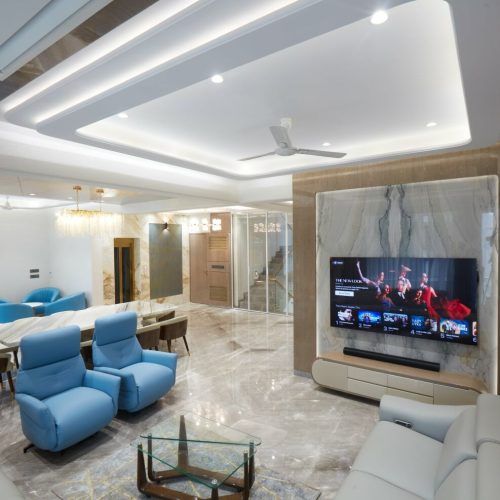
Selected work by Greenbox Design Studio. Tap any image to enlarge.
Frequently asked questions
What VOC level should I look for in paint?+
Under 50 g/l for an interior emulsion, and under 5 g/l if you want a genuinely zero-VOC product. The figure must come from the technical data sheet rather than the marketing on the tin, and remember that deep-shade tinting at the dealer can raise the content of a low-VOC base.
Is low-VOC paint worth the extra cost?+
The 10–18% premium on emulsion is modest and worth paying in bedrooms and children's rooms. But if you can only change one thing, change the joinery polish from solvent PU to water-based — solvent PU carries eight to twelve times the VOC content of conventional emulsion and is applied over a much larger surface area.
How long should I ventilate a newly painted flat?+
Seven to fourteen days of genuine cross-ventilation before occupation, with openings on two sides and a fan exhausting outward. Fourteen days for a room an infant will sleep in. Keep wardrobe and cabinet doors open throughout — enclosed volumes with freshly polished interiors hold concentration far longer.
Does low-VOC paint perform as well?+
Yes, in 2026. The durability and coverage gap that existed a decade ago has closed for interior emulsions, and current water-based polyurethanes cure hard enough for kitchen and wardrobe joinery. The one area where solvent products still hold an advantage is exterior enamel on metal in exposed coastal conditions.
What is E0 and E1 board?+
Formaldehyde emission classes for engineered boards, with E0 the lower-emission grade and E1 the common standard. Both are widely available in India in 2026 at a 5–12% premium over unclassified board. Since board is the largest single material volume in a fit-out, specifying the class explicitly in the BOQ is worthwhile.
Do air purifiers help with new-interior smell?+
A purifier with a substantial activated-carbon stage helps with VOCs; a HEPA-only unit does not, because HEPA filters particles rather than gases. Neither substitutes for ventilation, which removes the compounds from the flat entirely rather than adsorbing a fraction of them onto a filter you will eventually have to change.