
What to ignore
The Indian interiors market has absorbed the vocabulary of sustainability faster than the substance. A laminate described as eco-friendly because it contains recycled paper content, supplied without a certification number, is a marketing claim. Bamboo flooring glued with urea-formaldehyde adhesive and shipped from Southeast Asia is not obviously better than local rubberwood. And a 'green' modular kitchen built on MR-grade board that will be replaced in eight years is worse, in total material terms, than a conventional one built to last twenty.
Three questions cut through most of it. What is the certification number and who issued it? Where was it manufactured, and how far did it travel? How long will it last in a Mumbai flat before it is thrown away? A material that answers all three well is a sustainable choice regardless of what the brochure calls it.
Boards and substrates
| Material | What it is | ₹ per sq ft, 19 mm | Indian availability | Honest verdict |
|---|---|---|---|---|
| FSC-certified plywood | Ply from certified managed forests | ₹150–₹210 | Limited; a few mills | Genuinely better; verify the chain-of-custody number |
| Agri-fibre / bagasse board | Sugarcane residue, formaldehyde-free binder | ₹95–₹140 | Growing; made in Maharashtra and UP | Excellent where moisture is low; not for wet areas |
| Rice-husk composite board | Husk plus polymer | ₹120–₹175 | Limited | Moisture-stable, heavy, good for shutters |
| Reclaimed teak | Salvaged from demolition | ₹320–₹700 per sq ft of finished work | Good in Mumbai; several yards | The best genuinely sustainable timber available here |
| Bamboo board | Laminated bamboo strips | ₹190–₹320 | Mostly imported | Good material; check the adhesive and the distance travelled |
| Recycled-plastic composite (WPC) | Plastic waste plus wood flour | ₹120–₹165 | Widely available | Durable and moisture-proof; not recyclable again |
| Standard MDF | Virgin wood fibre, UF binder | ₹55–₹75 | Everywhere | The baseline this table is measured against |
Check for an E1 or E0 formaldehyde emission class on any engineered board. E0 is the lower-emission grade and is now widely available in India.
Design and build under one accountable roof
Finishes and indoor air
This is where sustainability and your own health overlap most directly. Solvent-based polyurethane, the default finish on Indian joinery, releases volatile organic compounds for weeks after application — in a closed Mumbai flat with limited cross-ventilation, that is measurable indoor air pollution in the rooms where people sleep. Water-based PU costs 15–25% more, cures harder than it used to, and removes most of that load.
- Water-based PU at ₹140–₹240 per sq ft against solvent PU at ₹110–₹190. The finish quality gap has largely closed since about 2022.
- Low-VOC emulsion from every major Indian paint brand, typically at a 10–18% premium. Look for a stated g/l VOC figure, not the word 'low'.
- Lime plaster and mineral paint on masonry: breathable, which matters on Mumbai's damp-prone external walls, and free of plastics. ₹120–₹320 per sq ft.
- Natural oil and wax finishes on solid timber: repairable in place, no film to peel. Needs re-oiling every 18–24 months.
- Avoid unlabelled imported adhesives. Contact adhesives are a large and under-discussed source of indoor VOCs during a fit-out; ask for low-VOC grades and ventilate hard for a week after.
The longevity argument
A kitchen built with BWP carcass, branded hardware and a serviceable finish lasts eighteen to twenty-five years in Mumbai. A kitchen built with MR board and unbranded hardware is typically rebuilt at eight to ten. Over a forty-year horizon that is two kitchens against four. No choice of substrate material offsets a doubling of replacement frequency, which makes build quality the dominant sustainability variable in interiors and the one nobody markets.
| Decision | Cheap version | Durable version | Extra cost | Replacements over 40 years |
|---|---|---|---|---|
| Kitchen carcass | MR board | BWP IS:710 | +₹22,000 | 4 vs 2 |
| Hinges and channels | Unbranded | Hettich / Hafele / Blum | +₹18,000 | 6 vs 2 |
| Shutter finish | 0.8 mm laminate | 1 mm laminate or acrylic | +₹14,000 | 3 vs 1 |
| Wardrobe internals | Fixed shelves | Adjustable, reconfigurable | +₹9,000 | Reconfigured vs rebuilt |
| Flooring | Cheap vitrified | Good vitrified or stone | +₹65,000 | 2 vs 1 |
What we specify by default
On a standard residential project we now write four things into the base specification rather than offering them as green upgrades: E1 or E0 emission-class boards throughout, water-based finishes on all internal joinery, low-VOC emulsion, and adjustable rather than fixed internals so a wardrobe can be reconfigured instead of replaced. Together those add roughly 4–7% to a project cost, and none of them require the client to accept a compromise in appearance or performance.
What we do not do is specify imported certified materials where a good local equivalent exists. A bamboo panel that has travelled four thousand kilometres to replace a locally made agri-fibre board of equal performance is a worse choice, whatever the certificate says, and clients are generally relieved to hear it.
Waste on site, and what happens to the old kitchen
A full 2BHK interior generates between 1.5 and 3 tonnes of waste, and almost none of it is currently separated in Mumbai. Broken tile and masonry debris, plywood offcuts, laminate trimmings, packaging, and the entire contents of the flat that was there before. Most of it goes to a mixed debris dump, which is both a regulatory issue for the society and a genuine loss of material that had value.
Three practices make a measurable difference and cost nothing. Sell or donate the old kitchen and wardrobes as a unit rather than demolishing them — there is a functioning second-hand market in Mumbai for modular units in reasonable condition, and a five-year-old kitchen removed carefully has real value. Separate the plywood offcuts, which carpenters will use for jigs and small components. And nest the cutting list in the workshop rather than on site: a factory-cut panel schedule typically wastes 8–12% of board area against 18–25% for site cutting, which is the single largest material saving available in a joinery project.
- Ask for the cutting optimisation. Any workshop with a panel saw and software can produce it; it saves board and it saves you money.
- Separate debris at source. Masonry, wood, metal and packaging in four piles. Societies increasingly require it and scrap dealers pay for the last three.
- Photograph and list the existing joinery before demolition. Two hours of effort often finds a buyer for a five-year-old wardrobe.
- Refuse unnecessary packaging. Hardware delivered in bulk cartons rather than individually boxed cuts both cost and waste.
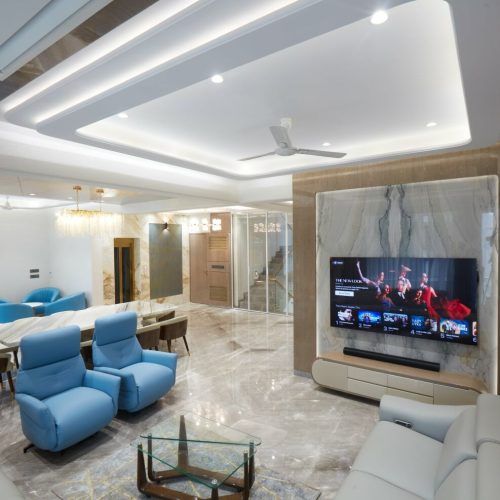
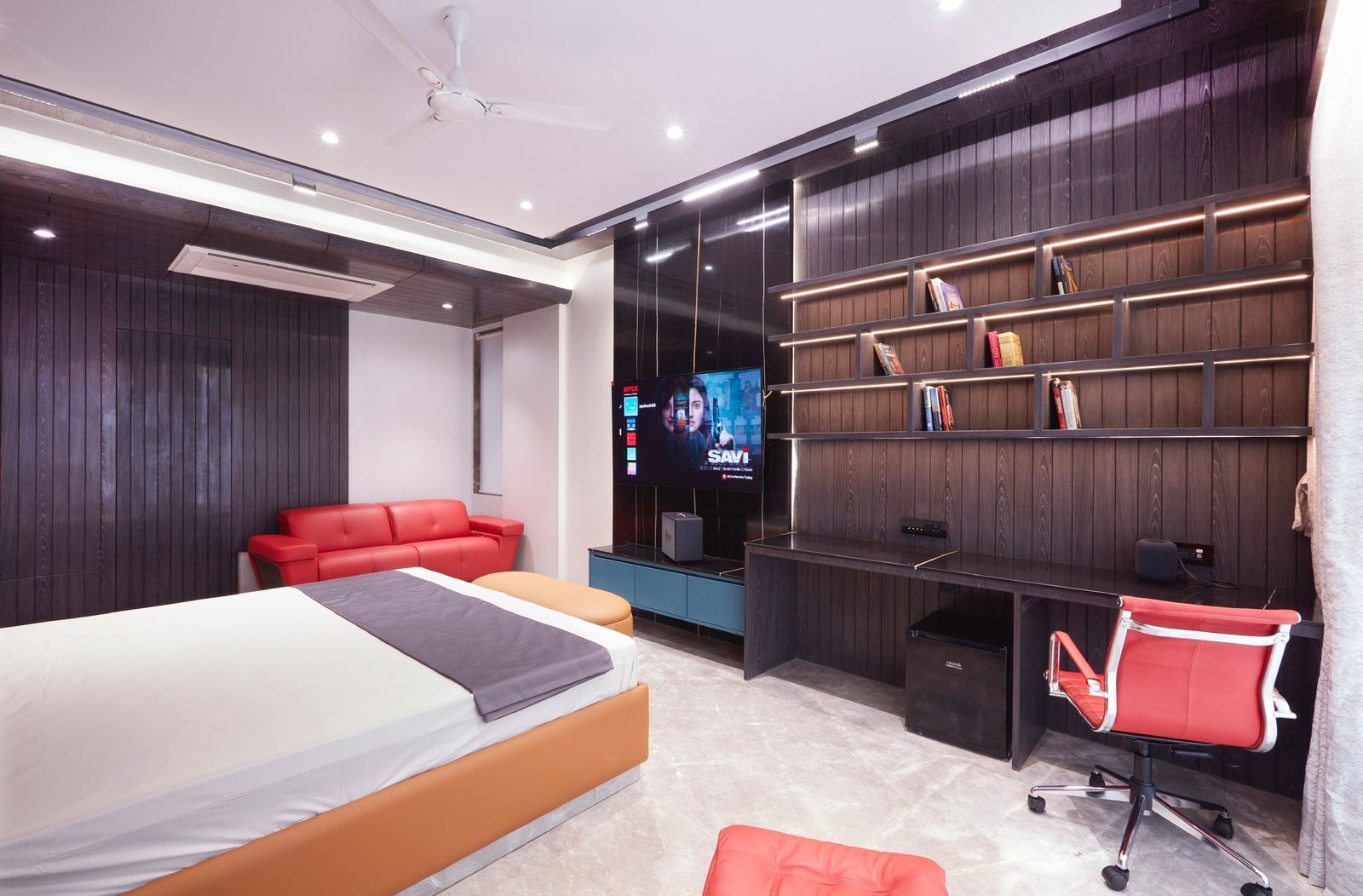
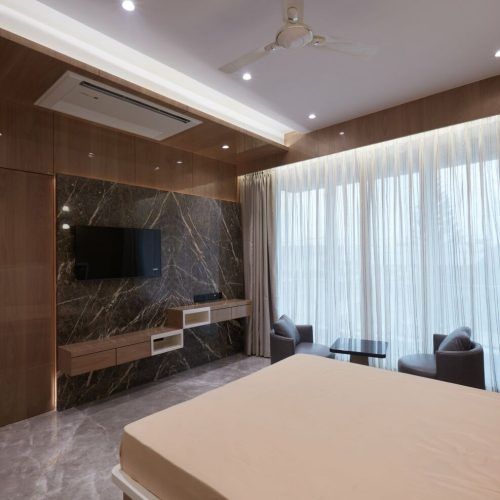
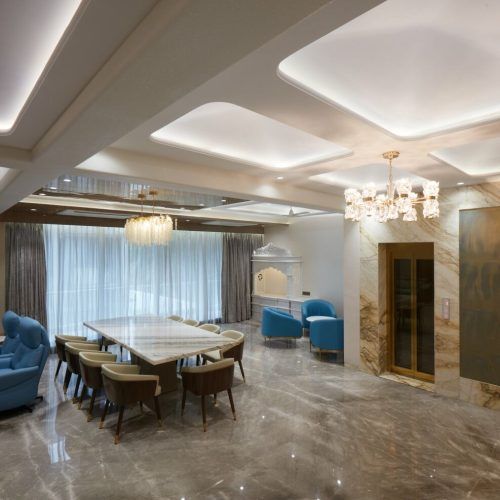
Selected work by Greenbox Design Studio. Tap any image to enlarge.
Frequently asked questions
Is bamboo flooring sustainable?+
The plant is — it regrows in four to six years. The finished board often is not, because most bamboo flooring sold in India is imported and bonded with urea-formaldehyde adhesive. Ask for the adhesive type, the emission class and the country of manufacture before treating it as the green option.
What is low-VOC paint and is it worth it?+
Paint with a low volatile organic compound content, typically under 50 g/l against 150–350 g/l for conventional emulsion. It costs 10–18% more and it noticeably reduces the smell and the irritation in the weeks after painting. In bedrooms and children's rooms it is worth it without argument.
Is agri-fibre board as good as plywood?+
For dry-area shutters and internal panels, yes — it is dimensionally stable, takes laminate well and is made in India from sugarcane residue at around ₹95–₹140 per sq ft. It is not a substitute for BWP plywood in kitchens, bathrooms or anywhere at skirting level, where moisture resistance is the governing property.
How can I tell if a sustainability claim is real?+
Ask for three things: a certification number that can be looked up (FSC chain-of-custody, GreenGuard, an E0/E1 emission class), the place of manufacture, and a stated warranty period. A claim with none of those attached is a description, not a certification, and it costs a supplier nothing to make.
Is reclaimed wood a good idea in Mumbai?+
Reclaimed Burma teak from demolished buildings is excellent — it is fully seasoned, dimensionally stable and locally available through several yards in the city. Have it treated for borer before use, and expect to pay ₹320–₹700 per sq ft of finished work. It is the strongest sustainable choice on offer here.
Does sustainable design cost more?+
A low-emission specification — E0 boards, water-based finishes, low-VOC paint — adds about 4–7% to a residential project. Designing for longevity adds more upfront and costs less over forty years. Specifying imported certified materials adds a great deal and often achieves less than the local alternative.