
Build once, adapt three times
The expensive mistake in children's rooms is building for the child in front of you. A themed bed for a five-year-old is obsolete at nine and embarrassing at twelve; a 1,500 mm-high wardrobe sized for small hands is useless the moment the child needs to hang a school blazer. The approach that survives is to build the permanent elements at adult scale and make the adaptable elements cheap to change.
In practice that means: wardrobe carcass full height to the ceiling from day one, with an adjustable internal layout; a bed at standard single or, better, a 1,200 mm-wide bed that works from age four to eighteen; and a study wall detailed so a desk can be added at the right height when it is needed rather than built in at the wrong height at the start.
Stage by stage
| Age | Primary need | Furniture | Storage reach | What to avoid |
|---|---|---|---|---|
| 0–3 | Safety and clear floor | Cot, changing surface, low soft seating | Adult reach only; child cannot open anything | Open shelving, sharp corners, loose rugs |
| 4–7 | Independence and play | Single bed 900 mm, toy storage, low hooks | Up to 900 mm — the child puts things away | Themed built-ins, high-gloss finishes |
| 8–12 | Study and displaying things | Desk at 680–700 mm, chair, pinboard, bookshelf | Up to 1,400 mm | Desk at adult height; it causes poor posture |
| 13–18 | Privacy, friends, screens | Adult desk, full wardrobe, seating for two | Full height | Childish colour; they will paint over it themselves |
Design and build under one accountable roof
Safety, specified properly
Safety in a child's room is mostly about anchoring, edges and electricity, and all three are cheap when designed in and expensive when retrofitted.
- Anchor every tall unit to the wall. Two brackets into masonry, not into plaster. Furniture tip-over is a real and avoidable injury; a chest of drawers with all drawers open has its centre of gravity outside its footprint.
- Round every edge below 1,200 mm. A 3 mm radius is enough to change a cut into a bruise. Above 1,200 mm you can return to sharp detailing.
- Shuttered sockets below 1,200 mm, and a 30 mA RCBO on the room's circuit. Both are code-standard and both get skipped.
- Soft-close on everything. Hinges and drawer channels with soft-close prevent finger injuries and cost about ₹340 per shutter more.
- No glass below 1,500 mm unless it is laminated or toughened. That includes wardrobe mirrors, which should be backed with safety film and fixed to the inside of a shutter.
- Check the window. Mumbai balconies and windows need a grille or a restrictor limiting opening to 100 mm for children under about eight. Society permission is usually needed for external grilles; ask early.
- Low-VOC paint and finishes. Children spend more hours in their bedroom than adults do in theirs; specify low-VOC emulsion and water-based polish, not solvent PU.
The study desk, and when it starts mattering
Around age eight, homework stops being a twenty-minute activity at the dining table and becomes an hour or more at a fixed place. That is the moment a desk earns its space. The height matters more than anything else: an eight-year-old of roughly 128 cm needs a desk surface at about 560 mm with a seat at 330 mm, which is nowhere near an adult desk. A height-adjustable desk covering 560–760 mm costs ₹16,000–₹38,000 and genuinely covers ages eight to eighteen, which makes it one of the better-value purchases in the room.
If a fixed built-in desk is preferred, build it at adult height (690–710 mm) and supply a height-adjustable chair with a footrest for the early years. That is the compromise that avoids rebuilding at fourteen. What does not work is a fixed desk at child height — it has a useful life of about three years.
What it costs
| Element | Specification | Cost |
|---|---|---|
| Full-height wardrobe, 6 ft | BWP carcass, laminate, adjustable internals | ₹78,000–₹1,35,000 |
| Bed with storage, 1,200 mm | Hydraulic lift-up, BWP box | ₹38,000–₹72,000 |
| Study unit with overhead | Desk, pinboard, shelves, cable route | ₹42,000–₹88,000 |
| Low toy storage / bench | Open cubbies with soft baskets | ₹16,000–₹34,000 |
| Painting, low-VOC, one feature wall | Washable emulsion + writable wall | ₹22,000–₹42,000 |
| Lighting | Ambient, desk task, night light, dimmer | ₹14,000–₹30,000 |
| Total | — | ₹2,10,000–₹4,01,000 |
Add 18% GST. The adjustable elements — shelves, hardware, paint — are about ₹25,000 to refresh at each stage.
Build the box once at adult scale. Change the shelves, the hardware and the colour three times. That is the whole strategy.
Greenbox principal designer
Two children, one room
Shared rooms are the normal case in Mumbai, where a second bedroom of 90–110 sq ft often has to hold two children for a decade. The planning problem is not the beds — it is giving each child a defined territory, because siblings sharing an undifferentiated room argue about the space itself rather than about anything in it. Bunk beds solve the floor-area problem and create a new one: the lower bunk is dark, the upper is hot near a ceiling fan, and neither child can sit up in bed. We use them only below about 100 sq ft, and then with a proper 900 mm headroom to the upper bunk and a reading light in each.
Where the room allows, two parallel single beds with a shared headboard wall and a 750 mm gap between them works far better, and the gap takes a shared bedside unit. Give each child their own wardrobe section with their own door, their own pinboard and their own light switch. Those three small ownerships prevent most of the daily friction, and they cost under ₹20,000 more than treating the room as one undivided space.
- Two of everything that is personal: wardrobe section, desk surface, pinboard, reading light, plug point.
- One of everything that is shared: floor space, main light, bookshelf, window.
- Divide with storage, not with a partition. A 450 mm-deep open shelf unit between two zones gives separation without cutting the light or the air.
- Plan for the eldest leaving. At some point one child moves out or to another room. A layout where one side converts to a study for the remaining child, without demolition, is worth designing in.



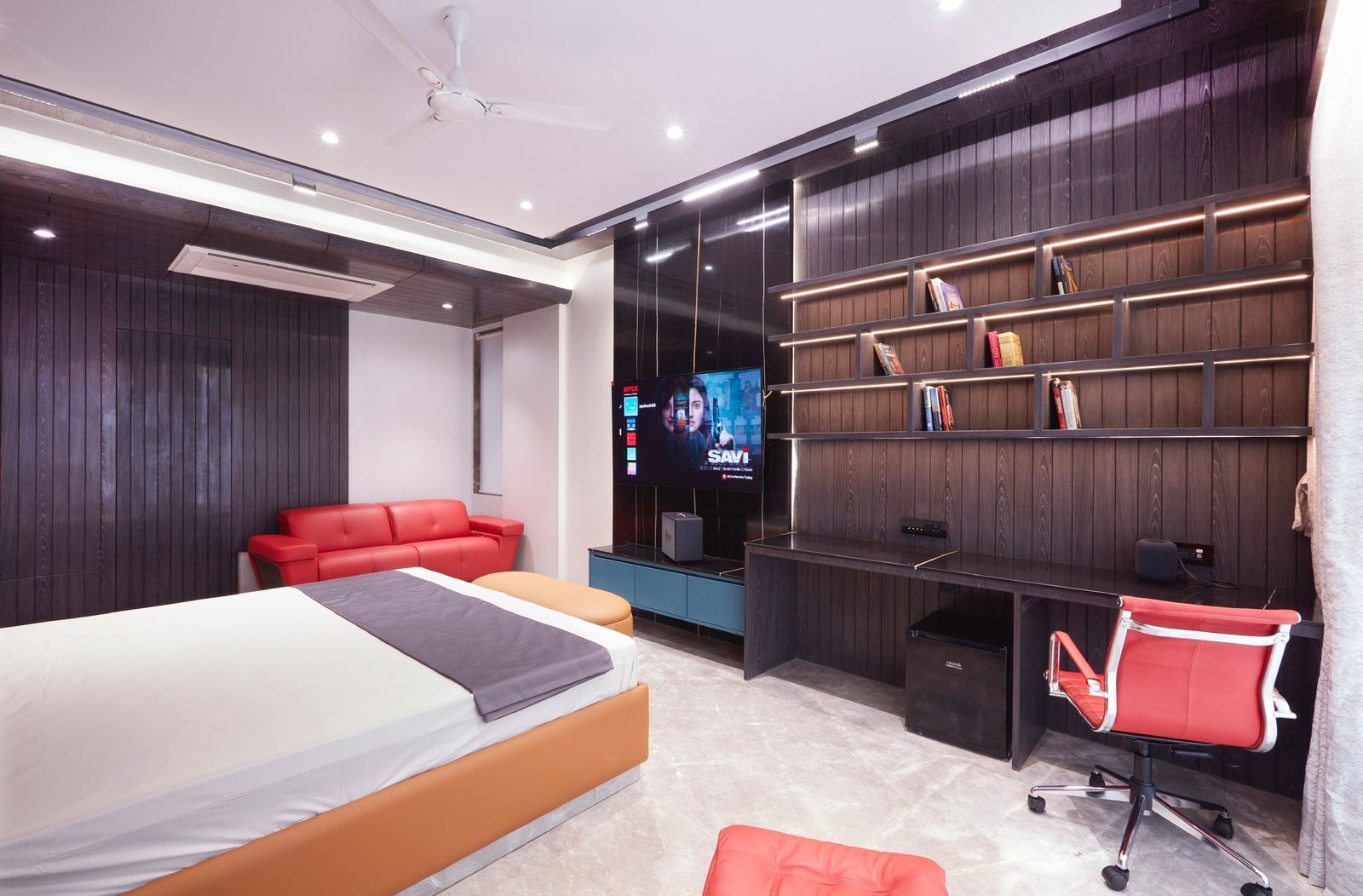
Selected work by Greenbox Design Studio. Tap any image to enlarge.
Frequently asked questions
What size bed is best for a child's room?+
A 1,200 mm-wide bed works from age four to eighteen and costs only marginally more than a 900 mm single. It is wide enough for a teenager, takes a standard mattress size, and avoids a replacement at around age thirteen when a 900 mm bed starts to feel small. Add hydraulic storage underneath.
When does a child need a study desk?+
At around eight, when homework becomes a sustained daily activity. Before that a shared dining or family table is genuinely better, because young children work more happily near adults. When you do build one, make it height-adjustable or build it at adult height with an adjustable chair and footrest.
How do I make a kids room safe?+
Anchor all tall furniture to masonry, round every edge below 1,200 mm, fit shuttered sockets and a 30 mA RCBO, specify soft-close on all hardware, restrict window opening to 100 mm, and use laminated or filmed glass only. All seven are cheap during construction and awkward afterwards.
Should I use themed decor?+
In paint, textiles and removable wall decals, yes — those are ₹5,000–₹20,000 decisions with a three-year life, which matches how long the theme will be wanted. In built-in joinery, no. A car-shaped bed is a ₹60,000 decision with a four-year life and no resale.
How much does a children's room cost in Mumbai?+
₹1.9–₹4.2 lakh ex-GST in 2026 for a full room — wardrobe, storage bed, study unit, painting and lighting — in a typical 90–120 sq ft Mumbai bedroom. The wardrobe is usually 40% of that. Shared rooms for two children run ₹3.4–₹5.8 lakh because of the second bed and desk.
What paint is safest for a child's room?+
A low-VOC washable interior emulsion, and a water-based polish rather than solvent PU on any joinery in the room. Ventilate for at least 72 hours after painting before the room is slept in. See low-VOC paints and indoor air for the certification marks worth looking for.