
Work out your curtain fabric
Track width, not window width — the track should overrun the window by 6 in each side.
How this calculator works
- Fabric width needed = track width (in) × fullness. A 6 ft track at 2× needs 144 inches of gathered fabric.
- Usable width = roll width − 4 in. A 54-inch roll gives 50 inches after side hems and the seam where drops are joined.
- Drops = ceiling(fabric width needed ÷ usable width). Always a whole number — a part drop is a join in the wrong place.
- Cut length = drop × 12 + 12 in + pattern repeat. The 12 inches covers a 4-inch doubled bottom hem and the heading tape.
- Metres = drops × cut length ÷ 39.37.
- Cost = fabric + lining at the same metreage + stitching at ₹120/m + track at ₹450 per running foot, with the track run 10% longer than the opening.
| Heading style | Fullness | Look | Stack-back |
|---|---|---|---|
| Eyelet / grommet | 1.5× | Soft, casual, modern | Wide — plan 20% of track width |
| Pinch pleat, 3-finger | 2.0× | The Indian default, formal | Medium — 15% |
| Wave / ripple fold | 2.5× | Even, contemporary, needs a wave track | Narrow — 12% |
| Rod pocket | 2.0× | Soft gather, cannot slide easily | Fixed |
| Sheer over drape | 2.0× each | Layered light control | Double track needed |
Stack-back is how much wall the open curtain occupies. It is the number people forget — a 6 ft track with pinch pleat curtains hides about 11 inches of window at each side when fully drawn back.
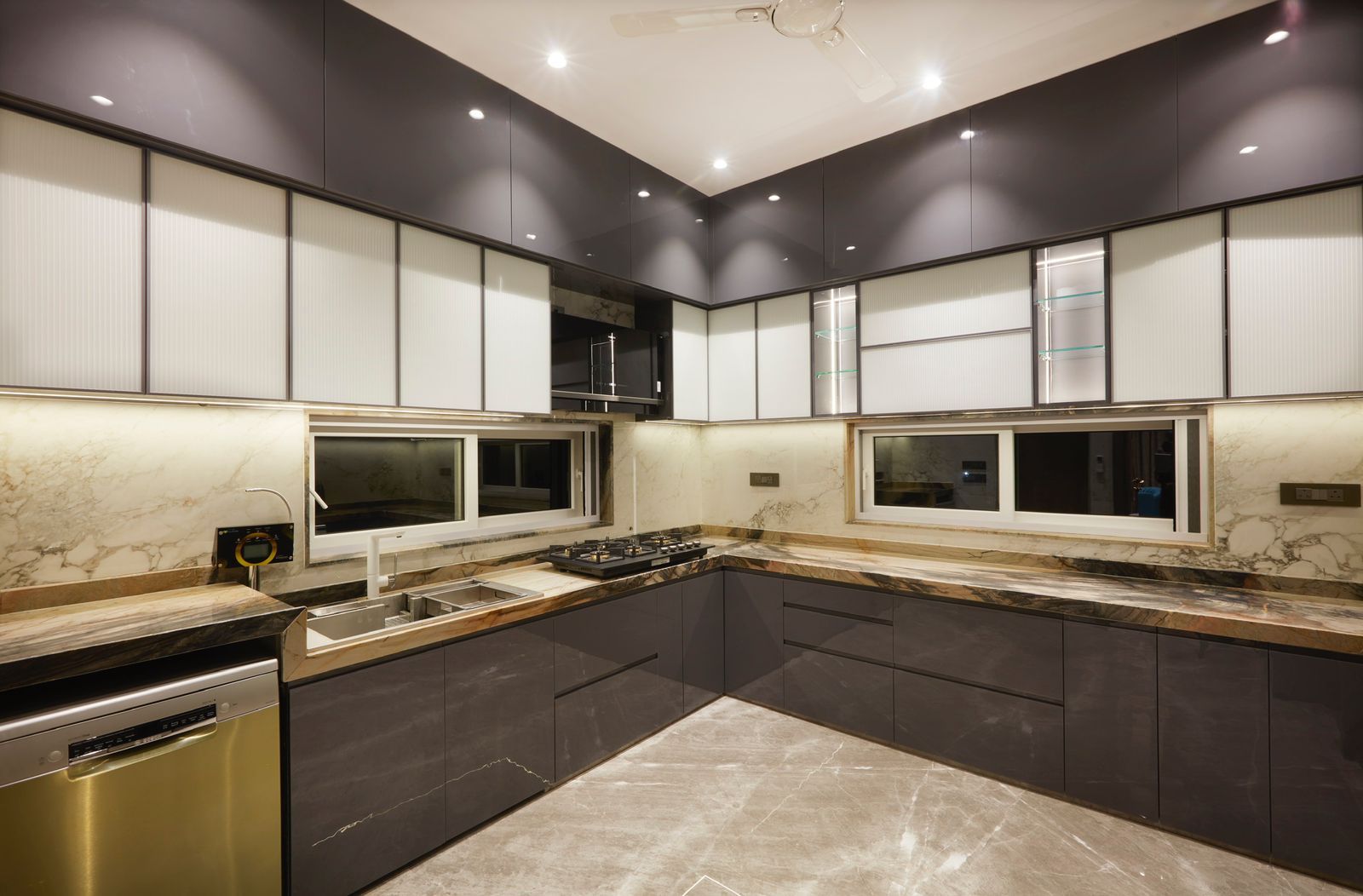
Design and build under one accountable roof
Worked example — the default window
| Step | Arithmetic | Result |
|---|---|---|
| Fabric width needed | 6 ft × 12 × 2.0 | 144 in |
| Usable width, 54 in roll | 54 − 4 | 50 in |
| Drops | ceiling(144 ÷ 50) | 3 drops |
| Cut length | (9 × 12) + 12 | 120 in |
| Fabric | 3 × 120 ÷ 39.37 | 9.1 m |
| Fabric cost | 9.1 × ₹650 | ₹5,944 |
| Cotton lining | 9.1 × ₹220 | ₹2,012 |
| Stitching | 9.1 × ₹120 | ₹1,097 |
| Track | 6.6 ft × ₹450 | ₹2,970 |
Curtains in a Mumbai flat
Two local realities change the specification. The first is sun: a west-facing window in Mumbai takes direct afternoon sun for six months of the year, and an unlined curtain will fade along one edge within two summers. Cotton lining is the minimum; blackout lining in a bedroom does double duty, cutting both light and a measurable amount of heat gain through the glass.
The second is dust. Curtains in Mumbai need washing or dry cleaning twice a year, which means the fabric has to survive it. Heavy silk and viscose blends look wonderful and shrink; cotton, linen blends and good polyester blends do not. Ask the supplier specifically whether the fabric is dry-clean only, because a nine-foot drop is not something you put in a domestic machine.
On track versus rod: a ceiling-recessed track in a pelmet looks cleanest and is what we specify on most projects, but it has to be planned with the false ceiling, because the pelmet recess must be at least 5 inches deep for a single track and 8 inches for a double. Retrofitting it into a finished ceiling means cutting the gypsum. Decide at ceiling stage or accept a surface-mounted rod.
Finally, on quantity: order the whole job at once. Curtain fabric is dyed in batches exactly as wallpaper is, and two windows in the same room made from two batches will show a difference in daylight that nobody notices in the shop. Where a project runs across several rooms, we specify one fabric per room and order each room complete, with half a metre spare per window for the tie-backs and any later repair.
Every constant on this page comes from Greenbox site records — measured drawings, signed BOQs and completion certificates from projects delivered between 2023 and 2026 — rounded to the figures an estimator would actually write down. We publish them so the arithmetic can be audited rather than trusted. Treat the output as a planning figure: accurate enough to brief a landlord, a bank or a family, and not accurate enough to sign a contract against.
What this tool does not cover
- Pelmet or valance joinery, and the ceiling recess it needs — this is false ceiling work, not soft furnishing.
- Motorised tracks, which need a power point at one end and are specified at drawing stage.
- Sheers layered under drapes, which need their own track and their own fabric calculation — run the tool twice.
- Blinds, which are measured entirely differently — use the blinds size calculator.
- Making up charges above ₹120 per metre for hand-finished, weighted or interlined curtains.
- 18% GST, shown separately in the breakdown.
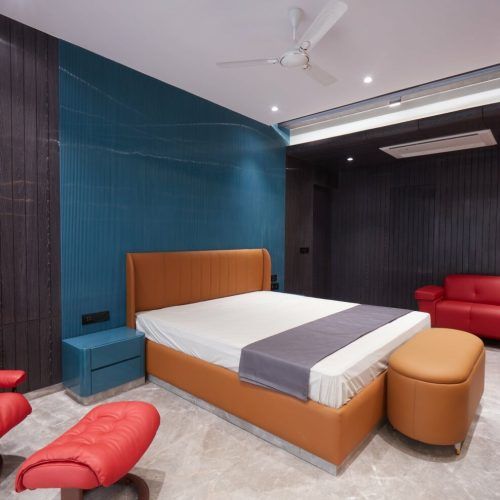
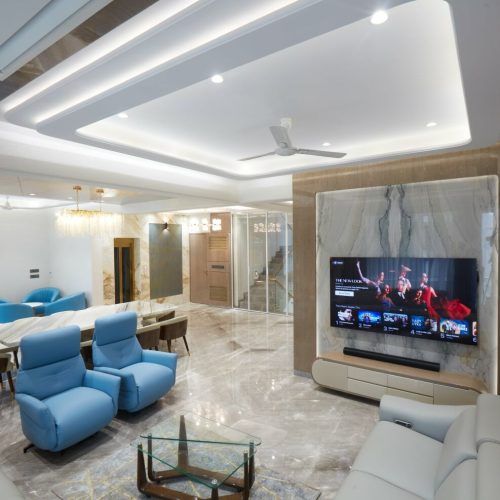
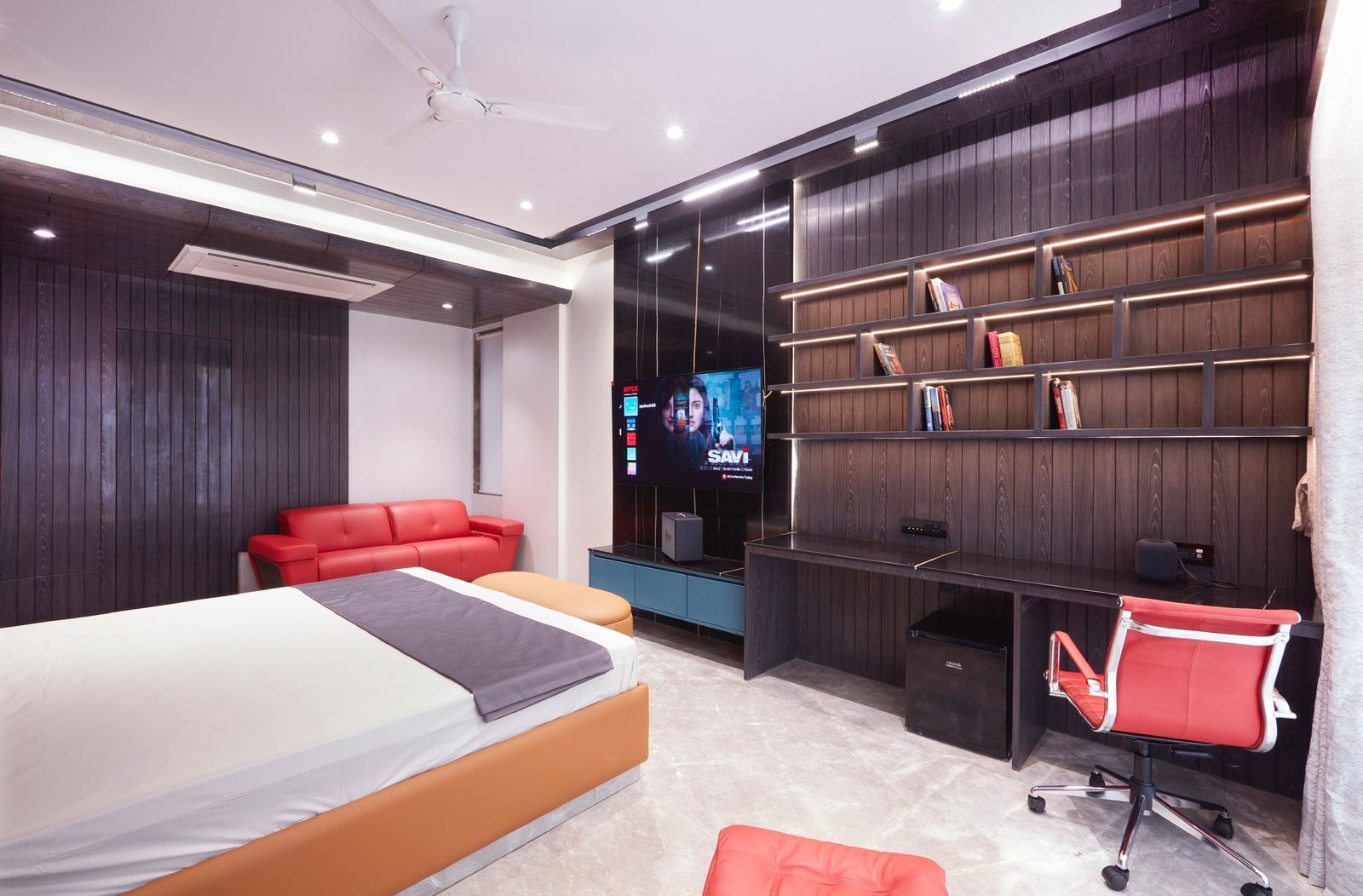
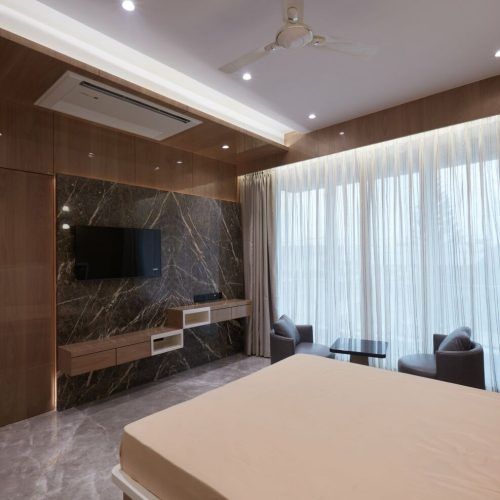
Selected work by Greenbox Design Studio. Tap any image to enlarge.
Frequently asked questions
How much fabric do I need for a 6 foot window?+
About 9.1 metres of 54-inch fabric for a 9 ft drop at 2× fullness, plus the same again in lining. That is three drops of 120 inches each. A shorter 7 ft drop on the same window comes down to about 7.3 metres.
What fullness should curtains be?+
Two times the track width for a standard pinch pleat, which is what most Indian tailors assume. Use 1.5× for eyelet curtains in a light fabric and 2.5× for wave heading or a sheer, which needs the extra gather to read as a fabric rather than a film.
Should curtains touch the floor?+
Yes — either just kissing the floor or breaking by half an inch. A curtain that stops two inches short looks like a mistake. The only exception is over a radiator or a floor-level AC unit, where a sill-length curtain is the sensible answer.
How wide should a curtain track be?+
Six inches wider than the window opening on each side, so the curtains stack clear of the glass when open. On a 5 ft window that means a 6 ft track. Any narrower and the drawn-back curtain permanently covers part of your daylight.
Is blackout lining worth it in Mumbai?+
In a west-facing bedroom, yes. It cuts the late-afternoon heat gain noticeably as well as the light, and it protects the face fabric from the fading that ruins unlined curtains within two summers. It costs about ₹200 per metre more than cotton lining.