
Dust, and why the palette moves
A pale interior in this city is a maintenance decision. The scheme still works — it simply has to be a shade warmer and a shade less pale than the Copenhagen reference, and the surfaces have to be chosen for cleaning.
| Element | The reference image | What we specify in Mumbai | Why |
|---|---|---|---|
| Floor | Very pale oak or white-washed plank | Light-mid oak tone, matte, large format | A very pale floor shows a day of Mumbai dust; a mid tone reads just as light and stays clean |
| Walls | Pure white | Warm off-white, washable acrylic emulsion, matte | Washability matters more here than the exact shade; a chalky finish cannot be cleaned |
| Joinery | Pale solid timber | Ash or oak veneer on BWP, matte finish | Solid pale timber against a Mumbai external wall cups and stains; veneer on BWP does not |
| Upholstery | Pale wool or undyed linen | Cotton or linen blend, washable covers, mid tone | Removable washable covers are the difference between year one and year five |
| Rugs | Wool and sheepskin | Flat-weave cotton or jute, washable | Wool pile in a Mumbai monsoon holds moisture and smells |
| Open shelving | Extensive | One run, and only in a low-dust room | Every open shelf here is a weekly commitment |
Timber in this climate
- Veneer on BWP 710 for all built-in joinery. Ash or light oak veneer gives the appearance across a large area and is dimensionally stable where solid pale timber is not. ₹320–₹720 per sq ft of veneered board here.
- Solid timber only in loose furniture, where the piece can be conditioned and is not fixed to a wall. Rubberwood and mango both behave well; imported ash is beautiful and moves more.
- Matte hardwax oil, not gloss lacquer. An oiled finish breathes with the timber, can be refreshed locally when a mark appears, and is what makes the surface touchable. Expect to refresh it every 18–30 months in this climate.
- Never solid pale timber against an external wall. Four months of driven rain on the other side of that wall will cup a solid panel and stain it from behind.
- Breather gaps and floating panels in any solid work. A 600 mm solid panel moves 4–7 mm between January and August in this city.
- Expect pale timber to darken slightly. Oiled ash and oak warm over two or three years, which usually improves the room and should be mentioned at specification rather than discovered.
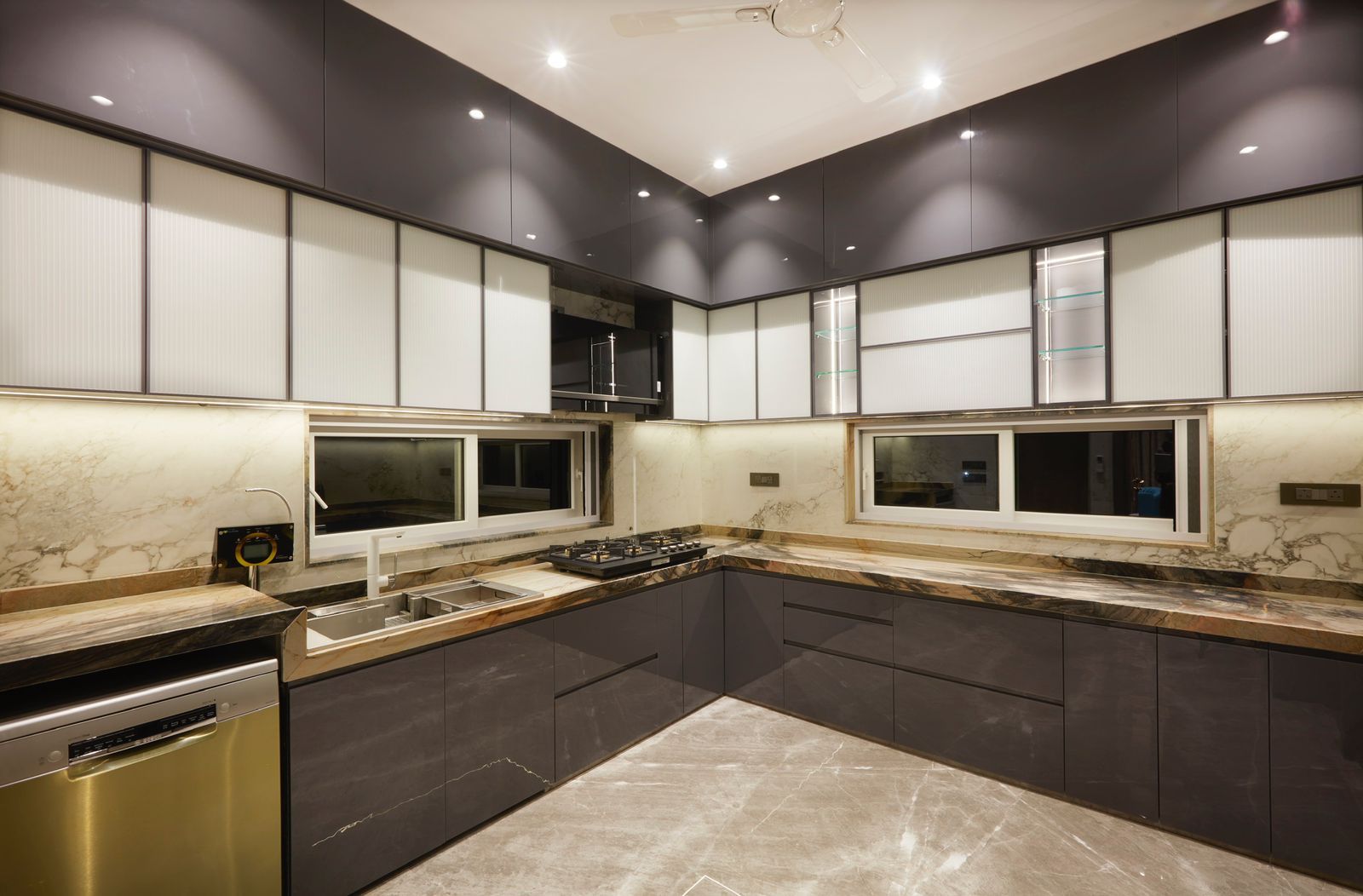
Pale timber in eighty-five per cent humidity
Textiles through a monsoon
- Washable covers on everything that can take them. Sofa, dining chair seats, cushions. This single decision extends the life of a pale scheme by years.
- Pre-shrink every natural fabric before making up. Cotton and linen bought in Mumbai and made up without pre-shrinking will pull at the seams within one wet season.
- Line the curtains. An unlined linen sheer alone lets west light through, fades unevenly and gives no privacy after dark. A sheer plus a lined roller on the same track solves all three.
- Keep heavy natural textile off the floor. A jute rug is fine; a deep wool pile in an unairconditioned Mumbai living room is a mildew risk from June to September.
- Store nothing textile in a sealed cupboard without ventilation. The style favours open, airy storage, which happens to be exactly right for this climate.
- Air the flat. This style assumes a house that is opened and aired. In a closed, air-conditioned Mumbai flat, run the AC on dry mode for an hour a day through the monsoon.
The part Mumbai does better
Scandinavian interiors use plants to bring life into a dark room, and in Scandinavia keeping them alive is genuinely hard. Here it is the easy part of the style, and it is worth leaning into. A monstera, a rubber plant and a fiddle-leaf fig that would be an achievement in Stockholm will simply grow in a Mumbai living room with an east window. Build planting positions into the joinery — a 300 mm ledge with a drip tray, a floor position with a drain-safe finish under it, a balcony shelf visible from the sofa — rather than leaving pots to be placed later. It costs almost nothing and it is the element of this style that Mumbai delivers better than the place it came from.
Rates by suburb
| Area | Scandinavian scheme ₹/sq ft | Local note |
|---|---|---|
| Bandra West, Juhu, Khar | ₹3,290 – 4,260 | Salt air; stainless rather than mild steel on any exposed furniture frame |
| Powai, Chembur, Ghatkopar | ₹2,680 – 3,650 | Greener outlook and lower dust than the highway suburbs; the palette holds better |
| Andheri West, Goregaon, Malad | ₹2,560 – 3,530 | Highway-side dust is the main consideration; go a shade darker |
| Borivali, Kandivali, Mulund | ₹2,490 – 3,350 | National-park side flats are greener and more humid; ventilate joinery well |
| Thane and Navi Mumbai | ₹2,430 – 3,230 | Larger, lighter flats; the easiest place in the region for this style |
Carpet area basis, ex-GST. The bands are taken from Scandinavian-referenced homes we have finished and invoiced, priced at October 2026. Solid imported timber and imported loose furniture sit outside these bands.
A Powai client wanted the palest oak floor in the catalogue. We laid a sample board in her hallway for a week in February, and she chose two shades darker herself.
Greenbox principal designer
A 700 sq ft Mumbai flat, costed
A Scandinavian-referenced 2BHK in Goregaon East, 700 sq ft carpet, at ₹2,980 per sq ft — the middle of the western-suburb band.
| Element | Cost | Specification |
|---|---|---|
| Kitchen — 9 running feet | ₹3,24,000 | BWP carcass, light oak veneer fronts with matte lacquer, quartz counter |
| Master bedroom joinery | ₹3,58,000 | 7 rft wardrobe with loft, veneered, bed with storage, bedside units |
| Second bedroom joinery | ₹2,55,000 | 6 rft wardrobe with loft, study ledge, open shelf run |
| Living and dining joinery | ₹2,90,000 | Low sideboard, TV ledge, dining bench with storage, one open shelf run |
| Ceiling and lighting | ₹1,87,000 | Peripheral cove, four warm dimmable circuits, two pendants, three lamp points |
| Flooring | ₹2,04,000 | Light-mid oak-tone large-format vitrified, matte, laid over existing |
| Painting and finishes | ₹1,28,000 | Warm off-white washable emulsion, one sage-grey wall |
| Electrical rework | ₹1,19,000 | New points, lamp circuits, dimmers, plant-position sockets |
| Design and project management | ₹2,21,000 | Survey, drawings, 3D, site supervision |
| Total, ex-GST | ₹20,86,000 | ₹2,980 per sq ft on 700 sq ft carpet |
Ex-GST. Excludes loose furniture, curtains, rugs and appliances. 18% GST adds ₹3,75,480.
The style itself
Why the original elements exist, the adapted palette with values, timber options and national costs are on Scandinavian interior design services. For the closest relative, which handles the same restraint with more warmth, see Japandi interior designers in Mumbai; for the stricter version, minimalist interior designers in Mumbai.
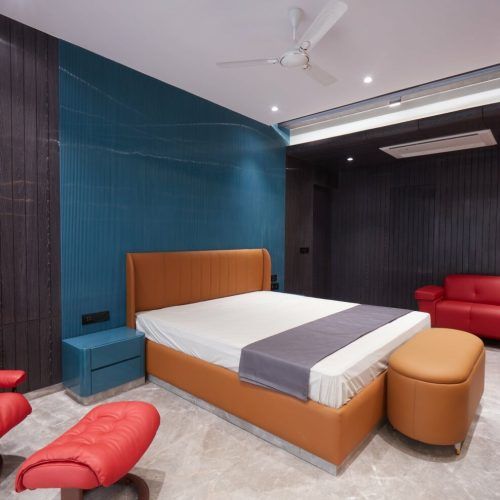
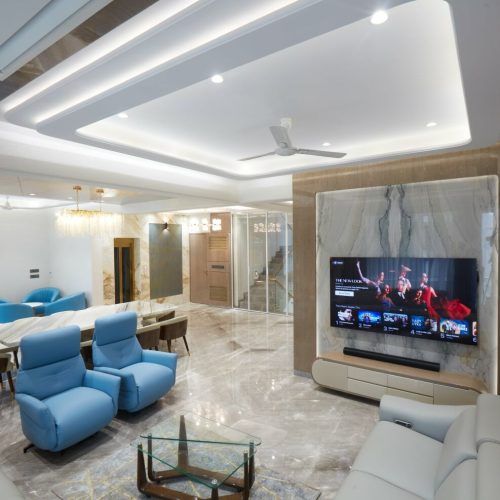
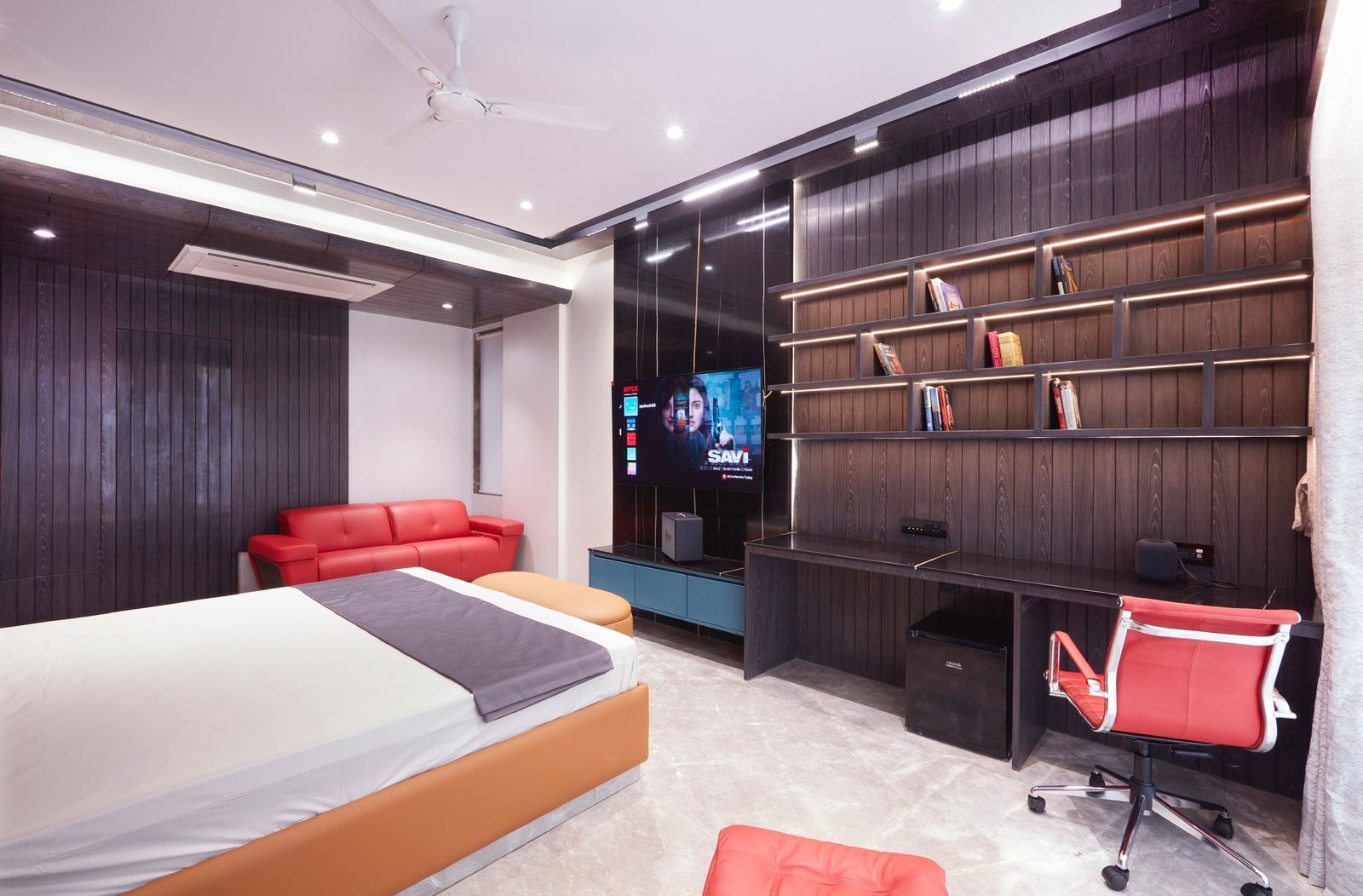
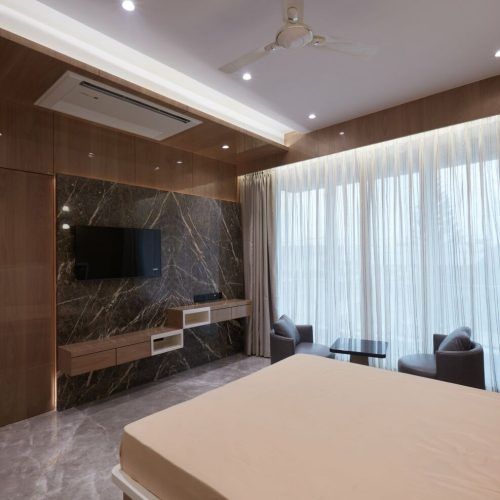
Selected work by Greenbox Design Studio. Tap any image to enlarge.
Frequently asked questions
What does a Scandinavian interior cost in Mumbai?+
₹2,430–₹3,230 per sq ft of carpet area in Thane and Navi Mumbai, ₹2,560–₹3,530 across the western suburbs and ₹3,290–₹4,260 in Bandra West, Juhu and Khar, ex-GST. Solid imported timber and imported loose furniture sit outside those bands.
Will a pale floor work in a Mumbai flat?+
A light-mid tone will; a very pale one will show a day of city dust, particularly on a highway-facing flat. Specify a matte large-format finish two shades darker than the reference image and it reads just as light while staying clean. A west-facing room also needs window control or the floor bleaches unevenly within two years.
Should joinery be solid pale timber or veneer here?+
Veneer on BWP 710 for anything built in, at ₹320–₹720 per sq ft of veneered board. Solid pale timber against a Mumbai external wall cups and stains from behind after a monsoon. Keep solid timber for loose furniture, where the piece can be conditioned and is not fixed to a wall.
How do natural textiles survive the monsoon?+
Washable removable covers on everything that can take them, every natural fabric pre-shrunk before making up, curtains lined rather than a bare sheer, and no deep wool pile on the floor of an unairconditioned room. Running the air conditioning on dry mode for an hour a day through the monsoon does more than any fabric treatment.
Does the oiled finish need maintenance?+
Yes, a refresh every eighteen to thirty months in this climate, which takes an afternoon and a tin of hardwax oil. In exchange you get a surface that can be locally repaired when it is marked, rather than a lacquered one where a single scratch means refinishing the whole panel.
Do plants really work better here?+
Considerably. A monstera, a rubber plant or a fiddle-leaf fig that is an achievement in Stockholm simply grows in a Mumbai living room with an east window. Build the positions into the joinery — a 300 mm ledge with a drip tray, a floor position with a water-safe finish under it — rather than leaving pots to be placed afterwards.