

What the monsoon actually does to an interior
Relative humidity in Mumbai sits between 80% and 95% for most of June to September, and the wall surface temperature on an external face drops several degrees below the room air. Two things follow. First, hygroscopic materials — plywood, MDF, particle board, natural wood, cotton, paper-backed laminate — absorb moisture and swell, and the swelling is uneven because only some faces are sealed. Second, moisture condenses on and inside cavities behind joinery fixed flush to an external wall, where it has no way of drying out.
Nothing dramatic happens in the first monsoon. The failures appear in years two to four: a kitchen base carcass that has lost its bottom edge, a wardrobe back that has delaminated where it touched the wall, shutters that no longer close flush, and the musty smell that never fully clears. All of it is preventable at the specification stage for 15–25% more on the carcass line.
Material choices that survive four wet months a year
| Location | Specify | Avoid | Cost delta |
|---|---|---|---|
| Kitchen base and sink unit | BWP IS:710 or WPC / HDHMR | MR ply, MDF, particle board | +18 – 25% |
| Joinery on an external wall | BWP IS:710 with sealed back and air gap | Flush-fixed MR ply | +15 – 20% |
| Bathroom vanity | WPC or marine-grade with PU sealing | Any wood-based board | +20 – 30% |
| Utility and washing area | WPC shutters, SS 304 hardware | Laminate on MDF | +22 – 28% |
| Internal bedroom wardrobe | MR ply is acceptable | — | Baseline |
| Hardware within 2 km of the sea | SS 316 screws and fittings | Mild steel, chrome-plated | +30 – 45% |
| Skirting on external walls | PVC or WPC | MDF skirting | +₹35 – ₹60 / rft |
The cost deltas are on those line items only, not on the whole project.

Design and build under one accountable roof
Detailing matters more than the board grade
A BWP carcass with unsealed cut edges will still fail, because IS:710 describes the glue line, not the surface. Water enters at the places the factory cut and the carpenter drilled. Four details do most of the work.
- Seal every cut edge. 2 mm PVC edge banding on exposed edges, and a coat of sealer on concealed ones. This includes the underside of the kitchen base, which nobody sees and everybody skips.
- Leave a 10–12 mm air gap between joinery and the external wall. Fix the unit off battens, not flush. The gap lets the wall dry and stops moisture bridging into the back panel.
- Raise kitchen bases 100–150 mm on a PVC or aluminium skirting leg. Never sit a wood-based carcass directly on the floor in a room that gets mopped.
- Seal hinge cups and screw holes. A 35 mm hinge boring in an unsealed shutter edge is an open channel; a drop of sealer at fabrication closes it permanently.
What to schedule when
Half of monsoon-proofing is calendar work. Some trades are entirely unaffected by humidity; others produce defects that cannot be corrected without redoing the work. The table below is how we phase a Mumbai project that overlaps the rains.
| Trade | June – September | Why |
|---|---|---|
| Demolition and civil | Yes, with care | Debris movement is harder in the rain but the work is unaffected |
| Electrical and plumbing first fix | Yes | Concealed work, no drying dependency |
| Carcass fabrication (factory) | Yes | Climate-controlled factory, moisture content managed |
| Ceiling framing and boarding | Yes | Provided the slab above is not leaking |
| Joinery installation | Yes | Dry fixing; keep material indoors before installation |
| Wall putty and painting | No | Will not cure at 85%+ RH; results in patchiness and peeling |
| PU and melamine polishing | No | Blooming and slow cure; the finish stays soft |
| Engineered or solid wood flooring | No | Boards acclimatise wet and shrink later, opening gaps |
| Tile and stone laying | Yes, with extended curing | Cement-based, tolerant of humidity |
| Waterproofing | Best before the rains | Needs a dry substrate to bond |
What not to do between June and September
- Do not paint to a deadline. Emulsion applied at very high humidity takes days to cure, traps moisture and shows patchy sheen. If it must happen, run dehumidifiers and accept a longer programme.
- Do not accept plywood delivered wet. Sheets stored under a tarpaulin at the timber market absorb enough moisture to warp after installation. Check the edges and refuse damp stock.
- Do not lay wooden flooring. Boards that acclimatise at 90% RH will shrink in December and open 1–2 mm gaps at every joint.
- Do not close up a damp wall. If a wall is showing damp, find the source — usually a leaking shaft, a failed external pointing or a neighbour's bathroom — before putting joinery in front of it. Joinery does not cure damp; it hides it and then rots.
- Do not seal the kitchen and bathrooms airtight. Exhaust ventilation matters more in the monsoon than in summer. A 6-inch exhaust fan running twenty minutes after cooking removes more moisture than any material specification.
Nobody calls us in July about a monsoon problem. They call in the third October, when the smell will not go away.
Greenbox project manager
Living with it after handover
Specification and scheduling do most of the work, but a Mumbai home still needs a small amount of monsoon routine. Open windows for twenty minutes on dry mornings even in the rains; a sealed flat holds moisture rather than excluding it. Keep silica or camphor sachets in wardrobes on external walls. Run the bathroom exhaust after every use and for ten minutes afterwards. Check the shaft-side wall of the kitchen and the ceiling under the terrace or a neighbour's bathroom in the first week of June, when any failure will show while it can still be fixed cheaply. And do not stack cardboard boxes against an external wall — it is the most common cause of a mildew patch that gets blamed on the plaster.

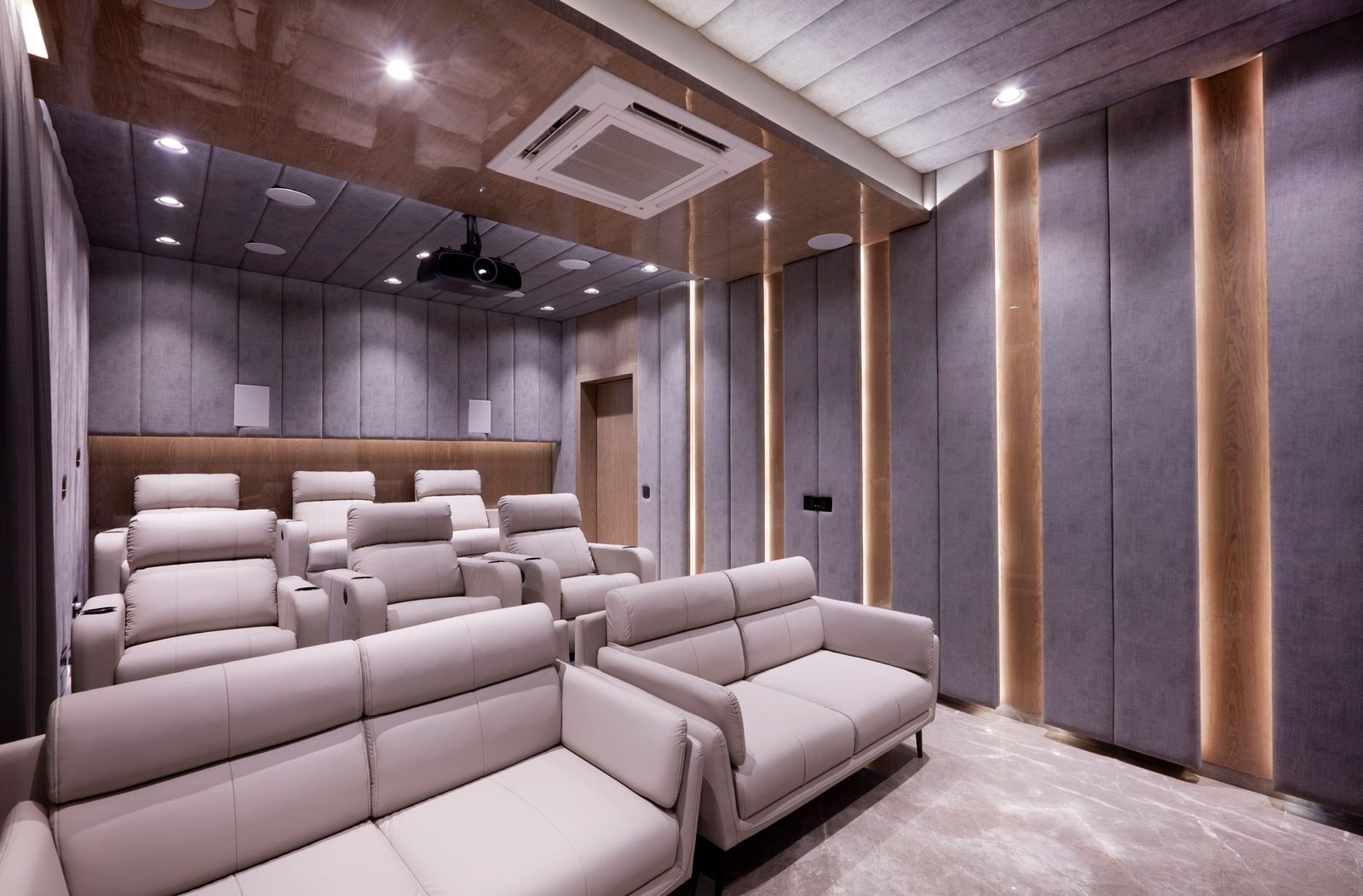
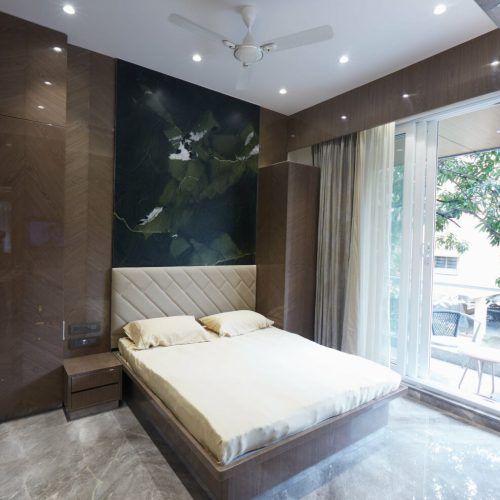

Selected work by Greenbox Design Studio. Tap any image to enlarge.
Frequently asked questions
When is the Mumbai monsoon and does it stop interior work?+
It runs roughly June to September. It does not stop interior work — civil, electrical, carcass fabrication, joinery installation and tiling all continue. It does rule out painting, polishing and wooden flooring, which need low humidity to cure correctly.
Is BWP plywood really necessary in Mumbai?+
In kitchens, bathrooms, utility areas and any joinery fixed against an external wall, yes. IS:710 boiling-water-proof plywood costs 18–25% more than MR grade on those items and is the difference between a carcass that lasts a decade and one that fails in year three.
Can I paint my flat during the monsoon?+
It is best avoided. At 85% or higher relative humidity, putty and emulsion cure slowly, trap moisture and often show patchy sheen or early peeling. If the schedule leaves no choice, use dehumidifiers, allow longer between coats, and expect the programme to extend by several days.
What causes the musty smell in Mumbai wardrobes?+
Usually a wardrobe fixed flush against an external wall with an unsealed back panel. Moisture bridges from the wall into the board and has no way to dry. The fix at design stage is a 10–12 mm air gap on battens plus a sealed back; the fix afterwards is usually removing and refitting the unit.
Does proximity to the sea change the specification?+
Within about two kilometres of the coast, yes — salt accelerates corrosion. Specify SS 304 as a minimum and SS 316 for exposed screws, handles and utility fittings, and avoid mild steel or chrome-plated hardware entirely. The premium is 30–45% on those items and worth it.
Should waterproofing be done before or during the monsoon?+
Before. Waterproofing membranes and cementitious coatings need a dry, clean substrate to bond properly. April and May are the right window in Mumbai; a membrane applied to a damp slab in July will lift.