
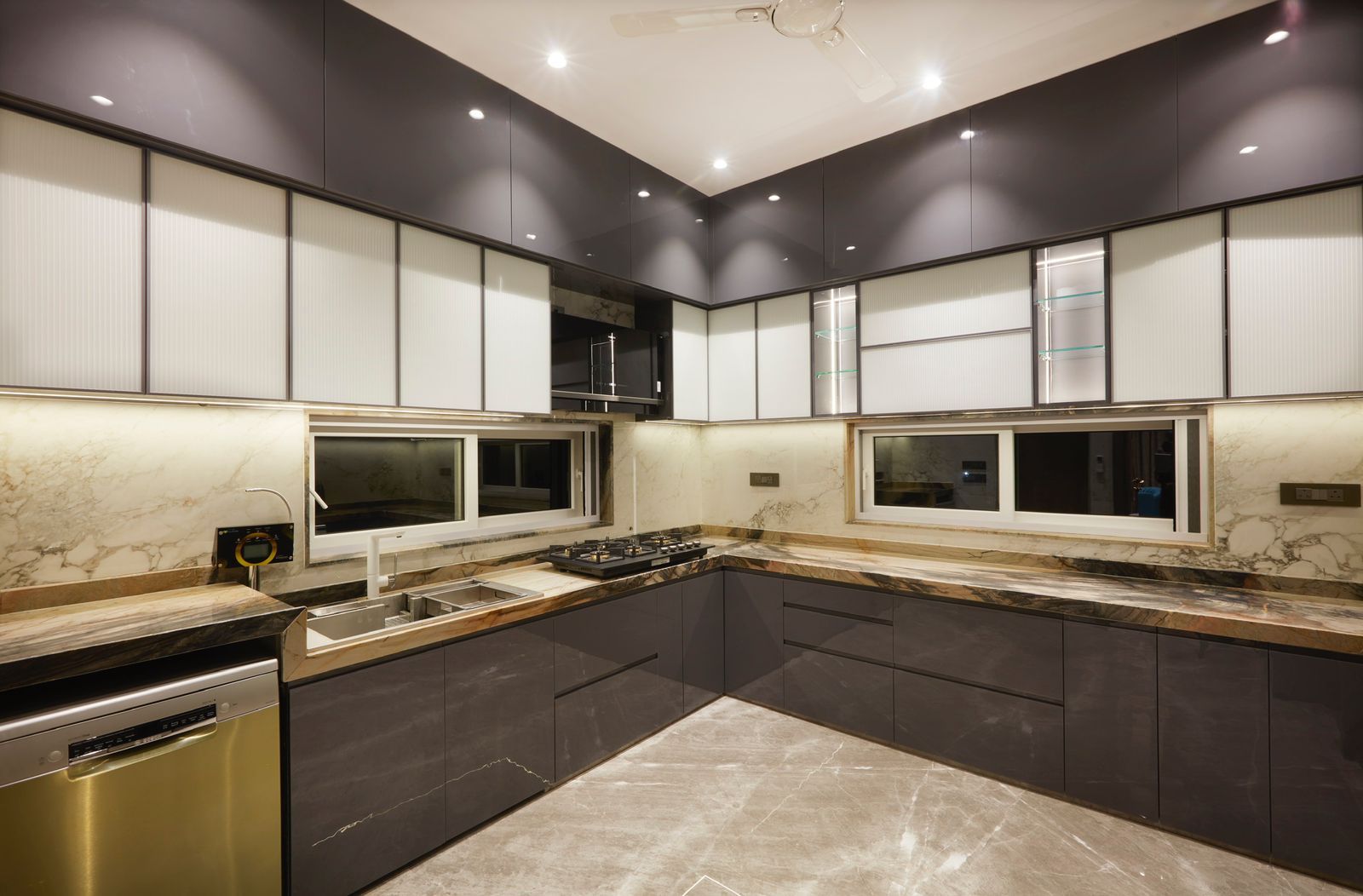
Designing around how the food is made
- A dry zone and a wet zoneKeep grinding, tempering and dough work at one end and washing at the other, with the hob between them. Indian cooking moves wet-to-dry constantly and a kitchen that mixes the two produces a permanently damp counter.
- Grain and pulse storage in volumeA tall unit with pull-out bins for 5–20 kg quantities of rice, atta, dals and sugar, not a shelf with jars. This is the storage most often under-provided, and it is why so many Indian kitchens end up with sacks on the floor.
- An open masala shelf at arm's reachA 450 mm open shelf 400 mm above the counter beside the hob, in stone or stainless rather than wood, for the daily masalas and oils. It gets oily; it is meant to, and it wipes.
- Framed shutters in teak or teak-lookA solid frame with a recessed panel, 18 mm, with a visible stile and rail. It is the single detail that reads as traditional, and it costs roughly 30% more than a flat slab because of the joinery.
The traditional Indian kitchen palette
Warm and mid-toned, with the wood darker than most contemporary kitchens would allow. Brass and stainless are both correct; chrome is not.
- Cream lime
#EFE4CC— walls above the splash and the ceiling - Teak
#5E3A22— framed shutters, both base and wall units - Black granite
#3B3B38— counter, splashband and the masala shelf - Brass
#B08A34— tap, handles and the puja niche fittings, if there is one - Terracotta
#9C4A2E— a tiled band behind the hob, if you want one
Specification for a working Indian kitchen
- Granite at 18–20 mm, honed or leathered rather than mirror polished. It takes a hot kadhai, a grinding stone and a chopping board, and a leathered finish hides the wear that polished granite shows.
- BWP 710 throughout, with a stainless or aluminium base rail. Indian kitchens see standing water more often than other kitchens; the base of the carcass is the first thing to fail.
- Framed shutters with mortise-and-tenon or dowelled corners, not mitred and glued. A mitred frame on a kitchen shutter opens at the corner within two years of steam and washing.
- A ducted 90 cm hood at 1,200–1,500 m³/hr, and separate cross ventilation. Daily tempering produces more oil vapour than any European kitchen is designed for; a window or a wall exhaust as well as the hood is not excessive.
What a traditional Indian kitchen costs
| Element | Specification | 2026 Mumbai cost |
|---|---|---|
| Base and wall units | 19 running ft, framed teak or teak-finish shutters, BWP carcass | ₹2,65,000 |
| Counter and flooring | Granite counter with splashband, plus a Kota or granite kitchen floor | ₹85,000 |
| Tall provisions unit | 600 mm with pull-out bins for grain and pulses in bulk | ₹72,000 |
| Brass fittings and masala shelf | Brass tap and handles, stone open shelf beside the hob | ₹48,000 |
| Lighting | Under-cabinet strips, one hanging lamp, warm circuit | ₹32,000 |
Total at this specification: ₹5,02,000 ex-GST. Add 18% GST. Appliances are excluded. Note that this kitchen carries more bulk storage than a modern one of the same size, which is where the tall unit cost sits.
Three traditional kitchen mistakes
- Wooden open shelving next to the hob. It absorbs oil and cannot be cleaned. The masala shelf should be stone or stainless; keep timber away from the tempering zone.
- Mitred shutter frames. They look identical to jointed frames on day one and open at the corners within two monsoons of kitchen steam.
- Under-sizing grain storage. A household buying rice and atta in 10–20 kg quantities needs pull-out bins, not jars. The sacks on the floor in most Indian kitchens are a design failure, not a habit.
Traditional kitchens in Mumbai flats
Mumbai kitchens are small, so the traditional workflow has to be compressed rather than abandoned: even in 55–70 sq ft you can put grinding at one end, the hob in the middle and the sink at the other, and that ordering alone improves the room. Ventilation is the recurring problem. Traditional Indian cooking in a sealed modern flat needs both a ducted hood and a second air path, and most societies will permit an exhaust through the existing kitchen window but not a new cored opening — check first. Humidity also argues for granite over engineered surfaces and for a stainless base rail, because Mumbai kitchens see water on the floor regularly. Finally, if a puja niche is going into the kitchen, keep it at least 900 mm from the hob and give it its own small vent.
Design the workflow, then dress it in framed teak. Other directions for the same room: Scandinavian kitchen ideas · Modern kitchen ideas. For rates and scope, see Modular kitchen cost in Mumbai, or go back to all interior design ideas.
Frequently asked questions
Is granite better than quartz for Indian cooking?+
For a traditional kitchen, yes. Granite takes a hot vessel directly and survives grinding and pounding; quartz can mark from sustained heat and is not meant for a stone grinder. Quartz wins on stain resistance and seam quality, which matters more in a modern kitchen.
How much grain storage does an Indian kitchen need?+
For a family of four buying in bulk: roughly 60–90 litres of pull-out bin capacity for rice, atta, dals and sugar, plus separate masala storage. That is a 600 mm tall unit's lower half, and it is the most commonly omitted element in modular kitchen quotations.
Do framed shutters cost more?+
About 30% more than flat slab shutters, because of the frame joinery. They are what makes a kitchen read as traditional rather than modern, so if the budget forces a choice, keep the framing on the wall units where it is seen and use slabs below.
Can a traditional kitchen have modern hardware?+
It should. Soft-close tandem drawers, a magic corner and a good chimney belong in every kitchen regardless of style. Traditional describes the shutters, the counter and the workflow, not the hinges.