
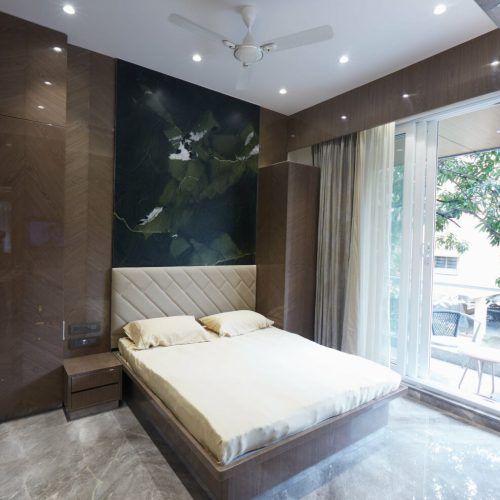
The pieces, and what to look for in each
The bed
A carved or turned teak or sheesham bed, ideally with a headboard panel rather than an openwork one so that pillows do not fall through. Look for mortise-and-tenon joints with drawbore pins, not screws and brackets. ₹85,000–₹2.4 lakh depending on carving and timber.
Jali wardrobe fronts
Teak jali panels set into solid frames on the wardrobe shutters. They ventilate the carcass, which matters in a coastal city, and they read as craft rather than as cabinetry. Add an internal dust-proof liner behind the jali for a bay holding folded clothes.
Brass lighting, low
Wall-mounted brass lamps with a fabric or mica shade, at 1,500 mm, plus a hanging lamp on a chain rather than a rod. The light should be warm, low and slightly uneven — a flat evenly lit traditional room reads as a showroom.
Textiles as the changeable layer
Block-printed cotton for summer, a heavier mashru or velvet for winter, a kantha throw, bolsters instead of scatter cushions. It is what makes the room feel lived in; budget ₹25,000–₹60,000 per set.
The traditional Indian bedroom palette
Deeper and warmer than most bedrooms, taking its colour from the textiles rather than the walls. The wall should be a ground for the wood, not a statement on its own.
- Ivory lime
#EFE0C4— walls, ideally in a lime or textured finish - Sheesham
#5B3A22— the bed, the wardrobe frames, the jali - Bottle green
#1F4C3F— quilt, bolsters, the curtain border - Madder red
#A63A2E— the block-print layer, used on cloth only - Brass
#B08A34— lamps, handles, the bed's inlay if it has one
Craft specification for a bedroom
- Seasoned teak or sheesham at 8–10% moisture with mortise-and-tenon joinery. Beds assembled with brackets and screws loosen within two years of daily use; drawbore-pinned joints do not.
- Jali panels at 12–18 mm with openings under 20 mm, set into a frame with a rebate rather than pinned on. A jali fixed to the face of a shutter is applied decoration and looks it.
- Handloom cotton, mashru or a cotton-silk in a treated finish, with a second seasonal set. Printed polyester imitations of block print are visible at a metre and cheapen the wood next to them.
- Solid brass lamps with a proper earthing terminal. Many decorative brass fittings sold in India are unearthed; insist on a three-core connection, particularly in a coastal flat.
What a traditional bedroom costs
| Element | Specification | 2026 Mumbai cost |
|---|---|---|
| Wardrobe | 8 ft teak-framed with jali panels, full height, internal liners | ₹2,25,000 |
| Bed | Carved or turned teak or sheesham, queen, with storage | ₹1,35,000 |
| Flooring | Kota or marble with a contrasting border to the bedroom zone | ₹55,000 |
| Lighting | Brass wall lamps, a hanging lamp, warm dimmable circuit | ₹42,000 |
| Textiles | Block-print quilt set, bolsters, curtains, a small durrie | ₹38,000 |
Total at this specification: ₹4,95,000 ex-GST. Add 18% GST. The bed and the wardrobe are furniture, not fit-out: they can be taken to the next home, which is rarely true of modular joinery.
Three traditional bedroom mistakes
- Carving on every surface. A carved bed, carved wardrobe, carved side tables and a carved mirror frame in 110 sq ft is oppressive. Let the bed carry the carving and keep the wardrobe as plain framed panels with jali.
- Openwork jali on a headboard. It looks wonderful and pillows fall through it. Use a solid panel behind the pillows and keep the jali for the wardrobe and the screen.
- Unseasoned wood. The cheapest carved beds in the market are made from unseasoned timber and they open at the joints through the first Mumbai monsoon. Ask for the moisture content.
Traditional furniture in a Mumbai bedroom
Scale is the constant problem: traditional Indian beds were made for larger rooms, and a carved teak queen with a headboard can measure 2,100 mm across the head and 2,250 mm long, which in a 10 ft by 11 ft bedroom leaves very little. Measure the piece, not the mattress size, and check that it will come up the lift — most carved beds knock down into four parts, but the headboard rarely does. Humidity is the second factor, and it is where jali earns its place: a ventilated wardrobe in a coastal flat protects clothes far better than a sealed one. Finally, a Kota or marble floor raises the level by 25–40 mm, which affects every door in the flat, and an older building’s society may want the added load confirmed.
One carved piece, ventilated storage, and textiles you change. Other directions for the same room: Scandinavian bedroom ideas · Modern bedroom ideas. For rates and scope, see Wardrobe cost in Mumbai, or go back to all interior design ideas.
Frequently asked questions
What wood should a traditional bed be made from?+
Teak or sheesham, seasoned to 8–10% moisture, with mortise-and-tenon joints. Mango wood is cheaper and softer and is fine for occasional furniture but not for a daily-use bed. Avoid anything sold as 'hardwood' without a species named.
Do jali wardrobe fronts collect dust?+
Some, yes. The trade-off is ventilation, which in Mumbai matters more. Use jali on the bays holding hanging clothes and a solid front with an internal liner on the bays holding folded items, and the dust stops being an issue.
Is a traditional bedroom expensive?+
It depends entirely on the carving. A plain turned teak bed and framed-panel wardrobe come in near a good modern scheme; deep hand-carving on both can double it. The cost is in karigar hours, not in the timber.
Can I mix a traditional bed with modern joinery?+
Yes, and it is often the better answer in a small Mumbai flat. A plain flush wardrobe with a carved teak bed gives the room a clear focus and keeps the storage wall quiet, which a carved wardrobe would not.