
Dimensions that matter
| Element | Dimension | Why |
|---|---|---|
| Internal depth, hanging | 600 mm | A hanger is 450–500 mm; below 550 mm clothes press on the back |
| External depth, hinged | 650 mm | 600 internal plus shutter and back panel |
| External depth, sliding | 700–750 mm | Track assembly costs 100 mm of internal depth |
| Shirt hanging height | 1,050 mm | Two shirt rails fit in a 2,100 mm section |
| Long hanging height | 1,600 mm | Saris, coats, long dresses, suits on a full hanger |
| Shelf spacing, folded | 320–380 mm | Below 300 mm a folded stack cannot be lifted out |
| Drawer height, internal | 150–220 mm | Deeper drawers become a pile, not a drawer |
| Shutter width, hinged | 450–600 mm | Above 600 mm a shutter sags and needs more hinges |
| Loft start height | 2,100–2,200 mm | Reachable from a two-step stool |
How deep should a wardrobe be?+
600 mm internal for any section that hangs clothes, which makes 650 mm external for a hinged wardrobe and 700–750 mm for a sliding one. A 550 mm wardrobe, which is common where a room is tight, presses shoulders against the back panel and creases everything hung in it.
How wide should each shutter be?+
450–600 mm for a hinged leaf. Above 600 mm the leaf becomes heavy, needs four or five hinges, and drops over time; below 450 mm you are paying for more hardware than necessary. Sliding shutters are 900–1,200 mm because the mechanism carries the weight.
What if the room cannot take 650 mm?+
Use a 450 mm-deep wardrobe with front-facing pull-out rails rather than a cross rail. It hangs clothes facing forward, which works and holds fewer garments per metre. The alternative, a 550 mm cross-rail wardrobe, is the compromise that satisfies nobody.
Sliding, hinged or open
Sliding or hinged — which should I choose?+
Hinged if the room has 900 mm of clear swing space, because you see the whole wardrobe at once, you get the full 600 mm depth, and the hardware is simpler and cheaper. Sliding where the bed or a passage is within 900 mm of the wardrobe face. The trade is real: a sliding wardrobe never opens more than half of itself.
Do sliding wardrobes have problems?+
The common ones are dust in the bottom track, wheels wearing after five to eight years, and shutters coming out of alignment. Top-hung systems avoid the bottom-track problem and cost ₹3,000–₹8,000 more per wardrobe. Specify a branded track system; unbranded sliding hardware is the most reliably disappointing item in an Indian wardrobe.
Should the wardrobe have mirrors?+
One full-height mirror per bedroom is genuinely useful, and inside a shutter is better than on it — it is protected, it does not dominate the room, and it is not the first thing you see on waking. If it is on the outside face, use safety-backed mirror and keep it off the shutter nearest the bed.
Is an open wardrobe a good idea?+
In Mumbai, rarely. Dust settles on everything within days and the room's appearance depends permanently on how tidy the wardrobe is. Where the look is wanted, a glass-fronted section for two or three items with the rest closed gives the effect without the maintenance.
Design and build under one accountable roof
Internals and storage planning
How should the internals be divided?+
Start from what you own: count the hanging metres you actually need, the folded stacks, and the special items — saris, suits, bags, shoes. A common workable split for a 6 ft wardrobe is 40% shirt hanging, 20% long hanging, 25% shelves and 15% drawers, with a loft above. See planning wardrobe internals.
Drawers inside the wardrobe or a separate chest?+
Inside, in any bedroom under about 120 sq ft. A separate chest of drawers consumes floor area and circulation that a small Mumbai bedroom does not have. Four internal drawers at 150–220 mm each, on soft-close telescopic channels, cost ₹9,000–₹18,000 and replace a piece of furniture.
How do I store saris properly?+
Either a 1,600 mm long-hanging section with sari hangers, or dedicated pull-out shelves at 300–350 mm spacing with a soft lining. Avoid deep shelves where saris are stacked more than five high — the ones at the bottom are never worn because retrieving them disturbs the whole stack.
Should the wardrobe go to the ceiling?+
Yes, with a loft section above 2,100 mm. The alternative leaves a gap that collects dust, cannot be cleaned, and wastes 600–800 mm of height. Finish the loft within 50 mm of the slab or the false ceiling. Our loft storage guide covers the construction.
Do wardrobes need lighting inside?+
A sensor-switched LED strip at the top of the hanging section transforms a deep wardrobe, particularly in a room where the main light is behind you when the doors are open. It costs ₹3,500–₹9,000 per wardrobe and needs a point planned before installation.
Materials, cost and life
What should a wardrobe carcass be made of?+
BWR or BWP plywood, with BWP mandatory at skirting level and on any wall shared with a bathroom or an external face. HDHMR is a reasonable alternative for shutters. Standard MDF should not be used for a wardrobe carcass in Mumbai; it swells irreversibly if it ever gets wet.
What does a wardrobe cost?+
₹1,350–₹3,200 per sq ft of shutter area ex-GST, so a 6 x 7 ft wardrobe runs ₹57,000–₹1,35,000 depending on carcass, finish and hardware. Sliding adds 15–25%. Our wardrobe cost calculator prices your dimensions and specification.
How long should a wardrobe last?+
Eighteen to twenty-five years with a BWP or BWR carcass and branded hardware, with a hardware refresh at around year twelve. With MR board and unbranded hinges, eight to twelve years, and the failure is usually the hardware and the bottom rail rather than the shutter you are looking at.
Can internals be changed later?+
If they were built adjustable, yes — shelves on a 32 mm pin system and a removable hanging rail can be reconfigured in an afternoon. Fixed shelves glued and pinned into the carcass cannot. Specify adjustable internals; it costs ₹3,000–₹7,000 more and it is what lets a wardrobe follow a family's changing needs.
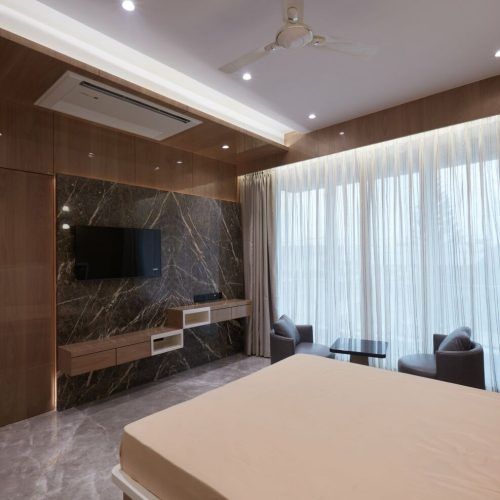
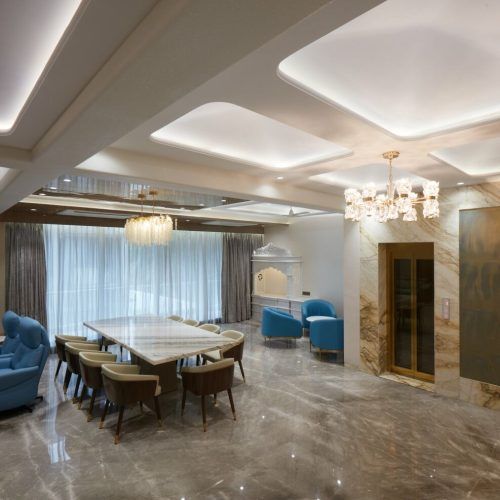
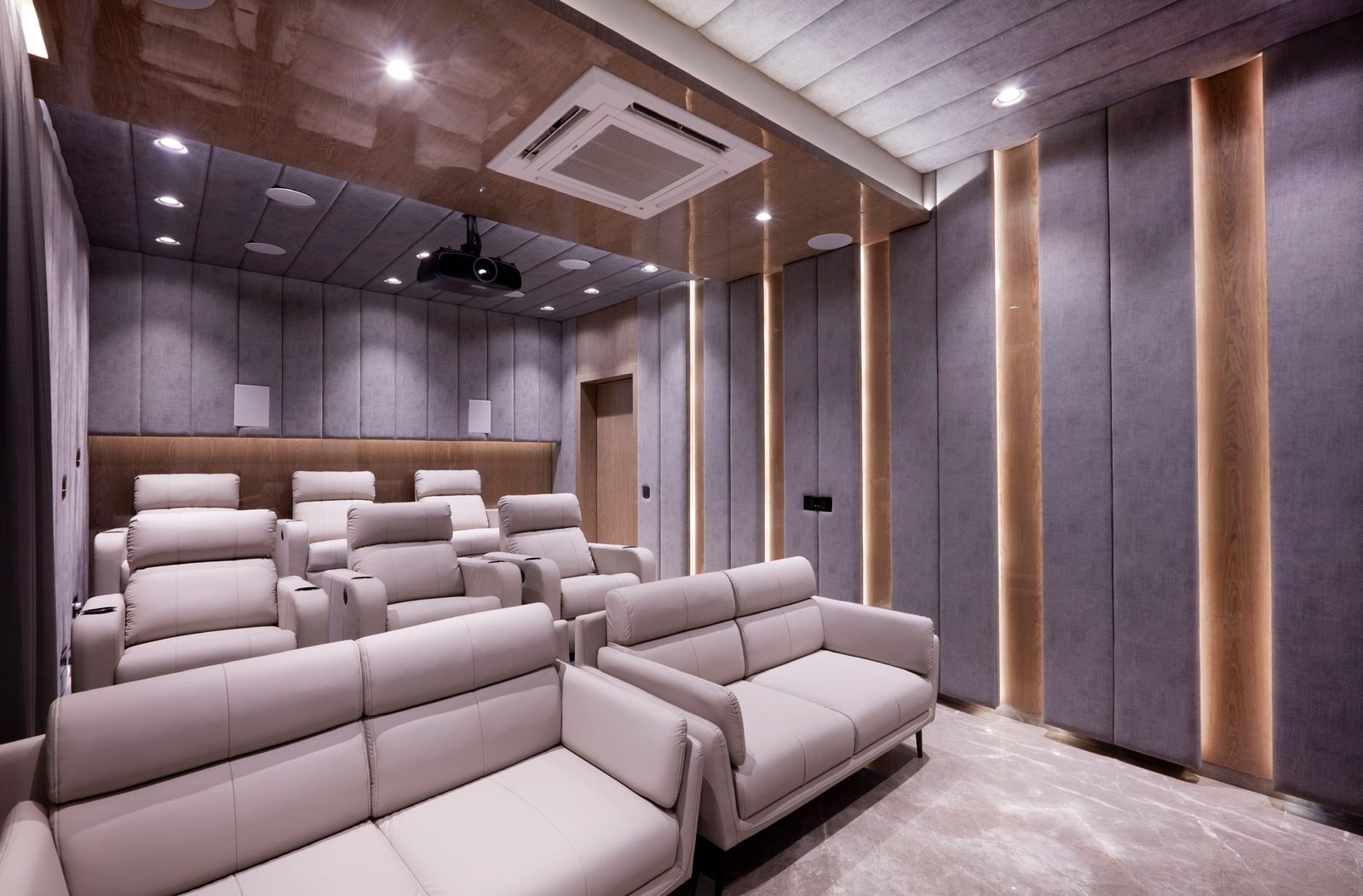
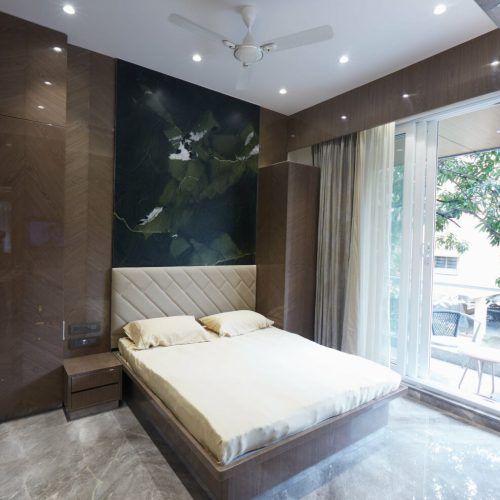
Selected work by Greenbox Design Studio. Tap any image to enlarge.
Frequently asked questions
How deep should a wardrobe be?+
600 mm internal depth for hanging, which is 650 mm external for a hinged wardrobe and 700–750 mm for a sliding one, because the track assembly consumes about 100 mm. At 550 mm internal, shoulders press against the back panel and hung clothes crease permanently.
Sliding or hinged wardrobe doors?+
Hinged wherever there is 900 mm of clear swing space: you see the whole wardrobe at once, keep the full depth and pay less for hardware. Sliding where a bed or passage sits within 900 mm of the wardrobe face, accepting that you can only ever open half of it.
What hanging heights should a wardrobe have?+
1,050 mm for shirts, which lets two shirt rails stack inside a 2,100 mm section, and 1,600 mm for saris, coats, long dresses and full-length suits. Planning a single 2,100 mm hanging section wastes roughly a third of the wardrobe's volume.
What does a wardrobe cost in Mumbai?+
₹1,350–₹3,200 per sq ft of shutter area ex-GST, so ₹57,000–₹1,35,000 for a 6 x 7 ft wardrobe depending on carcass grade, finish and hardware brand. Sliding shutters add 15–25% over hinged for the same size.
Should a wardrobe go all the way to the ceiling?+
Yes, with a loft section starting at 2,100–2,200 mm. Stopping short leaves a gap that collects dust, cannot be cleaned and wastes 600–800 mm of height — roughly 40 cubic feet of storage above a standard six-foot wardrobe.
What board should a wardrobe carcass use?+
BWR plywood as a minimum, and BWP at skirting level and against any wall shared with a bathroom or an external face. HDHMR works for shutters. Standard MDF is not suitable for a wardrobe carcass in Mumbai, because it swells irreversibly the first time it gets wet.