
Start by counting, not by choosing
Standard wardrobe internals exist because they are easy to fabricate, not because they suit anybody. The single most useful hour in wardrobe design is spent in your current wardrobe with a tape measure: how many running feet of rail are actually occupied, how many folded shelves are full, how many pairs of shoes live in the bedroom, how many saris or suits need full-length hanging. Those four numbers determine the design. Everything else is styling.
| What to count | How | Typical adult | Typical couple |
|---|---|---|---|
| Hanging rail in use | Measure occupied rail, in running feet | 7 – 11 rft | 14 – 20 rft |
| Long-hang items | Count saris, gowns, coats, suits | 6 – 25 | 20 – 60 |
| Folded shelves in use | Count full shelves, 600 × 350 mm | 9 – 15 | 18 – 28 |
| Shoes stored in bedroom | Count pairs | 6 – 12 | 14 – 26 |
| Bags and accessories | Count items needing shelf space | 4 – 10 | 10 – 20 |
| Seasonal or stored items | Count in cubic feet | 8 – 14 cu ft | 16 – 26 cu ft |
Add 20% to every figure. Wardrobes fill to capacity within about two years.
The dimensions that matter
These are the internal dimensions we work to. They are not arbitrary; each derives from the garment or object it holds, and most disappointing wardrobes get one or two of them wrong.
| Element | Dimension | Why |
|---|---|---|
| Hanging depth | 600 mm internal | A shirt on a hanger is 550–580 mm across the shoulders |
| Short hang (shirts, trousers folded) | 1,050 – 1,150 mm | Allows a full hanger plus clearance |
| Long hang (saris, gowns, coats) | 1,400 – 1,500 mm | Full-length garments plus hanger |
| Folded shelf spacing | 350 – 400 mm | A stack of 8–10 folded shirts is 280–320 mm |
| Shelf depth | 450 – 550 mm | Deeper and the back of the shelf is unreachable |
| Shelf span without support | Max 900 mm | 18 mm ply sags visibly beyond this under load |
| Drawer internal height (underwear, socks) | 120 – 150 mm | Shallow drawers stay organised |
| Drawer internal height (jeans, knitwear) | 220 – 280 mm | Two folded stacks |
| Shoe shelf spacing | 160 – 200 mm | 220 mm for boots, angled racks save 40 mm |
| Loft clear height | 450 – 600 mm | Suitcase depth on its side |
Design and build under one accountable roof
Allocating a standard 7-foot wardrobe
A 7 ft wide by 8 ft tall wardrobe gives you three bays of roughly 700 mm each, plus a loft. Here is how we usually allocate it for one adult, and what each element costs on top of the basic carcass.
- Bay one — long hangFull-height rail at 1,450 mm with a 450 mm shelf above and a two-drawer stack below. Holds saris, coats and dresses.
- Bay two — double hangTwo rails at 1,100 mm each, doubling the shirt and trouser capacity of the same footprint. This is the highest-value move in wardrobe planning.
- Bay three — folded and drawersFour shelves at 380 mm spacing above a three-drawer stack. Drawers at 150, 220 and 280 mm internal heights.
- LoftTwo compartments, 500 mm clear, for suitcases and seasonal bedding. Doors hinged, not sliding, so both halves open fully.
- Leave one bay shortDeliberately leave 300 mm of vertical space unallocated. Every household we have built for has filled it within a year.
Accessories: what is worth the money
| Accessory | Cost (2026) | Worth it? |
|---|---|---|
| Soft-close drawers, Hettich Quadro | ₹2,800 – ₹4,200 per drawer | Yes — daily contact item |
| Pull-down wardrobe lift for high rails | ₹6,500 – ₹14,000 | Only above 2,100 mm |
| Pull-out trouser rack | ₹3,200 – ₹6,800 | Rarely — a rail does the same |
| Internal LED strip with door sensor | ₹1,800 – ₹4,500 per bay | Yes — cheap and used daily |
| Mirror on the inside of a shutter | ₹2,400 – ₹5,000 | Yes, in a small bedroom |
| Pull-out shoe rack | ₹4,500 – ₹9,000 | Only if shoes must live in the bedroom |
| Jewellery insert tray | ₹3,500 – ₹8,000 | Personal — but a lockable one is useful |
| Corner carousel | ₹8,000 – ₹18,000 | Usually not — a hinged corner shelf costs a fifth |
Double-hang one bay. It is the cheapest fifty per cent more wardrobe anyone will ever sell you.
Greenbox principal designer
Where wardrobes fail
Three failures account for almost every wardrobe complaint we are asked to inspect, and none of them is about the shutter. The back panel is the first: a 3 mm or 4 mm back pinned into a rebate has no structural role and sags against an external wall, and in a humid flat it is the element that absorbs damp and carries the smell. Specify 6 mm, sealed, with a 10–12 mm air gap behind the unit. The second is shelf sag, caused by spans over 900 mm without a support or a stiffening lip. The third is hinge count — two hinges on a 2,100 mm tall shutter guarantees misalignment within a year; that shutter needs four.
Sliding or hinged?
Hinged shutters give full access to the bay behind them, allow internal mirrors and shelves right to the front edge, and cost less. Sliding shutters need no swing space, which matters when the bed is less than 700 mm from the wardrobe face, but they always hide one section, they steal 80–100 mm of internal depth for the track, and a good sliding system costs ₹1,200–₹2,400 per running foot more than hinges. Our default is hinged unless circulation genuinely forbids it. If you do go sliding, specify a top-hung system rather than a bottom-rolling one — bottom tracks collect dust and grit and become gritty within two years in Mumbai.
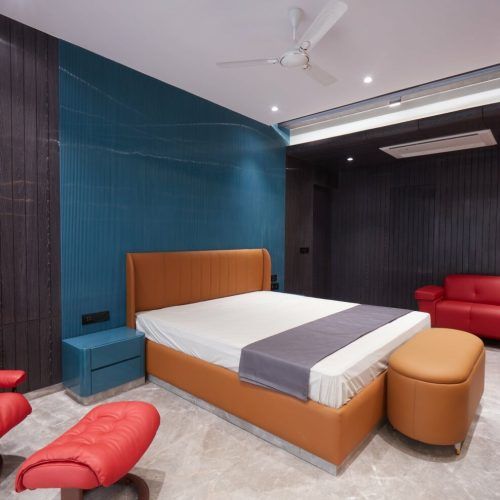
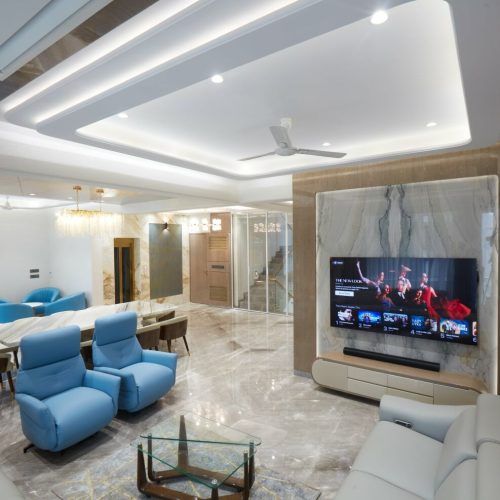
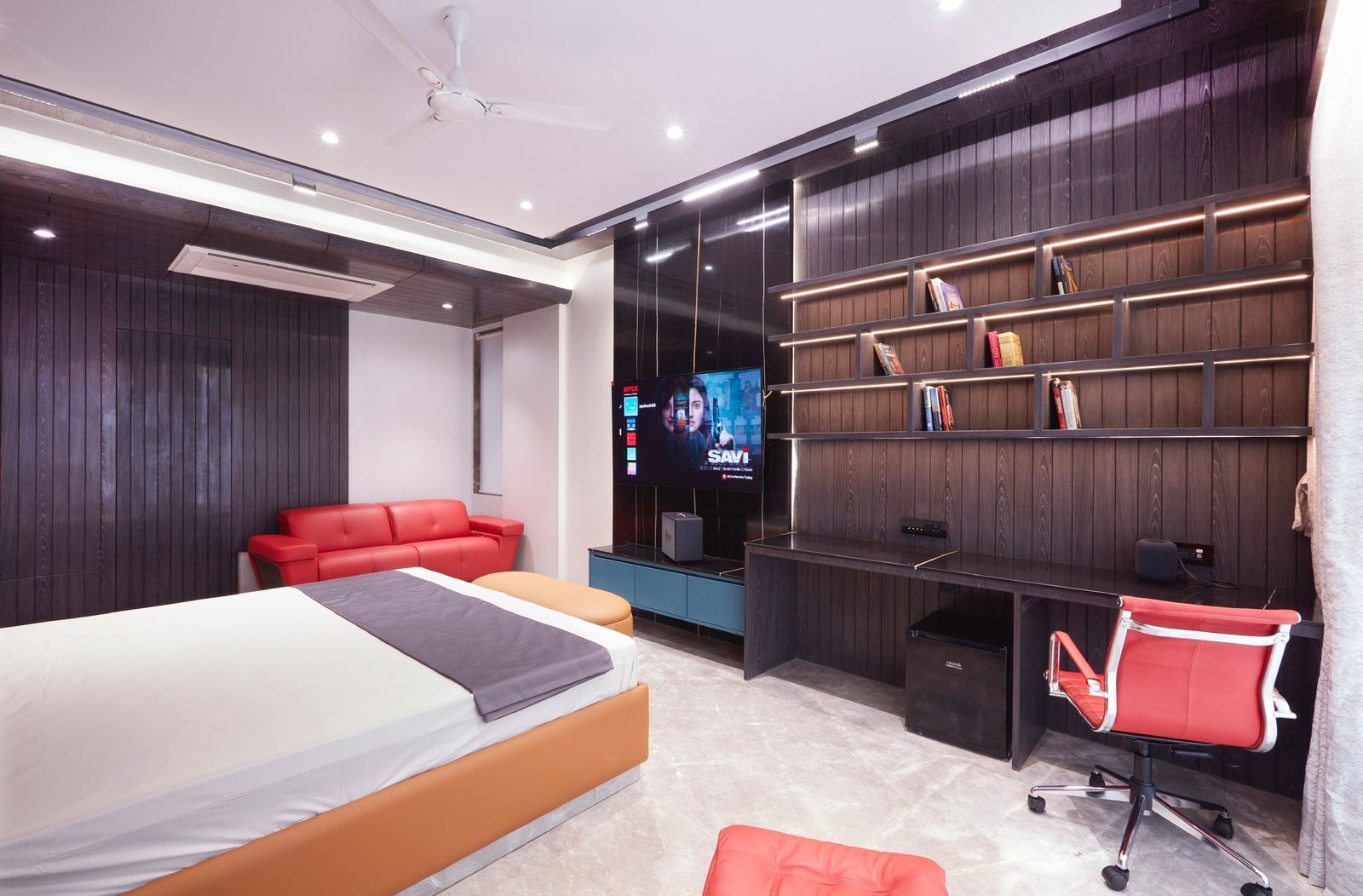
Selected work by Greenbox Design Studio. Tap any image to enlarge.
Frequently asked questions
How deep should a wardrobe be?+
Six hundred millimetres internal for hanging, because a shirt on a hanger measures 550–580 mm across the shoulders. Wardrobes built at 450 or 500 mm depth force garments to hang at an angle and press against the shutter, and are really shelf units with a rail in them.
What is the right shelf spacing in a wardrobe?+
350–400 mm between folded shelves. A stack of eight to ten folded shirts is 280–320 mm high, so that spacing lets you lift from the middle of a stack without collapsing it. Shelves should not span more than 900 mm unsupported, or 18 mm plywood will sag visibly.
Are wardrobe accessories worth the cost?+
Soft-close drawers, internal LED lighting and an inside-shutter mirror consistently earn their cost. Corner carousels, pull-out trouser racks and most specialist inserts usually do not — a well-proportioned shelf or rail does the same job for a fifth of the money.
Should I choose sliding or hinged wardrobe shutters?+
Hinged unless circulation forbids it. Hinged gives full access, allows internal mirrors and costs less. Sliding needs no swing space but always conceals one bay, loses 80–100 mm of internal depth to the track, and adds ₹1,200–₹2,400 per running foot.
How much wardrobe do a couple actually need?+
Fourteen to twenty running feet of hanging rail, eighteen to twenty-eight folded shelves and around 20 cubic feet of stored-item space, which is typically two 7-foot wardrobes plus lofts. Count what you use today and add twenty per cent rather than working from a rule of thumb.