
Where the desk goes
In a Mumbai flat there are usually four candidate positions, and they are not equally good. Ranked by how well they work over a year rather than how they photograph: a bedroom alcove or the wall beside a wardrobe; a converted balcony or utility with the door closed; a dedicated corner of the living room with a partial screen; and last, the dining table, which works for a fortnight and then stops.
| Location | Usable desk width | Call privacy | Daylight | Typical build cost, ex-GST |
|---|---|---|---|---|
| Bedroom alcove | 1200–1800 mm | Good | Usually good | ₹42,000–₹1,35,000 |
| Beside the wardrobe run | 900–1200 mm | Good | Variable | ₹28,000–₹65,000 as part of the wardrobe |
| Enclosed balcony / utility | 1500–2400 mm | Very good | Excellent, but glare and heat | ₹75,000–₹2,20,000 with glazing |
| Living room corner with screen | 1200–1500 mm | Poor during family hours | Good | ₹55,000–₹1,10,000 |
| Dining table | Whatever is free | None | Variable | Nil, and it will not last |
The dimensions
These are the numbers we hold on every built-in study. They come from eight hours a day, not from a photograph.
| Element | Minimum | Comfortable | Note |
|---|---|---|---|
| Desk height | 720 mm | 750 mm | 740–760 mm suits 5 ft 2 in to 6 ft with an adjustable chair |
| Desk depth | 600 mm | 750 mm | Below 600 mm a 27-inch monitor sits too close |
| Desk width, single monitor | 1050 mm | 1200 mm | 1500 mm for dual monitors |
| Knee clearance height | 650 mm | 680 mm | Watch the drawer box — it is the usual offender |
| Knee clearance depth | 450 mm | 600 mm | Do not put a CPU cabinet here |
| Chair pull-back space | 750 mm | 900 mm | Measure from the desk edge to the wall behind |
| Monitor eye distance | 500 mm | 600–700 mm | Top of screen at or just below eye level |
| Overhead shelf clearance | 400 mm | 450 mm | Below 400 mm you hit your head reaching for a file |
Light — for the work and for the camera
These are two different problems and most home setups solve neither. The work surface wants 400–500 lux of fairly neutral light with no reflection into the screen. The camera wants soft light on your face from roughly the direction of the monitor. A window behind the desk gives you a silhouette on every call; a window directly in front gives you glare on the screen. The good position is a window to one side.
- Task light: an under-shelf 4000 K LED strip, 8–10 W per running metre, set 450 mm above the desk and shielded so you cannot see the diode. ₹450–₹900 per running foot fitted.
- Ambient: a 3000 K ceiling layer so the room is not a bright desk in a dark box. Eye strain comes from contrast, not from brightness.
- Call light: a diffused 5000 K panel or a bounced lamp behind the monitor, about 250–400 lux on the face. An ₹1,800 panel is the single highest-return purchase in a home office.
- Anti-glare: if the window is in front, a light-filtering roller blind at 3–5% openness. Blackout is the wrong answer; you lose the daylight you were trying to use.
- Avoid a downlight directly above the monitor. It puts a bright bar across a glossy screen for the whole afternoon.
Sound
Home offices in Mumbai have two acoustic problems: your echo on other people's calls, and your neighbours' drilling on yours. The first is cheap to solve and the second is not. For the echo, the goal is simply to stop the sound bouncing between two parallel hard surfaces behind and in front of you — a curtain, a pinboard in felt, a bookshelf with uneven contents, or a fabric-wrapped 25 mm panel on the wall behind the chair all do it. A 900 mm x 1200 mm fabric panel costs ₹3,800–₹7,500 and measurably improves how you sound.
For external noise, the honest answer is that a single-glazed aluminium window facing a main road will pass 55–60 dB straight through, and no amount of soft furnishing changes that. Secondary glazing or a uPVC double-glazed replacement at ₹850–₹1,600 per sq ft is the only real fix, and it is a window job, not an interiors job.
Power, data and cable management
- Six sockets at desk heightTwo 16 A and four 6 A on a 300 mm-high band above the desk, plus two USB-C PD outlets. Laptop, monitor, dock, lamp, phone, printer — you will use all of them.
- One RJ45 pointWi-Fi is fine until it is not. A single cat-6 run from the router costs ₹1,800–₹4,000 during electrical first fix and is impossible to add neatly later.
- A cable tray under the deskA 100 mm powder-coated tray screwed to the underside of the worktop. ₹1,200–₹2,600, and it is the difference between a desk and a nest.
- One grommet, back-left60 mm, positioned where the monitor arm clamps. Cutting it after the worktop is fitted risks a chipped edge.
- A UPS shelfIf you are on a floor with frequent short cuts, plan a 300 x 400 mm ventilated shelf at skirting level rather than a box on the floor.
Clients spend ₹40,000 on a chair and then sit at a 450 mm-deep shelf with a socket behind the bed. The shelf is the problem.
Greenbox principal designer
What it costs to build in 2026
| Build | Scope | Cost, ex-GST |
|---|---|---|
| Wall-mounted worktop | 1200 mm, 25 mm ply with laminate, two brackets, cable tray | ₹12,000–₹22,000 |
| Alcove study, laminate | 1500 mm desk, two drawers, overhead shelf, task light | ₹42,000–₹68,000 |
| Alcove study, veneer or PU | Same, in veneer with soft-close Hettich hardware and a fabric back panel | ₹85,000–₹1,35,000 |
| Study as part of a wardrobe run | 900 mm desk return, shared carcass | ₹28,000–₹65,000 |
| Enclosed balcony office | Glazing, flooring, desk, storage, light, power | ₹75,000–₹2,20,000 |
| Electrical add-on | 6 sockets at desk height, one RJ45, one lighting circuit | ₹8,500–₹18,000 |
Add 18% GST. Chair, monitor and IT are excluded — budget ₹18,000–₹60,000 for a task chair worth sitting in.

A built-in study that survives eight hours a day
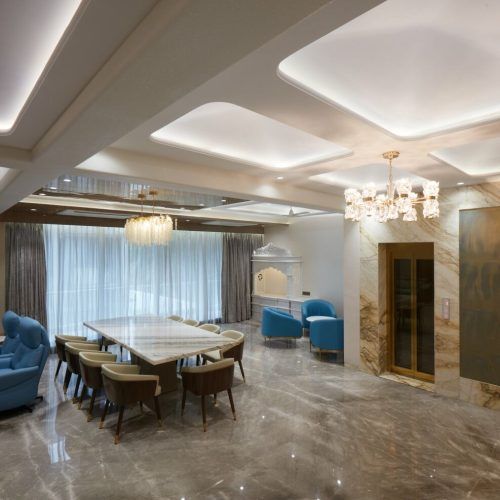
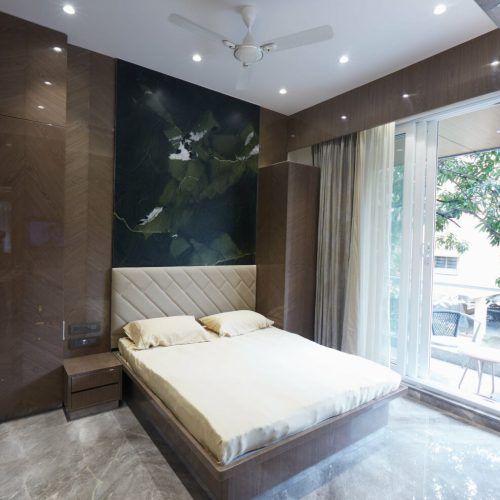
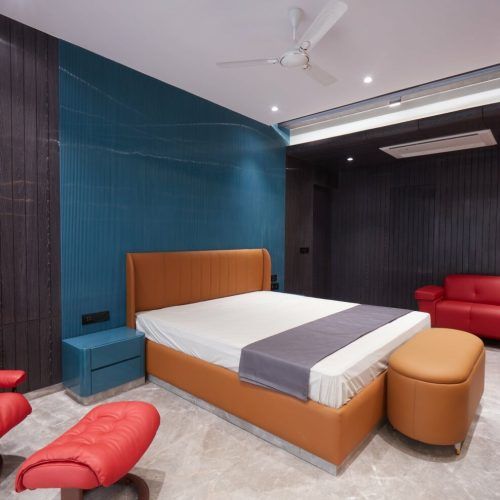

Selected work by Greenbox Design Studio. Tap any image to enlarge.
Frequently asked questions
What is the ideal desk size for working from home?+
1200 mm wide by 750 mm deep at 750 mm height for a single monitor, and 1500 mm wide for dual monitors. Depth is the dimension people get wrong — at 600 mm a 27-inch screen sits about 450 mm from your eyes, which is too close, and below 600 mm you end up working at an angle to the desk.
How do I look better on video calls without buying equipment?+
Move the desk so the window is to one side rather than behind you, and put any lamp you already own behind the monitor bouncing off the wall in front of you. That covers most of it. If you want to spend money, a diffused 5000 K panel at around ₹1,800 delivering 250 to 400 lux on your face is the highest-return purchase in a home office.
How many sockets should a home office desk have?+
Six, at desk height — two 16 A and four 6 A — plus two USB-C outlets and one RJ45 data point. Two sockets at skirting level is the standard builder provision and it is not enough for a laptop, monitor, dock, lamp, phone and printer. Adding them afterwards costs ₹8,500 to ₹18,000 and means chasing the wall.
Can I convert a balcony into a home office in a Mumbai flat?+
Often, but check two things first. The society may treat enclosing a balcony as a change to the elevation and refuse permission, and in many buildings the balcony is not permitted to be enclosed at all under the approved plan. Where it is allowed, expect ₹75,000 to ₹2,20,000 including glazing, flooring, desk, storage and power, and plan for west-facing heat gain.
What is the cheapest way to stop echo on calls?+
Break up the parallel hard surfaces around you. A curtain behind the chair, a loaded bookshelf on one side, or a 900 mm by 1200 mm fabric-wrapped panel at ₹3,800 to ₹7,500 on the wall behind you. Any of the three makes a bigger difference to how you sound than a more expensive microphone.