
What humidity actually does to a panel
Plywood and MDF are hygroscopic: they take on moisture from the air until they reach equilibrium with it, then give it back when the air dries. At 55% RH a sheet of commercial ply sits at roughly 9% moisture content. At 85% it climbs towards 12–13%. That gain is not distributed evenly — the face that is exposed takes it up first, the sealed face lags, and the panel cups towards the wetter side.
On a 2,100 mm wardrobe shutter, a 1.5% moisture gain across the thickness is enough to bow the leaf 3–4 mm at the centre. That is why a wardrobe that closed perfectly in April rubs in July. It is not bad carpentry; it is a panel doing what panels do, in a flat where nobody specified the clearance to absorb it.
| Board | IS grade | 24-hr water absorption | Behaviour at 85% RH | ₹ per sq ft, 19 mm |
|---|---|---|---|---|
| MR commercial ply | IS:303 MR | 18–25% | Swells at edges, delaminates at the bottom rail | ₹78–₹105 |
| BWR ply | IS:303 BWR | 10–14% | Holds shape; glue line survives damp, core may not | ₹105–₹135 |
| BWP marine ply | IS:710 | 6–9% | Stable; the only correct carcass below the counter | ₹135–₹175 |
| HDHMR | IS:17051 | 8–12% | Very stable, heavier, holds screws poorly at edges | ₹115–₹150 |
| Standard MDF | IS:12406 | 25–35% | Swells irreversibly; never for Mumbai carcass | ₹55–₹75 |
| WPC / PVC board | — | Under 1% | Inert; soft, so no heavy loading or long shelves | ₹120–₹165 |
Rates are for the board alone, before lamination, hardware and labour. Add 18% GST.
The five details that decide whether joinery survives a monsoon
- Seal all six faces. Most carpenters laminate the two visible faces and leave the top, bottom and back edges raw. Moisture enters through raw edges twenty times faster than through a laminated face. Insist on edge banding or at minimum two coats of sealer on hidden edges.
- 2 mm edge banding, hot-melt or laser. The 0.8 mm tape most quotations assume peels at the bottom rail within two monsoons. The upgrade costs roughly ₹9–₹14 per running foot.
- Lift the carcass off the floor. A 75–100 mm skirting in WPC or aluminium, never ply sitting on the slab. Mopping water wicks straight up a ply bottom rail.
- Ventilate the back. A 12–15 mm air gap between the back panel and an external wall, and two 50 mm grommets in the back panel of any wardrobe on a west-facing wall.
- 3 mm reveals. Shadow gaps of 3 mm on shutters and 4 mm on tall units. Tight 2 mm gaps photograph beautifully and bind every July.
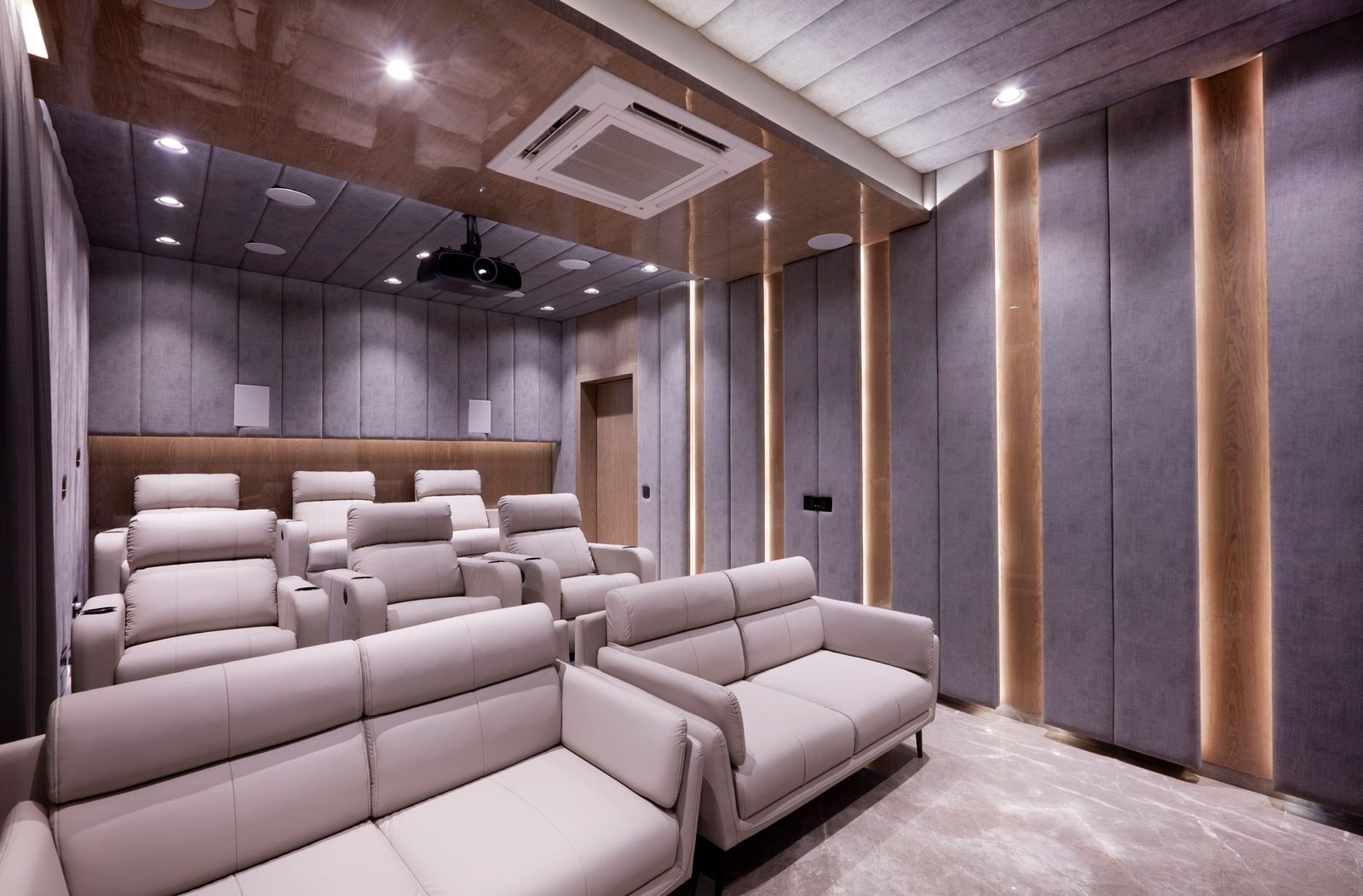
Design and build under one accountable roof
Solid wood, veneer and what moves most
Solid timber moves across the grain, not along it. Teak moves roughly 2.2% tangentially across a seasonal cycle, so a 600 mm solid teak panel changes width by around 13 mm between January and July. That is why traditional Indian furniture used frame-and-panel construction: the panel floats in a groove and is free to move. A solid slab glued into a rigid frame will split, and it will split in the second year, not the first.
Veneered ply avoids the problem — the 0.5 mm veneer moves with the substrate under it — but only when both faces are balanced. A panel veneered on one face and left raw on the other will cup, every time. If you are paying for veneer, pay for backing veneer on the hidden face too. It adds about ₹45–₹70 per sq ft and it is the difference between a flat door and a warped one.
What it costs to specify for the climate
| Upgrade | Where it matters most | Extra cost on a 2BHK | What it prevents |
|---|---|---|---|
| MR → BWP carcass, wet areas | Kitchen, utility, bathroom vanity | ₹16,000–₹22,000 | Bottom-rail delamination in year 2–3 |
| 0.8 → 2 mm edge banding, all edges | Every shutter and drawer front | ₹7,500–₹11,000 | Peeling tape, swollen edges |
| WPC skirting under all carcass | Kitchen, wardrobes, TV unit | ₹4,000–₹6,500 | Wicking from floor mopping |
| SS 304 hinges in place of MS | All shutters | ₹5,500–₹9,000 | Rust bleed onto shutter faces |
| Backing veneer on veneered doors | Wardrobe and main door leaves | ₹9,000–₹15,000 | Cupping of unbalanced panels |
Total ₹42,000–₹63,500 on a typical 2BHK, ex-GST — around 4–6% of a mid-range interior budget.
The July service visit
Even correctly built joinery needs one adjustment in its first monsoon. European hinges have three-way cam adjustment; fifteen minutes with a Pozidriv driver resets every shutter in a flat. Book it for the second week of July, not September, and the doors behave for the rest of the season. Our warranty covers this visit; if yours does not, it is worth asking why.
Where the moisture actually comes from
Clients assume the monsoon is the enemy, and it is only half of it. Four sources feed moisture into joinery, and three of them operate year-round. Ambient humidity is the obvious one. The second is the floor: mopping water sits in the 2–3 mm gap under a carcass and is drawn up the end grain of a ply bottom rail, which is why skirting-mounted joinery survives and floor-mounted joinery does not. The third is the wall behind — an external or duct-sharing wall carries damp into a back panel that is pressed flat against it with no air gap. The fourth is the kitchen itself: a pressure cooker releases well over a litre of water into the air in twenty minutes, and without an extraction path that water condenses on the coolest surface in the room, which is usually the inside of the tall unit next to the hob.
This is why the same wardrobe specification behaves differently in two flats in the same building. A south-west corner flat on the second floor with a shared bathroom wall is a materially harsher environment than a tenth-floor east unit, and the specification should reflect that rather than being copied from the last job. On site surveys we record wall orientation, the position of every plumbing duct and the age of the building's waterproofing before we finalise the board schedule.
- Check the wall before the carcass is fixed. A moisture meter reading above 16% on a plastered wall means the wall is treated before joinery goes against it, not after.
- Plan an extraction path in the kitchen. A 60 cm chimney at 1,200 m³/hr, or a 150 mm exhaust in the utility. Without one, humidity in a closed Mumbai kitchen stays above 80% for hours after cooking.
- Do not seal a bathroom shaft wall airtight. A wardrobe with a solid back against a shaft wall traps moisture rather than excluding it. Ventilate the cavity.
- Leave the loft breathable. Lofts above 2,100 mm are the hottest and dampest part of the flat in July. Louvred or perforated shutters cost ₹180–₹300 per sq ft more and keep stored fabric usable.
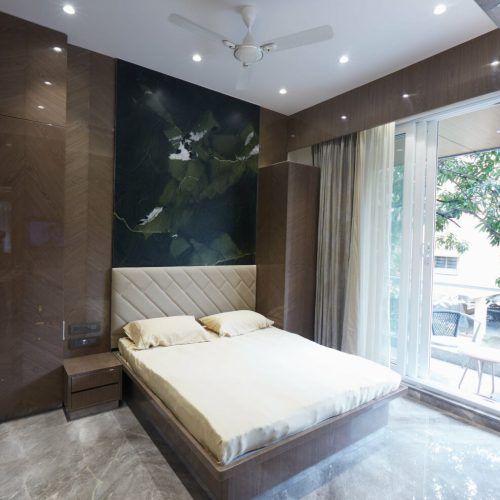
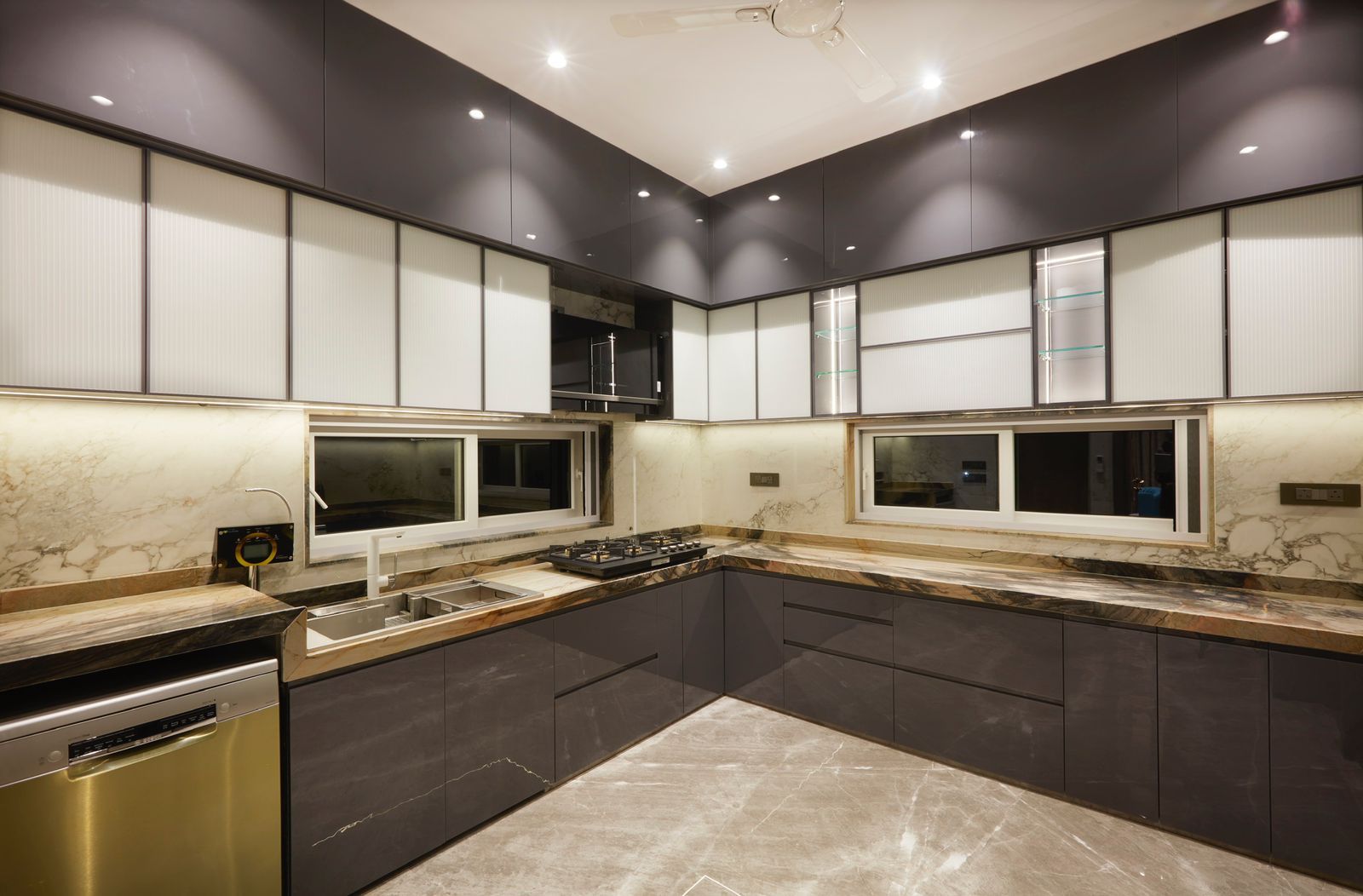
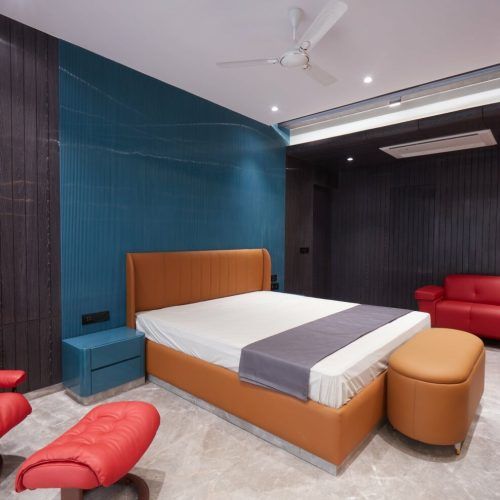

Selected work by Greenbox Design Studio. Tap any image to enlarge.
Frequently asked questions
Is BWP plywood worth the extra cost in Mumbai?+
In kitchens, utility areas and bathroom vanities, yes without qualification — the ₹38–₹52 per sq ft premium buys a board that absorbs 6–9% water against MR ply's 18–25%. In dry bedroom wardrobes above skirting level, BWR at ₹105–₹135 per sq ft is a defensible saving.
Why did my wardrobe shutter warp after one year?+
Almost always an unbalanced panel: veneer or laminate on the show face only, with the hidden face left raw. The finished face resists moisture, the raw face takes it up, and the leaf cups towards the raw side. Rebalancing means laminating the back face, which usually requires removing the shutter.
Do dehumidifiers help protect interiors?+
In a closed bedroom, a 12-litre-per-day unit holding 55–60% RH genuinely reduces panel movement and mould on the back of wardrobes. It is not a substitute for correct board grade — but in a ground-floor or sea-facing flat with a persistent damp problem, it is ₹18,000–₹28,000 well spent.
What hardware should I specify near the sea?+
SS 304 as the minimum for hinges, telescopic channels and handles anywhere within two kilometres of the coast, and SS 316 for balcony-adjacent and open-to-sky applications. Mild steel with a zinc flash will bloom rust through the plating within eighteen months in Bandra or Worli.
Should the carpenter work during the monsoon?+
Site carpentry, yes, with the flat closed and ply stored off the floor on battens. What should not happen in July is polishing, PU spraying or final laminate pressing — adhesive cure times stretch, and finishes trap ambient moisture. Schedule those for a dry window or a climate-controlled factory.