
Two different problems
Walk into a bare flat before furniture arrives and clap. The ring you hear is reverberation — sound bouncing between hard parallel surfaces — and it is an absorption problem, solved inside the room with soft material. Now stand in the same flat with the window closed and listen to the road. That is transmission, and no amount of panel on the inside face of a wall will reduce it, because absorption panels are light and transmission is stopped by mass, sealing and air gaps.
Almost every disappointed purchase of acoustic foam comes from confusing the two. A client buys sixteen pyramid foam tiles to quieten a bedroom facing the Western Express Highway, fixes them to the wall, and reports no change. They are correct: the foam reduced the room's reverberation time by perhaps 0.2 seconds, which is inaudible when the actual complaint is a bus at 74 dB coming through a 6 mm single-glazed window with a 4 mm gap at the sill.
Understanding NRC and STC
Two numbers describe the two problems. NRC (Noise Reduction Coefficient) runs from 0 to 1 and describes how much sound a surface absorbs — 0.85 means 85% absorbed, 15% reflected. STC (Sound Transmission Class) describes how many decibels an assembly blocks; a standard 115 mm brick wall is around STC 40, a hollow flush door around STC 20, and an open window is effectively STC 5. Reading both numbers on a product datasheet, rather than the word 'acoustic' on the box, is the whole skill.
| Material / assembly | NRC (absorption) | STC (blocking) | ₹ per sq ft installed | Use |
|---|---|---|---|---|
| 25 mm polyester acoustic panel | 0.70–0.85 | ~2 | ₹180–₹340 | Echo control, home theatre, study |
| 50 mm rockwool behind fabric | 0.90–1.00 | ~4 | ₹320–₹560 | Serious absorption, music rooms |
| 25 mm foam pyramid | 0.50–0.60 | ~1 | ₹95–₹180 | Budget echo control only |
| Heavy lined curtain, full height | 0.45–0.65 | ~3 | ₹220–₹480 | Absorption plus a little window help |
| Carpet with underlay | 0.35–0.55 | ~5 (impact) | ₹180–₹420 | Footfall from the flat above — in their flat, not yours |
| Double-leaf gypsum partition with rockwool | 0.15 | STC 48–52 | ₹320–₹520 | New internal partitions |
| Acoustic laminated glazing, 6-12-6 | — | STC 38–44 | ₹1,400–₹2,800 | Road-facing windows |
| Door seal kit + drop seal | — | +6–10 dB | ₹3,200–₹6,500 per door | The cheapest real improvement |
A material with a high NRC and a low STC is an absorber, not a barrier. Almost all 'soundproofing foam' falls into that category.
Design and build under one accountable roof
What to do first in a Mumbai flat
The order matters, because the cheap interventions deliver most of the benefit. We work down this list with clients and typically stop at step three.
- Seal the gaps. Sound follows air. A 1 mm gap around a window frame can leak more sound than the entire glazed area transmits. Silicone the frame perimeter, fit brush or EPDM seals to sliding tracks, and add a drop seal to any door that matters. Under ₹6,000 for a whole flat, and typically worth 4–8 dB.
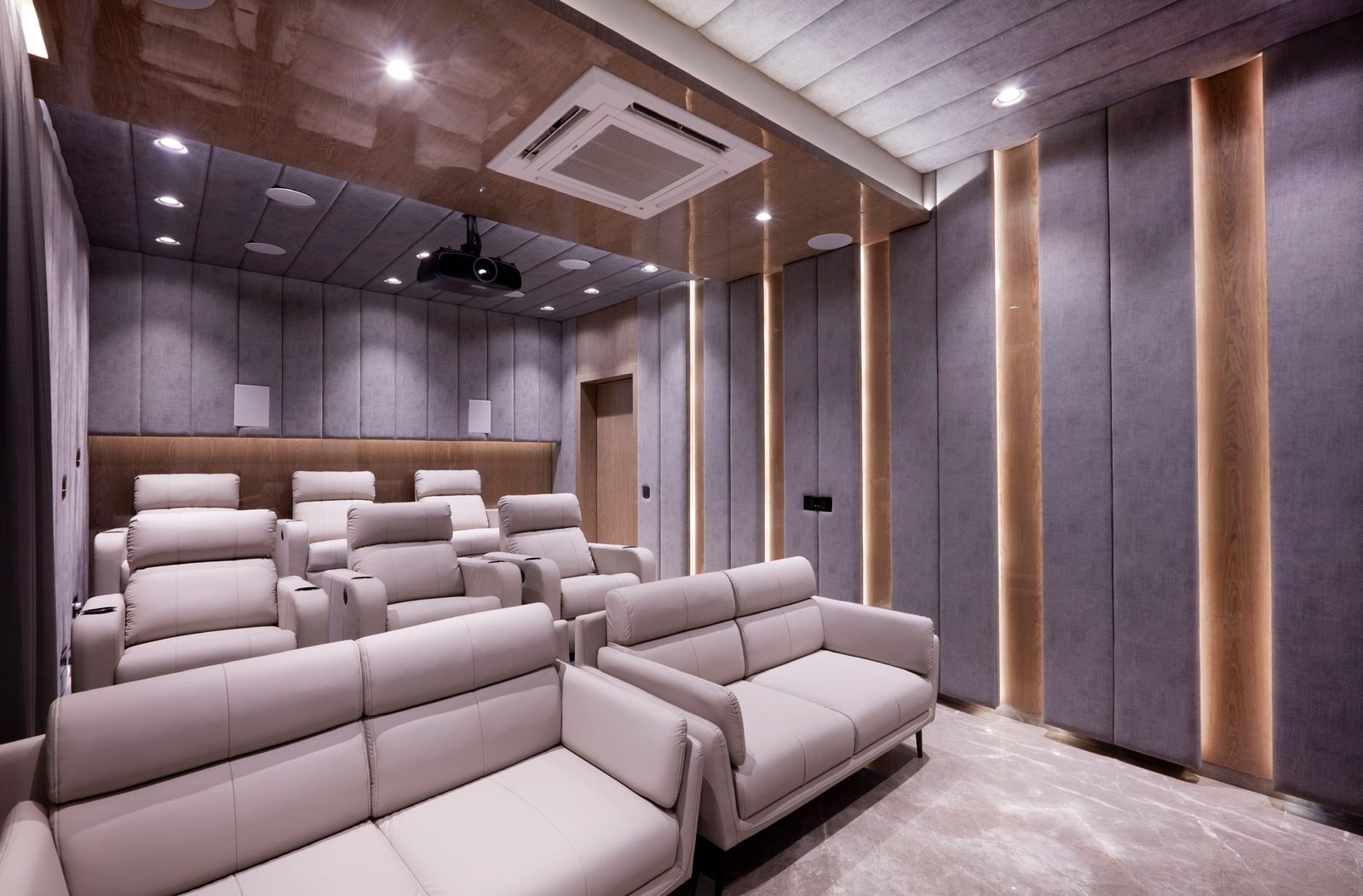
- Add soft mass to the room. A full-height lined curtain, a rug with underlay and upholstered seating together take a bare living room from a 0.9-second reverberation time to around 0.5, which is the range that makes conversation and television comfortable.
- Treat the first reflection points. In a home theatre or a study, four to six panels placed at the side-wall reflection points and on the rear wall do more than sixteen panels distributed evenly. Use a mirror held against the wall by a second person to find the points where you see the speaker from the seat.
- Upgrade the glazing. Only after the first three. Acoustic laminated or double glazing with an unequal pane pair gives a genuine 12–18 dB improvement over single glass, but it is the most expensive step and it is wasted if the frame still leaks.
- Deal with the door. A hollow flush door is an acoustic hole in an otherwise decent wall. A solid-core door with perimeter seals costs ₹14,000–₹26,000 fitted and changes a bedroom completely.
Rooms that actually need treatment
Most homes need acoustic work in one or two rooms, not everywhere. A living room full of soft furnishing is usually fine. The rooms that justify deliberate treatment are the home theatre, where the design target is a controlled 0.3–0.4 second reverberation; the study or work-from-home room, where call clarity matters and the microphone picks up every reflection; and any bedroom sharing a wall with a lift shaft, a pump room or a neighbour's kitchen.
Panels that do not look like panels
The objection to acoustic treatment in a home is almost always visual, and it is a fair one — a wall of grey foam wedges belongs in a rehearsal room. There are three ways to get the absorption without the studio look: fabric-wrapped rockwool panels built as a framed wall feature at 600 x 1,200 mm modules; slatted timber over a 50 mm rockwool cavity, which reads as a design element and performs to NRC 0.75 or better; and a heavily upholstered headboard wall, which is genuinely effective across the mid frequencies where speech sits.
The slatted-timber-over-absorber detail is the one we specify most often in Mumbai homes. It costs ₹520–₹880 per sq ft installed, which is more than a plain panel, but it is doing two jobs — it is the feature wall the room wanted anyway, and it is absorbing. Clients who would never accept a visible acoustic panel accept this one without discussion, because it does not announce itself.
If a room sounds wrong and you cannot afford to fix it properly, buy a rug and a lined curtain. That is 60% of the answer for 15% of the money.
Greenbox principal designer
Measure before and after. A free sound-meter app on a phone is accurate to within two or three decibels, which is plenty for this purpose. Take a reading at the seat position at the hour that bothers you most — typically 8 am or 10 pm — write it down, do the sealing work, and take the reading again at the same hour. Decibels are logarithmic: a 3 dB reduction halves the sound energy, and 10 dB is heard as roughly half as loud. Knowing you moved from 58 to 49 dB stops the debate about whether the work helped, and tells you whether the expensive glazing step is still worth taking.
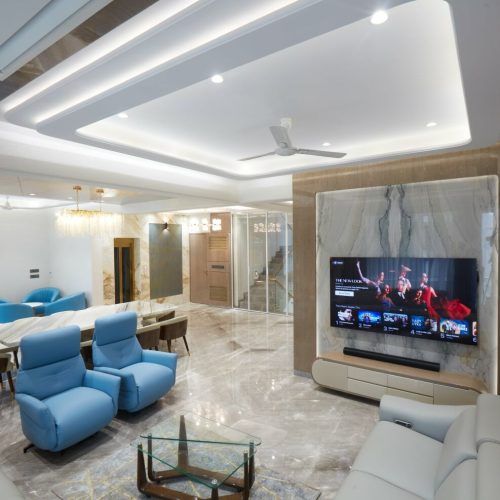
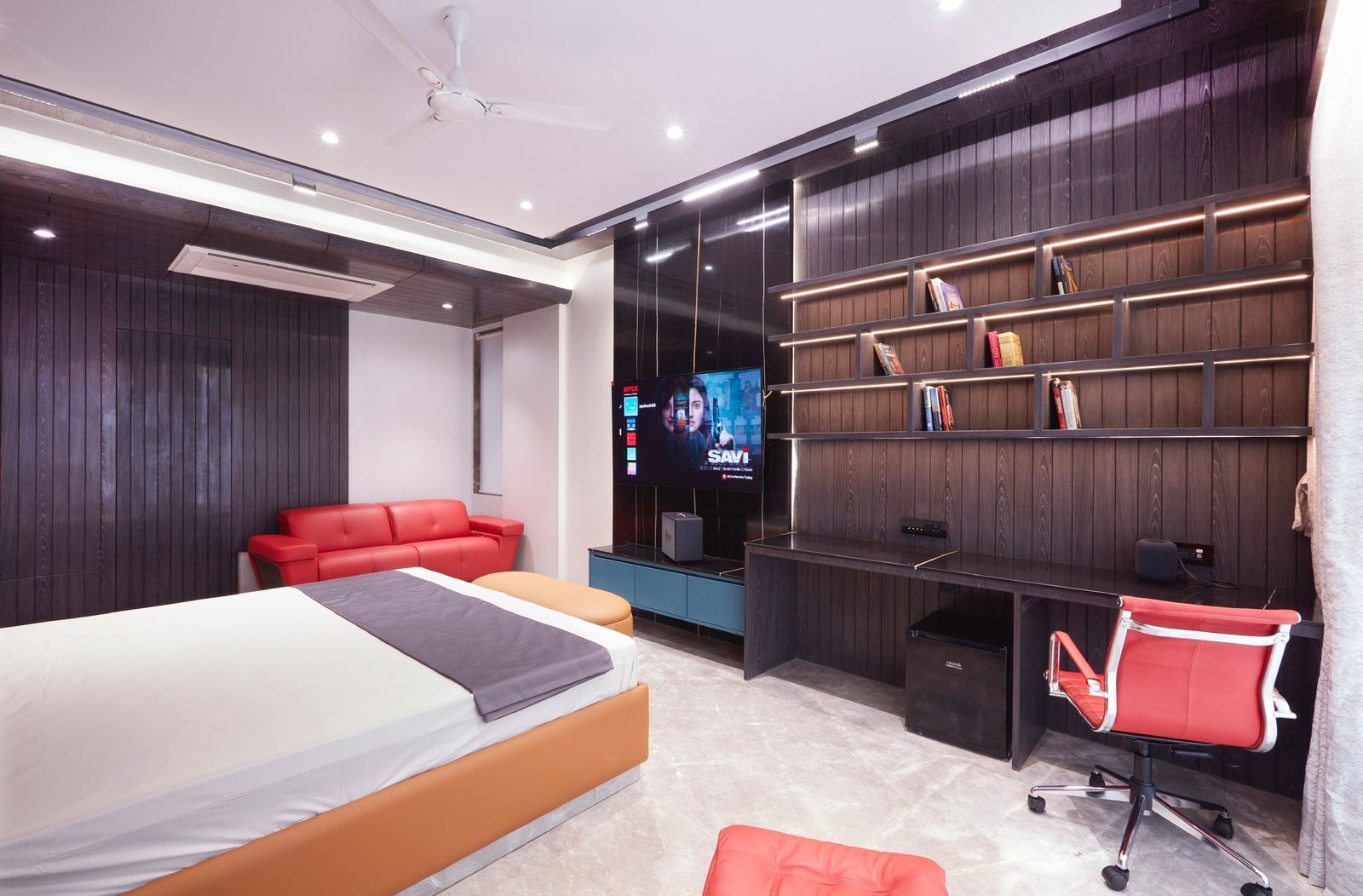
Selected work by Greenbox Design Studio. Tap any image to enlarge.
Frequently asked questions
Does acoustic foam block outside noise?+
No. Foam panels absorb sound within a room and have essentially no ability to block transmission — an STC of around 1 or 2. For traffic or neighbour noise you need mass, sealed joints and better glazing. Sealing window and door gaps is the cheapest step and usually delivers 4–8 dB on its own.
How many acoustic panels does a room need?+
For speech and television comfort, treating 15–20% of the total wall and ceiling area is enough — roughly 8–12 panels of 600 x 1,200 mm in a 12 x 14 ft room. For a home theatre, 25–35%. Placement matters more than quantity: the first reflection points and the rear wall come first.
What is a good STC rating for a bedroom wall?+
STC 50 is the benchmark for a wall between a bedroom and a neighbouring flat, which a 230 mm brick wall with plaster both sides roughly achieves. A 115 mm partition sits nearer STC 40, which passes raised voices. A double-leaf gypsum partition with rockwool reaches STC 48–52 at ₹320–₹520 per sq ft.
Will carpet reduce noise from the flat above?+
Only if it is laid in the flat above. Impact noise from footfall is generated at their floor surface; carpet on your ceiling side does nothing for it. Your options are a suspended acoustic ceiling with resilient hangers, which costs ₹420–₹780 per sq ft and loses 120 mm of height, or a polite conversation.
Is acoustic glazing worth it in Mumbai?+
On a road-facing bedroom or study, yes — 12–18 dB is the difference between sleeping with the window shut and sleeping. At ₹1,400–₹2,800 per sq ft it is a serious spend, so seal the existing frame first and measure the result with a phone sound meter before committing to the glass.
Do acoustic panels help with work calls?+
Substantially. A microphone picks up reflected sound as a hollow quality that listeners notice even when you do not. Four panels at the reflection points behind and beside the screen, plus a rug, remove it. This is the cheapest improvement available to anyone on video calls daily from a hard-surfaced room.