
The three levers, and why one alone never works
Acoustic comfort in an office is the product of absorption, blocking and masking — the ABC of workplace acoustics — and buying only one of the three is the standard failure. An office with beautiful acoustic baffles and a hard floor, glass partitions and no background sound will still have a distraction distance of ten metres or more, because absorption alone reduces reverberation without reducing the intelligibility of a nearby conversation.
The measure that matters is distraction distance: how far from a speaker you have to be before their speech stops being intelligible enough to interrupt your work. In a hard-surfaced open floor it is commonly 12–15 m, which means half the floor plate is disturbed by one phone call. Well-specified, it falls to 5–8 m, and the difference is roughly the difference between an office people can work in and one where everyone wears headphones.
| Lever | What it does | Specification | ₹ per sq ft | Effect on distraction distance |
|---|---|---|---|---|
| Absorb: ceiling | Removes reflected speech | Mineral fibre or PET tile, NRC 0.85–0.95 | ₹180–₹420 | Large; the first thing to buy |
| Absorb: vertical | Screens, baffles, wall panels | 1,350 mm desk screens, NRC 0.70+ | ₹90–₹260 | Moderate |
| Absorb: floor | Carpet with underlay | Carpet tile, NRC 0.25–0.35 | ₹120–₹320 | Moderate; also kills footfall |
| Block: partitions | Stops transmission between rooms | Slab-to-slab, double-leaf, STC 45–50 | ₹320–₹620 | Large for enclosed rooms |
| Block: doors and glazing | The weak link in every meeting room | Acoustic door seals, 10 mm laminated glass | ₹18,000–₹55,000 per room | Large; usually the failure point |
| Cover: sound masking | Raises the noise floor to mask speech | Distributed emitters, 42–48 dBA, tuned | ₹95–₹180 | Large; halves distraction distance |
The slab-to-slab rule
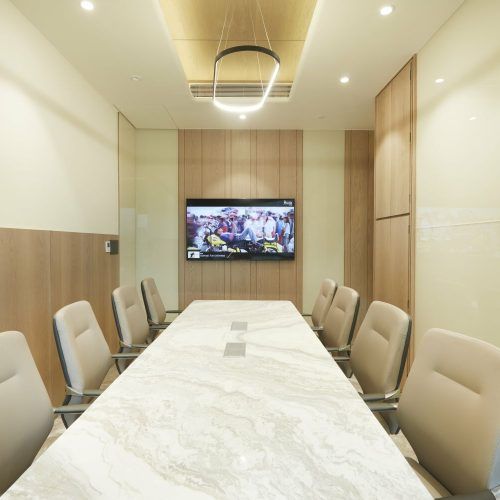
More meeting rooms fail acoustically for this single reason than for all others combined. A partition built up to the underside of the false ceiling leaves the ceiling void open above it, and sound travels over the top through the plenum as if the wall were not there. A room can have a double-glazed front, an acoustic door and a rated partition, and still leak completely because the last 400 mm above the ceiling was left open to save cost and to simplify the services coordination.
Taking the partition to the structural slab costs ₹80–₹180 per running foot more and requires the HVAC ducting to be sealed or cross-talk-attenuated where it passes through. It is the correct specification for every room where confidential conversations happen: the MD's cabin, HR, finance, and any room where clients discuss commercial terms. For general meeting rooms, a plenum barrier of dense board plus insulation above the ceiling line achieves most of the benefit at lower cost.
Design and build under one accountable roof
Sound masking, and when it earns its place
Sound masking adds a carefully shaped broadband sound — not white noise, and not music — at a level of 42 to 48 dBA, distributed evenly so it is not locatable. It works by raising the floor of the ambient noise so that a conversation four desks away falls below the intelligibility threshold sooner. Properly tuned, occupants stop noticing it within a week and report that the office is quieter, which is counter-intuitive and consistently observed.
- Worth it above about 40 open-plan seats on a floor, or on any floor with confidential work in an open setting.
- Cost: ₹95–₹180 per sq ft installed, including emitters, zone controllers and commissioning.
- It must be commissioned with a meter, zone by zone. An uncommissioned system is audible, irritating and worse than nothing.
- Do not run it in meeting rooms at the same level; those get their own lower setting or none.
- It is not a substitute for absorption. Masking on a hard ceiling produces a loud, harsh room. Buy the ceiling first.
How many enclosed spaces per 100 people
The commonest post-occupancy complaint in Indian offices is not noise in the abstract — it is that there is nowhere to take a call. Hybrid working has made this worse, because a far higher proportion of meetings now have a remote participant, which means one person talking aloud at a desk. The provision ratios that worked in 2018 are inadequate in 2026.
| Space type | Per 100 staff, 2018 norm | Per 100 staff, 2026 | Size | Cost each |
|---|---|---|---|---|
| Single phone booth | 2–3 | 7–9 | 1.2 x 1.2 m | ₹1.6–₹3.2 lakh |
| Two-person focus room | 2 | 4–5 | 2.4 x 2.0 m | ₹2.4–₹4.5 lakh |
| 4–6 person meeting room | 4 | 5–6 | 3.6 x 3.0 m | ₹4–₹8 lakh |
| 8–12 person room | 2 | 2–3 | 5.4 x 3.6 m | ₹8–₹16 lakh |
| Boardroom | 1 | 1 | 7.2 x 4.5 m | ₹18–₹45 lakh |
| Informal collaboration | 2 zones | 4 zones | Varies | ₹1.2–₹4 lakh |
Booth provision is the single biggest change. Offices built to the 2018 ratio have queues at the booths by 10 am.
Testing it before handover
Acoustic performance is measurable and should be a handover condition rather than an opinion. Ask for three tests: a reverberation time measurement in the open plan, which should sit at 0.5–0.7 seconds; a speech transmission index or a simple intelligibility walk-test for each enclosed room; and a masking level survey with a meter showing 42–48 dBA uniformly with no more than 2 dB variation across a zone. A competent acoustic contractor will offer this. One who resists it is telling you what the test would find.
Take the partition to the slab. Everything else in an acoustic specification is an optimisation of that one decision.
Greenbox commercial fit-out lead
One structural point worth making to the finance side of any fit-out decision. Acoustic work is cheap during construction and expensive afterwards, and the ratio is steep. An NRC 0.90 ceiling costs ₹280 per sq ft as part of the base ceiling package; retrofitting acoustic rafts into a completed office costs ₹520–₹900 per sq ft, requires out-of-hours access, and never looks as considered. A masking system installed with the ceiling open costs ₹140 per sq ft; the same system installed after occupation costs closer to ₹260 and involves six weekends of disruption.
The same applies to the partitions. Taking a wall to the slab during the fit-out adds ₹80–₹180 per running foot. Doing it afterwards means stripping the ceiling in two rooms and a corridor, rerouting services that were installed across the line of the wall, and re-commissioning the HVAC for the affected zone. This is why an acoustic consultant engaged at the drawing stage typically pays for themselves several times over on a floor above about 8,000 sq ft.
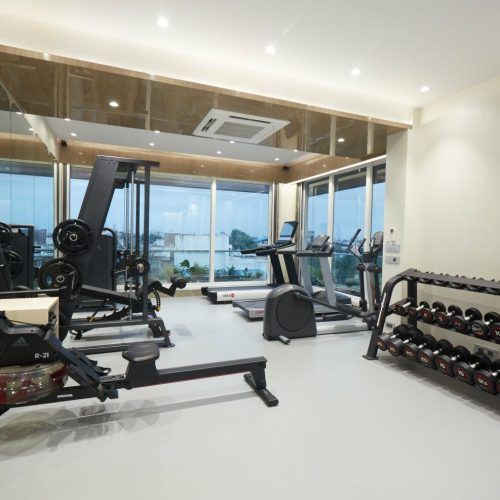
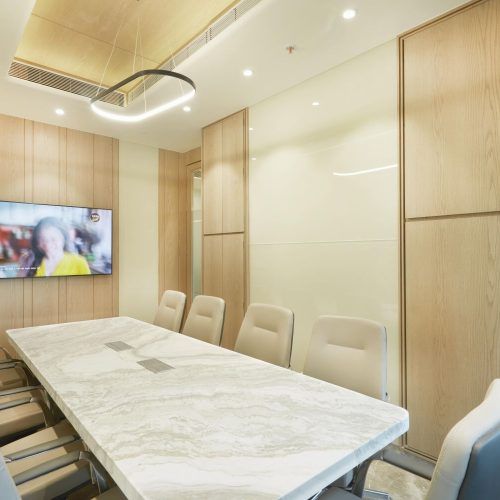
Selected work by Greenbox Design Studio. Tap any image to enlarge.
Frequently asked questions
What is a good NC rating for an office?+
NC 35–40 for open-plan work areas, NC 30–35 for meeting rooms and private offices, and NC 25–30 for a boardroom or a room used for video conferencing. NC describes the background noise from building services; above NC 40 an open floor feels noisy even before anyone speaks.
Does sound masking actually work?+
Yes, when it is properly tuned and commissioned. It typically halves the distraction distance on an open floor, from 12–15 m to 5–8 m. Badly commissioned it is a persistent hiss that staff complain about within a fortnight, so insist on zone-by-zone measurement at handover.
How many phone booths does an office need?+
Seven to nine per 100 open-plan staff in 2026, against two or three under pre-hybrid norms. The proportion of meetings with a remote participant has changed the arithmetic completely. Under-provisioning is visible within a week: people take calls in stairwells, corridors and empty meeting rooms booked for one person.
Why can I hear everything in the meeting room next door?+
Almost certainly because the partition stops at the false ceiling and sound passes over it through the ceiling void. It can also be an unsealed door, a shared HVAC duct carrying cross-talk, or a glass front with no acoustic seal. Check the partition first — it is the cause in the large majority of cases.
What does an acoustic package cost?+
For a 10,000 sq ft floor in an Indian metro in 2026: an NRC 0.90 ceiling at ₹280 per sq ft, carpet at ₹180, desk screens at ₹120, slab-to-slab partitions where required, and masking at ₹140 — roughly ₹65–₹95 lakh all in, ex-GST, depending on how many enclosed rooms are included.
Do acoustic panels help in a glass-walled office?+
They help with reverberation inside the room, but glass is the problem for transmission. A single-glazed 10 mm partition gives around STC 32; a double-glazed acoustic partition with a proper perimeter seal reaches STC 45–48. If confidentiality matters, the glass specification and the door seal matter far more than wall panels.