
Where the real buildings are
| Precinct | Period | What survives inside flats | Listing |
|---|---|---|---|
| Marine Drive and the Oval Maidan | 1935 – 1945 | Terrazzo floors, curved balcony reveals, Burma teak doors, original ironmongery | Grade II-A and II-B in parts; a UNESCO-inscribed ensemble |
| Churchgate and Fort fringe | 1930s | Terrazzo, stepped plaster cornices, curved corner windows | Grade II in parts |
| Shivaji Park and Dadar | 1938 – 1950 | Terrazzo, teak joinery, geometric grilles | Largely unlisted; a substantial and under-appreciated stock |
| Matunga and Wadala | 1940s | Terrazzo floors, stepped door heads, original tiles | Largely unlisted |
| Colaba and Cuffe Parade edge | 1930s – 40s | Curved plan forms, terrazzo, timber panelling | Grade II in parts |
| Later flats, anywhere in the city | 1960 onward | Nothing original; the language is referenced | None |
Grade II listing restricts the facade and anything visible from a public road. Interiors are generally unrestricted, but window replacement, balcony enclosure and external colour are not.
Restoring what is there
- Survey before you decide anything. Lift a corner of the carpet. A very large number of Marine Drive, Dadar and Matunga flats have an intact original terrazzo floor under forty years of vinyl or tile, and restoring it costs a fraction of replacing it.
- Terrazzo restoration is ₹180–₹420 per sq ft — grinding, filling with a matched cement and chip, honing and sealing. Against ₹320–₹1,100 per sq ft for new, and the original is better than anything made today.
- Burma teak doors and windows are worth every rupee of restoration. Strip, repair, re-glaze and re-polish at ₹6,500–₹18,000 per leaf. The timber in them cannot be bought now at any price.
- Keep the original ironmongery. Deco handles, espagnolette window fittings and letter plates can be stripped, repaired and re-plated for ₹900–₹3,500 a piece. Reproductions never match them.
- Repair plaster profiles rather than replacing them. A stepped cornice can be run in situ with a made template by a plasterer who still does this work; a handful of them are still practising in this city.
- Do not over-restore. Ninety years of wear in a terrazzo floor is the reason it looks the way it does. Grinding it flat and glassy removes exactly what made it worth keeping.

Marine Drive built this vocabulary before most cities had heard of it
Heritage rules, precisely
- Interiors are generally unrestricted. Inside your own flat, in a Grade II building, you may replan, rewire and refit as any other flat — subject to the society and to structural common sense.
- The facade is not yours. Colour, render, balcony rails, external grilles and anything projecting are governed by the listing and the heritage committee.
- Windows are the flashpoint. Replacing original timber casements with aluminium or uPVC on a listed facade is not permitted, and it is the change most often attempted. Repair and re-glaze instead; the frames are usually sound.
- Balcony enclosure is generally refused in a listed precinct, regardless of what a neighbour did in 1996.
- Air-conditioning units on the facade are restricted. Plan the outdoor unit positions with the society and the heritage guidance before the design, not after the units arrive.
- Allow time. Where a heritage approval is needed, six to twelve weeks is normal. It runs in parallel with the interior design, not after it.
Referencing Deco in a later Mumbai flat
Most of this work is not in an original building. A 1990s Andheri or Powai flat can carry the language convincingly if it is done with restraint and with an eye on the ceiling height.
| Move | In a 9′6″ flat | ₹ guide |
|---|---|---|
| Terrazzo floor | The strongest single move; precast tile or resin-bound, laid across the public rooms | ₹420 – 900 per sq ft laid in Mumbai |
| Stepped door heads | Three steps, not five; works at this height | ₹1,100 – 2,800 per opening |
| Fluted joinery faces | Works well and reads as both Deco and current | ₹800 – 2,100 per sq ft |
| Curved joinery returns | One per room; softens a tight plan | ₹5,000 – 13,000 per corner |
| Brass inlay in the floor | A single line defining the dining zone | ₹1,600 – 4,500 per running foot |
| Sunburst element | Headboard or a single wall, never the ceiling at this height | ₹2,600 – 7,000 per sq ft |
| Full-height mirrored panel | Between joinery bays; doubles a small room and is authentically Deco | ₹950 – 2,400 per sq ft |
Ex-GST. Pick two or three of these, not all seven.
A Shivaji Park client wanted the floor replaced. We ground back a square metre in the corner and showed her the original 1946 terrazzo underneath. She spent the money on the kitchen instead.
Greenbox principal designer
Craft and sourcing in this city
Mumbai is the easiest place in India to build in this language, because the trades never entirely disappeared. In-situ terrazzo teams still work out of Dadar, Wadala and Bhiwandi and can match an existing chip and colour from a sample. Brass inlay and metalwork come from the Bhuleshwar and Zaveri Bazaar workshops. There are still plasterers in the central suburbs who can run a stepped profile in situ from a template rather than fixing a factory cornice. Reclaimed Burma teak and original Deco ironmongery turn up regularly in the Chor Bazaar and Kurla trades. All of these are small groups booked six to ten weeks ahead, and all of them should be engaged at concept stage rather than at tender.
What the original flats actually give you
Beyond the decoration, the Deco-era Mumbai flat has planning virtues that later stock lost, and a renovation should protect them rather than design them out.
- Ceiling heights of 10 to 11 feet. Roughly a foot more than a 1990s flat, which is what makes period-scale detailing work here and nowhere else in the city.
- Cross ventilation that was designed in. Windows on two elevations and a through-draught. Sealing one side of that with joinery is the most common and most regretted change we are asked to make.
- Deep balconies with curved reveals. Usable, shaded outdoor space. Enclosing them is usually prohibited on a listed facade and is a poor idea in any case.
- Generous room proportions. Bedrooms of 130–170 sq ft rather than 90–110, which changes what the joinery has to do.
- Thick masonry walls. Better thermal performance and better acoustics than a modern block wall, and considerably harder to chase — plan the services accordingly.
- Services that are at the end of their life. Wiring, plumbing and the soil stack in a 1940 building are almost always due. Budget for all three; that is where a restoration budget actually goes.
The vocabulary itself
The motifs, the symmetry and odd-number rules, national craft rates and how to avoid pastiche are set out on Art Deco interior design services. For high-specification work in this city see luxury interior designers in Mumbai, and for older-building renovation generally, renovating an old Mumbai flat.


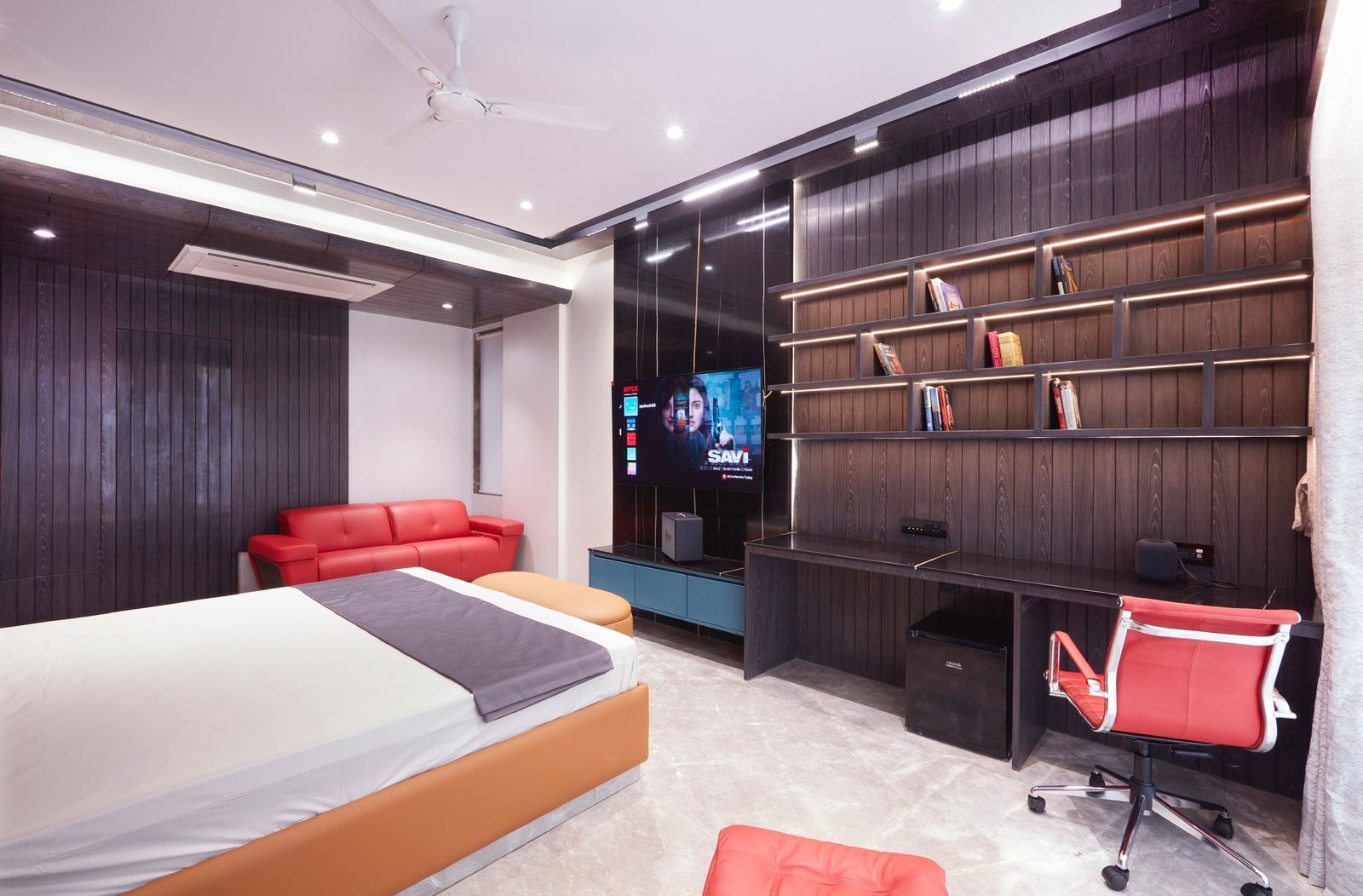

Selected work by Greenbox Design Studio. Tap any image to enlarge.
Frequently asked questions
What does Art Deco interior work cost in Mumbai?+
₹3,200–₹6,500 per sq ft of carpet area for conservation-led work in an original Marine Drive, Oval Maidan or Shivaji Park building, and ₹2,400–₹4,200 for a later flat referencing the language. Ex-GST. The difference is restoration craft rather than material.
Can I renovate the inside of a heritage-listed Mumbai flat?+
Generally yes. Grade II listing restricts the facade and anything visible from a public road — colour, render, balcony rails, external grilles, window replacement and balcony enclosure — but interiors are largely unrestricted, subject to the society and to structural sense. Where approval is needed, allow six to twelve weeks running in parallel with design.
Is my original terrazzo floor worth restoring?+
Almost certainly. Restoration is ₹180–₹420 per sq ft — grinding, filling with matched cement and chip, honing and sealing — against ₹420–₹900 for a new terrazzo floor in Mumbai. A very large number of flats in Marine Drive, Dadar and Matunga have an intact 1940s floor under forty years of vinyl. Lift a corner before you decide.
Should I replace original Burma teak windows?+
No, and on a listed facade you may not. Restoration is ₹6,500–₹18,000 per leaf for stripping, repair, re-glazing and re-polishing, and the timber in those frames cannot be bought at any price today. The frames are usually structurally sound; it is the glazing beads, the putty and the finish that have failed.
Which Deco moves work in an ordinary Mumbai flat?+
A terrazzo floor across the public rooms is the strongest single move at ₹420–₹900 per sq ft laid. Then three-step door heads, fluted joinery faces, one curved return per room, a brass inlay line defining the dining zone, and a full-height mirrored panel between joinery bays. Pick two or three, not all of them.
Can I still find the craft for this in Mumbai?+
Yes, and more easily than anywhere else in India. In-situ terrazzo teams work out of Dadar, Wadala and Bhiwandi and can match an existing chip from a sample; brass inlay comes from the Bhuleshwar workshops; there are plasterers in the central suburbs who still run stepped profiles in situ. All are small groups booked six to ten weeks ahead.