
Which contemporary moves survive a Mumbai flat
| Move | Verdict here | What we do instead, or why it works |
|---|---|---|
| Arched doorway | Rarely | Under a 9′6″ slab the springing point drops the head to about 1,950 mm. Use an arched niche or a curved reveal on a wider opening |
| Curved joinery returns | Yes | Costs the same premium as anywhere and softens a tight plan genuinely; one per room |
| Fluted joinery faces | Yes | Vertical ribbing hides the dust that settles on a flat plane here; the most Mumbai-friendly current detail |
| Plaster-effect walls | Yes, October to May | Needs a controlled drying window; applied in the monsoon it patches unevenly |
| Micro-cement floors | Yes with a caveat | Excellent and seamless; needs a competent applicator and a good sealer, and cracks follow any slab movement |
| Bouclé upholstery | With care | Open loop fabrics hold humidity and attract mildew in an unairconditioned flat; use a treated or blended version |
| Book-matched stone feature | Yes | Works well and dates slowly; the cost is the slab, and the lead time for matched slabs is four to eight weeks |
| Mixed metals | Yes, with a rule | Within 2 km of the sea, both metals must be corrosion-appropriate; brass-plated steel pits |
Height, and what to do about it
The city standard slab is 9′6″, and a false ceiling takes another 100–150 mm. That leaves roughly 2,750 mm of usable height, which rules out several of the details that define the current look and rewards a different set.
- Cove the perimeter, not the whole ceiling. A 100 mm peripheral cove with a profile light gives the height back visually. A multi-level designed ceiling in a 2,750 mm room compresses it.
- Take joinery to the slab. A wardrobe stopping at 2,100 mm with a gap above it reads as a box in a room. A full-height run to the ceiling reads as architecture and gains a loft.
- Use vertical fluting. It is the current detail and it also draws the eye upward, which is exactly what a 2,750 mm room needs.
- Arched niches instead of arched doorways. A 1,200 mm arched niche in a wall gives you the gesture without the head height, and it costs ₹9,000–₹22,000.
- Keep the door heads high. A 2,400 mm door in a 2,750 mm room is disproportionately more generous than a 2,100 mm one, and the cost difference is small.
- Hang the art higher than the rule. Centre at 1,550–1,600 mm rather than 1,500 mm, which reads correctly against a lower ceiling.
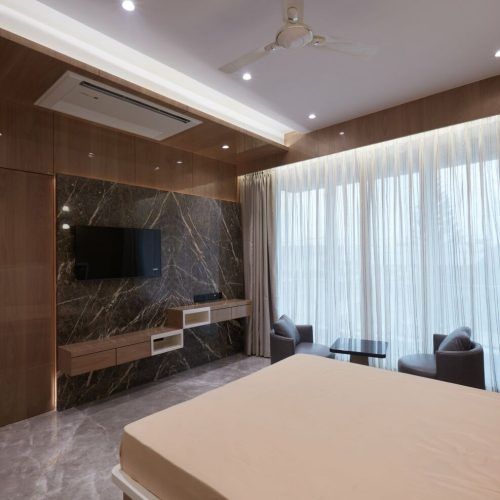
An arch under a nine-foot-six slab
Finishes and the monsoon window
- Plaster-effect and lime-wash walls: October to May. These are hand-applied and depend on an even drying rate. Applied at 85% relative humidity they cure unevenly and the patching shows permanently.
- Micro-cement: any time, with control. It is more tolerant than lime wash but the sealer is not. Seal in a dehumidified room or schedule it dry.
- Veneer with PU or matte polish: not in the monsoon without a dehumidifier. Bloom on a PU finish is not repairable by polishing over it.
- Laminate, acrylic and membrane: all year. Pressed off site, unaffected by site humidity.
- Natural stone: all year, but store slabs vertically and dry. A marble slab left flat on a wet site picks up staining from underneath.
- Upholstery and curtains: deliver at the end. Fabric brought to site early in the monsoon and stored in a closed flat is how a new sofa arrives smelling of damp.
Rates by suburb
| Area | Contemporary scheme ₹/sq ft | Local note |
|---|---|---|
| Bandra West, Juhu, Worli | ₹3,530 – 4,750 | Highest finish expectation; salt air rules out several metal finishes |
| Powai, Chembur, Ghatkopar | ₹2,800 – 3,890 | Taller slabs in newer towers make curved and arched work genuinely possible |
| Andheri West, Goregaon, Malad | ₹2,680 – 3,650 | The baseline; 9′6″ slabs and compact plans |
| Borivali, Kandivali, Mulund | ₹2,620 – 3,410 | Redevelopment towers with 10′ slabs; good for this style |
| Thane and Navi Mumbai | ₹2,560 – 3,290 | Larger rooms and taller ceilings at the lowest rate in the region |
Carpet area basis, ex-GST. The rates are what our own completed and invoiced contemporary projects came to, brought to October 2026. Curved elements, plaster-effect walls and statement stone are the three items that move a scheme to the top of its band.
A client in Chembur wanted three arches. We built one, as a niche in the dining wall, and put the money into a book-matched stone island. Two years on, nobody has asked about the other two.
Greenbox principal designer
Sourcing in Mumbai
The current palette depends on materials that are not uniformly available here, and lead times are the thing that derails a contemporary programme rather than cost. Book-matched stone slabs need to be selected physically at a Kandivali or Bhiwandi yard and reserved — four to eight weeks from selection to delivery, and the slab you liked will be sold if you take a fortnight to decide. Specialist plaster applicators are a small group in this city and are booked six to eight weeks ahead. Curved glass and shaped stone are three to five weeks. We front-load all four of these at concept stage, because a contemporary scheme waiting on a slab is a site standing still.
Three Mumbai flats, three different answers
The same brief produces three different schemes depending on the building, and it is worth seeing why before you fix on a reference image.
| 1992 Andheri West 2BHK | 2019 Thane 3BHK | 1968 Bandra West 2BHK | |
|---|---|---|---|
| Slab height | 9′4″ | 10′2″ | 10′0″ with 300 mm beams |
| Walls | Out of plumb 40–55 mm | Square within 10 mm | Out of plumb, plus two chases from a past renovation |
| Curves possible | One joinery return, one arched niche | Arched opening, curved island, curved bed back | One curved return; beams prevent arched openings |
| Wall finish | Warm emulsion; plaster effect on one wall only | Plaster effect across the living room | Micro-cement on the dining wall, emulsion elsewhere |
| Rate achieved | ₹3,230 / sq ft | ₹2,920 / sq ft | ₹4,080 / sq ft |
| What drove it | Scribing and a compressed ceiling | Straight walls and height — the easiest of the three | Beams, salt-air hardware, lane access, heritage-adjacent lane |
Ex-GST, carpet area basis. Indicative of projects of this type rather than a single job.
The style itself
The current vocabulary, the layering strategy, the cost of curves and what dates fastest are set out on contemporary interior design services. For the fixed historical alternative see modern interior designers in Mumbai, and for the high-specification version of this language, luxury interior designers in Mumbai.
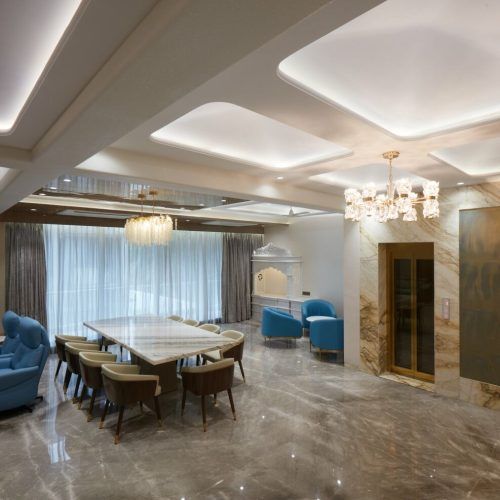
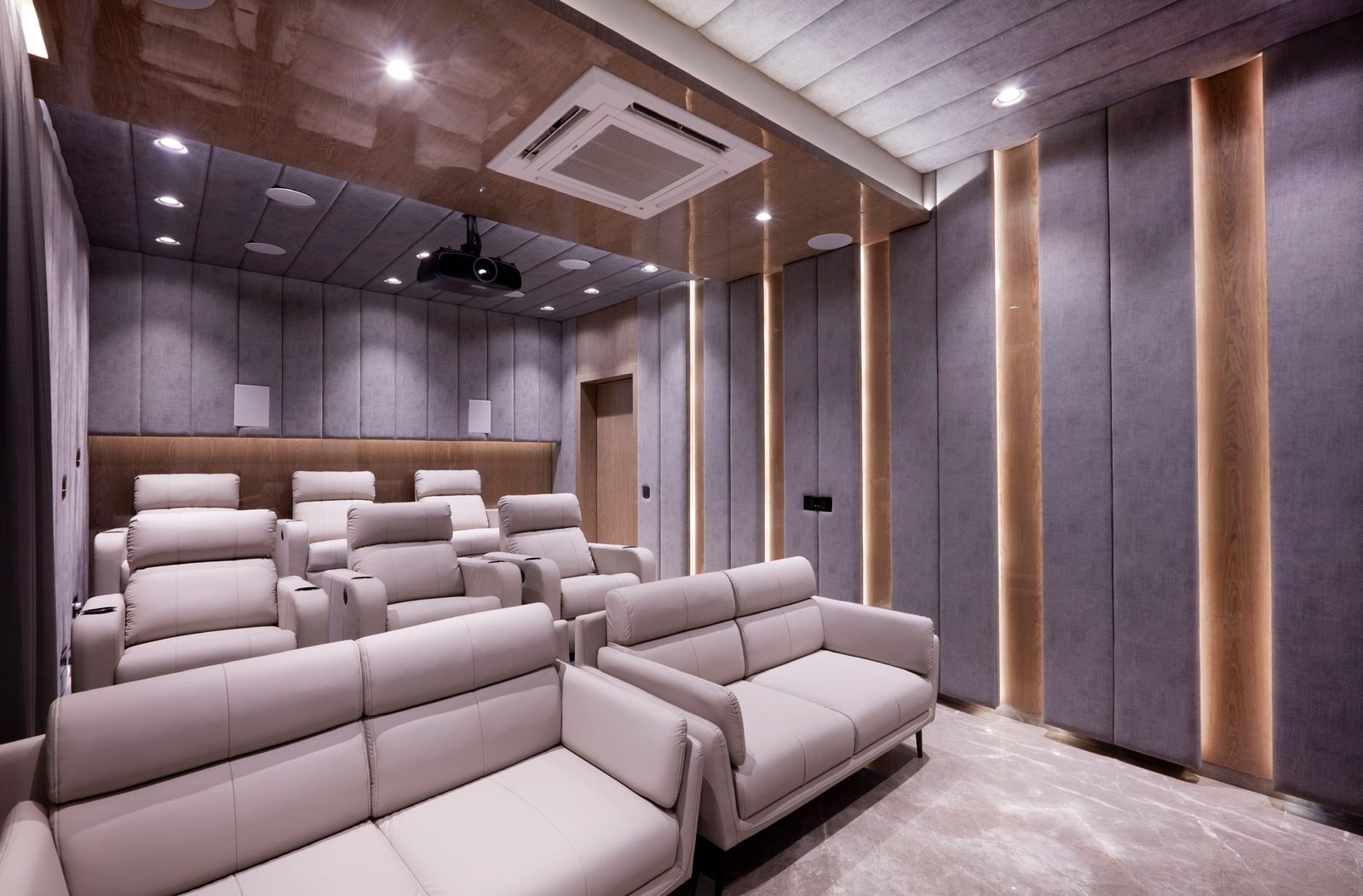
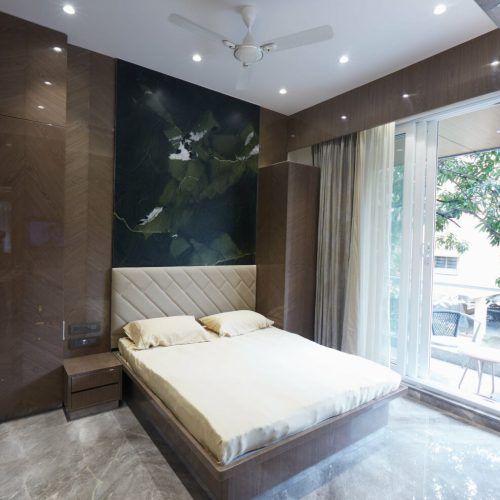
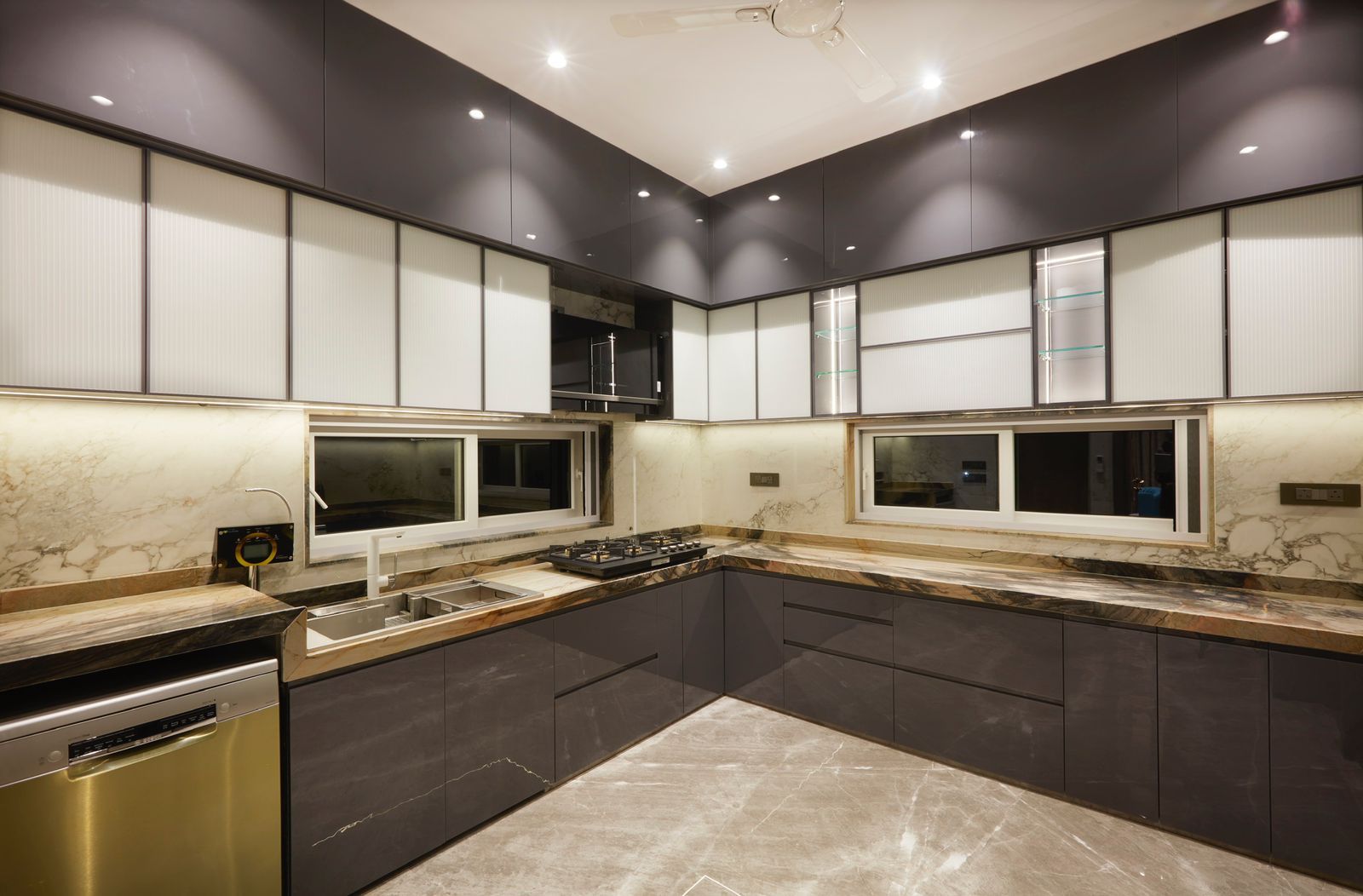
Selected work by Greenbox Design Studio. Tap any image to enlarge.
Frequently asked questions
What does a contemporary interior cost in Mumbai?+
₹2,560–₹3,290 per sq ft of carpet area in Thane and Navi Mumbai, ₹2,680–₹3,650 across the western suburbs, ₹2,800–₹3,890 in Powai and Chembur and ₹3,530–₹4,750 in Bandra West, Juhu and Worli. Ex-GST. Curves, plaster-effect walls and statement stone are what push a scheme to the top of its band.
Can I have an arched doorway in a Mumbai flat?+
Usually not a good idea. Under the city-standard 9 ft 6 in slab, once you allow for a false ceiling the arch springing point drops the head height to around 1,950 mm, which feels oppressive. An arched niche in a wall at ₹9,000–₹22,000, or a curved reveal on a wider opening, gives the same gesture without the loss.
Do plaster-effect walls work in Mumbai?+
Yes, applied between October and May. They are hand-applied and depend on an even drying rate; at 85% relative humidity in the monsoon they cure unevenly and the patching shows permanently. Micro-cement is more tolerant but its sealer is not, so schedule that dry or dehumidify the room.
Is bouclé a bad idea in Mumbai?+
Open-loop bouclé in an unairconditioned flat holds humidity and attracts mildew through the monsoon. A treated or blended version with a synthetic content behaves much better, and so does keeping the heavy texture to occasional pieces rather than the main sofa. Deliver all upholstery at the end of the programme, not early.
Which contemporary details suit a small Mumbai flat best?+
Vertical fluting, which draws the eye up and hides settled dust; full-height joinery run to the slab rather than stopping at 2,100 mm; a 100 mm peripheral cove with profile lighting instead of a multi-level ceiling; 2,400 mm door heads; and one curved joinery return per room. All of them work with the height rather than against it.
How far ahead should I select stone?+
Four to eight weeks before you need it, selected physically at a Kandivali or Bhiwandi yard and reserved. Book-matched slabs are sold as a pair and the one you liked will go if you take a fortnight to decide. Specialist plaster applicators in this city are booked six to eight weeks ahead, and curved glass or shaped stone is three to five weeks.