
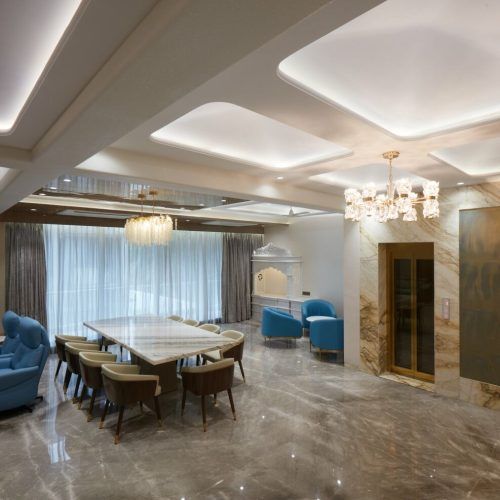
The vocabulary
| Motif | What it is | Where it belongs | ₹ guide |
|---|---|---|---|
| Stepped or ziggurat profile | A setback in three or five steps, in joinery, plaster or stone | Door heads, cornices, headboards, cabinet tops | ₹900 – 2,600 per running foot |
| Chevron and herringbone | A 45° or 60° repeat in timber, stone or inlay | Floors, panelled walls, cabinet doors | ₹480 – 1,400 per sq ft |
| Sunburst and fan | Radiating rays, always an odd number, from a true centre | A single wall, a headboard, a mirror, a door | ₹2,200 – 6,500 per sq ft |
| Fluting and reeding | Vertical ribbing at a constant pitch | Bar fronts, island faces, wall dados, columns | ₹700 – 1,900 per sq ft |
| Curved corners | A true radius return, usually 150–300 mm | Joinery ends, wall corners, counter noses | ₹4,500 – 12,000 per corner |
| Brass inlay | A 3–6 mm brass strip let into timber or stone | Table tops, floors, cabinet fronts, terrazzo | ₹1,400 – 4,200 per running foot |
| Terrazzo | Marble chips in cement or resin, ground and polished | Floors, counters, bathroom walls | ₹320 – 1,100 per sq ft |
| Burl and figured veneer | Highly figured veneer, always book-matched and centred | Cabinet doors, headboards, a single panel | ₹850 – 3,200 per sq ft |
Ex-GST. These are craft rates and they vary widely with the maker. Ask to see finished work before comparing quotations.
The rules that make it work
- Symmetry, strictly. Pair everything: two lamps, two chairs, two cabinets flanking a centre. An Art Deco room is composed about an axis, and breaking the axis breaks the style.
- Odd numbers within the motif. A sunburst has 7, 9, 11 or 13 rays, never 8 or 12. A stepped profile has 3 or 5 steps. This is not superstition; even counts produce a dead centre line.
- Strike every curve from a centre. A radius that has been drawn by eye reads as wrong immediately, even to someone who cannot say why. Dimension it on the drawing.
- Two or three motifs per home, repeated — not eight used once each. Repetition is what makes a scheme read as a language rather than as a collection of references.
- Contrast dark and light hard. Deco is not a tonal style. Black and cream, walnut and brass, deep green and white marble. Mid tones weaken it.
- One reflective material per room. Mirror, lacquer, polished brass or glass — not all four. The style uses reflection as punctuation.
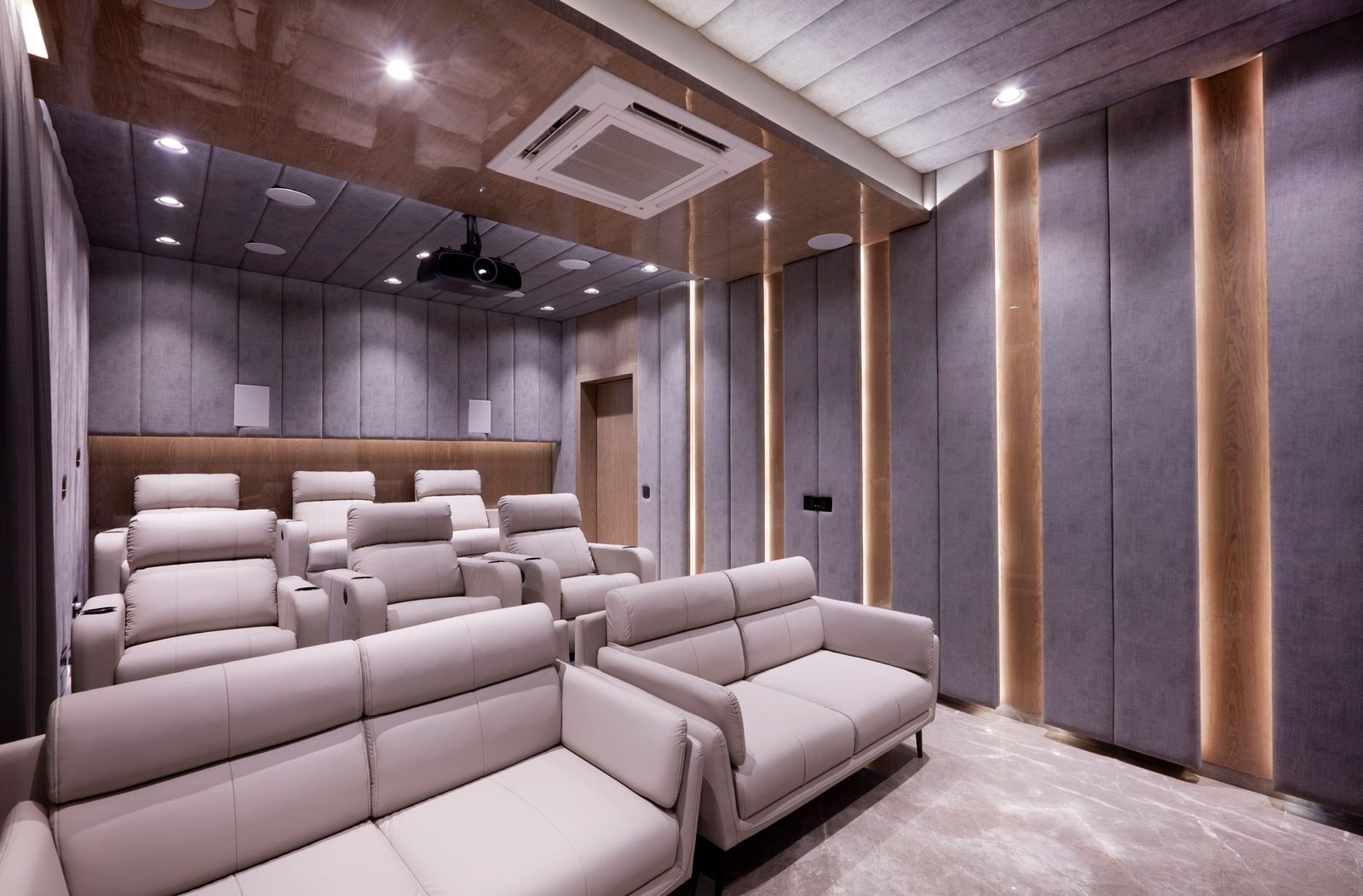
Geometry, symmetry and terrazzo
Terrazzo, the most useful Deco material
Terrazzo is having a second moment and it is genuinely the most practical element of this vocabulary, because it works as a floor, a counter, a bathroom wall and a stair tread and it lasts indefinitely.
- Cement terrazzo, cast in situ — ₹320–₹620 per sq ft including grinding and polishing. The traditional method, seamless over large areas, needs a skilled team and a long cure.
- Precast terrazzo tile — ₹380–₹780 per sq ft laid. Faster, more predictable, with visible joints that can be designed as part of the pattern.
- Resin-bound terrazzo — ₹700–₹1,100 per sq ft. Thinner, lighter, brighter chip colours, better for counters. Less appropriate historically and better performing practically.
- Brass divider strips in a cast-in-situ floor at ₹900–₹2,200 per running foot are both a control joint and the single most recognisable Deco floor detail.
- Chip selection is the whole design. Large chip reads bold and period; fine chip reads quiet and contemporary. Always look at a 600 mm sample, never a 100 mm one.
- Seal it. Cement terrazzo is porous and stains with turmeric, oil and lime. A penetrating sealer, reapplied every three to four years.
The palette
| Role | Value | Use |
|---|---|---|
| Ground | #F0E9DC | Cream, the classic Deco field colour; walls and terrazzo base |
| Dark | #1F2A2E | Near-black with a blue-green cast; lacquer, one wall, joinery frames |
| Jewel | #1E5B4F | Deep emerald, the most characteristic Deco colour; upholstery, a single wall |
| Metal | #B08D35 | Polished or satin brass; inlay, hardware, lighting, mirror frames |
| Timber | #6B4423 | Walnut, burl or figured teak, always book-matched |
A carpenter gave us a sunburst with twelve rays because it divided evenly. We had it remade with eleven. Everyone who walks past the first one knows something is wrong with it and nobody can say what.
Greenbox principal designer
Pastiche, and how to avoid it
- Use the geometry, not the props. A room with a flamingo, a gramophone and a fan-back chair is a theme. A room with a stepped cornice, a chevron floor and hard symmetry is Art Deco.
- Modern plan, period language. Keep the layout, the kitchen and the bathrooms entirely contemporary. Deco was a decorative language applied to modern buildings, which is exactly what you are doing.
- Restrain the metal. Brass on the hardware, the inlay and one light fitting. Brass on everything reads as a hotel bar.
- Lose the gold. Deco used brass and bronze, which are metals. Gold paint is not a metal and it is the fastest way to make a scheme look cheap.
- Keep the scale right. The motifs were designed for tall rooms. In a 2.9 metre ceiling, a three-step cornice works and a five-step one does not.
- One heroic element per home. A terrazzo floor, a sunburst headboard, a fluted bar. Then let the rest of the house be quiet around it.
Lighting and furniture
Deco was the first style to treat electric light as an element in its own right rather than as a replacement for a gas lamp, and the fittings are part of the geometry rather than accessories to it.
- Stepped and tiered fittings. A three-tier opal glass pendant or a stepped alabaster uplighter is the period form. One per principal room, sized generously — Deco fittings are larger than their modern equivalents.
- Wall lights in pairs, always. Flanking a mirror, a bed or a fireplace. A single wall light breaks the axis the whole room is built on.
- Uplight the cornice. Concealed light in a stepped cornice washing the ceiling is period-correct and it solves the ambient lighting at the same time.
- 2700K, warm, and dim it. The style was built around tungsten light and it does not survive 4000K.
- Furniture: curved, low-backed, on a plinth or on short legs. Club chairs, a curved-back sofa, a low burl-veneer sideboard. Nothing spindly and nothing tall.
- Upholster in velvet, mohair or a tight weave in a jewel tone. Texture in this style is smooth and reflective rather than rough.
Where we work
We deliver Art Deco schemes across India, and in Mumbai we work in and alongside the real thing — the city holds one of the largest concentrations of Deco buildings in the world. See Art Deco interior designers in Mumbai for heritage precinct rules, local terrazzo and restoration work. For the modern relative, see contemporary interior design.
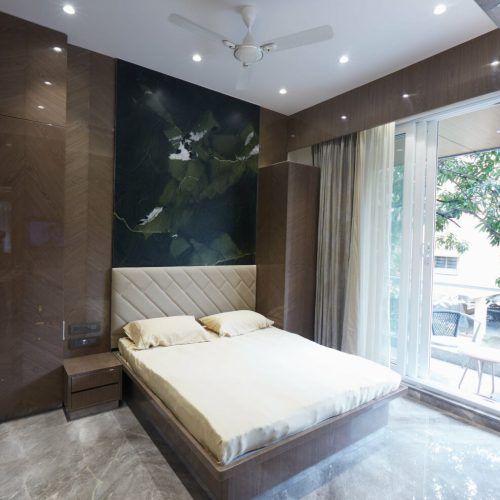
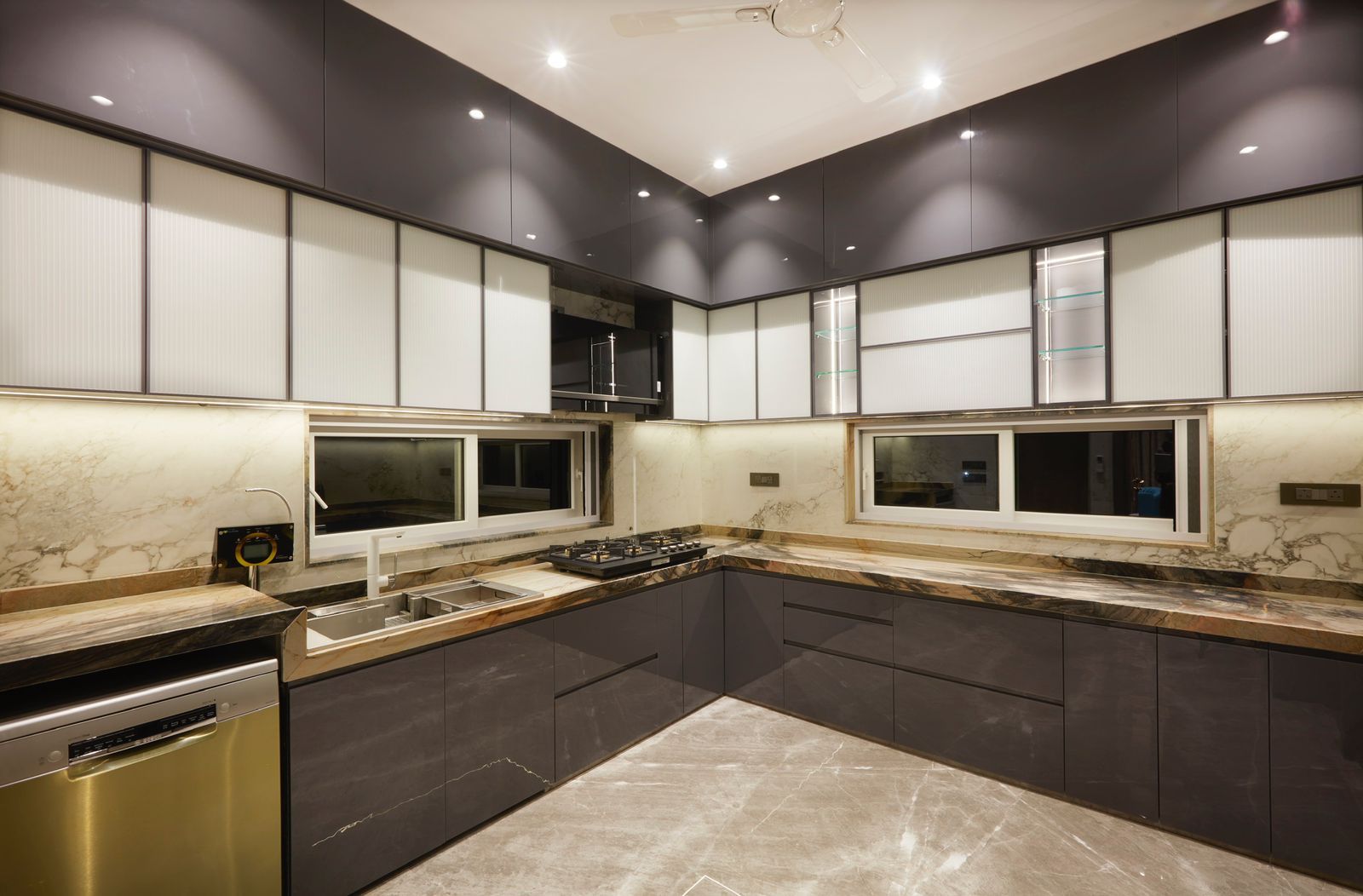
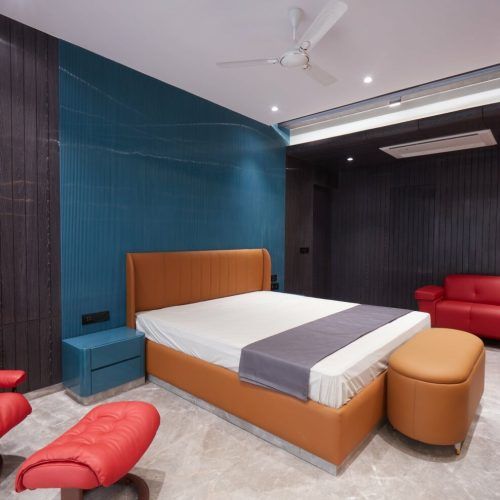
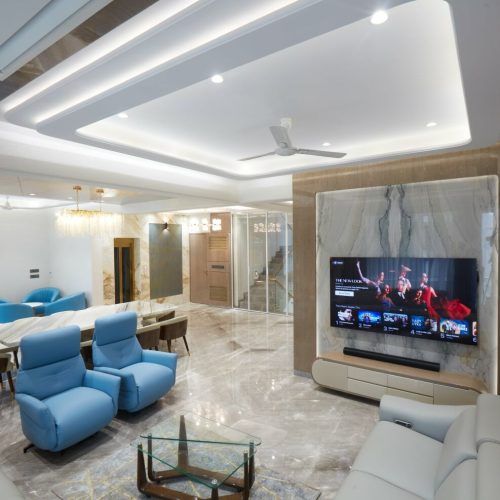
Selected work by Greenbox Design Studio. Tap any image to enlarge.
Frequently asked questions
What makes a room Art Deco rather than just decorative?+
Geometry and symmetry. Stepped profiles, chevrons, sunbursts and true radii, composed about an axis with everything paired. If the motifs are drawn by eye rather than struck from a centre, or the room is asymmetric, it reads as decoration with Deco references rather than as the style itself.
How much more does Art Deco cost?+
Eighteen to forty per cent above a plain scheme of the same quality, and essentially all of the premium is craft labour rather than material. Stepped profiles at ₹900–₹2,600 per running foot, sunbursts at ₹2,200–₹6,500 per sq ft and brass inlay at ₹1,400–₹4,200 per running foot are where it goes.
Why must a sunburst have an odd number of rays?+
Because an even number produces a ray on the centre line and its mirror on the opposite side, which reads as a dead axis rather than as a radiating form. Seven, nine, eleven or thirteen. The same logic applies to stepped profiles, which use three or five steps rather than four.
What does terrazzo cost?+
₹320–₹620 per sq ft for cast-in-situ cement terrazzo including grinding and polishing, ₹380–₹780 for precast tile laid, and ₹700–₹1,100 for resin-bound. Brass divider strips in a cast floor add ₹900–₹2,200 per running foot and are the most recognisable Deco floor detail there is.
Does Art Deco work in a room with a normal ceiling?+
Yes, with the scale adjusted. The motifs were drawn for tall rooms, so at 2.9 metres use a three-step cornice rather than five, keep the dado line low, and put the heroic element on the floor or a single wall rather than on the ceiling. What does not work is period-scale detailing compressed into a modern height.
How do I avoid it looking like a theme?+
Use the geometry rather than the props, keep the plan and the kitchen entirely contemporary, restrict the brass to hardware, inlay and one light fitting, never use gold paint in place of a real metal, and choose one heroic element per home and let everything else be quiet around it.