
Price your tile floor
Area, tile grade and size. Laying rate follows the size.
How this calculator works
- Tile to buy = floor area × wastage factor.
- Material = area to buy × grade rate. Tile pieces are reported using the actual coverage of each size: 3.875 sq ft for 600 × 600, 6.889 for 800 × 800, 7.75 for 600 × 1200.
- Laying = floor area × laying rate, ₹175 per sq ft for 600 × 600 and ₹210 once the tile is large format.
- Adhesive, spacers and grout = floor area × ₹22.
- Skirting = run × 4 in × grade rate × 1.1 for material, plus ₹65 per running foot fixing.
- Removal of the existing floor, where selected, is ₹42 per sq ft of breaking plus ₹4,575 for every debris run — tile debris is taken at 12 kg per sq ft and 1,500 kg to a tempo load.
| Tile type | Rate | What it is | Best use |
|---|---|---|---|
| Glazed vitrified (GVT basic) | ₹65 / sq ft | Printed glaze over a vitrified body | Bedrooms, budget projects |
| Double charge | ₹85 / sq ft | Two layers of pigment pressed 3–4 mm deep | High traffic, passages, commercial |
| GVT / PGVT | ₹120 / sq ft | Digital print with a polished glaze, marble looks | Living and dining — the current default |
| Full body | ₹165 / sq ft | Colour through the full thickness | Commercial floors, anywhere chipping matters |
| Floor tile, laying with chemical | ₹175 / sq ft | Notch-trowelled C1TE bed, 2 mm joints | 600 × 600 and smaller |
| Large-format laying | ₹210 / sq ft | Levelling clips and two-man placing | 800 × 800 and above |
| Adhesive, spacers, grout | ₹22 / sq ft | C1TE adhesive and 2 mm joints | Always — not a sand-cement bed |
| Skirting fixing | ₹65 / running ft | 4 in strip cut from the same tile | Standard |
| Floor removal | ₹42 / sq ft | Breaking and bagging; debris runs at ₹4,575 each | Renovation only |
Design and build under one accountable roof
Worked example — 500 sq ft in GVT
| Line | Arithmetic | Amount |
|---|---|---|
| Tile to buy | 500 × 1.08 | 540 sq ft |
| Tile pieces at 600 × 600 | 540 ÷ 3.875 | 140 tiles |
| Material | 540 × ₹120 | ₹64,800 |
| Laying | 500 × ₹175 | ₹87,500 |
| Adhesive and grout | 500 × ₹22 | ₹11,000 |
| Skirting material | 90 ft × 4 in × ₹120 × 1.1 | ₹3,960 |
| Skirting fixing | 90 × ₹65 | ₹5,850 |
| Total | sum | ₹1.73 L |
| All-in rate | ₹1.73 L ÷ 500 | ₹346 |
The two details that separate a good tile floor from a bad one
Adhesive, and levelling. A vitrified tile laid on a traditional sand-cement bed is bedded by hand, and the bond depends entirely on how carefully each tile is tapped down. Five years later a proportion of them sound hollow, and a hollow tile eventually cracks. A cement-based tile adhesive to C1TE, notch-trowelled, gives full-bed contact and costs about ₹22 per sq ft more. On a 500 sq ft floor that is ₹11,000 to avoid a problem that cannot be fixed without lifting the floor.
Levelling clips matter more as the tile gets bigger. A 600 × 1200 mm tile is long enough that a one-millimetre difference in bedding shows as a visible and palpable step at the joint. Clip systems hold adjacent tiles flush while the adhesive cures, cost about ₹8 per sq ft, and are the reason large-format laying is quoted at ₹210 rather than ₹175. A contractor quoting ₹175 for 600 × 1200 is not planning to use them.
The last thing worth insisting on is dry-laying the first two rows before any adhesive is mixed, so the cut at each end is symmetrical and no wall finishes with a 30 mm sliver. It takes an hour, costs nothing and is the difference between a floor that looks set out and one that looks fitted.
The labour lines here are ours and nobody else’s: ₹175 per sq ft to lay a tile floor with chemical, ₹210 once the tile is large format, ₹42 per sq ft to break an old floor out and ₹4,575 for each debris run. They are the rates Greenbox has billed on tiled floors it has finished, held at October 2026. The tile, adhesive and grout prices are what the trade charges and we have left them alone. Treat the output as a planning figure: accurate enough to brief a landlord, a bank or a family, and not accurate enough to sign a contract against.
What this tool does not cover
- Screed and levelling of the base slab, which is civil work.
- Epoxy grout, at ₹40–55 per sq ft over cement grout — worth it on a large-format floor.
- Anti-skid tile for bathrooms and balconies, which is a different specification and rate.
- Threshold strips, expansion joints and the junction with adjacent flooring.
- Wooden or marble skirting against a tiled floor, which is priced separately.
- For quantity only rather than cost, use the tiles quantity calculator.
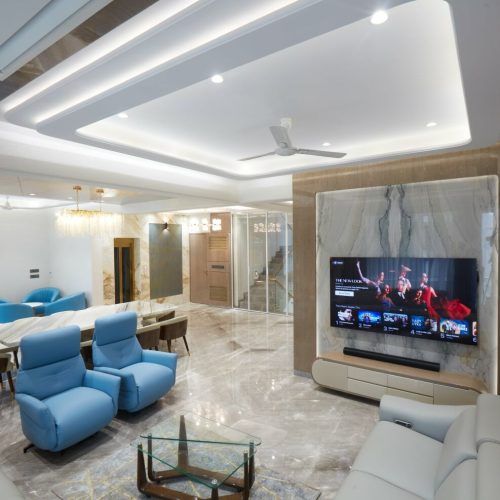
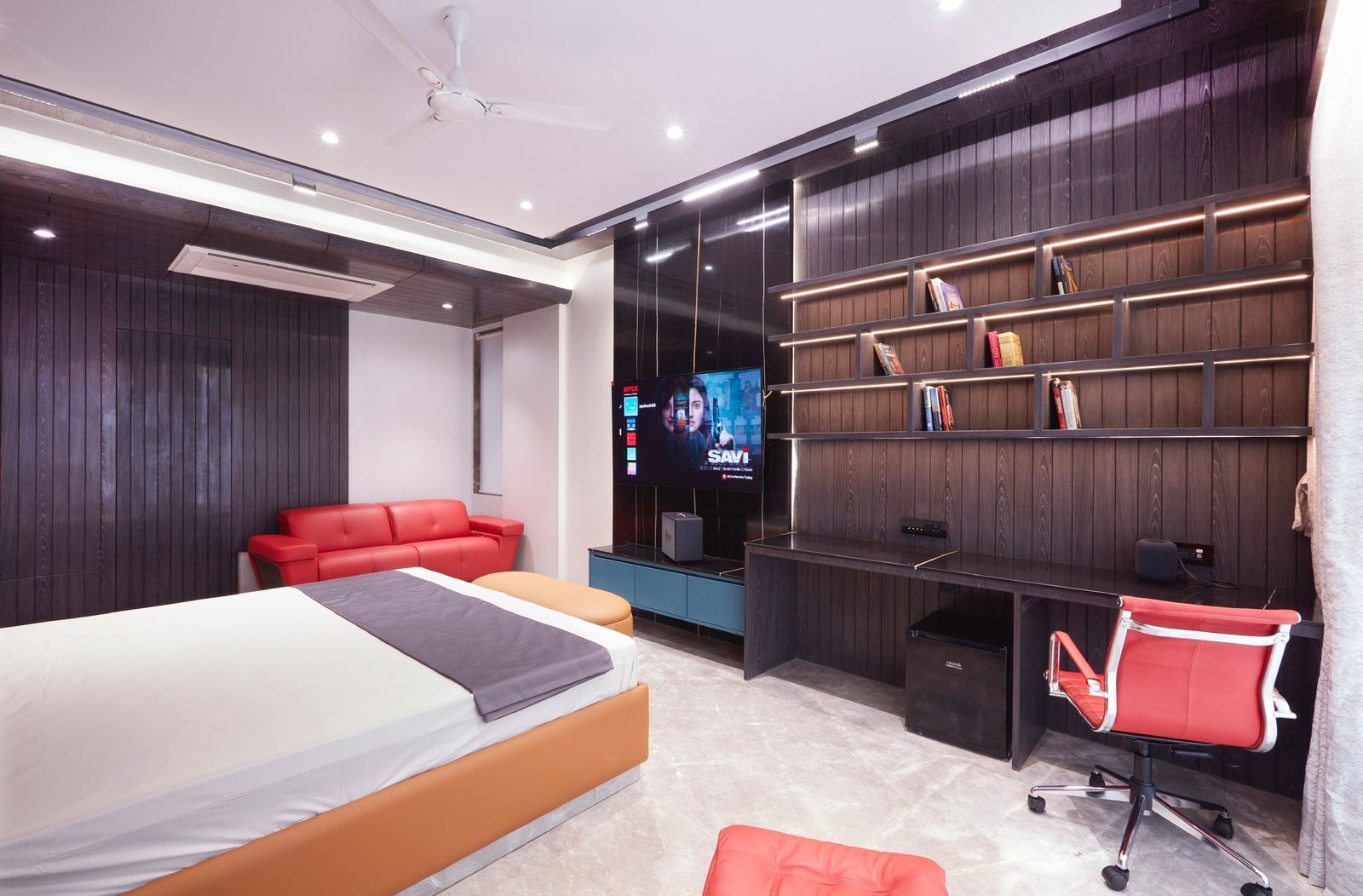
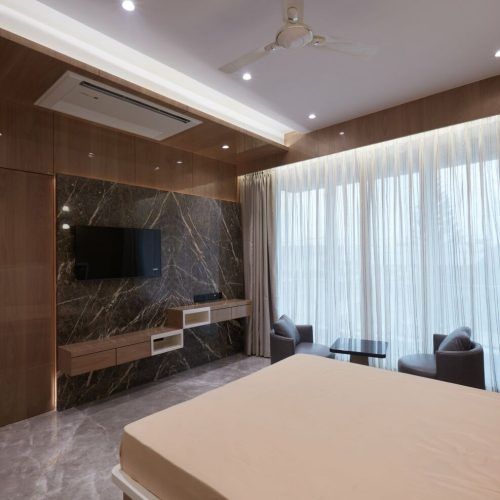
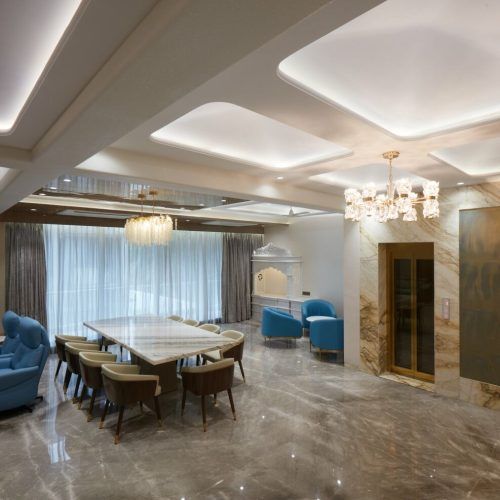
Selected work by Greenbox Design Studio. Tap any image to enlarge.
Frequently asked questions
What is the cost of vitrified tiles per square foot?+
₹65 for glazed, ₹85 for double charge, ₹120 for GVT and ₹165 for full body — material only. Supplied and laid with adhesive, grout and skirting, a GVT floor works out at about ₹346 per sq ft before GST.
Which is better, double charge or GVT?+
Double charge has 3–4 mm of pigment pressed through the surface, so it wears extremely well and is the right choice for passages and commercial floors. GVT is digitally printed under a glaze, which gives far better marble and stone effects but a thinner wear layer. For a home, GVT; for a shop floor, double charge.
Should vitrified tiles be laid with adhesive or cement?+
Adhesive. A sand-cement bed depends on how well each tile is tapped down by hand, and a proportion always end up hollow and eventually crack. Tile adhesive gives full-bed contact for about ₹22 per sq ft more, which is the cheapest insurance in the whole floor.
How much wastage for floor tiles?+
Eight per cent for a standard straight lay in a rectangular room. Fifteen for a diagonal lay or a room with many corners and cuts. Buy from one batch and keep four or five spare tiles for future repairs — batches change and matching later is impossible.
Can I lay new tiles over old ones?+
Technically yes, with a primer and the right adhesive, and it saves the mess, the ₹42 per sq ft of breaking and the ₹4,575 each debris run costs. The floor level rises 12–15 mm, which changes every threshold and door bottom in the flat. In a full renovation we almost always take the old floor out.