
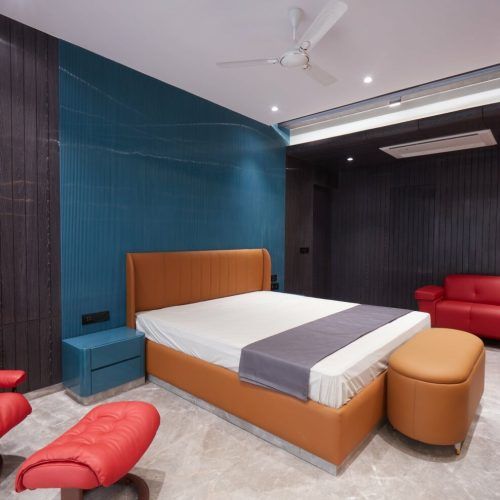
Preview a wall colour
Pick the wall, the accent and the floor. The preview redraws instantly.
How this visualizer works
- The preview is drawn live as vector graphics from the hex values you select — a back wall, an accent wall, a side wall shaded to 86% of the main colour, a floor plane, a window and skirting in the trim colour.
- The light setting overlays a tint: a warm amber wash at 14% opacity for evening, a very light cool wash at 7% for daylight. It is an approximation of how a colour shifts, not a render.
- LRV = (0.2126 R + 0.7152 G + 0.0722 B) ÷ 255 × 100, the standard luminance formula. It is published for every shade in the table below.
- The band and the advice are looked up from the LRV, not generated — the same colour always returns the same guidance.
- Paint quantity = wall area × 2 coats ÷ 110 sq ft per litre.
| Shade | Hex | LRV | Where it works |
|---|---|---|---|
| Bone white | #F5F1E8 | 94.6% | Ceilings and small rooms |
| Warm oat | #EDE6D6 | 90.3% | Ceilings and small rooms |
| Pale sage | #E3E7E3 | 90.1% | Ceilings and small rooms |
| Soft sky | #DCE3EA | 88.6% | Ceilings and small rooms |
| Clay beige | #CFC6B8 | 78.0% | Main walls in any room |
| Muted eucalyptus | #B9C4BA | 75.7% | Main walls in any room |
| Dusty blue | #A7B5C4 | 70.2% | Main walls in any room |
| Terracotta | #C08A6A | 57.7% | Main walls with good daylight |
| Olive grey | #8A9A8B | 58.6% | Main walls with good daylight |
| Slate blue | #6E7F8D | 48.8% | Main walls with good daylight |
| Deep pine | #4A5A52 | 33.7% | Feature walls and evening rooms |
| Charcoal brown | #33302C | 19.0% | Single feature wall, deliberately lit |
LRV is calculated from the hex value using the standard luminance formula. A manufacturer's published LRV for a similar shade may differ by a point or two because it is measured off a painted drawdown rather than computed.
Design and build under one accountable roof
Worked example — the default room
The tool opens on warm oat walls (#EDE6D6, LRV 90.3%) with an olive grey accent (#8A9A8B), off-white trim, a light oak floor and daylight. That puts the main walls in the very light band: they will bounce daylight into the back of the room and make a small Mumbai flat read larger, and they will also show fingerprints at switch height, which is why the tool recommends a washable matt on the walls with a satin below four feet.
The olive accent sits at LRV 58.6%, a gap of nearly 32 points, which is about the minimum contrast at which an accent wall reads as a deliberate decision rather than as a batch mismatch. Below roughly 15 points of LRV difference, most people simply see two whites that do not quite agree. Across 450 sq ft of wall, two coats need about 8.2 litres of emulsion — two four-litre tins plus a litre, bought together so the batch matches.
Why the colour on your wall is never the colour on the chip
Three things change it. The first is area: the same pigment across 400 sq ft reads considerably more saturated than on a 40 mm chip, which is why so many rooms end up two shades stronger than intended. Choose one step lighter than the chip you like. The second is the light source. Indian daylight is bright and slightly cool; an incandescent-warm LED at 2700K pushes everything yellow and can turn a pale grey visibly green. The tool's two light settings approximate that shift, and painting a real patch confirms it.
The third is everything else in the room. A colour never appears alone — it sits next to a floor, a wardrobe shutter and a curtain, and those reflect onto it. A warm oak floor bounces yellow up onto a wall all day, which is why a cool grey that looked crisp in the shop can look muddy once the floor is in. That is the specific reason this tool asks for the floor tone: the preview is not a render, but seeing the two together catches the worst mistakes.
Every constant on this page comes from Greenbox site records — measured drawings, signed BOQs and completion certificates from projects delivered between 2023 and 2026 — rounded to the figures an estimator would actually write down. We publish them so the arithmetic can be audited rather than trusted. Treat the output as a planning figure: accurate enough to brief a landlord, a bank or a family, and not accurate enough to sign a contract against.
What this tool does not cover
- Screen colour accuracy. Every display renders hex differently, so treat the preview as a relationship between colours rather than as a match.
- Texture and sheen, which change how a colour reads as much as the pigment does.
- Manufacturer shade matching. Take the hex to the dealer's tinting machine rather than assuming a named shade matches.
- Wall condition. A colour on fresh putty looks different from the same colour over an old painted surface.
- Cost — the painting cost calculator prices the job and the paint quantity calculator handles primer and putty.
- Whole-scheme planning, which the room colour scheme tool and the colour palette generator cover.
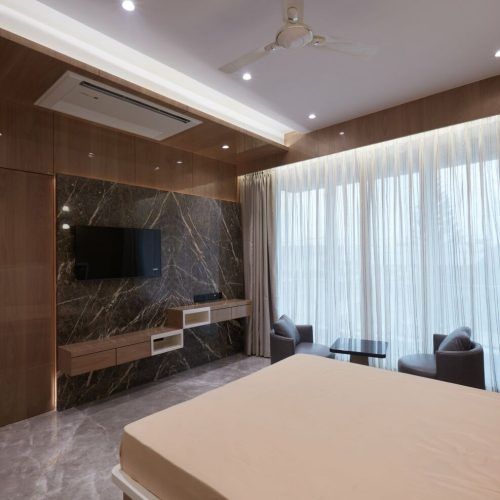
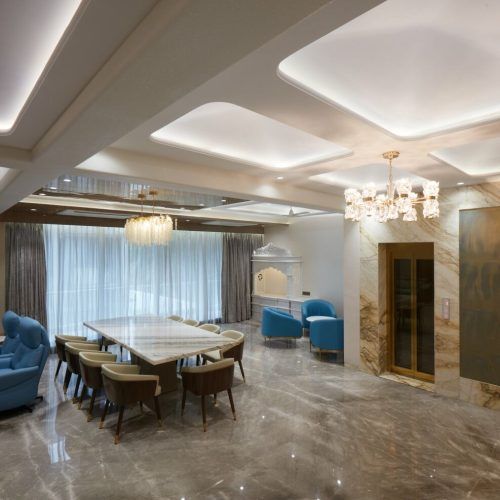
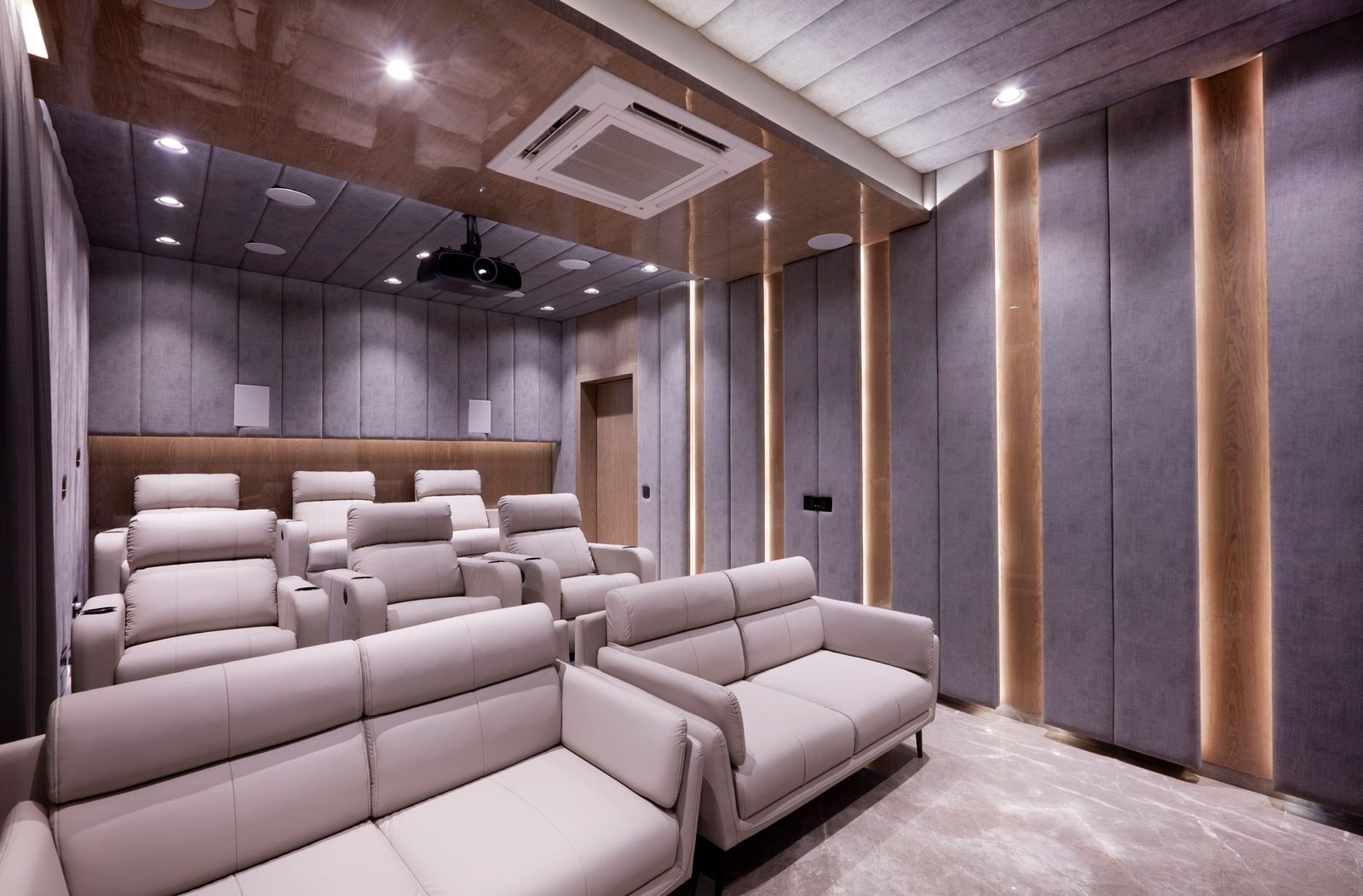
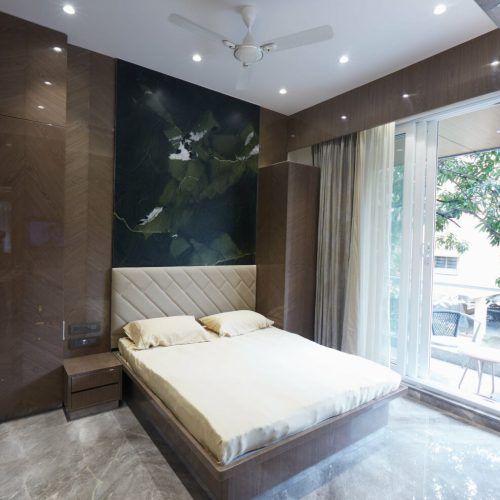
Selected work by Greenbox Design Studio. Tap any image to enlarge.
Frequently asked questions
What is LRV in paint?+
Light reflectance value — the percentage of visible light a colour bounces back. 100 is pure white, 0 is pure black. Above 70 a colour opens up a room; below 25 it absorbs most of the light reaching it and needs deliberate artificial lighting.
Why does paint look different on the wall than on the chip?+
Because area increases apparent saturation, because your light source shifts the hue, and because the floor and furniture reflect onto the wall. A colour chosen from a 40 mm chip typically lands two shades stronger than expected across a whole room.
How do I test a paint colour properly?+
Paint A3 patches on two different walls of the actual room — one that gets direct light and one that does not — and look at them at 9 am, 3 pm and 9 pm. A sample pot costs a few hundred rupees and saves repainting 400 sq ft.
Should walls be matt or satin?+
Matt on the walls, because it hides the unevenness that every plastered wall has. Satin or a washable emulsion below four feet in corridors, children's rooms and near switches, where the wall gets touched. Satin across a whole wall exaggerates every ripple in the plaster.
How much paint do I need for a room?+
Wall area divided by 110 square feet per litre, times two coats. A 450 sq ft wall area needs about 8.2 litres. Bare plaster drinks about 20% more than a puttied surface, and a dark colour over a light one may need three coats.