
Price your drywall partition
Partition dimensions, then the build-up.
How this calculator works
- Net area = (length × height) − openings. Openings are deducted at their actual square footage.
- All-in rate = board and framing + stud upgrade + insulation + finish. Each component is a published per-sq-ft figure.
- Cost = net area × all-in rate. GST at 18% is shown separately.
- Sound reduction is looked up from the build-up: single board one side 29 dB bare and 36 insulated, single both sides 34 and 42, double both sides 44 and 52.
- Dead load ≈ 14, 25 or 38 kg per sq ft-equivalent depending on board layers — reported because a structural consultant will ask.
- Time ≈ one working day per 120 sq ft of partition for a two-person crew, including taping but excluding paint curing.
| Build-up | Rate | Sound reduction | Where to use it |
|---|---|---|---|
| Single board one side, bare | ₹110 / sq ft | 29 dB | Duct casing, service shaft cladding |
| Single board both sides, bare | ₹165 / sq ft | 34 dB | Dry partition, storage division |
| Single both sides + glass wool | ₹230 / sq ft | 42 dB | Study, meeting room, dressing area |
| Single both sides + wool + 70 mm stud + paint | ₹340 / sq ft | 42 dB | The standard residential partition |
| Double both sides + rock wool | ₹340 / sq ft | 52 dB | Bedroom party wall, boardroom, home theatre |
| Double + rock wool + 92 mm stud + paint | ₹470 / sq ft | 52 dB | Acoustic separation where it really matters |
Sound reduction figures are indicative laboratory-style values for the build-up. Real-world performance is always lower, and is governed by flanking paths — the gap under the door, the ceiling void above the partition and any service penetration.

Design and build under one accountable roof
Worked example — the default partition
| Step | Arithmetic | Result |
|---|---|---|
| Gross area | 20 × 10 | 200 sq ft |
| Less door opening | − 21 | 179 sq ft |
| Board and framing | single both sides | ₹165 / sq ft |
| 70 mm stud | + ₹25 | ₹190 |
| Glass wool | + ₹65 | ₹255 |
| Taped, puttied, painted | + ₹85 | ₹340 / sq ft |
| Partition cost | 179 × ₹340 | ₹60,860 |
| GST @18% | on the total | ₹10,955 |
Drywall versus brick in a Mumbai flat
A 4-inch brick wall with plaster both sides costs about ₹405 per sq ft on our audited rates — ₹215 of brickwork and ₹95 of plaster on each face — blocks around 40 dB, and weighs about ten times as much. So the standard drywall build-up at ₹340 is the cheaper wall as well as the lighter one, and in an existing building the gap widens, for three reasons. The dead load has to be justified to the society and sometimes to a structural engineer. The wet trades bring water, curing time and three weeks of dust into an occupied flat. And once it is up, running a conduit or moving a socket means chasing masonry.
Drywall goes up in two days, carries its services inside the cavity, and can be opened and closed again without a mess. What it does not do is take weight. A wall-hung TV, a wall-hung WC, a heavy mirror or a wardrobe hung from the wall all need a plywood or MS backing plate fixed to the studs before the board goes on. Decide those positions at framing stage — retrofitting a backing plate means cutting the board out.
The other detail that decides whether a drywall partition performs is what happens above and below it. A partition that stops at the false ceiling is acoustically almost useless, because sound travels straight over the top through the ceiling void. Take it to the slab, seal the head with acoustic sealant, and seal every service penetration. That instruction costs nothing and is the difference between 42 dB on paper and 42 dB in the room.
The board, framing and painting rates here are derived from what Greenbox billed for gypsum-on-GI work and wall painting on completed homes, held at October 2026; studs and insulation are supplier prices carried through unchanged. We publish the build-up so the arithmetic can be audited rather than trusted. Treat the output as a planning figure: accurate enough to brief a landlord, a bank or a family, and not accurate enough to sign a contract against.
What this tool does not cover
- Door and window frames, shutters and hardware in the openings you deducted.
- Backing plates for wall-hung fixtures, at ₹180–350 per position.
- Electrical and data conduiting inside the cavity, which is part of the electrical package.
- Moisture-resistant or fire-rated board, which adds 15–35% to the board line.
- Glass or glazed partitions — the glass partition cost calculator prices those.
- Society permissions, service-lift bookings and debris removal.


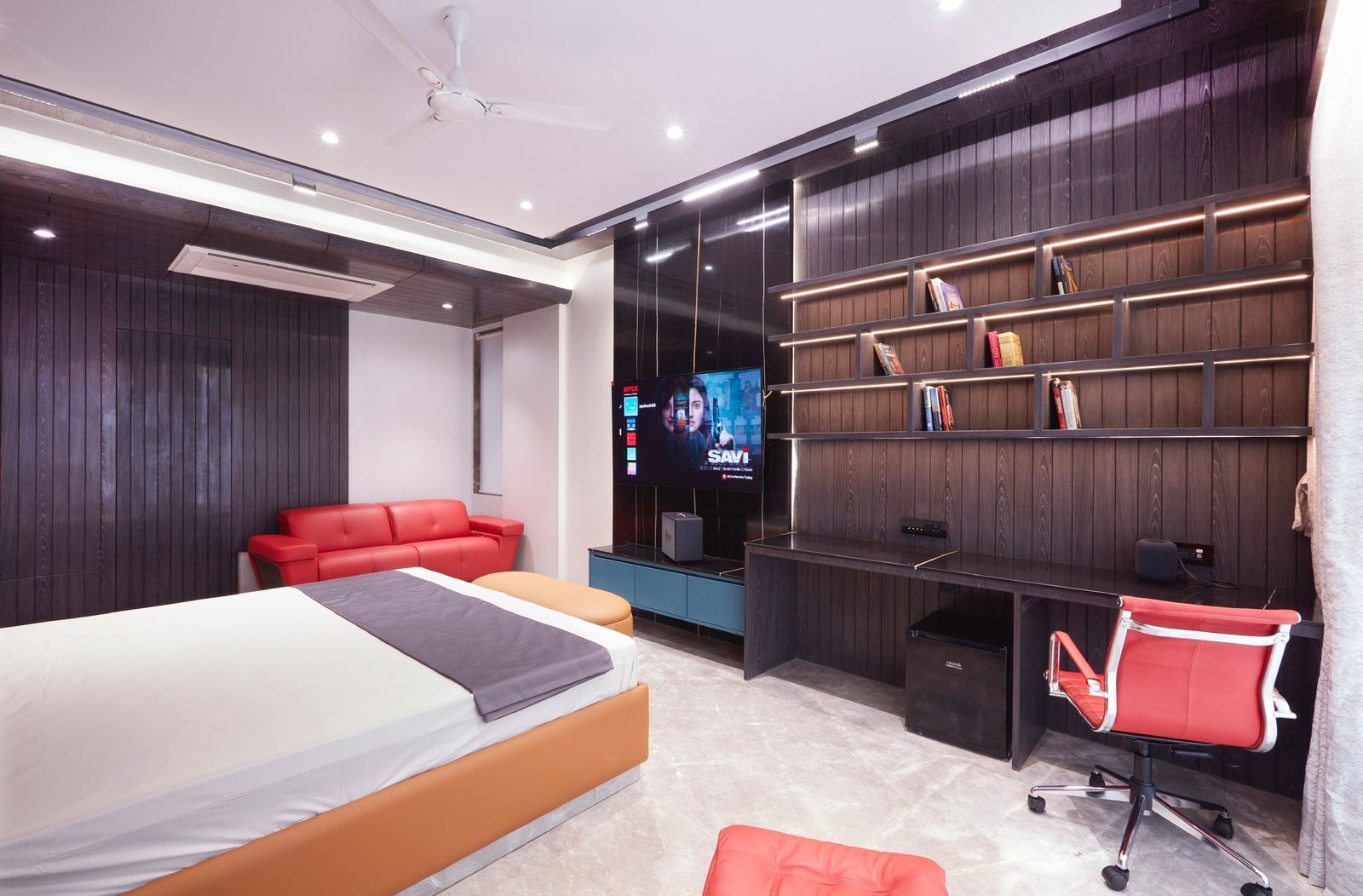

Selected work by Greenbox Design Studio. Tap any image to enlarge.
Frequently asked questions
How much does a gypsum partition cost per square foot?+
₹110 for a single board on one side, ₹165 for single board both sides, and ₹245 for double board both sides. Insulation adds ₹65–95, a larger stud ₹25–45, and taping, putty and paint another ₹85. A typical residential partition lands at ₹340 per sq ft.
Is drywall soundproof?+
No partition is soundproof, but the build-up matters enormously. Single board both sides with no insulation gives about 34 dB — you will hear conversation. Add glass wool and it reaches 42 dB. Double board with rock wool gets to around 52 dB, at which point normal speech is inaudible.
Is gypsum partition cheaper than a brick wall?+
Cheaper — ₹340 per sq ft for the standard build-up against about ₹405 for 4-inch brick plastered both faces — and cheaper again in practice in an occupied flat, because it goes up in two days with no water, no curing and far less dust. It also weighs a tenth as much, which is often the deciding factor with a housing society.
Can you hang a TV on a gypsum wall?+
Only onto a backing plate. A plywood or MS plate fixed to the studs before boarding will take a television, a wall-hung WC or a heavy mirror. Board alone will not, whatever anchor is used. Mark those positions on the drawing before framing starts.
Should a drywall partition go up to the slab?+
Yes, wherever sound matters. A partition that stops at the false ceiling lets sound travel over the top through the ceiling void, and the acoustic rating of the wall becomes irrelevant. Take it to the slab and seal the head joint.