
Estimate your glass partition
Enter the run length and height of the partition you want built.
How this calculator works
- Partition area = running feet × height. Everything except the door is priced on that area.
- Glass = area × glass rate. The rate includes supply, edge polishing, transport, hoisting and installation — 10 mm clear ₹420, 12 mm clear ₹520, 10 mm frosted or tinted ₹470, 6+6 laminated ₹640, double-glazed acoustic ₹1,150 per sq ft.
- Framing = area × framing rate. Frameless with patch fittings and silicone joints adds nothing, slim aluminium ₹95 per sq ft, powder-coated MS or SS ₹150.
- Manifestation film = area × film rate. Frosted privacy band ₹85, full frosted ₹140, printed graphic ₹190 per sq ft.
- Integrated blinds = area × ₹480, available only inside a double-glazed cavity.
- Door is a lump sum: single swing ₹28,000, double swing ₹52,000, sliding ₹38,000, each including patch fittings, floor spring, handle and lock.
- City factor multiplies the total; the displayed range is −8% to +10%.
| Glass specification | Rate per sq ft | Sound reduction | Where it belongs |
|---|---|---|---|
| 10 mm clear toughened | ₹420 | ~29 dB | Home study, balcony enclosure, shower screens |
| 12 mm clear toughened | ₹520 | ~31 dB | Full-height partitions and frameless doors |
| 10 mm frosted or tinted | ₹470 | ~29 dB | Bathroom and dressing-area screens |
| 6+6 mm laminated | ₹640 | ~36 dB | Where safety on breakage matters — stairs, mezzanines |
| Double-glazed acoustic unit | ₹1,150 | ~42 dB | Home offices on a main road, meeting rooms |
| Slim aluminium framing | +₹95 | — | Cleanest look that still hides the silicone joint |
| Powder-coated MS or SS frame | +₹150 | — | Industrial-look grids and heavy doors |
Sound reduction figures are indicative laboratory Rw values; a partition that stops short of the slab will perform far worse regardless of the glass.
Design and build under one accountable roof
Worked example: a 20 ft study partition
- Partition area = 20 running ft × 8 ft = 160 sq ft
- Glass at 12 mm toughened = 160 × ₹520 = ₹83,200
- Slim aluminium framing = 160 × ₹95 = ₹15,200
- Frosted privacy band = 160 × ₹85 = ₹13,600
- Single glass swing door with patch fittings and floor spring = ₹28,000
- Subtotal = ₹1,40,000; × 1.15 Mumbai = ₹1,61,000
- Displayed range = ₹1.48 L – ₹1.77 L, or about ₹8,050 per running foot, ex-GST.
Details that decide whether the partition works
- Take it to the slab, not the false ceiling. A partition that stops at the ceiling line lets sound travel straight over the top through the plenum. Acoustic glass above a ceiling gap is money spent on nothing.
- Order the cut-outs with the glass. Toughened glass cannot be drilled or trimmed after tempering. Every patch fitting, handle hole and lock keeper has to be on the factory drawing.
- Floor level matters more than you expect. A frameless partition needs a level base channel. On an uneven Mumbai screed the fitter will pack the channel, and the packing shows.
- Manifestation is a safety requirement, not a style choice. Full-height clear glass with no band at eye level is a genuine hazard, particularly with children in the house.
- Floor springs need a recess. A glass swing door usually needs 50 to 65 mm of floor cut-out for the spring body — easy in a new screed, disruptive in a finished floor.
- Plan the hoist. A single 12 mm toughened pane of 8 ft × 5 ft weighs around 140 kg. In a Mumbai society, that means a service-lift booking and sometimes a night-time move.
What this estimate excludes
- 18% GST, shown separately in the breakdown
- Civil work: base channel recess, floor-spring cut-outs, making good the ceiling line
- Structural support where the partition carries a header or a heavy sliding track
- Curtains, roller blinds or motorised shading outside the glass cavity
- Electrical, data and switching integrated into a framed partition
- Society deposits, hoist bookings and out-of-hours installation premiums
These rates were re-checked in October 2026 against what Greenbox actually billed for framed toughened partitions on completed jobs, and they hold: nothing here needed moving. Glass, film, blinds and the door assembly are supplier prices rather than our own trade rates, so we carry them as quoted. It is an indicative estimate, not a quotation — the real figure depends on your drawings, site condition and the brands you finally specify.
Where a glass partition earns its place in a flat
- A study carved out of a living room. The most common use we build. Ten millimetre toughened with a frosted band from 3 to 5 ft keeps the daylight moving through the plan and gives you a door to close for a call.
- Kitchen to dining. A glazed screen keeps cooking smells out of the living area while the kitchen still borrows light and sightlines. Specify a door that swings out of the kitchen, not into it.
- A dry balcony enclosure. Turns an unusable monsoon balcony into a reading or laundry space. Check society and municipal rules first — enclosing a balcony is regulated, and some societies prohibit it outright.
- Bathroom shower screens. Ten millimetre toughened with a stainless hinge set, and a properly graded floor under it. This is the one application where the waterproofing matters more than the glass.
- A bedroom dressing area. Frosted or fluted glass at 8 ft, which divides the room without making either half feel like a corridor.
Toughened, laminated or double-glazed
Toughened glass is heat-treated so that it is four to five times stronger than annealed glass and, when it does break, shatters into blunt granules rather than shards. It is the default for partitions. Its limitation is absolute: once tempered it cannot be cut, drilled or edged, so every dimension and every hole is locked at the factory order.
Laminated glass is two panes bonded to an interlayer. It is heavier and dearer, it can be cut on site in some configurations, and when broken it holds together in the frame — which is why it belongs at a stair edge, a mezzanine or anywhere a fall is possible. A double-glazed acoustic unit is two panes with a sealed air or gas cavity and is the only option that genuinely changes what you hear through the partition; it is also where integrated blinds can live, sealed inside the cavity where they never need dusting.
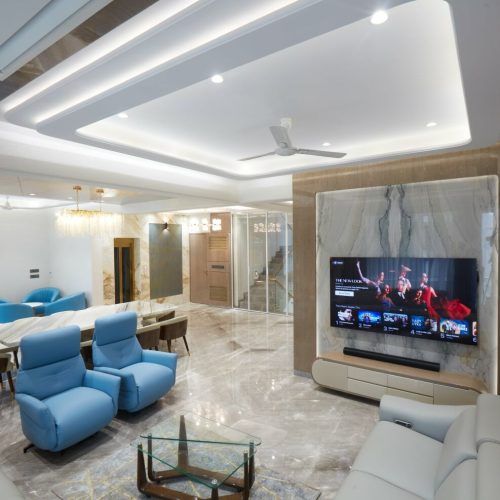
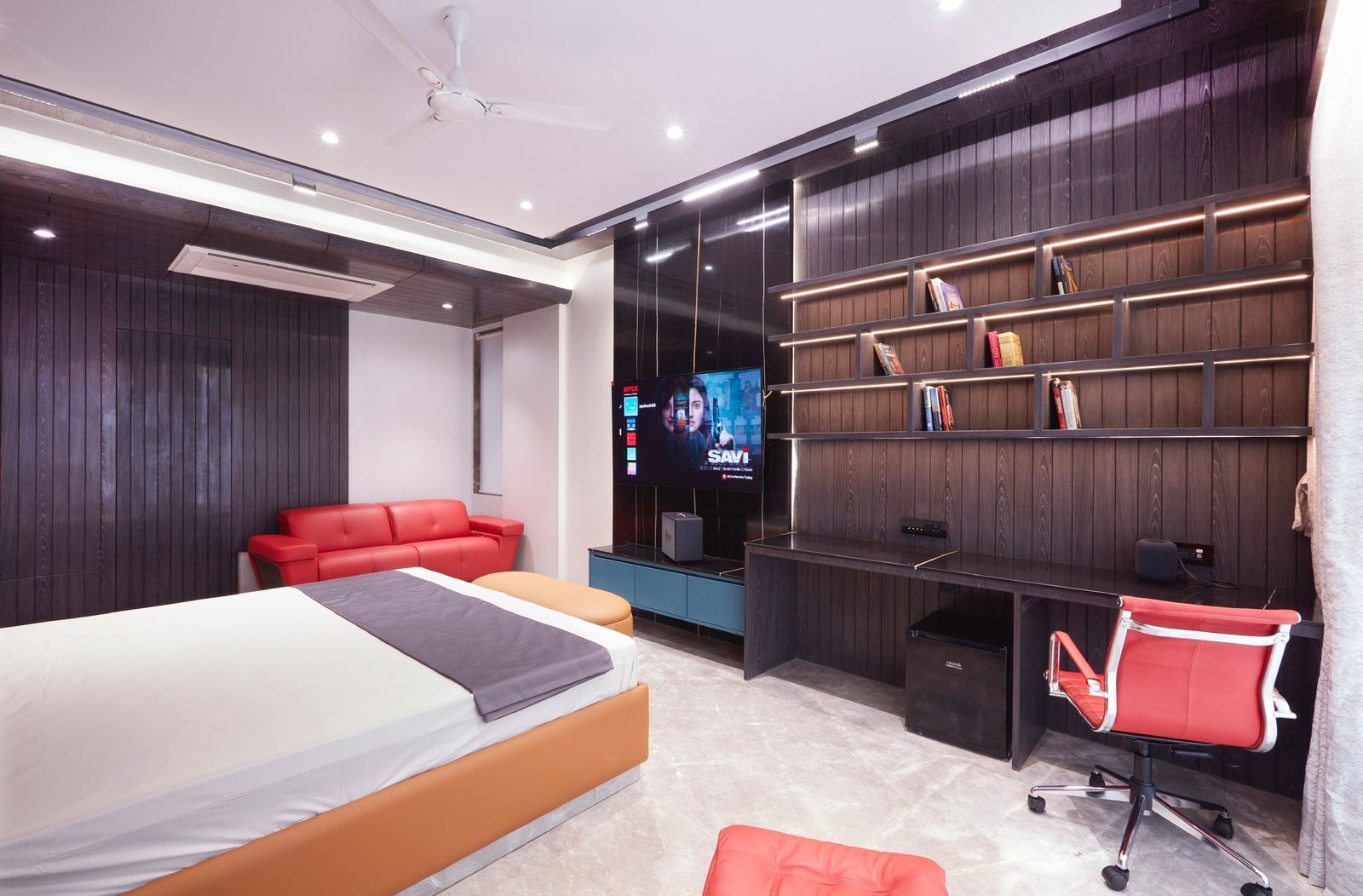
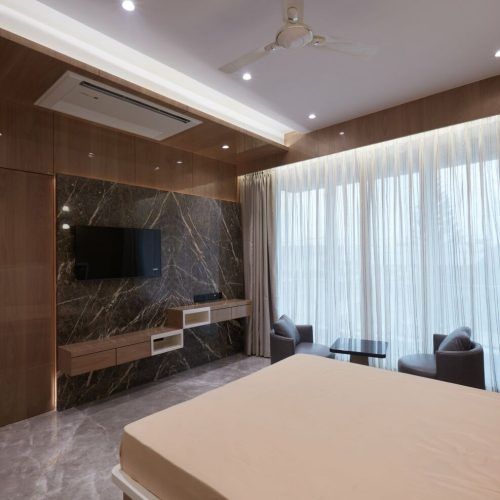
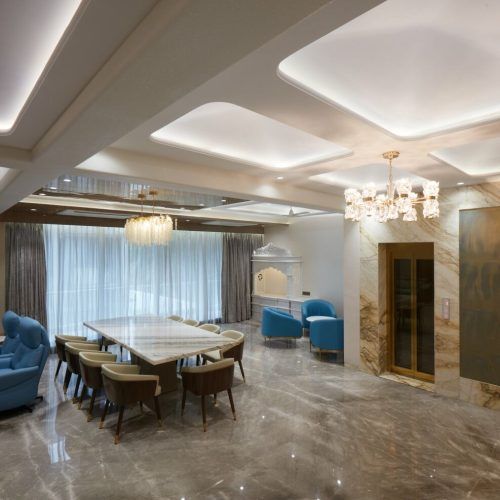
Selected work by Greenbox Design Studio. Tap any image to enlarge.
Frequently asked questions
How much does a glass partition cost per running foot?+
About ₹6,000–₹8,500 per running foot at 8 ft height for 12 mm toughened glass with slim framing and a privacy band, in Mumbai and ex-GST. A door adds ₹28,000–₹52,000 as a lump sum. Acoustic double-glazed units roughly double the per-foot figure.
What thickness of glass do I need for a partition?+
Ten millimetres toughened for a partition up to about 8 ft that does not carry a door, and 12 mm where the partition is full height, frameless, or carries patch-fitted doors. Laminated 6+6 is the choice where breakage safety matters, such as beside a staircase or a mezzanine edge.
Do glass partitions block sound?+
Partially. Single 12 mm toughened glass reduces sound by roughly 31 dB in laboratory conditions, laminated by 36 and an acoustic double-glazed unit by around 42. In practice the weak point is almost never the glass — it is the gap above a false ceiling or under the door.
Is a frameless partition more expensive?+
No, it is usually cheaper on material because there is no frame to supply, but it demands a level floor, accurate site dimensions and factory-drilled glass. The saving is real; the tolerance for site error is not. Slim aluminium framing at ₹95 per sq ft buys forgiveness on an out-of-square opening.
Can I use a glass partition in a home?+
Yes, and it is one of the better moves in a compact Mumbai flat — a glass partition around a study or a home office keeps daylight moving through the plan while giving you a door to close. Specify 10 mm toughened with a frosted band at eye level, and take it to the slab if you actually want quiet.