
Rates by micro-market
Mumbai restaurant rates track three things: the building type, the landlord’s fit-out manual, and what the neighbours can hear.
| Micro-market | ₹ per sq ft | The building reality |
|---|---|---|
| Lower Parel and Worli mill compounds | ₹4,600 – 10,500 | Tall volumes, developer fit-out manuals, mandated vendors for fire and sprinkler modification |
| BKC and Kurla complex | ₹5,000 – 10,500 | Grade-A landlord rules, night-only working, barricade and hoarding specification |
| Bandra West, Khar, Juhu high street | ₹4,200 – 9,000 | Ground floors of residential buildings; exhaust routing and closing time are the whole negotiation |
| Andheri West, Versova, Lokhandwala | ₹3,600 – 6,500 | Mixed commercial and residential; easier access, tighter budgets, high turnover of tenancies |
| Malls across the city | ₹4,200 – 9,500 | Barricade, night work, mall MEP tie-ins at the mall’s rates, fixed handover date with penalties |
| Thane, Powai, Navi Mumbai | ₹3,200 – 5,800 | Newer stock, proper service cores, the easiest exhaust routing in the metropolitan region |
Ex-GST. Excludes kitchen equipment (₹18–60 lakh for 100 covers) and the exhaust package (₹9–28 lakh).
Licences, neighbours and a duct route decide the programme
The licence stack, in the order it actually happens
Nothing here is optional and almost all of it can run in parallel with construction. Restaurants that treat licensing as a post-construction task open two months late.
- Shop and Establishment registration — the first one, and the one every other application asks to see. Days, not weeks, if the lease documentation is clean.
- FSSAI licence — state licence for most restaurants, central for larger operations. Requires a kitchen layout, a water test report and a list of food categories. Four to eight weeks.
- BMC health and trade licence — inspected against the kitchen layout, the wash-up arrangement and the staff facilities. This is why staff changing space is a design item, not a nicety.
- Fire NOC — the item most affected by the interior design. Exit widths, travel distance, the suppression system over the cooking line and the material class of the ceiling all sit here.
- Excise licence, if you serve alcohol — the longest of them all, commonly eight to twenty weeks, with distance rules from schools and places of worship that should be checked before the lease is signed, not after.
- Eating house licence from the police, plus a music or performance licence if applicable, plus a weights and measures registration.
- Society or landlord consent — not a licence, but in a residential building it is the one that can end the project.
Living under flats
- The exhaust has to reach above the top occupied floor. A duct terminating at the second floor of a residential building will generate complaints in week one and a notice in month two. Riser space, or an external duct on the rear elevation with the society’s written consent, is the real constraint on any Bandra or Khar high-street site.
- Grease filtration is the price of consent. An electrostatic precipitator or UV unit, maintained and logged, is frequently the condition on which a society agrees at all. Budget ₹4–₹11 lakh for the filtration element alone.
- Structure-borne noise travels upward. Speakers hard-fixed to a slab put bass into the flat above. Resilient mounts, floating speaker boxes and a sub crossover above 60 Hz are cheaper than the dispute.
- Kitchen equipment is the other noise source. Exhaust fans and refrigeration compressors run when the neighbours are asleep. Anti-vibration mounts and an acoustic enclosure on the fan are a design decision.
- Waste and delivery timing is written into the consent. Expect a restriction on deliveries before 8am and on waste collection after 10pm. That changes the size of the dry store and the cold store.
- Smells other than the kitchen. A grease trap that is undersized or in a poorly ventilated position is the second most common complaint after noise.
Night working and the programme
A mall or a Grade-A building will often permit only night work, and a residential high street will often permit only day work. Both change the cost and the duration, and the difference is large enough to belong in the feasibility, not the contract.
| Working pattern | Where | Productivity | Cost effect |
|---|---|---|---|
| Day only, 10am–6pm | Residential building ground floors | Baseline | Baseline |
| Day plus evening to 10pm | Standalone commercial buildings | +30% | +6 – 9% on labour |
| Night only, 10pm–7am | Malls and most Grade-A towers | −15% per hour worked | +18 – 28% on labour |
| Two shifts | Standalone premises with no residential above | +70% | +22 – 32% on labour, and the programme halves |
Night work is less productive per hour because of lighting, material movement restrictions and supervision, but it compresses a fixed-opening-date programme.
The lease is signed, the menu is written, and then somebody asks where the duct goes. We now ask that question before we quote, because on about one Mumbai site in five the honest answer changes the site.
Greenbox commercial fit-out lead
Five Mumbai-specific design consequences
- Covers shrink because the kitchen cannot. Mumbai rents push operators toward smaller units, but the menu still dictates the back of house. On a 2,200 sq ft Bandra unit with a full Indian kitchen, back of house takes 40% and you are planning 95–110 covers, not 140.
- Gas is a design decision. Piped gas is available in parts of the city and a manifold LPG bank elsewhere, and the bank needs a ventilated external location with a fire separation. That location is frequently the same courtyard the society uses for parking.
- Water storage, not water supply. Most Mumbai commercial premises get a timed supply, so a restaurant needs its own underground or sump storage sized for a full day of service plus wash-up, with a booster set.
- Monsoon affects the shopfront, not the interior. Driven rain on a west-facing high-street elevation finds every sliding door track and every unsealed signage penetration. Detail the threshold with a drained channel and a 75 mm upstand.
- Staff facilities are tighter than you expect. Mumbai kitchens run large brigades in small spaces. Allow lockers, a changing area and a staff WC separate from the customer one — the BMC health inspection checks it and the licence depends on it.
The rent-to-fit-out arithmetic
A Mumbai operator is paying rent from the day the lease starts, which means every week of fit-out has a real cost on top of the construction. On a 2,500 sq ft Bandra unit at ₹350 per sq ft a month, that is roughly ₹2.02 lakh a week. Spending 20% more on labour to finish three weeks earlier is arithmetic, not extravagance — and it is why we issue a rent-adjusted programme alongside the BOQ.
The design fundamentals
Cover planning, back-of-house ratios, the exhaust system itself and the acoustic strategy are the same anywhere in India and are set out on restaurant interior design. For an itemised Mumbai budget, see restaurant interior cost in Mumbai; for the wider commercial picture, commercial interior designers in Mumbai.
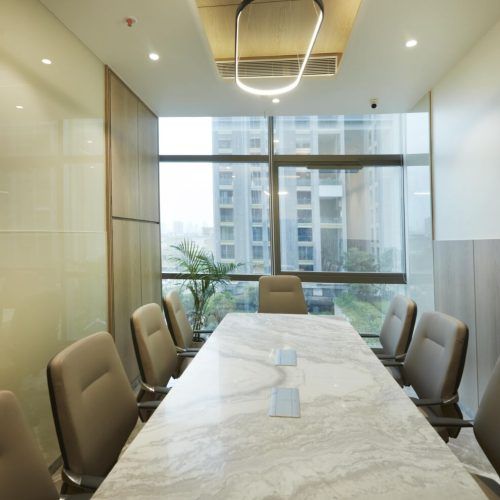
Selected commercial work by Greenbox Design Studio. Tap any image to enlarge.
Frequently asked questions
What does a restaurant fit-out cost in Mumbai?+
₹3,200–₹5,800 per sq ft in Thane, Powai and Navi Mumbai, ₹3,600–₹6,500 in Andheri West and Versova, ₹4,200–₹9,500 in malls and on the Bandra and Juhu high streets, and ₹4,600–₹10,500 in Lower Parel, Worli and BKC. All ex-GST, excluding kitchen equipment and the exhaust package.
How long do Mumbai restaurant licences take?+
Eight to twenty weeks for the full stack. Shop and Establishment is quick, FSSAI four to eight weeks, BMC health and trade and the fire NOC run alongside construction, and the excise licence — if you serve alcohol — is the longest and should be checked for distance rules before the lease is signed.
Can I open a restaurant on the ground floor of a residential society?+
Often yes, and the whole negotiation is the exhaust. The duct has to terminate above the top occupied floor, which means riser space or an external duct with written society consent, plus electrostatic or UV grease filtration that is maintained and logged. Expect restrictions on delivery timing, waste collection and closing hours in the consent letter.
Does night working make sense for a Mumbai fit-out?+
In a mall or a Grade-A tower you usually have no choice. Elsewhere it depends on the rent. Night work costs 18–28% more on labour and is about 15% less productive per hour, but on a 2,500 sq ft Bandra unit at ₹350 per sq ft a month you are burning roughly ₹2 lakh a week in rent, which often makes the premium worth paying.
Who mandates vendors in a Mumbai mall or Grade-A building?+
The landlord. Fire detection, sprinkler modification, and sometimes the HVAC tie-in and the BMS interface, must be done by the building's own contractors at the building's rates. We price these as named provisional sums rather than absorbing them, because they are not competitive items and pretending otherwise misleads the budget.
How much does the kitchen exhaust system cost in Mumbai?+
₹9–28 lakh for the hood, duct run, fan, make-up air unit and filtration, depending on the length of the run and how sensitive the neighbours are. The electrostatic precipitator or UV filtration element alone is ₹4–11 lakh, and in a residential building it is usually the condition on which consent is given.