
Mall versus high street
| Factor | Mall unit | High street unit |
|---|---|---|
| Working hours | Usually 11pm – 7am while the mall trades | Daytime, subject to local nuisance limits |
| Barricade | Mandatory branded hoarding, ₹450 – 900 per running ft | Not required |
| Fit-out deposit | ₹1.5 – 8 L, refundable | Usually none; landlord deposit only |
| Mandated vendors | Fire, sprinkler, often HVAC tie-in and signage | Rare |
| Drawing approval | 2 – 4 weeks through the mall's technical team | BMC and society, variable |
| Material movement | Service corridor, booked slots, trolley only | Direct from the street, easier |
| Signage | Mall specification governs size and illumination | BMC licence, size and language rules apply |
| Cost impact | +15 – 25% | Baseline |
Mumbai retail costs by location and format
| Location type | Value apparel | Premium apparel | F and B / QSR | Jewellery |
|---|---|---|---|---|
| Premium malls — Lower Parel, Goregaon, BKC | ₹3,200 – 4,300 | ₹4,800 – 7,000 | ₹5,500 – 9,500 | ₹7,500 – 14,000 |
| Suburban malls — Malad, Vashi, Ghatkopar, Thane | ₹2,800 – 3,800 | ₹4,000 – 5,800 | ₹4,800 – 8,000 | ₹6,500 – 12,000 |
| Premium high street — Bandra Linking Road, Colaba | ₹2,900 – 3,900 | ₹4,200 – 6,200 | ₹5,000 – 8,500 | ₹7,000 – 13,000 |
| Neighbourhood high street — Andheri, Chembur, Mulund | ₹2,600 – 3,400 | ₹3,600 – 5,000 | ₹4,200 – 7,000 | ₹5,800 – 10,500 |
| Suburban high street — Powai, Thane, Navi Mumbai | ₹2,600 – 3,300 | ₹3,500 – 4,800 | ₹4,200 – 6,800 | ₹5,800 – 10,000 |
Excluding 18% GST, stock, IT and landlord charges. A 1,200 sq ft premium-mall apparel store therefore runs approximately ₹58–₹84 lakh; the same store in a suburban mall ₹48–₹70 lakh.
Design and build under one accountable roof
Working inside a trading mall
Phoenix Palladium, Oberoi Mall, Infiniti, Inorbit, R City, Seawoods — the names differ and the technical manuals are remarkably similar. The pattern is consistent enough to plan around.
- The barricade goes up before anything else. A branded hoarding to the mall's height and finish standard, typically ₹450–₹900 per running foot, installed before any material enters the unit. Malls are strict about this because the shopper-facing corridor is their product.
- Night shift is the default. Noisy and dusty work is confined to roughly 11pm to 7am while the mall trades. Labour carries a 15–25% premium and productivity is lower, which is why a mall programme is longer than the same build on a high street.
- Mandated vendors for life safety. Sprinkler modification, fire detection tie-in and often the shopfront signage connection must go through the mall's nominated agencies at their rates. We price these in the BOQ from day one rather than treating them as variations.
- Service corridor and trolley movement only. No material through the shopper mall. Panel sizes are planned around the service lift and corridor turning radius.
- Deposit back on clean handover. Debris removed, barricade dismantled, common areas undamaged, snag closed. On a ₹5 lakh deposit, thorough snagging is a commercial activity, not housekeeping.
On a mall unit the programme is written by the barricade date and the trading hours. Design is the part that has to fit around them.
Greenbox commercial team
High street: BMC, licences and the street itself
- Shop and Establishment registration under the Maharashtra Shops and Establishments Act, which the landlord will usually want in place before handover.
- Signage licence from the BMC. Size, projection and illumination are regulated, and rules on language content apply to prominent signage. Apply in parallel with the build; retrospective approval is slower and more expensive.
- Footpath and loading. On Linking Road, Hill Road or Colaba Causeway there is no loading bay. Deliveries are early-morning, small-load and planned, or they do not happen.
- Neighbouring tenants. A residential floor above a high-street shop means the same noise sensitivity as any Mumbai society — and a complaint from upstairs can stop the site.
- Shopfront and the monsoon. A sealed threshold with a stepped or channelled entrance, a drainage point, and a canopy with a proper drip edge. Stores on low-lying stretches of Andheri, Dadar and Kurla flood; designing for it costs little and losing stock costs a season.
Programme for a Mumbai store
| Stage | Mall unit | High street unit | Notes |
|---|---|---|---|
| Technical drawing approval | 2 – 4 weeks | 1 – 2 weeks | Run in parallel with detailed design |
| Barricade and mobilisation | 3 – 5 days | 1 – 2 days | Mall barricade to their standard |
| Civil, flooring, partitions | 2 – 3 weeks | 1.5 – 2 weeks | Night-only in mall |
| MEP first fix and mandated vendors | 2 – 3 weeks | 1 – 2 weeks | Book mandated vendors at approval stage |
| Ceiling, fixtures, joinery | 2 – 3 weeks | 2 weeks | Fixtures fabricated off site |
| Signage, VM, snag, handover | 1 – 2 weeks | 1 week | Signage licence must already be granted |
A 1,200 sq ft apparel store typically runs 8–11 weeks in a trading mall and 6–8 weeks on a high street, from approved drawings.
Power, backup and what Mumbai retail actually runs on
Electrical provisioning is where Mumbai retail fit-outs are most often under-scoped, particularly in older high-street premises where the sanctioned load was set for a very different kind of shop.
- Check the sanctioned load before designing the lighting. A 1,200 sq ft apparel store with accent lighting, air conditioning, signage and POS typically needs 18–25 kW. Older Linking Road and Dadar premises are frequently sanctioned at half that.
- A load increase takes three to six weeks through the supply licensee, with landlord consent. It is applied for in week one of the project, not week six.
- Mall units are metered separately and the load is defined in the lease. Exceeding it is a commercial issue, not just a technical one.
- Backup provisioning. Mall units usually get a DG allocation stated in the fit-out manual; high-street stores need their own inverter or DG, and the space for it has to be found in the back of house.
- Signage power is a separate circuit with a timer, and in mall units often runs off the mall's own supply to their switching schedule.
- Keep a spare 20% on the distribution board. Retail changes — a coffee machine, a new display, an extra screen — and a full DB means calling an electrician for every one of them.
Retail design fundamentals
For customer flow, fixture planning, lighting specification and rollout standards that apply to any Indian store, see our retail interior design company overview.
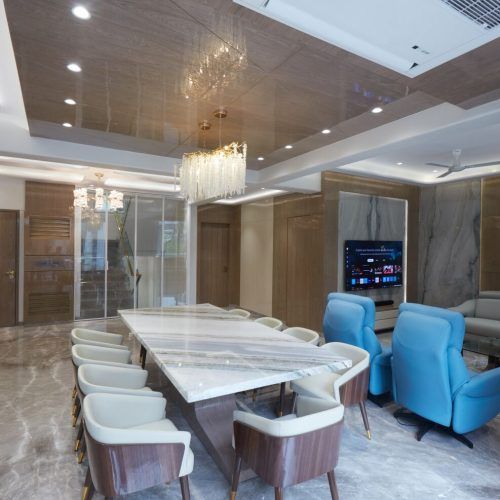
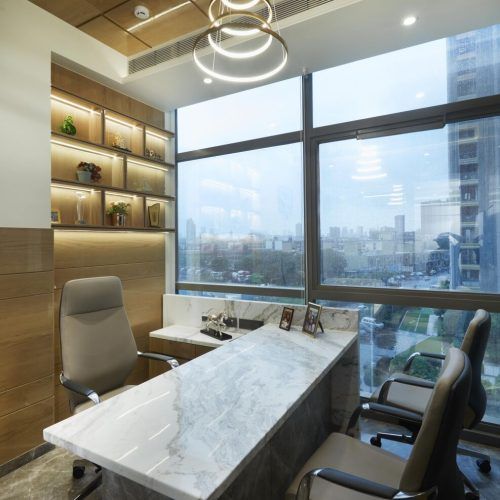
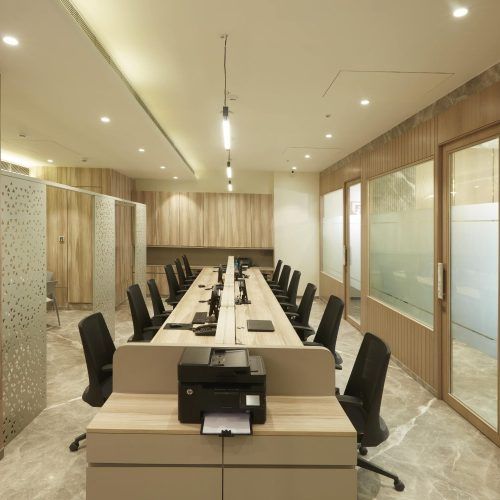
Selected work by Greenbox Design Studio. Tap any image to enlarge.
Frequently asked questions
How much does a retail fit-out cost in Mumbai?+
₹2,600–₹4,300 per sq ft for value apparel, ₹3,500–₹7,000 for premium apparel, ₹4,200–₹9,500 for F and B, and ₹5,800–₹14,000 for jewellery, excluding 18% GST. Premium malls in Lower Parel, Goregaon and BKC sit at the top of each band and neighbourhood high streets at the bottom.
Why do mall fit-outs cost more than high-street stores?+
Roughly 15–25% more, for reasons that have nothing to do with design: a mandatory branded barricade at ₹450–₹900 per running foot, night-only working with a 15–25% labour premium, mandated vendors for sprinkler and fire tie-ins at the mall's rates, booked service-corridor movement, and a refundable fit-out deposit of ₹1.5–₹8 lakh.
Can we work during mall trading hours?+
Only for quiet, dust-free activity, and many malls do not permit even that. Civil work, drilling, cutting and material movement are confined to roughly 11pm to 7am. This is the main reason a mall programme runs eight to eleven weeks where the same store on a high street takes six to eight.
What approvals does a high-street store in Mumbai need?+
Shop and Establishment registration under the Maharashtra Act, a BMC signage licence covering size, projection and illumination, and where there are residents above, the same noise and working-hour sensitivities as any society. We apply for signage in parallel with the build because retrospective approval is slower and costlier.
How do you design a shopfront for the Mumbai monsoon?+
A sealed threshold with a stepped or channelled entrance, a dedicated drainage point immediately outside, a canopy with a proper drip edge, and flood-tolerant material in the first metre of the store. On low-lying stretches of Andheri, Dadar and Kurla this is the difference between a wet morning and losing a season of stock.